A cutting board touches almost everything you cook, from raw chicken to the salad you serve beside it. That is why so many home cooks search for the cutting boards safest and healthiest for everyday use. The honest answer is that material matters, but it is only half the story. How you clean, dry, separate, and replace a board matters just as much.
The stakes are real. The CDC estimates that about 48 million Americans get sick from foodborne illness each year, roughly 128,000 are hospitalized, and about 3,000 die. Cross-contamination on kitchen surfaces is one of the everyday habits behind those numbers.
In this guide, we rank the 10 best cutting board materials, explain the non-porous vs. porous debate, and review 10 boards available on Amazon. You will find glass, plastic, titanium-style, bamboo, and acacia options, each with clear pros, cons, and care notes.
This is a specification-based editorial review, not a laboratory test. We compared listed materials, dimensions, design features, and cleaning requirements. Product details can change, so check the current Amazon listing before you order.

Fresh ingredients arranged on a wooden cutting board. Photo: Unsplash.
Key Takeaways
- No single material is automatically the safest. Cleaning, drying, and replacing worn boards matter as much as the material itself.
- Plastic and other non-porous boards are easier to clean than wood, according to USDA guidance.
- Hard maple, walnut, and cherry are among the best woods for cutting boards because they are close-grained and durable.
- A 2023 study found plastic boards can shed millions of microplastic particles a year, though health effects are still unclear.
- Glass, marble, and metal boards are non-porous but very hard on knife edges.
- Use separate boards for raw meat, poultry, and seafood and for ready-to-eat foods.
- The cutting boards safest and healthiest for most homes are one non-porous plastic board plus one hardwood board.
Quick Picks: Cutting Boards Safest and Healthiest at a Glance
Short on time? This table matches each reviewed board to the job it suits best.
| Product | Material | Best For |
|---|---|---|
| OXO Good Grips Carving Board | Plastic | Best overall everyday board |
| San Jamar Saf-T-Grip | Co-polymer plastic | Best dedicated raw meat board |
| Ziruma Acacia Board | Acacia wood | Best non-toxic wood finish |
| ROYAL CRAFT WOOD Set | Bamboo | Best multi-size bamboo set |
| SMIRLY Set with Stand | Bamboo | Best for organized storage |
| Keechee Set | Carbonized bamboo | Best budget-friendly set |
| SUMZZZ Double-Sided | Titanium/PP | Best two-sided design |
| Titanium Set of 3 | Titanium (per listing) | Best titanium-style set |
| Tempered Glass 16 x 20 | Tempered glass | Best large serving surface |
| Murrey Home Glass Board | Tempered glass | Best decorative countertop board |
How We Chose These Boards
We started with a shortlist of popular boards sold on Amazon in the United States. Then we narrowed it to 10 products that cover the five most common materials: plastic, wood, bamboo, glass, and titanium-style composites.
Each board was scored on five practical questions:
- Cleanability: Can the surface be washed and sanitized easily, and is it dishwasher-safe?
- Material transparency: Does the listing clearly state the material and finish?
- Knife friendliness: Will the surface protect or dull a blade edge?
- Stability: Does it have grip corners, non-slip feet, or enough weight to stay put?
- Everyday value: Does the size, set count, or extra feature solve a real kitchen problem?
We did not run lab tests on bacteria or microplastics. Instead, we relied on published research from the USDA, the CDC, UC Davis, and peer-reviewed journals to judge each material fairly.
What Makes Cutting Boards Safest and Healthiest?
Safe and healthy cutting boards share four traits. They are easy to clean thoroughly, they resist deep knife scarring, they do not release questionable materials into food, and they stay stable while you cut. No board scores perfectly on all four, which is why trade-offs matter.
In the United States, materials meant to touch food are regulated by the FDA as food-contact substances. That gives buyers a baseline, but it does not tell you how a board will hold up after a year of chopping. Real-world safety still comes down to design and care.
Ease of Cleaning
The USDA notes that non-porous surfaces such as plastic, marble, and glass are easier to clean than wood. Many plastic boards can go in the dishwasher, where hot water and detergent do much of the work. Wood and bamboo need handwashing and careful drying instead.
Bacteria and Knife Grooves
Research on bacteria is more nuanced than many people expect. Food-safety researcher Dean Cliver at UC Davis set out in the 1990s to show how to make wood as safe as plastic. Instead, his team found that bacteria were harder to recover from wooden boards than from plastic ones under the same conditions. Bacteria tended to be drawn into the wood grain, while heavily knife-scarred plastic was harder to clean.
The practical lesson is simple. A new plastic board is very easy to clean, but a deeply grooved one is not. Any board with grooves you cannot scrub clean should be replaced.
Microplastics
Microplastics are a newer concern. A 2023 study published in Environmental Science & Technology estimated that chopping on plastic boards could release about 14 to 71 million polyethylene particles, or about 79 million polypropylene particles, per person each year.
The same researchers found that wooden boards shed more particles overall, but those were wood fibers. In lab tests, neither polyethylene nor wood particles significantly affected mouse cells. Long-term human effects remain unknown, so treat microplastics as a reasonable factor in your choice, not a proven health hazard.
Knife Friendliness and Stability
A board that is too hard dulls your knife quickly, and a dull knife slips more easily. A board that slides around is also a cut waiting to happen. For more on this, see our guide on how to prevent cuts in the kitchen.
Safest Cutting Board Material: The 10 Best Cutting Board Material Options Ranked
So what is the safest cutting board material? It depends on whether you value easy sanitizing, knife care, or avoiding plastic. The ranking below balances all three for a typical U.S. home kitchen and shows which materials make the safest and healthiest cutting boards for daily use. It also answers a common question: what is the best material for cutting boards if you only buy one?
| Rank | Material | Porous? | Hardness (Janka) | Dishwasher | Knife Wear |
|---|---|---|---|---|---|
| 1 | Hard maple | Slightly | 1,450 lbf | No | Low |
| 2 | Walnut / cherry | Slightly | 950–1,010 lbf | No | Very low |
| 3 | Acacia | Slightly | 1,700–2,200 lbf | No | Moderate |
| 4 | Teak | Slightly | 1,155 lbf | No | Moderate |
| 5 | Bamboo | Slightly | 1,180–1,380 lbf | No | Moderate |
| 6 | Polyethylene plastic | No | Soft | Usually | Low |
| 7 | Rubber | No | Soft | Varies | Very low |
| 8 | Wood-fiber composite | No | Hard | Usually | Moderate |
| 9 | Polypropylene plastic | No | Soft | Usually | Low |
| 10 | Glass, marble, metal | No | Very hard | Often | High |
Janka figures are typical published values and vary by species and source. A higher number means a harder wood. For a deeper species-by-species comparison of maple, walnut, cherry, teak, and olive, see our guide to the best wood for cutting boards.
1. Hard Maple
Hard maple is the classic butcher-block wood for good reason. It is dense, close-grained, and durable. The FDA Food Code, which many U.S. states adopt for restaurants, specifically allows hard maple or an equally hard, close-grained wood for cutting boards. That makes it a strong benchmark for the safest and healthiest cutting boards made from wood.
Best for: an everyday wood board that lasts for years with basic oiling.
2. Walnut and Cherry
Walnut and cherry are slightly softer than maple, so they are gentler on knife edges. Both are close-grained hardwoods with attractive color. They tend to cost more, and they still need oiling and handwashing.
Best for: cooks who own premium knives and want the gentlest wood surface.
3. Acacia
Acacia is hard, water-resistant, and widely available at moderate prices. Its hardness varies by species, and the harder types can be a little tougher on knives. The Ziruma board in our review uses acacia. Rubberwood is another common low-cost hardwood; see our rubberwood cutting board guide for its pros and cons.
Best for: a durable, budget-friendly hardwood that doubles as a serving board. For handled styles, see our guide to the best wooden cutting board with handle.
4. Teak
Teak is naturally oily, so it resists moisture well. However, teak contains silica, which can dull knives faster than maple or walnut. It works well for serving and light prep.
Best for: humid kitchens and serving boards rather than heavy daily chopping.
5. Bamboo
Bamboo is technically a grass, pressed and glued into boards. It is affordable, renewable, and fairly hard. The trade-off is that adhesives hold it together, so choose brands that clearly describe food-safe materials.
Best for: affordable multi-board sets for produce, bread, and cooked foods.
6. Polyethylene (HDPE) Plastic
High-density polyethylene is the standard plastic in many professional kitchens. It is non-porous, lightweight, often dishwasher-safe, and easy on knives. Its drawbacks are knife scarring over time and the microplastic question.
Best for: a dedicated raw meat, poultry, and seafood board you can run through the dishwasher.
7. Rubber
Synthetic rubber boards are popular with sushi chefs because they are soft on blades and non-porous. They are heavier and pricier than plastic. Check whether a given model is dishwasher-safe.
Best for: serious home cooks who want a non-porous surface that is kind to knives.
8. Wood-Fiber Composite
Composite boards are made from wood fiber or paper bonded with resin. They are non-porous, thin, and many makers list them as dishwasher-safe. They are harder than plastic, so they wear knives somewhat faster.
Best for: thin, dishwasher-safe boards that resist warping.
9. Polypropylene Plastic
Polypropylene is common in budget and double-sided boards. It cleans easily, but the 2023 study estimated it sheds more particles than polyethylene. It is a fine choice if you replace it when it gets scarred.
Best for: lightweight, low-cost backup boards.
10. Glass, Marble, and Metal
These surfaces are fully non-porous and easy to wipe. However, they are very hard and can dull a knife edge quickly. They are best for serving, pastry work, or occasional light prep.
Best for: serving, rolling dough, or a heat-resistant landing spot near the stove.
Non-Porous Cutting Board vs. Porous Board: Which Is Healthier?
A non-porous cutting board, such as plastic, rubber, composite, or glass, does not absorb liquids. That makes it easy to wash and sanitize, especially in a dishwasher. It is the practical choice for raw meat, poultry, and seafood.
Porous boards, such as wood and bamboo, absorb a small amount of moisture. That is why they need prompt drying and occasional oiling. Well-maintained hardwood can still be very sanitary, as the UC Davis research suggested.
For most households, the healthiest cutting boards setup uses both types. Keep one non-porous board for raw proteins and one wood or bamboo board for produce, bread, and cooked foods. Together, they are the best cutting boards for health and convenience.
Color-coded plastic boards make it easier to keep foods separate. Photo: Kampus Production via Pexels.
The 10 Best Non-Toxic Cutting Boards Reviewed
Below are our picks for the best non-toxic cutting boards across five materials, chosen to help you find the cutting boards safest and healthiest for your cooking style. Each review covers listed features, practical uses, and points to check before buying. “Non-toxic” is a seller claim, so we note where to read the fine print.
1. OXO Good Grips Plastic Carving and Cutting Board

Image: Amazon
Best for: Everyday prep and carving
The OXO Good Grips board is our top everyday pick. Its listed size is about 14.34 x 21.11 inches, which gives you room to prep several ingredients or carve a roast. It is double-sided, with a non-slip base and deep juice grooves.
Tapered edges and easy-pour corners help you slide chopped food into a pot. The plastic surface is non-porous and listed as dishwasher-safe. As with any plastic board, replace it once deep grooves form.
Pros:
- Large, double-sided surface
- Non-slip base and deep juice grooves
- Listed as dishwasher-safe
Cons:
- Needs a lot of storage space
- Plastic scars with heavy use
Our take: A roomy, easy-to-clean board that suits most U.S. home kitchens and ranks among the safest and healthiest cutting boards in plastic.
Skip it if: You have a small kitchen or narrow sink, since a board this large is awkward to wash by hand. Care tip: Flip it regularly so both sides wear evenly, and use the grooved side for carving.
2. San Jamar Saf-T-Grip Plastic Cutting Board

Image: Amazon
Best for: A dedicated raw meat board
The San Jamar Saf-T-Grip measures 12 x 18 x 0.5 inches, according to the listing. It is a green co-polymer board with anti-slip grip corners and a safety hook for hanging. The half-inch thickness feels solid and resists warping, per the seller.
Its color makes it easy to assign to one food group. Many households reserve a board like this for raw meat or produce only. It is listed as dishwasher-safe.
Pros:
- Manageable 12 x 18-inch size
- Grip corners reduce sliding
- Supports a color-coded system
Cons:
- Smaller than carving boards
- Will show knife marks over time
Our take: A simple, sturdy board that works well as a dedicated non-porous cutting board for proteins.
Skip it if: You want one board for big roasts or holiday carving. Care tip: Hang it on its hook after washing so it dries on both sides, and keep it only for raw meat to make the color system work.
3. Ziruma Non-Toxic Acacia Wood Cutting Board

Image: Amazon
Best for: Shoppers who want a plastic-free board with a known finish
The Ziruma board is a 16 x 11-inch board made from FSC-certified acacia, according to the listing. Its finish uses beeswax, flaxseed oil, and lemon oil instead of mineral oil. That detail appeals to buyers who want to know exactly what touches their food.
Acacia’s grain also makes it a handsome serving board for bread or cheese. It must be handwashed and dried promptly. The “non-toxic” label is a seller claim, not an independent certification.
Pros:
- Plastic-free acacia construction
- Finish ingredients are listed
- Doubles as a serving board
Cons:
- Handwash only
- Needs regular oiling
Our take: One of the best cutting boards for health-conscious buyers avoiding plastic, if you will maintain it.
Skip it if: You want a board you can toss in the dishwasher after raw chicken. Care tip: Rub in a thin coat of food-safe oil or board cream once a month, or whenever the wood looks dry.
4. ROYAL CRAFT WOOD Bamboo Cutting Board Set

Image: Amazon
Best for: A natural-looking set in three sizes
This three-piece set includes boards of about 15 x 10, 12 x 8, and 9 x 6 inches, per the listing. Each has deep juice grooves and side handles. The range covers everything from meal prep to slicing a lemon.
Bamboo should be handwashed with mild soap, never soaked, and dried thoroughly. A dishwasher can crack or warp it. Inspect the boards regularly and replace any piece that splits.
Pros:
- Three useful sizes
- Juice grooves and handles
- Works for prep and serving
Cons:
- Not dishwasher-safe
- Must be dried carefully
Our take: A practical set for produce, bread, and cooked foods.
Skip it if: You plan to use bamboo for raw meat every day and dislike handwashing. Care tip: Label each board by task, such as produce, bread, and cheese, so the set also supports safe food separation.
5. SMIRLY Three-Piece Bamboo Cutting Board Set with Stand

Image: Amazon
Best for: Organized storage and multiple board sizes
The SMIRLY set includes three bamboo boards with a stand, handles, and juice grooves. Three sizes make it easier to assign each board to a different task. For example, use one for vegetables, one for bread, and one for cheese.
The stand is a genuine health feature. Boards stored upright dry more evenly than boards stacked flat while damp. A simple cutting board organizer makes that habit easy. Still, make sure each board is dry before you rack it.
Pros:
- Includes a storage stand
- Three sizes with handles
- Juice grooves catch liquids
Cons:
- Takes up counter space
- Handwash and dry required
Our take: A tidy set for cooks who want boards that air-dry properly.
Skip it if: Counter space is tight, because the stand needs a permanent spot. Care tip: Wipe the stand itself every week or two, since water can collect at its base.
6. Keechee Three-Piece Bamboo Cutting Board Set

Image: Amazon
Best for: Everyday bamboo boards in several sizes
The Keechee set is made from carbonized bamboo, which gives it a darker color. The listing gives sizes of about 15 x 10, 12 x 8, and 9 x 6 inches. Each board has built-in handles and deep juice grooves.
Carbonized bamboo is heat-treated, which darkens it and makes it slightly softer than natural bamboo. Clean the grooves carefully so residue does not linger. Handwash, dry promptly, and store in a dry place.
Pros:
- Three sizes for flexible prep
- Built-in handles
- Attractive dark finish
Cons:
- Grooves need careful cleaning
- Can crack if left wet
Our take: A good-value bamboo set if you will use all three sizes.
Skip it if: You prefer a light, natural bamboo look. Care tip: Use a small brush to clean the juice grooves, then dry the boards upright so water does not pool in the channels.
7. SUMZZZ Titanium Cutting Board – Double-Sided Design

Image: Amazon
Best for: Buyers curious about a two-sided metal and plastic board
The SUMZZZ board combines a titanium side with a polypropylene (PP) side, per the listing. It measures about 16 x 11 inches. The idea is to use one side for raw food and the other for cooked or ready-to-eat food.
This is not a solid titanium board, so read the material details closely. The metal side is very hard and less forgiving on knives. A two-sided design also only helps if you always use the same side for the same food.
Pros:
- Two separate prep surfaces
- Compact everyday size
- Marketed as odor-resistant
Cons:
- Mixed-material construction
- Metal side can dull knives
Our take: Interesting for small kitchens, but follow the care instructions closely.
Skip it if: Your knives are expensive Japanese blades you want to keep razor sharp. Care tip: Mark which side is for raw food, for example with a small sticker on the edge, so no one in the household mixes them up.
8. Titanium Cutting Board Set of 3 – M, L, and XL

Image: Amazon
Best for: Households that want several titanium-style boards
This set includes medium, large, and extra-large double-sided boards, according to the listing. It is marketed as dishwasher-safe. Three sizes make it easy to keep raw meat, produce, and bread on separate surfaces.
The word “titanium” can describe different constructions on Amazon. Confirm whether the boards are solid metal or a metal and plastic combination before you buy. Also check the dimensions so all three fit your storage space.
Pros:
- Three sizes, double-sided
- Listed as dishwasher-safe
- Supports a separate-board routine
Cons:
- Exact construction should be verified
- Hard surfaces wear knife edges
Our take: Convenient if you want dishwasher-friendly boards and accept some knife wear.
Skip it if: You want a solid wood or all-plastic set with clearly stated materials. Care tip: Dry the boards fully before stacking, since trapped water between layers can leave spots or odors.
9. Tempered Glass Cutting Board – 16 x 20 Inches

Image: Amazon
Best for: A large serving or light-prep surface
At 16 x 20 inches, this is one of the largest boards in our review. The listing describes it as scratch-, heat-, and shatter-resistant and dishwasher-safe. Its smooth glass surface is completely non-porous.
The trade-off is knife wear. Glass is far harder than any knife-friendly material and can dull a blade quickly. It is also noisy to chop on. Use it for serving, rolling dough, or occasional tasks.
Pros:
- Large, fully non-porous surface
- Listed as dishwasher-safe
- Useful for serving
Cons:
- Dulls knives quickly
- Noisy and slippery for daily chopping
Our take: A handy secondary surface, not a primary chopping board.
Skip it if: You chop vegetables daily with a chef’s knife. Care tip: Never move it straight from a hot oven dish to cold water, because sudden temperature changes can stress even tempered glass.
10. Murrey Home Tempered Glass Cutting Board

Image: Amazon
Best for: A decorative countertop or serving board
The Murrey Home board is a tempered-glass board with a decorative design. It suits shoppers who want a smooth, easy-to-wipe surface that also looks good on the counter. Specifications in the listing are limited, so check the current size and care notes.
Like all glass boards, it is non-porous but very hard on knives. Pair it with a plastic or wood board for regular chopping.
Pros:
- Decorative tempered glass
- Smooth, non-porous surface
- Easy to wipe clean
Cons:
- Hard on knife edges
- Limited listing details
Our take: Best treated as a serving piece or trivet-style surface.
Skip it if: You need a full-size prep board, since listing details are limited. Care tip: Set it on a towel or rubber mat when cutting, because glass can slide on smooth countertops.

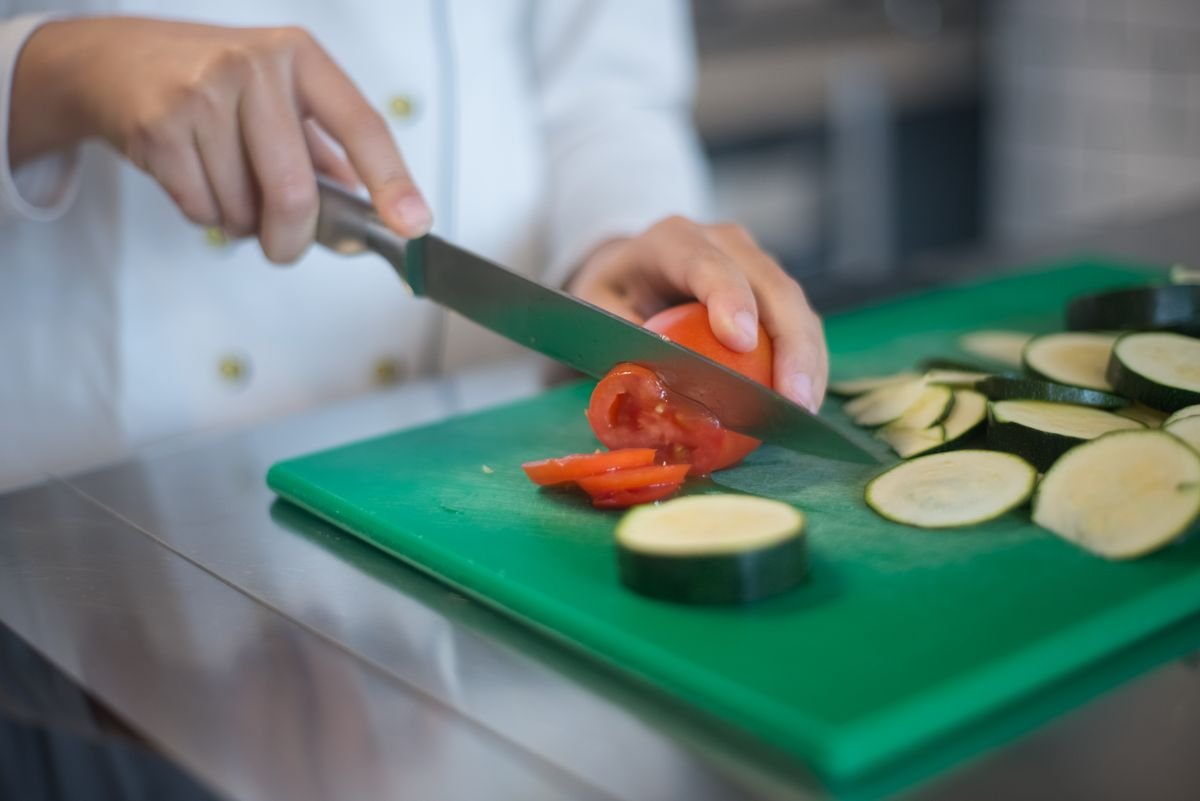
Preparing fresh vegetables on a wooden cutting board. Photo: Jun Ren via Unsplash.
Cutting Board Comparison Table
This table summarizes the main differences. Details come from current product listings, so confirm them on Amazon before ordering.
| Product | Material | Key Features | Cleaning |
|---|---|---|---|
| OXO Good Grips | Plastic | 14.34 x 21.11 in; double-sided; juice grooves; non-slip | Dishwasher-safe |
| San Jamar Saf-T-Grip | Co-polymer plastic | 12 x 18 in; grip corners; hook | Dishwasher-safe |
| Ziruma | Acacia | 16 x 11 in; beeswax and plant-oil finish | Handwash only |
| ROYAL CRAFT WOOD | Bamboo | 3 sizes; handles; grooves | Handwash, dry well |
| SMIRLY | Bamboo | 3 boards; stand; grooves | Handwash, dry well |
| Keechee | Carbonized bamboo | 3 sizes; handles; grooves | Handwash, dry well |
| SUMZZZ | Titanium/PP | 16 x 11 in; two-sided | Check instructions |
| Titanium Set of 3 | Titanium (per listing) | M, L, XL; two-sided | Dishwasher-safe |
| Tempered Glass 16 x 20 | Tempered glass | 16 x 20 in; heat-resistant | Dishwasher-safe |
| Murrey Home | Tempered glass | Decorative design | Check listing |
Best Cutting Board Material by Kitchen Task
Different jobs call for different surfaces. Use this quick guide to decide which board to reach for.
| Task | Best Material | Why |
|---|---|---|
| Raw chicken, beef, pork, fish | Polyethylene plastic or rubber | Non-porous and easy to sanitize |
| Fruits and vegetables | Hard maple, walnut, or bamboo | Knife-friendly and plastic-free |
| Bread and baked goods | Bamboo or acacia | Crumbs brush off easily; doubles for serving |
| Carving cooked roasts | Large plastic or end-grain wood with grooves | Catches juices and stays stable |
| Cheese and charcuterie | Acacia, walnut, or marble | Attractive serving surface |
| Rolling dough | Glass or marble | Cool, smooth, non-stick surface |
For most people, the best material for cutting boards is not one material at all. It is a non-porous board for raw proteins plus a hardwood board for everything else. That two-board approach gives you the safest and healthiest cutting boards setup without spending much.
How to Build a Safe Cutting Board Setup on a Budget
You do not need to spend a lot to set up a safe kitchen. A practical starter kit costs less than a single premium end-grain board.
- Buy one dishwasher-safe plastic board and reserve it for raw meat, poultry, and seafood.
- Add one hardwood or bamboo board for produce, bread, and cooked foods.
- Pick up a small board for quick jobs such as slicing limes or garlic.
- Keep a bottle of food-safe board oil for wooden boards.
- Set a reminder to inspect your boards every few months for deep grooves and cracks.
This simple system covers the habits that matter most: separation, cleanability, and timely replacement. Those three habits are what make cutting boards safest and healthiest in real kitchens, far more than brand names or marketing labels.
How to Choose the Safest and Healthiest Cutting Boards for Your Kitchen
The right board depends on what you cook, how often, and how much upkeep you will actually do. Use these factors to narrow your choice.
Match the Material to Your Cleaning Habits
If you want dishwasher convenience, choose plastic, rubber, or composite. If you prefer a natural material, choose hard maple, walnut, acacia, or bamboo and commit to handwashing. A neglected wooden board is not healthier than a well-kept plastic one.
Use Separate Boards for Raw Proteins
The USDA recommends separate boards for fresh produce and for raw meat, poultry, and seafood. A simple three-board setup works for most homes: one for raw proteins, one for produce, and one for bread and cooked foods. Color coding helps everyone in the house follow the system. Our cross contamination cutting boards guide includes a full color chart and cleaning steps.
Look for Stability
Non-slip feet or grip corners keep a board from sliding. If your board has neither, place a damp towel underneath it. A stable board plus a sharp knife, like those in our guide to the best knife for cutting meat, makes prep safer.
Protect Your Knives
Glass, marble, and metal boards dull edges fastest. If you already use them, plan to hone and sharpen more often. Our guide on what grit whetstone to use for kitchen knives explains how. Blade steel matters too, as covered in our article on the best materials for kitchen knives.
Pick the Right Size
A board around 12 x 18 inches handles most daily tasks. Larger boards, like a large wooden cutting board, help with carving and batch prep, while small boards are handy for fruit and garnishes. For compact options, see our picks of the best small cutting boards for kitchen use. Measure your counter and storage space before ordering, and use our cutting board sizes chart to compare standard dimensions.
Read “Non-Toxic” Claims Carefully
Labels like “non-toxic,” “natural,” and “food-grade” are mostly seller claims, and they do not prove which cutting boards are safest and healthiest. Look for the actual material, the finish ingredients, and care instructions. When details are vague, contact the manufacturer.
How to Clean and Maintain Cutting Boards
Even the safest and healthiest cutting boards become risky when they are not cleaned correctly. Follow these steps after every use.
Plastic and Other Non-Porous Boards
- Scrape off food scraps.
- Wash with hot, soapy water, including edges and grooves.
- Rinse well, or run the board through the dishwasher if it is listed as dishwasher-safe.
- Let it dry completely before storing.
Wood and Bamboo Boards
- Wash right away with mild soap and warm water.
- Never soak the board or put it in the dishwasher.
- Towel-dry, then let it air-dry standing upright.
- Oil it when the surface looks dry or pale.
For a full routine, read our guide on how to take care of a wooden cutting board.
Sanitizing After Raw Meat
The USDA suggests sanitizing boards with a solution of 1 tablespoon of unscented liquid chlorine bleach per gallon of water. For step-by-step methods, see our guide on how to disinfect cutting boards. Flood the surface, let it stand for several minutes, then rinse and air-dry. See the USDA’s cutting board and cross-contamination advice for details.
Remember to clean your sponges and towels too. Our guide on how to disinfect kitchen cloths after wiping raw meat covers that step.
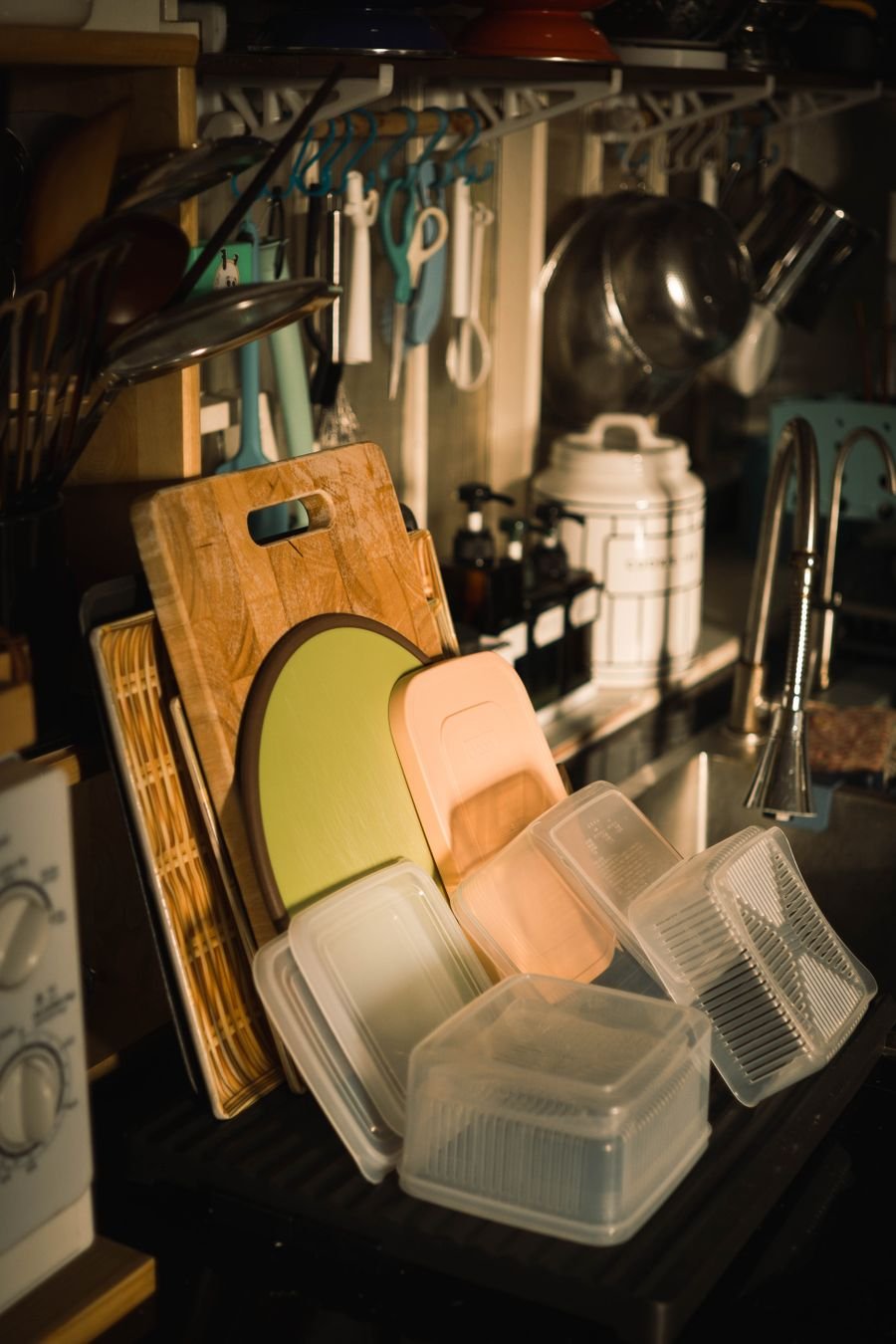
Store boards upright so air can reach every side. Photo: FOX via Pexels.
When to Replace a Board
The USDA advises replacing any cutting board that becomes excessively worn or develops hard-to-clean grooves. Also replace boards that crack, warp, or hold odors after washing. Plastic usually needs replacing sooner than hardwood.
Common Cutting Board Mistakes to Avoid
- Using one board for everything: Cutting raw chicken and then salad on the same unwashed board spreads bacteria.
- Ignoring deep grooves: Scarred boards trap residue that washing cannot reach.
- Dishwashing wood or bamboo: Heat and water can crack, warp, or loosen glue.
- Storing boards wet: Trapped moisture encourages mold and odors.
- Trusting labels alone: A “non-toxic” title does not replace good cleaning habits.
Frequently Asked Questions
What is the safest cutting board material?
There is no single safest material for every task. Non-porous plastic is easiest to sanitize, which makes it practical for raw meat. Hard maple is a strong all-around wood choice and is allowed by the FDA Food Code. Many cooks use both, which is how we define the safest and healthiest cutting boards in this guide.
What are the healthiest cutting boards if I want to avoid plastic?
Close-grained hardwoods such as maple, walnut, and cherry are excellent plastic-free options. Acacia and bamboo also work well. Choose boards with a food-safe finish and keep them clean and dry.
Are wooden cutting boards healthier than plastic?
Not automatically. UC Davis research found bacteria were harder to recover from wood, while plastic is easier to sanitize in a dishwasher. Plastic can also shed microplastics. Both are safe when maintained and replaced on time.
Is a non-porous cutting board better for raw meat?
Yes, for most homes. A non-porous cutting board can be washed in hot, soapy water or a dishwasher and sanitized easily. Keep it only for raw meat, poultry, and seafood.
Are bamboo cutting boards safe?
Yes, a well-made solid bamboo board is safe for everyday food prep. It is hard and absorbs little water, but its strips are glued together, so choose a brand that discloses a food-safe adhesive and avoid “bamboo fiber” melamine boards. Our full guide answers are bamboo cutting boards safe in detail, covering glue, bacteria, and knife wear.
Are titanium cutting boards safe?
Titanium is generally considered inert, but many “titanium” boards on Amazon combine metal with plastic. The metal surface is also hard on knives. Read the material description before you buy.
How often should I replace a cutting board?
There is no fixed schedule. Replace any board that has deep grooves, cracks, warping, or lingering odors. Heavily used plastic boards often need replacing sooner than hardwood boards.
Do plastic cutting boards put microplastics in food?
Research suggests they can. A 2023 study estimated millions of plastic particles a year from regular chopping. Health effects are not yet clear, but replacing scarred boards and using wood for produce can reduce exposure.
Can I use a glass cutting board every day?
You can, but your knives will dull much faster. Glass is better for serving, rolling dough, or occasional light prep. For daily chopping, choose plastic, rubber, or hardwood.
What size cutting board do I need?
A board around 12 x 18 inches handles most daily cooking. Add a larger board for carving and a small one for fruit, cheese, and garnishes.
Should I buy a cutting board set or one large board?
A set makes it easier to keep raw meat, produce, and bread on separate surfaces. One large board saves storage space. Many families buy a set plus one dedicated plastic board for raw proteins.
Final Thoughts on the Cutting Boards Safest and Healthiest for You
Finding the cutting boards safest and healthiest for your kitchen is less about one perfect material and more about a smart system. Choose a non-porous board for raw proteins and a hardwood or bamboo board for everything else.
Among our picks, the OXO Good Grips board is the best everyday option, and the San Jamar Saf-T-Grip makes a great dedicated meat board. The Ziruma acacia board and the ROYAL CRAFT WOOD, SMIRLY, and Keechee bamboo sets suit cooks who want plastic-free boards. Glass and titanium-style boards are best as secondary surfaces.
Whatever you choose, wash every board after use, dry it well, and replace it once it is worn. Those habits do more to keep your family safe than any label.

Hey, My name is MAMON. I am a SEO content creator and affiliate marketer with over 8 years of experience. I create honest product reviews, in-depth buying guides, and practical how-to articles to help readers make informed decisions. My mission is to provide trustworthy, research-backed content that delivers real value.
Leave a Reply