Key Takeaways
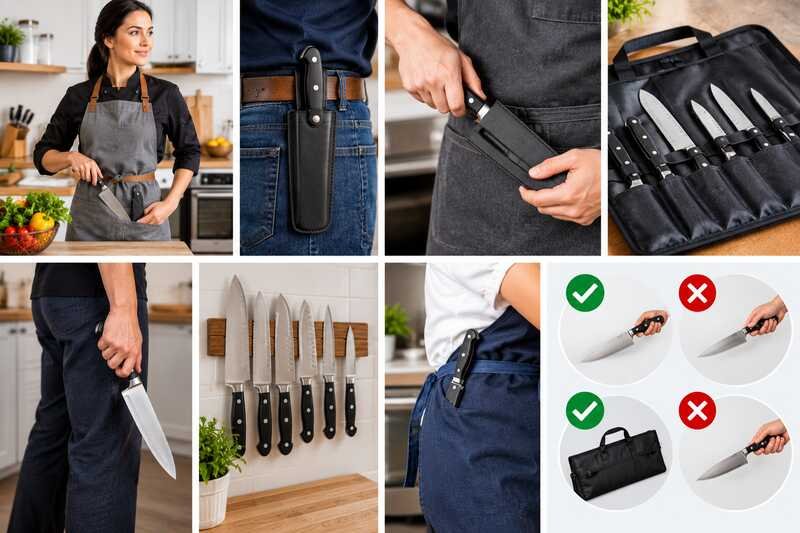
- Always carry a knife with the tip pointed down and the blade angled slightly behind you, away from your body.
- Never hand a knife directly to someone. Set it down on a flat surface and let them pick it up, or offer the handle first with a clear verbal warning.
- If a knife starts to fall, let it fall. Reaching for it is how most “dropped knife” injuries actually happen.
- Carry only the knife, nothing else, and wear closed-toe, non-slip shoes whenever you’re moving through the kitchen with one in hand.
Most people who’ve spent any real time in a kitchen have had at least one close call with a knife in transit, not while cutting, but while walking it from one spot to another. The risk goes up fast the moment other people are nearby. Learning how to carry a knife in the kitchen properly is one of the simplest safety habits to build, and one of the most commonly skipped. This guide covers the actual technique, professional kitchen etiquette for passing knives, and the habits that prevent the accidents that happen in transit rather than at the cutting board.
What Is Knife Safety, and Why Does Carrying Matter?
Amateur cooks and trained chefs are often easiest to tell apart by how they handle a knife, not how they cut with one. Professional training spends real time on knife etiquette specifically because so many kitchen injuries happen between cuts: walking across a busy line, handing a blade to a coworker, or reacting to something falling. Knife safety starts with the basics of grip and technique, but learning how to carry a knife in the kitchen properly, not just cutting technique, is just as much a part of it.
How to Carry a Knife in the Kitchen: The Core Rules
A few habits cover most of what actually prevents accidents in transit:
- Keep the handle clean and dry. Wipe off grease, oil, or moisture before picking the knife up; a slick handle is how knives get dropped in the first place.
- Point the blade down, angled slightly behind you. This is the standard professional-kitchen protocol, and it means that if you stumble or someone bumps into you, the blade isn’t pointed at anyone, including yourself.
- Keep your arm relaxed and steady at your side. Don’t swing the knife or gesture with it in hand; a waving blade turns a normal conversation into a hazard.
- Use your dominant hand. It’s stronger, more coordinated, and gives you more control if something unexpected happens.
- Carry only the knife. Don’t try to carry a cutting board, a bowl, or anything else in the same trip. Set the knife down first if you need a free hand.
Passing a Knife to Someone Else Safely
This is the part most home cooks never learn, and it’s responsible for a disproportionate number of kitchen cuts. Never hand a knife directly to another person, blade first or otherwise. Standard practice is to set the knife down on a clean, flat surface and let the other person pick it up themselves, which removes the moment of shared control where accidents happen. If setting it down isn’t practical, offer the handle first, with the blade pointed toward yourself and away from the other person, and say something out loud, “knife,” or “sharp,” so they know what’s coming before they reach for it.
Sheathe or Store the Blade Whenever Possible
Covering the blade is one of the simplest ways to protect yourself and anyone nearby. If your knife came with a protective sheath or blade guard, clean it first, then sheath it before carrying it any real distance, especially through a shared or crowded kitchen. A sheathed blade can’t come into accidental contact with anyone, which eliminates a whole category of risk. If you’re moving several knives at once, a dedicated knife roll or case keeps them organized and covered rather than loose. This matters just as much when you’re not actively using a knife: our guide on what material is best for a kitchen knife covers how different steels hold up to the kind of daily handling and storage most kitchens actually involve.
Knife Etiquette in Shared or Busy Kitchens
The rules change slightly once you’re not cooking alone. In a shared kitchen, whether that’s a professional line, a culinary class, or just a crowded family gathering, awareness of everyone else’s position matters as much as your own technique. Announce yourself out loud whenever you’re moving with a knife near someone’s back, a simple “behind” or “knife” is standard and takes a fraction of a second. Avoid crossing directly behind someone who’s also holding a knife or working at a cutting board; route around instead, even if it’s a slightly longer path.
It also helps to designate where knives live between tasks, a specific spot on the counter or a knife block rather than wherever happens to be free. When everyone in the kitchen knows where knives are supposed to be, nobody reaches for a drawer or a countertop without checking first, which removes a surprising number of avoidable nicks and cuts.
Carrying Knives Outside the Kitchen
Carrying technique doesn’t stop at the kitchen door. If you’re transporting knives to a friend’s house, a cooking class, or a catering job, exposed carry isn’t enough, even briefly. Use a dedicated knife roll, a padded knife bag, or at minimum individual blade guards on each knife before they go anywhere near a car seat, a backpack, or a shared bag with other items. Loose knives in a tote or backpack are a genuine hazard to whoever reaches in next, including you. If you’re retiring a knife rather than transporting it, our guide on how to dispose of kitchen knives safely covers wrapping and labeling it properly so it doesn’t become someone else’s accident on the way to the trash.
What to Wear When Carrying Knives
Footwear affects knife safety more than people expect. Traction matters, since a slip while holding a knife turns a minor stumble into something much worse. Avoid high heels, sandals, or slick-soled shoes in any kitchen where knives are in regular use. Closed-toe shoes made from sturdy material add a layer of protection if a knife does slip from your hand; a dropped blade landing on an exposed foot is a genuinely common injury that better footwear prevents outright.
Clothing matters too, in a smaller but still real way. Loose sleeves or dangling accessories can snag on a counter edge or a drawer handle at exactly the wrong moment, pulling your arm off course while a knife is in hand. Professional kitchens favor fitted, practical clothing for this reason as much as for heat and cleanliness. It’s not about looking a certain way; it’s one more variable removed from a moment where variables matter.
The Falling Knife Rule
If a knife starts to fall, whether it slips off a counter or out of your hand, let it fall. This is one of the most repeated principles in professional kitchens for good reason: the instinct to grab a falling knife is exactly what turns a dropped tool into a cut hand. Step back, let it hit the floor, and pick it up afterward. Part of knowing how to carry a knife in the kitchen is accepting this trade-off: a knife on the floor is an inconvenience. A knife caught mid-fall by reflex is how people lose fingers.
Common Mistakes That Lead to Kitchen Knife Accidents
A few habits show up again and again in avoidable knife injuries:
- Walking with the blade pointed up or forward. It only takes one unexpected turn from someone else to turn this into an accident.
- Rushing through a busy kitchen with a knife in hand. Speed and sharp objects don’t mix; slow, deliberate movement costs almost nothing and prevents a lot.
- Setting a knife down in a sink full of water or suds. It disappears from view, and the next person to reach in has no warning it’s there. Keep knives visible on a counter or in a dedicated spot instead.
- Leaving a knife near the edge of a counter. It’s an easy bump away from falling, and falls are how the falling-knife rule becomes necessary in the first place.
- Getting distracted mid-task. If you’re interrupted while holding a knife, stop, set it down safely, and deal with the distraction before picking it back up.
Frequently Asked Questions
How to carry a knife in the kitchen if I’m moving through a crowded space?
Point the blade down, keep your arm close to your body, move slowly, and announce yourself with a verbal warning like “knife” or “behind” as you pass anyone.
Is it ever okay to hand a knife directly to someone?
It’s best avoided. Setting the knife down for the other person to pick up, or offering the handle first with a clear warning, removes the shared-control moment where most passing accidents happen.
What should I do if I drop a knife?
Step back and let it fall. Never try to catch it. A knife on the floor is easy to deal with; a reflexive grab at a falling blade is not.
Does the type of knife change how I should carry it?
The core rules, point down, dominant hand, sheathed when possible, apply to every knife type. Larger or longer knives, like slicers or chef’s knives, deserve extra care simply because there’s more blade to manage.
What should I say when passing behind someone with a knife?
A simple, clear “behind” or “knife” is standard. The exact word matters less than saying something loud enough to be heard before you’re within arm’s reach.
Is it safe to carry a knife in a bag with other kitchen tools?
Not without a guard or sheath. Loose knives shifting around in a bag with other items can cut through the bag itself or injure whoever reaches in, including you.
Final Thoughts
Every knife follows the same rules for how to carry it safely in the kitchen. Wipe the handle clean, point the blade down, keep your arm steady, and never carry anything else at the same time. Sheath the blade when you can, wear shoes with real traction and closed toes, and if a knife ever starts to fall, let it. None of these habits take extra time once they’re automatic, and together they remove most of the risk that comes from simply moving a knife from one place to another.

Hey, My name is MAMON. I am a SEO content creator and affiliate marketer with over 8 years of experience. I create honest product reviews, in-depth buying guides, and practical how-to articles to help readers make informed decisions. My mission is to provide trustworthy, research-backed content that delivers real value.
Leave a Reply