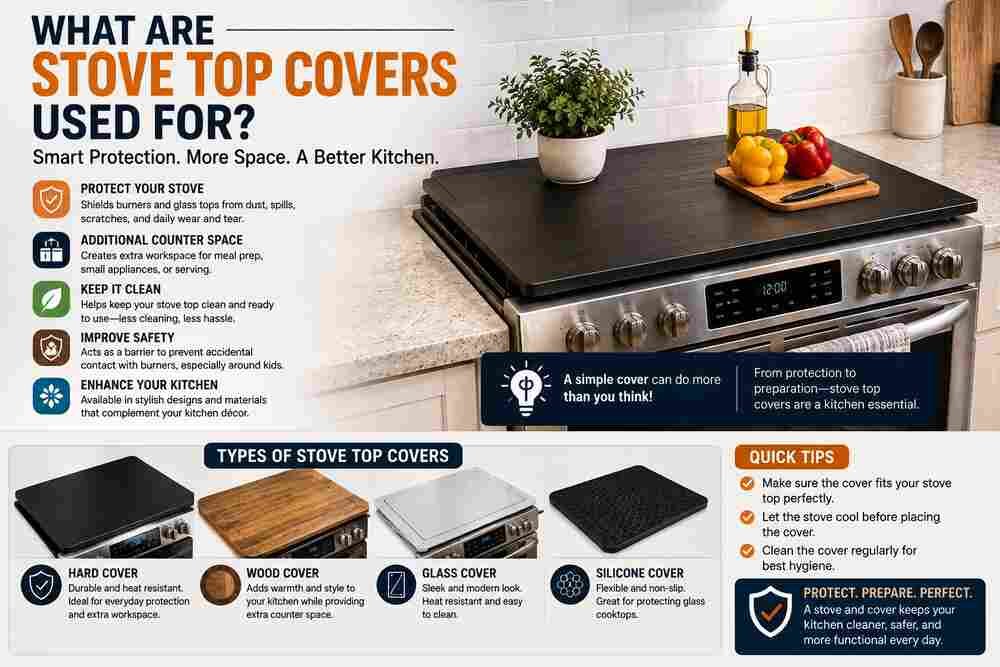
Has a friend, relative, or coworker suggested you buy a stove top cover for your range? You might be wondering what it actually does. You’re in good company. Stove top covers have become a genuinely popular kitchen accessory, especially in smaller kitchens. Plenty of people still aren’t sure what they’re for, or whether they’re worth buying.
So, what are stove top covers used for? In this guide, we’ll walk through their real benefits, the materials they’re actually made from, and the safety rules that matter if you decide to use one.
Key Takeaways
- Stove top covers are typically made from tempered glass, stainless steel, wood, or silicone, not Teflon.
- They’re meant for use when the stove is off and cool, not as a workspace over an active burner or lit pilot light.
- The National Fire Protection Association identifies cooking equipment as the leading cause of U.S. home fires, which is exactly why cover material and safe use matter.
What Are Stove Top Covers Used For?
A stove top cover, sometimes called a burner cover or noodle board, is a protective panel placed over your stove’s burners or grates when they’re not in use. People ask what are stove top covers used for because the answer covers more ground than it first seems. There are four main reasons: protecting the stove surface, adding counter space, dressing up the kitchen, and keeping unused burners clean. Let’s look at each one.
Types of Stove Top Covers
Before getting into what are stove top covers used for in more detail, it helps to know the two basic formats they come in:
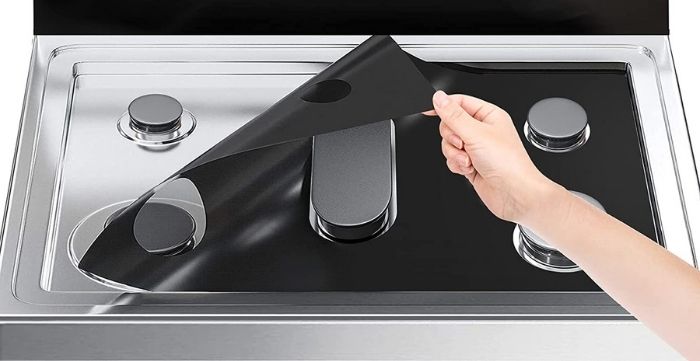
- Individual burner covers: Small, round or square caps sized to fit over a single burner or grate. These are common on gas ranges, where each burner can be covered separately depending on which ones you’re using that day.
- Full stove top covers: Larger panels that span the entire cooktop, covering all burners at once. These are the type most often used for extra counter space, since they create one continuous flat surface.
They Protect Your Stove Top Surface
One of the main uses of a stove top cover is shielding the surface beneath it from spills, stains, and everyday wear. A cover adds a barrier between your grates or cooktop and whatever gets splashed, dropped, or set down nearby. That happens most when you’re not actively cooking on that section of the stove.
This matters most for gas ranges. Grates and the surrounding surface catch grease and food debris regularly. A cover over unused burners keeps dust, crumbs, and cooking residue off the parts of the stove you’re not using that day. If you already have cookware suited to a gas stove, pairing it with a well-chosen cover rounds out a setup that stays cleaner with less scrubbing.
They Add Counter Space
If your kitchen is short on prep space, a full stove top cover can genuinely help. Once it’s in place over cool, unused burners, it creates a flat surface. Use it for extra staging area, setting down bowls, or holding ingredients while you cook on other burners. Some covers, particularly wood “noodle boards,” double as cutting boards, serving trays, or charcuterie boards.
That said, this benefit only applies with the stove off and cool. It’s not meant as a permanent workspace over active burners. We’ll cover exactly why in the safety section below.
They Make Your Kitchen More Attractive
Beyond function, stove top covers come in a wide range of finishes. Brushed stainless steel, printed tempered glass, and natural wood are all common. Picking one that complements your countertops or cabinetry is a low-cost way to freshen up a kitchen’s look. Many wood and glass covers can also be personalized with a family name, a pattern, or a printed design. That’s part of why they’ve become popular as gifts and small kitchen upgrades.
What Are Stove Top Covers Made Of?
Contrary to some older buying guides, stove top covers aren’t made of Teflon. The material depends on the type of cover:
- Tempered glass: The most common material for full covers and individual burner covers. Tempered glass, also called safety glass, is heat-strengthened. It shatters into small, relatively dull pieces rather than sharp shards if it ever breaks. It’s scratch-resistant and doubles well as a cutting or serving surface.
- Stainless steel: Common for individual burner caps on gas ranges. Stainless resists warping and won’t absorb odors or stains the way some other materials can.
- Wood: Used for “noodle boards,” typically hardwoods like maple, acacia, or bamboo. Wood covers look rustic and double as serving trays. But they’re combustible, which is the main safety consideration below.
- Silicone or fabric mats: Softer, foldable options rated for moderate heat exposure, commonly up to around 500°F. Often used on electric or induction cooktops rather than gas.
Stove Top Cover Safety: What You Need to Know
This is the part that’s easy to overlook, and it matters. The National Fire Protection Association identifies cooking equipment as the leading cause of home fires and home fire injuries in the U.S. That statistic is exactly why stove top covers, whatever they’re made of, need to be used correctly.
Fire safety experts have specifically pushed back on the trend of leaving wood or fabric covers permanently in place over a cooktop, even when it’s off. Placing combustible material directly over a cooking appliance is one of the more avoidable risks in a kitchen. An accidental burner bump, a pilot light, or residual heat can ignite it. Here are the core safety rules:
- Only use a cover when the stove is completely off and cool. Never place any cover, glass, wood, or otherwise, over an active burner or a hot cooktop.
- Be extra cautious with gas ranges that have a standing pilot light. A pilot flame that stays lit can ignite a wood or fabric cover even if the burners themselves are off. It can also allow gas to build up beneath a raised cover if there’s ever an unlit leak.
- Remove the cover entirely before you start cooking, rather than pushing it to one side. Store it on a countertop or hang it away from the stove.
- Check the manufacturer’s rating before buying. Many tempered glass covers are explicitly labeled “not for use on direct flame or high heat.” They’re meant for cool, unused burners only, not as a trivet for hot cookware straight off an active burner, unless the product specifically says otherwise.
- Skip flammable materials on gas stoves if you’re at all unsure. Stainless steel or tempered glass tolerate stray heat far better than wood or fabric.
None of this means stove top covers are unsafe to own. It means they’re a “stove is off” accessory, not a workspace you build around an active cooktop. Used that way, they’re a low-risk, genuinely useful addition to a kitchen.
Choosing the Right Stove Top Cover
Once you know what are stove top covers used for, picking one comes down to matching the cover to your stove and your goals. A few things to consider before buying:
- Match the material to your stove type. Gas ranges do best with stainless steel or tempered glass burner caps sized to your specific burner diameter. Electric and induction cooktops have more flexibility, including silicone mats.
- Measure before you buy. Full covers need to match your cooktop’s width and depth closely enough to sit securely. Look for rubber or silicone feet that keep it from sliding.
- Decide what you actually want it for. If counter space is the priority, a full cover with a flat, stable top matters more than decorative styling. If it’s mainly protective, individual burner caps might be enough.
- Check for non-slip feet. These stabilize the cover if you’re using it as a cutting surface or setting down cookware. They also protect a glass or ceramic cooktop underneath from scratches.
If you’re weighing a cover alongside a bigger range purchase or upgrade, our guide on how to choose a gas range for your kitchen is a good place to start. Our guide on how to clean gas range burners safely covers the routine maintenance a cover helps cut down on.
Watch: Stove Top Cover Review
For a closer look at how a stove top cover looks and functions in a real kitchen, this review walks through the practical side of using one.
Cleaning and Caring for Your Stove Top Cover
Keeping a cover clean is part of understanding what are stove top covers used for day to day, since a dirty cover defeats much of the purpose. Cleaning steps vary a bit by material:
- Tempered glass: Wipe with a standard glass cleaner or mild dish soap and water. Avoid abrasive scrubbers, which can dull the surface over time even though the glass itself resists scratching.
- Stainless steel: A dedicated stainless steel cleaner cuts down on streaking and fingerprints. Wipe with the grain of the brushed finish rather than across it.
- Wood: Wipe down with a damp cloth and mild soap, then dry immediately. Avoid soaking wood covers or running them through a dishwasher, since prolonged moisture exposure can warp or crack the wood over time. Re-oiling periodically with food-safe mineral oil helps keep it from drying out.
- Silicone or fabric mats: Most are machine washable or wipeable, depending on the specific product. Check the care label before washing.
Stove Top Covers vs. Other Counter-Space Solutions
If extra counter space is your main goal, a stove top cover isn’t the only option, but it’s often the cheapest and easiest to try. Rolling carts and pull-out cutting boards add space without touching the stove at all, which sidesteps the safety considerations above entirely. Wall-mounted fold-down shelves work well in tight galley kitchens. Compared to those, a stove top cover has one clear advantage: it reclaims space that’s otherwise sitting unused every time the stove is off, without requiring any installation or extra floor footprint. The tradeoff is that it only works part-time, since you’ll need to clear it before cooking.
Frequently Asked Questions
What are stove top covers used for on a daily basis?
Most people use them to keep unused burners clean between cooking sessions, add a bit of extra counter space when the stove is off, and improve the kitchen’s overall look. Some also double as cutting boards or serving trays. That combination is really the whole answer to what are stove top covers used for in a typical household.
Are stove top covers made of Teflon?
No. Common materials are tempered glass, stainless steel, wood, and silicone. Teflon isn’t a standard stove top cover material.
Can I use a stove top cover while cooking?
No, not over an active burner. Covers are designed for a stove that’s turned off and cooled down. Using one over a lit burner, or leaving a combustible cover like wood near an active cooktop, is a fire risk that fire safety experts specifically warn against.
Is it safe to put a hot pan directly on a stove top cover?
Only if the manufacturer specifically rates the cover for that use. Many tempered glass covers are explicitly labeled as not intended for direct flame or high heat contact. Check the product’s specifications before assuming it can double as a trivet.
Do stove top covers work on gas ranges with a pilot light?
They can, but with extra caution. A standing pilot light stays lit even when the burners are off. Keep flammable covers like wood well away from it, and never let a cover trap gas beneath it if you smell anything unusual.
Final Verdict
So, what are stove top covers used for? At their core, they protect your stove’s surface, add usable counter space when the stove is off, and give your kitchen a quick style upgrade, all without a major renovation. They’re made from tempered glass, stainless steel, wood, or silicone rather than Teflon. Each material has its own strengths depending on your stove type. The one rule that matters most: use them only when the stove is off and cool. Follow that, and a stove top cover is a genuinely useful, low-cost addition to almost any kitchen.

Hey, My name is MAMON. I am a SEO content creator and affiliate marketer with over 8 years of experience. I create honest product reviews, in-depth buying guides, and practical how-to articles to help readers make informed decisions. My mission is to provide trustworthy, research-backed content that delivers real value.