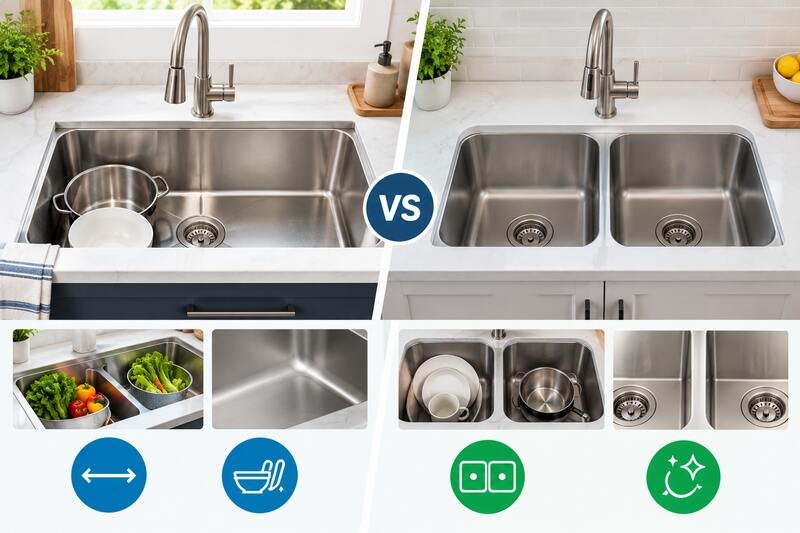
A low divide sink looks like a regular double-bowl sink, but its center wall is shorter. That one change affects how you wash big pans, soak dishes, and use a garbage disposal. Choosing between a low divide sink and a standard 50/50 double sink? This guide explains the real differences with specs from actual models. Use it to pick the layout that fits how you cook.
Key Takeaways
- A 50/50 sink has two equal bowls. A low divide sink is also usually 50/50, but its divider sits several inches below the rim.
- On many low divide models, the divider sits about 4 inches below the rim.
- The lower wall lets long pans and baking sheets lie across both bowls.
- The trade-off: each bowl holds less water before it spills over the divider.
- Choose a low divide sink if you wash large cookware often. Choose a full-height divider if you soak and rinse at the same time.
What Is a 50/50 Double Sink?
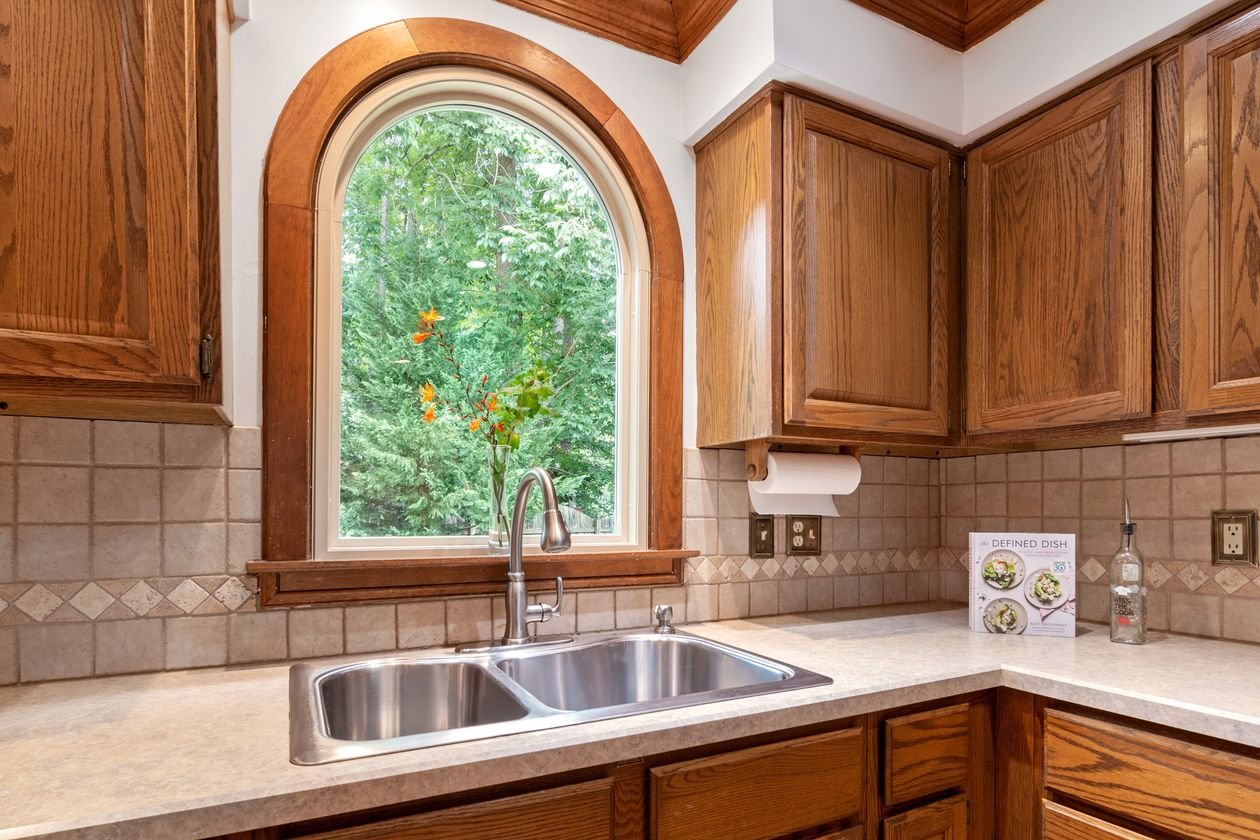
A 50/50 sink splits the basin into two equal bowls. On a standard model, the center divider rises close to the rim. Each side works as its own separate basin.
This layout is popular in U.S. homes because it supports a classic routine. You wash on one side and rinse on the other. Or you soak pans on one side while the other stays free for daily use.
The weak spot is bowl width. In a 30-inch sink, each bowl might be only about 13.5 inches wide. That is too narrow for many sheet pans, roasting pans, and large skillets.
What Is a Low Divide Sink?
A low divide sink keeps two bowls, but the center wall is shorter. Water and large items can pass over it. The idea is to get the flexibility of two bowls with some of the open space of a single bowl.
How low is “low”? It varies by brand. Ruvati explains that on its low-divide sinks, the center divider sits four inches below the top of the rim. A 30-inch, 16-gauge stainless model sold by Cabinets To Go uses the same 4-inch drop with 10-inch-deep bowls.
Composite sinks follow the same idea. Blanco’s Diamond Equal Double Low Divide lists 9.5-inch-deep bowls and a 5.5-inch divider in its official spec sheet. That is roughly half the bowl depth.
Low Divide Sink vs Standard 50/50 at a Glance
Here is how the two layouts compare in daily use.
| Feature | Low Divide Sink | Standard 50/50 Sink |
|---|---|---|
| Divider height | Several inches below the rim (often about 4 inches) | At or near rim height |
| Large pans and sheet pans | Can lie across both bowls | Limited to one bowl’s width |
| Soaking capacity per side | Limited by divider height | Can fill close to full depth |
| Wash and rinse at once | Possible, with shallower water | Easy |
| Garbage disposal use | Works well on one side | Works well on one side |
| Cleaning the sink | Slightly easier around a lower wall | Tall divider has more surface to wipe |
Always check the spec sheet for your exact model. Divider height and bowl size vary between brands.
Benefits of a Low Divide Sink
Room for Big Cookware
This is the main reason people buy a low divide sink. A standard half sheet pan is about 18 by 13 inches. It will not lie flat in a narrow bowl. With a lower divider, the pan can rest across both sides for scrubbing.
The same goes for roasting pans, grill grates, and long griddles. You get more usable space without giving up the two-bowl layout.
Easier Filling of Large Pots
Tall stock pots are easier to angle under the faucet when the center wall is low. You also bump the divider less when you swing a heavy pot from side to side.
Still Two Separate Zones
A low divide sink still gives you two basins. You can keep dirty dishes on one side and a clean rinse area on the other. You can also run a disposal on one side while you wash on the other.
Simpler Cleaning
A shorter wall means less surface to wipe. Many low divide models also have rounded inside corners, which helps food debris rinse away.
Drawbacks of a Low Divide Sink
Less Water Per Side
Water spills over the divider once it passes the divider’s height. On a sink with a 5.5-inch divider, you cannot fill one side deeper than that without both sides filling. This matters if you like to soak pans in deep water.
Splashing Between Bowls
With a lower wall, water can splash from one bowl into the other. If you rinse raw chicken on one side, droplets may reach the other. Keep a clear zone and clean both bowls after handling raw meat.
Fewer Choices and Higher Prices
Standard 50/50 sinks are sold everywhere and in many sizes. Low divide models are common, but the range is smaller. They can also cost a bit more than a basic double sink of the same size and gauge.
Benefits of a Standard 50/50 Sink
- Deep soaking on both sides. Each bowl can fill close to full depth on its own.
- Clean separation. A tall wall keeps soapy water and rinse water apart.
- Wide availability. You will find many sizes, materials, and price points.
- Familiar routine. It suits a wash-and-rinse habit and hand washing in two basins.
The main downside is width. If you often cook with large pans, a full-height divider can feel cramped.
What About 60/40 and Single Bowl Sinks?
A 60/40 sink has one larger bowl and one smaller bowl. The big side handles pans. The small side handles prep, rinsing, or a disposal. It is a good middle ground if you want more room than a 50/50 but still want a tall divider.
A single bowl sink has no divider at all. It gives the most open space for large items. However, you lose the ability to soak and wash in separate basins.
Some brands also make low divide versions of 60/40 layouts. For example, Blanco sells a 40/60 double bowl with a low divide in its Diamond line. That combines an off-center split with a shorter wall.
Low Divide Sink and Garbage Disposals
A low divide sink works well with a garbage disposal. Install the disposal under one bowl, and use the other for washing. On a 50/50 layout, most people put the disposal on the side closest to the dishwasher. This keeps the drain lines short and simple.
Keep one thing in mind. If you fill the non-disposal side past the divider, water will flow into the disposal side. That is harmless, but plan your soaking around it. For plumbing help, see our guide on how to plumb a kitchen sink with a disposal and dishwasher.
Wondering whether you can run both at once? Our article on running a garbage disposal while the dishwasher is running answers that.
How to Choose the Right Double Sink
Ask yourself these questions before you buy:
- How big is your largest pan? If it is wider than one bowl, a low divide sink will help.
- Do you soak dishes often? If yes, a full-height divider holds more water per side.
- Do you hand wash in two basins? A tall divider keeps wash and rinse water apart.
- What size is your base cabinet? Check the minimum cabinet size on the spec sheet. Many double sinks need a 33- to 36-inch cabinet.
- Which material do you want? Low divide designs come in stainless steel and granite composite.
Measure your cabinet and countertop cutout before you shop. Our guide to measuring a kitchen sink shows you how.
Who Should Choose Each Layout?
Your cooking habits are the best guide. Here is a quick way to decide.
Pick a Low Divide Sink If You:
- Bake often and wash sheet pans, cooling racks, or muffin tins.
- Roast large cuts of meat and clean big roasting pans.
- Grill and need to scrub grates indoors.
- Run the dishwasher for most dishes and use the sink mainly for cookware.
- Want two bowls but dislike how cramped a standard double sink feels.
Pick a Standard 50/50 Sink If You:
- Hand wash most dishes using a wash side and a rinse side.
- Soak pots overnight in deep water.
- Thaw food in a water bath while using the other bowl.
- Want the widest choice of sizes, colors, and budget models.
- Rarely cook with pans wider than about 13 inches.
Still unsure? A 60/40 layout or a single large bowl may suit you better than either option.
Installation Tips for a Low Divide Sink
A low divide sink installs the same way as any double sink. Most models are undermount, though drop-in versions exist.
- Confirm the base cabinet meets the minimum size on the spec sheet.
- Use the template in the box to mark the countertop cutout.
- Support heavy composite sinks with proper clips and adhesive.
- Plan the drain layout for both bowls, including the disposal side.
- Seal the rim with silicone to keep water out of the cabinet.
For a full walkthrough, read our step-by-step article on installing an undermount kitchen sink.
Care and Maintenance
Caring for a low divide sink is simple. Rinse both bowls after use, and wipe the top of the divider, where food bits collect. Clean with mild dish soap and a soft sponge. Use a bottom grid to protect the finish from heavy pots.
If one side drains slowly, the clog is often in the shared trap. Our guide on unclogging a double kitchen sink with standing water covers the fix.
Frequently Asked Questions
Is a low divide sink worth it?
Yes, if you wash large pans often. A low divide sink gives you more room for big cookware and still keeps two bowls. If you mostly soak dishes in deep water, a full-height divider may suit you better.
How low is the divider on a low divide sink?
It depends on the brand. Many stainless models put the divider about 4 inches below the rim. Blanco’s Diamond Equal Double Low Divide lists a 5.5-inch divider with 9.5-inch bowls.
Is a low divide sink the same as a 50/50 sink?
Not exactly. “50/50” describes equal bowl sizes. “Low divide” describes the height of the center wall. Many low divide sinks are also 50/50, but some use a 60/40 split.
Can water overflow from one side to the other?
Yes. Once the water level rises above the divider, it flows into the other bowl. That is the main trade-off of this design.
What size cabinet do I need?
Most 30- to 33-inch double sinks need a 33- to 36-inch base cabinet. Always confirm on the maker’s spec sheet.
Final Verdict
A low divide sink is the better choice for home cooks who wash big pans, sheet pans, and grill grates. It keeps two bowls but frees up space where you need it. A standard 50/50 sink is better if you soak dishes often or wash and rinse by hand in separate basins.
Think about your largest cookware and your daily routine. Then check the divider height and cabinet size on the spec sheet. Ready to compare real models? Browse our double bowl kitchen sink reviews, which include low-divider options.

Hey, My name is MAMON. I am a SEO content creator and affiliate marketer with over 8 years of experience. I create honest product reviews, in-depth buying guides, and practical how-to articles to help readers make informed decisions. My mission is to provide trustworthy, research-backed content that delivers real value.
Leave a Reply