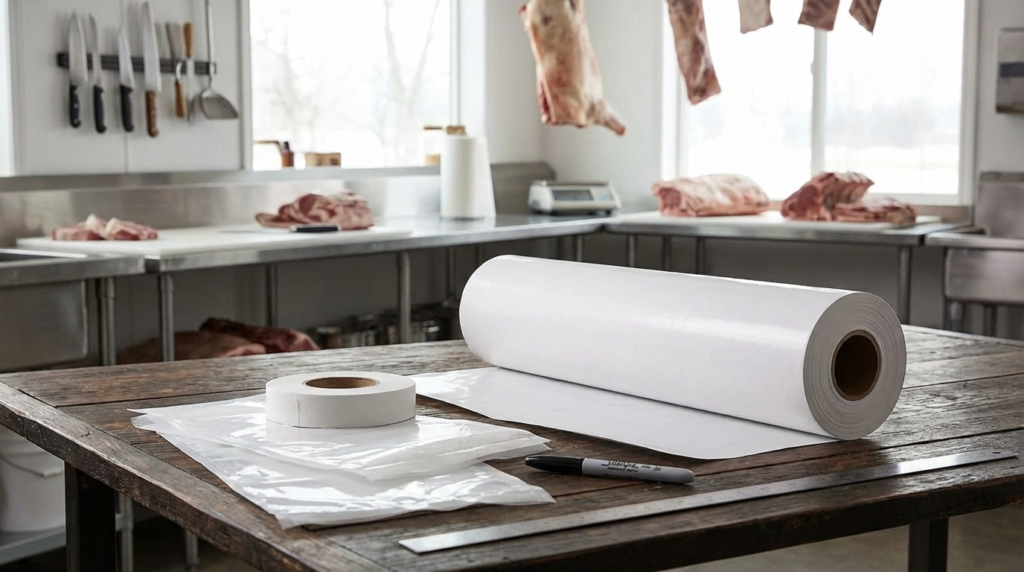
Grocery prices don’t seem to be going anywhere but up, which is exactly why so many U.S. households are buying meat in bulk and freezing it. The problem is that most people freeze meat the same way they’d store leftovers — a loose layer of plastic wrap and hope — and three months later they’re chipping grey, leathery freezer burn off a $30 roast. Wrapping meat correctly takes an extra two minutes per package, and it’s the single biggest factor in whether that meat tastes as good in month six as it did on day one.
This guide walks through exactly how to wrap meat for freezing using the materials most people already have (or can buy for a few dollars), plus how long different cuts actually last, the mistakes that ruin good meat, and how to thaw it safely once you’re ready to cook.
Key Takeaways
- Air is the enemy, not the freezer. Freezer burn is caused by air reaching the meat’s surface and pulling moisture out through sublimation, not by the cold itself.
- The USDA confirms meat held at 0°F stays safe to eat indefinitely — wrapping is about preserving quality (taste and texture), not safety.
- A tight plastic wrap layer followed by heavy-duty foil or freezer paper, or better yet, vacuum sealing, cuts freezer burn dramatically compared to store packaging alone.
- Vacuum-sealed raw meat can hold good quality for 1 to 3 years, versus roughly 1 to 12 months for meat that isn’t vacuum sealed.
- Portion meat into meal-sized amounts before wrapping, label everything with the cut and date, and thaw in the refrigerator, never on the counter.
Why Freezer Burn Happens (and Why Wrapping Is the Fix)
Freezer burn isn’t spoilage, and it isn’t a food safety problem. It’s a moisture problem. When air touches the surface of frozen meat, the ice on that surface sublimates — it turns directly from solid ice into water vapor and drifts away, leaving the meat dehydrated in that spot. That’s what creates the grayish-brown, leathery patches you’ve probably seen on forgotten freezer meat. It’s still safe to eat once trimmed, but the texture and flavor take a real hit.
How fast the meat freezes matters too. The USDA explains that quick freezing keeps ice crystals small, while slow freezing lets large crystals form that puncture cell walls and damage the meat’s structure — which is part of why home freezers (which freeze more slowly than commercial blast freezers) benefit even more from tight, air-excluding packaging. Setting your freezer to 0°F (-18°C) or below and freezing meat as soon as possible after wrapping gives you the best starting point before packaging technique even comes into play.
Standard grocery store shrink-wrap is designed to look good on a shelf, not to survive months at sub-zero temperatures — it’s thin, somewhat permeable to air, and prone to becoming brittle and cracking in the cold. That’s why the first rule of freezing meat well is: don’t rely on the package it came in.
For related reading on meat prep tools, see how a manual meat grinder works for perfect ground meat if you’re freezing your own ground meat from whole cuts.
The Best Materials for Wrapping Meat for Freezing
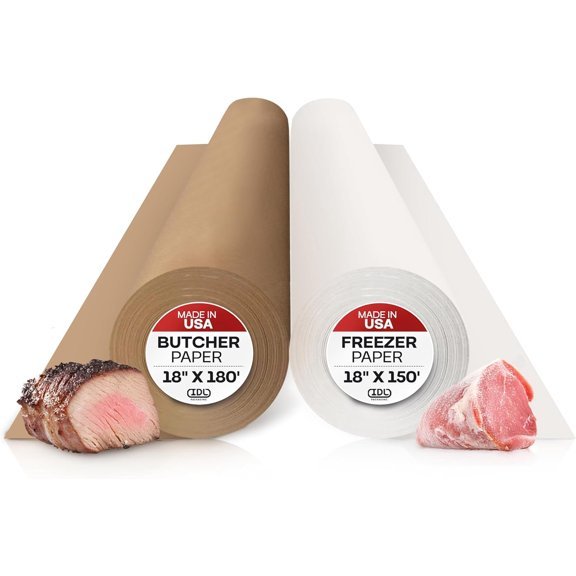
Not every wrap that works in the fridge works in the freezer. Materials made for freezer use need to resist moisture, stay flexible in the cold, and seal tightly enough to push out air. Here’s how the common options stack up.
Plastic freezer wrap. Only plastic wrap labeled for freezer use should touch meat headed for long-term storage — ordinary kitchen cling wrap is too thin and permeable. Press it directly against the meat’s surface to force out air pockets, then use it as your first, tightest layer.
Butcher paper (freezer paper). The classic choice for whole cuts, roasts, and steaks. It’s coated on one side to resist moisture and is what the “drugstore wrap” fold — the same tight, professional fold butcher shops use — is built around. On its own it isn’t fully airtight, so it works best as a second layer over plastic wrap, sealed with freezer tape (regular tape’s adhesive fails in the cold).
Heavy-duty aluminum foil. Impermeable to air and good as a second or third layer, but it punctures easily and doesn’t conform well to irregular shapes on its own, so it’s rarely the only layer you want.
Zipper-lock freezer bags. Thicker than storage bags and reasonably effective, especially for ground meat or stew meat you’ll use within 3–4 months. Push out as much air as possible before sealing — some people use the “straw trick,” sealing all but a small corner and sucking out the remaining air before closing it.
Vacuum sealing. The most effective method available to home cooks. By removing essentially all the air from the package, vacuum sealing addresses the root cause of freezer burn directly. It requires a vacuum sealer and bags, but for anyone freezing meat regularly, it typically pays for itself in saved meat quality within a year.
According to the USDA’s Food Safety and Inspection Service, if you’re keeping meat and poultry in its original store packaging for longer than about two months, you should overwrap it with airtight heavy-duty foil, plastic wrap, or freezer paper, or seal it inside a freezer bag (USDA FSIS, retrieved 2026-08-02).
Step-by-Step: How to Wrap Meat for Freezing
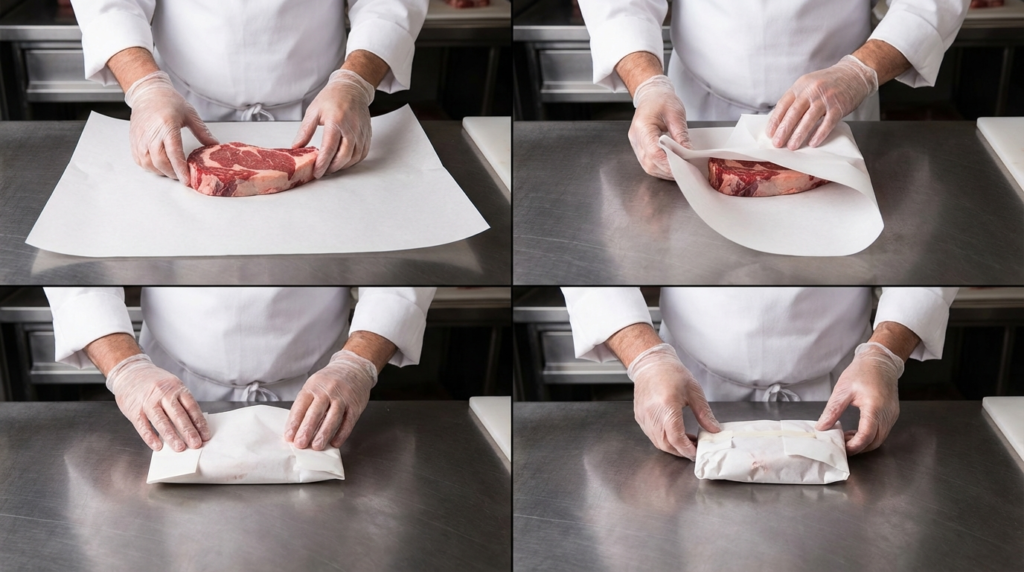
This is the “drugstore wrap” method professional butchers use, adapted for a home kitchen with butcher paper and plastic wrap.
- Pat the meat dry. Extra surface moisture forms ice crystals faster inside the package — a paper towel pat-down before wrapping makes a real difference.
- Portion it out. Divide large cuts into meal-sized portions. A common rule of thumb is about 6 ounces per person, so a family of four might portion into 24-ounce packages. Smaller portions also freeze faster than one large block.
- Wrap tightly in plastic freezer wrap first, pressing out as much air as you can and molding it directly to the meat’s surface.
- Wrap again in butcher paper or heavy-duty foil, folding the ends over tightly (the classic butcher fold: fold the paper over the meat, tuck and roll the sides in, then fold the ends up and seal with freezer tape).
- Label every package with the cut, weight, and date using a permanent marker or a piece of freezer tape. Six months from now, “mystery meat” is not a helpful label.
- Freeze quickly, laid flat and spaced apart so air can circulate, then stack once solid.
If you’re working through a bulk order or a whole animal, a good meat slicer or meat cutting knife makes portioning faster and cleaner before you even get to the wrapping stage.
How to Vacuum Seal Meat for Freezing
Vacuum sealing follows a similar prep process but skips the multi-layer wrap:
- Chill or partially freeze the meat for 30–60 minutes first — firming up the surface reduces the chance of juices leaking into the seal area.
- Trim excess fat and pad sharp bone ends with a scrap of freezer paper so they don’t puncture the bag.
- Portion the meat and leave 3–4 inches of empty bag above it so the sealer has room to work.
- Insert the open end into the vacuum sealer, run the vacuum and seal cycle, then check the seal is fully airtight before freezing.
Because it removes nearly all the air, vacuum-sealed raw meat can hold good quality in the freezer for roughly 1 to 3 years, compared with about 1 to 12 months for meat that’s frozen without vacuum sealing. Keep in mind this is a quality window, not a safety cutoff — properly frozen meat stays safe indefinitely at 0°F.
How Long Meat Actually Lasts in the Freezer
These are quality guidelines from USDA-based storage charts, not safety limits. Meat kept at a consistent 0°F is safe indefinitely, but taste and texture decline the longer it sits — and decline faster if it wasn’t wrapped well to begin with.
| Cut / Type | Recommended Freezer Time (well-wrapped) |
|---|---|
| Ground meat (beef, pork, turkey, lamb) | 3–4 months |
| Steaks | 6–12 months |
| Chops | 4–6 months |
| Roasts | 4–12 months |
| Stew meat | 3–4 months |
| Whole poultry | Up to 12 months |
| Poultry pieces | 9 months |
| Bacon | About 1 month |
| Cooked meat / leftovers | 2–4 months |
Whole-muscle cuts that are vacuum-sealed sit at the higher end of these ranges, sometimes well beyond 12 months for quality; ground meat and cuts wrapped only in standard butcher paper or bags sit toward the shorter end.
If you’re freezing rotisserie or pre-cooked meat rather than raw cuts, the storage math is a little different — see our guide on how long rotisserie chicken lasts in the fridge and freezer for specifics.
Watch: Wrapping Meat the Way Butchers Do It
Seeing the fold in motion makes the technique click faster than reading about it. This video walks through the process step by step.
Common Mistakes That Cause Freezer Burn
- Freezing meat in its original store tray. That thin film is built for a few days in the fridge, not months in the freezer.
- Skipping the second layer. Plastic wrap alone, or freezer paper alone, leaves gaps. Doubling up materials is what actually blocks air.
- Leaving air pockets around the meat. Air trapped inside the wrap does the same damage as air outside it — press it out deliberately, don’t just fold and hope.
- Using regular tape instead of freezer tape. Standard adhesive lets go in the cold, and the package pops open.
- Overloading the freezer or stacking warm packages. Both slow down freezing time, which allows larger, more damaging ice crystals to form.
- Forgetting to label and date. Not a quality issue exactly, but it’s how good meat quietly turns into freezer clutter nobody wants to cook.
How to Thaw Frozen Meat Safely
Good wrapping only pays off if thawing is done safely too:
- Refrigerator thawing is the safest method. Plan on roughly 24 hours of thaw time per 4–5 pounds, and keep the meat on a plate or tray to catch any drips.
- Cold water thawing is faster: submerge the sealed package in cold water, changing the water every 30 minutes, and cook immediately after thawing.
- Never thaw meat on the counter at room temperature. Bacteria multiply quickly once the surface warms above 40°F, even while the center is still frozen.
- Meat and poultry can also be cooked directly from frozen, though it takes roughly one and a half times as long as cooking from thawed, according to the FDA’s food storage guidance (FDA, retrieved 2026-08-02).
Frequently Asked Questions
Is freezer-burned meat safe to eat? Yes. Freezer burn is a quality issue, not a safety issue. You can trim off the affected areas and cook the rest as normal, though the texture and flavor won’t be as good as unaffected meat.
Can I freeze meat in its store packaging? For a short period, yes — the USDA notes original packaging is fine for freezing initially, but for anything beyond about two months, overwrap it with a freezer-rated material for better quality.
Do I need a vacuum sealer to freeze meat well? No. A tight double wrap of plastic freezer wrap plus butcher paper or foil, sealed with freezer tape, works well for most home cooks. Vacuum sealing simply extends the quality window further, which matters more for long-term or bulk storage.
How long can you keep meat in the freezer safely? Indefinitely, as long as the freezer stays at 0°F or below — safety and quality are two different clocks. The storage times above are about taste and texture, not whether the meat is safe to eat.
What’s the best wrap for ground meat specifically? Ground meat has more exposed surface area than a whole cut, so it’s more freezer-burn prone. Press it flat inside a labeled freezer bag with the air pushed out — flat packages also freeze faster and stack more efficiently.
The Bottom Line
Wrapping meat for freezing well comes down to one idea: keep air away from the surface. Whether that’s a tight double wrap of plastic and butcher paper or a vacuum sealer, the goal is the same — slow down sublimation so the meat you pull out in six months tastes like the meat you put in. Portion before you wrap, label everything, freeze it fast, and thaw it safely, and a freezer full of meat becomes a genuine grocery-budget advantage instead of a gamble.

Hey, My name is MAMON. I am a SEO content creator and affiliate marketer with over 8 years of experience. I create honest product reviews, in-depth buying guides, and practical how-to articles to help readers make informed decisions. My mission is to provide trustworthy, research-backed content that delivers real value.
Leave a Reply