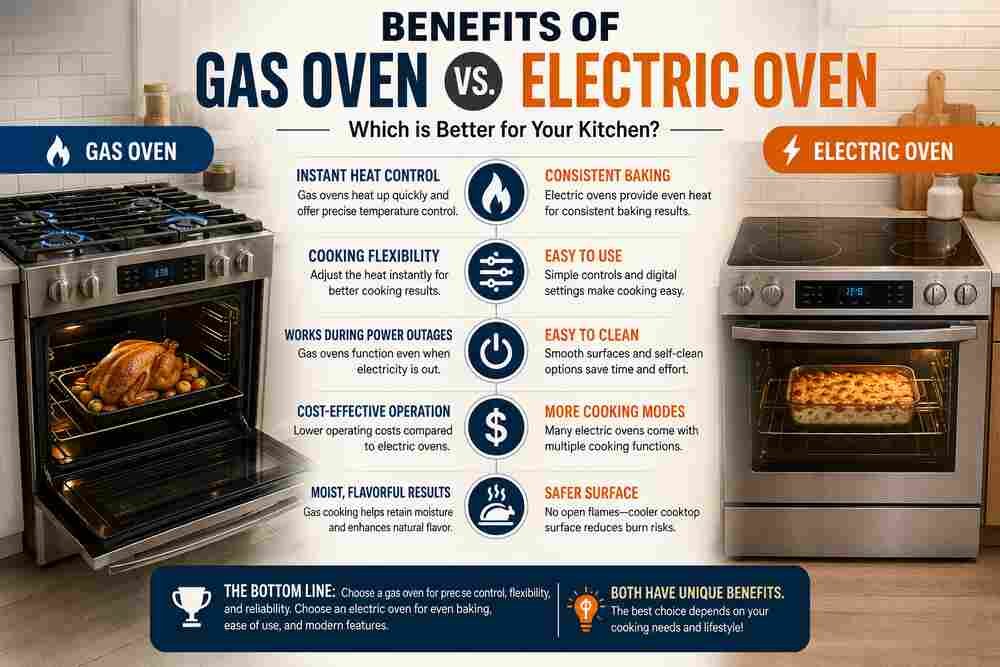
From roasting a Sunday dinner to baking a batch of cookies, your oven does a lot of work. Choosing between gas and electric is worth getting right. The benefits of gas oven vs electric oven come down to a handful of real differences. How they distribute heat, what they cost to run, and what it takes to install one all matter. Here’s an honest, U.S.-focused breakdown to help you decide.
Key Takeaways
- Gas ovens create a naturally humid cooking environment from moisture released during combustion. That suits roasts and some breads. Electric ovens run drier and more evenly, which suits precision baking like cookies and cakes.
- Running costs depend heavily on your local utility rates. At the 2026 national averages, gas is usually cheaper per hour of cooking, but this varies a lot by state.
- Electric ranges need a dedicated 240-volt circuit, not just a standard outlet. Gas ranges need an existing gas line and, in most areas, a code-compliant shutoff valve.
- Consumer Reports lab testing has found electric ovens outperform gas in most categories except baking. Results there are closer, or favor gas depending on the recipe.
Understanding How Gas Ovens and Electric Ovens Work
Before comparing costs and performance, it helps to understand the mechanics behind each type, since that explains most of the practical differences that follow.
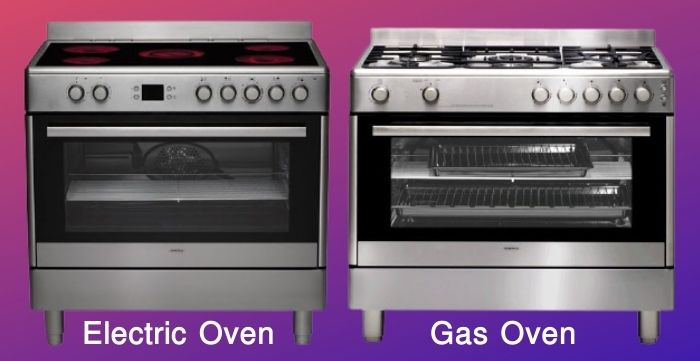
Gas ovens rely on a burner to heat the cavity, typically located at the bottom. Some models add a second burner near the top for broiling. Burning natural gas produces water vapor as a byproduct of combustion. That releases moisture directly into the oven as it cooks.
Electric ovens use one or more heating elements. Most commonly, that’s a visible coil at the bottom for baking and a second element at the top for broiling. Some models add a third, circular element at the back paired with a fan for convection cooking. Electric ovens don’t produce any combustion byproducts. That’s why the cooking environment stays drier.
The Benefits of Gas Oven vs Electric Oven: Running Costs
Cost comparisons for gas oven vs electric oven often get muddled with pricing from other countries. Here’s what the numbers actually look like for U.S. households. According to U.S. Energy Information Administration data, the national average residential electricity rate sits around 18 cents per kWh as of 2026. It ranges from roughly 11 cents in states like North Dakota to over 40 cents in Hawaii. Natural gas prices average around $1.35 per therm nationally, also with significant regional variation.
At those national averages, running an electric oven typically costs 20 to 29 cents per hour depending on temperature. A gas oven’s per-use cost tends to run somewhat lower. But your actual bill depends entirely on local rates. In states with expensive electricity and cheap natural gas, gas ovens win by a wide margin. In states with cheap electricity, like parts of the Midwest and South Central U.S., the gap narrows considerably. It can even flip.
For a household that bakes or roasts several times a week, the difference between gas and electric typically adds up to a few dollars a month either way at national average rates, though the gap widens noticeably in high-cost electricity states.
Cooking Performance: Moisture, Even Heat, and Baking Results
This is where a lot of gas oven vs electric oven comparisons get the details backward. It’s worth being precise here. Gas ovens release moisture into the cooking cavity as a natural byproduct of burning fuel. That humidity can help keep roasts from drying out. It also gives some bread recipes a better crust. Electric ovens, by contrast, run drier, since there’s no combustion happening inside the cavity.
That dry, steady heat is exactly why electric ovens tend to win recommendations for precision baking. Cookies, cakes, and other delicate baked goods benefit from the more even, consistent temperature that electric heating elements provide. This especially holds with a convection fan circulating the air. According to testing referenced by Angi, electric ranges outperformed gas in most Consumer Reports lab categories. Results for baking specifically were closer between the two, though, with gas’s humidity giving certain recipes an edge.
Preheat and Cooking Time
Gas ovens generally preheat faster, often reaching temperature in well under 10 minutes. The burner delivers heat directly and immediately. Electric ovens typically take a bit longer to preheat. The heating elements need time to reach full temperature before the cavity catches up.
Once at temperature, gas ovens tend to cycle the burner on and off to hold heat. That can create small temperature swings. Electric ovens, especially newer models, generally hold a steadier set point once they reach it. Cooling down between uses is faster than some guides suggest for either type. Neither typically requires anywhere close to an hour before you can use it again. Most residential ovens cool enough to handle safely within 20 to 30 minutes, though the interior may take longer to return fully to room temperature.
Watch: Gas vs. Electric Ovens Compared
This video walks through the practical differences in performance, cost, and installation between the two oven types.
Installation Requirements
This is a common source of confusion, so it’s worth being specific about what each type actually needs.
A gas range needs an existing gas line and a properly installed, code-compliant shutoff valve. If your kitchen already has both from a previous range, connecting a new one is a manageable project for many homeowners. Running an entirely new gas line requires a licensed professional, though. Many municipalities also require a permit for any gas line work.
An electric range isn’t as simple as “just needing an outlet.” Full-size electric ranges require a dedicated 240-volt circuit, typically rated for 40 to 50 amps. That’s not a standard 120-volt household outlet. If your kitchen doesn’t already have that circuit and outlet installed, an electrician will need to run one from your panel. That adds real cost if you’re switching from gas to electric for the first time.
Safety and Maintenance Differences
Both oven types carry different safety considerations worth knowing about. Gas ovens involve an open flame and a fuel line, which means the risk of a gas leak, however small, always exists. Some lab testing has also found elevated nitrogen oxide levels around gas appliances during use, which is part of why proper kitchen ventilation matters more with gas. Electric ovens remove the combustion risk entirely, but they carry their own hazards: a flat electric cooktop can stay hot after use without an obvious visual cue, and it’s easier to forget a burner was left on.
Maintenance also differs somewhat. Gas burners and igniters occasionally need cleaning to keep the flame burning evenly and blue rather than yellow. Electric heating elements rarely need cleaning themselves, though the oven cavity around them still needs the same regular attention as any oven.
Which Should You Choose?
The honest answer to the benefits of gas oven vs electric oven debate is that it depends on what you cook most. What your kitchen already has in place matters too.
- Choose gas if: you do a lot of roasting, want faster preheat times, already have a gas line installed, or live somewhere with cheap natural gas.
- Choose electric if: you bake frequently and want the most consistent results, prefer a simpler installation with no combustion byproducts to vent, or live in a state with cheap electricity.
- Consider a dual fuel range if: you want a gas cooktop for stovetop control paired with an electric oven for baking consistency. It costs more upfront, but gives you both strengths in one appliance.
Environmental Considerations
The environmental picture between gas and electric ovens depends heavily on where you live. Burning natural gas releases carbon dioxide directly at the point of use. Electric ovens have no direct emissions at all, but their overall carbon footprint depends on how your local electricity grid generates power. In states with a cleaner electricity mix, including a growing number that now draw more than 30% of generation from renewables, an electric oven’s effective footprint can be meaningfully lower than a gas oven’s. In states that still rely heavily on fossil fuels for electricity generation, the gap narrows or can favor gas instead.
Frequently Asked Questions
What are the main benefits of gas oven vs electric oven for baking?
Gas ovens add natural humidity that can benefit roasts and certain bread recipes. Electric ovens run drier with more consistent, even heat, which is generally preferred for cookies, cakes, and other precision baking.
Is a gas oven or electric oven cheaper to run in the U.S.?
It depends on your local utility rates. At national average prices, gas is often somewhat cheaper per hour of use. Electricity-heavy states with cheap power can narrow or reverse that gap, though.
Does an electric oven really need a special electrical circuit?
Yes. Full-size electric ranges require a dedicated 240-volt circuit, not a standard household outlet. If your kitchen doesn’t have one installed, an electrician will need to add it.
Which oven type preheats faster?
Gas ovens generally preheat faster, often in under 10 minutes, since the burner delivers heat immediately. Electric ovens usually take somewhat longer since the heating elements need time to reach temperature.
Can I install a gas oven myself?
If your kitchen already has a gas line and shutoff valve, connecting a new range is a reasonable DIY project for many homeowners. Running a brand-new gas line requires a licensed professional, though, and often a permit.
Overall, what’s the biggest difference in the benefits of gas oven vs electric oven?
The single biggest practical difference is moisture and heat consistency. Gas adds humidity and preheats faster; electric runs drier and holds a steadier temperature, which most bakers prefer for precision work.
Final Thoughts
Weighing the benefits of gas oven vs electric oven ultimately comes down to your cooking habits and your kitchen’s existing setup. Gas offers faster preheating and a moist cooking environment good for roasts. It also often runs cheaper, depending on local utility rates. Electric offers steadier, more even heat that suits precision baking, along with a simpler installation if you don’t already have a gas line. Neither option is universally better. It’s about which strengths matter most in your kitchen.
If you’re still deciding on a full range rather than a built-in oven, our guide to choosing a gas range for your kitchen covers BTU output and burner layout in more detail. For a hybrid approach, see our guide to dual fuel ranges, which pair a gas cooktop with an electric oven.

Hey, My name is MAMON. I am a SEO content creator and affiliate marketer with over 8 years of experience. I create honest product reviews, in-depth buying guides, and practical how-to articles to help readers make informed decisions. My mission is to provide trustworthy, research-backed content that delivers real value.
Leave a Reply