Why does a soft-boiled egg have a set white but a runny yolk? The answer is temperature. Egg whites and yolks set at different points, which is why timing and heat control make such a big difference. So, what temperature do eggs cook at? According to the American Egg Board, egg whites coagulate at about 144 to 149°F, while yolks set at about 149 to 158°F. For safety, however, egg dishes are usually cooked to 160°F. In this guide, we explain the science, the safety numbers, and the right temperatures for boiling, poaching, frying, baking, and sous vide.
Key Takeaways
- Egg whites coagulate at about 144 to 149°F (62 to 65°C), according to the American Egg Board.
- Egg yolks set at about 149 to 158°F (65 to 70°C), and whole beaten eggs at about 144 to 158°F.
- Hard-cooked eggs should reach more than 160°F inside, according to the Egg Safety Center.
- The FDA Food Code, which guides restaurants, uses 145°F for 15 seconds for eggs cooked for immediate service.
- Adding sugar raises the temperature at which eggs set, which is why custards cook more slowly.
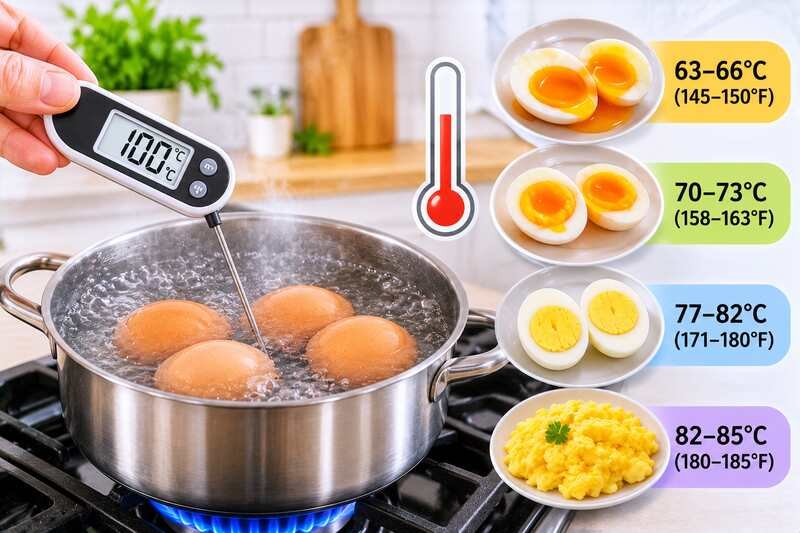
What Temperature Do Eggs Cook At? The Science
To answer what temperature eggs cook at, start with what eggs are made of. Eggs are mostly water and protein. When you heat them, the proteins unfold and link together into a firm network. Food scientists call this coagulation. Because the white and the yolk contain different proteins, they coagulate at different temperatures.
The American Egg Board’s coagulation guide lists these ranges:
| Part of the Egg | Coagulation (°F) | Coagulation (°C) |
|---|---|---|
| Egg white | 144 to 149°F | 62.2 to 65°C |
| Egg yolk | 149 to 158°F | 65 to 70°C |
| Whole egg | 144 to 158°F | 62.2 to 70°C |
In other words, the white starts to set at a slightly lower temperature than the yolk. As a result, if you stop cooking at the right moment, you get a firm white and a soft, flowing yolk. That is the basic principle behind every soft-boiled, poached, and sunny-side-up egg.
Why Whites Set in Stages
Interestingly, the white is not a single protein. It contains several proteins that set at slightly different points. The thin, outer white tends to firm up first, while the thick inner white needs a bit more heat. Therefore, a very gently cooked white can look set at the edges but still feel loose near the yolk.
How Sugar and Liquid Change the Numbers
In addition, other ingredients shift these temperatures. According to the American Egg Board, sugar raises the temperature needed for coagulation. That is one reason sweet custards, such as crème brûlée, bake slowly in a low oven. Similarly, diluting eggs with milk or water spreads the proteins out, so the mixture sets more gently and stays tender, as in steamed egg custard.
Safe Egg Temperatures: What the Experts Say
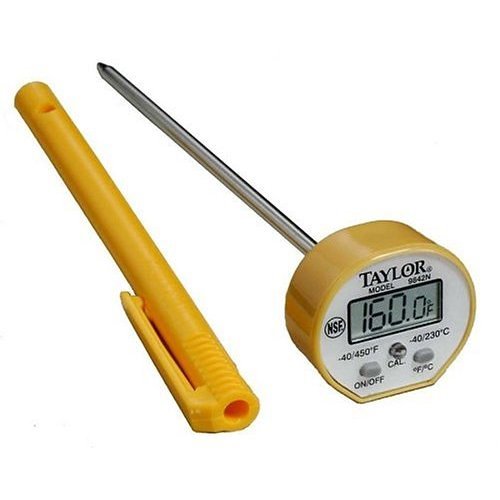
Photo: edkohler via Flickr (CC BY 2.0).
Of course, texture is one goal, but safety is another. Raw or undercooked eggs can carry bacteria such as Salmonella. Here is how official guidance lines up:
| Guidance | Temperature | Applies To |
|---|---|---|
| Egg Safety Center | More than 160°F | Hard-cooked eggs |
| USDA home guidance | 160°F | Casseroles and other egg dishes |
| FDA Food Code | 145°F for 15 seconds | Restaurant eggs cooked for immediate service |
The Egg Safety Center also notes that cooking eggs until the white and yolk are firm helps destroy bacteria. So, for home cooking, the simplest rule is this: cook eggs until both the white and yolk are firm, and use a food thermometer to check that casseroles and mixed dishes reach 160°F.
What About Runny Yolks?
A runny yolk has not reached the temperatures that fully set it. For most healthy adults, that is a personal choice. However, for young children, older adults, pregnant people, and anyone with a weakened immune system, it is safer to serve firm yolks or use pasteurized eggs.
What Temperature Do Eggs Cook At by Method?
The temperature of your cooking medium is very different from the temperature inside the egg. For example, boiling water is about 212°F at sea level, but the egg’s center rises slowly toward that point. That is why timing matters so much. Here is how common methods compare:
| Method | Cooking Medium | Typical Timing |
|---|---|---|
| Soft-boiled | Simmering to boiling water | 5 to 7 minutes from a boiling start |
| Hard-cooked | Water brought to a boil, then off heat | About 12-minute stand for large eggs |
| Steamed | Steam over boiling water | 12 minutes for hard eggs |
| Poached | Gently simmering water | 3 to 5 minutes |
| Fried or scrambled | Pan over low to medium heat | A few minutes |
| Baked dishes | Moderate oven | Until center reaches 160°F |
| Sous vide | Water bath held at a set temperature | Depends on target texture |
Sources: boiling times from Eggland’s Best and the American Egg Board; steaming from Milk Street; poaching from the American Egg Board.
Boiling and Steaming
Generally, water and steam cook eggs from the outside in. Because the water is far hotter than the coagulation range, the white sets first, and the yolk follows as heat moves inward. Therefore, a few extra minutes take a yolk from runny to firm. For hard-cooked eggs, the American Egg Board recommends bringing cold water just to a boil, covering the pan, and letting large eggs stand off the heat for about 12 minutes.
Poaching
By contrast, poaching uses water that is simmering gently, well below a rolling boil. As a result, the white sets softly without turning rubbery. According to the American Egg Board, poached eggs take 3 to 5 minutes, until the whites are set and the yolks begin to thicken.
Frying and Scrambling
Admittedly, pan temperature is harder to measure, but heat level still matters. Low to medium heat gives tender whites and creamy scrambles, while high heat creates crisp, browned edges and can make whites tough. For tips on even heat, see our guide on cooking eggs in a cast iron skillet without sticking.
Baking
Meanwhile, baked eggs, frittatas, and quiches cook more slowly in dry oven heat. For mixed egg dishes, check the center with a food thermometer for 160°F. If you bake in a small oven, our guide on how to cook eggs in a toaster oven covers timing, and our guide on how to tell if a pan is oven safe helps you pick the right dish.
Sous Vide
Finally, sous vide cooking holds eggs in a water bath at a precise temperature. Because the bath never gets hotter than the setting, the egg cannot overcook. Many cooks use settings in the low-to-mid 140s°F, which you may see called a “63°C egg,” for a soft, custardy texture. Keep in mind that these temperatures are below the 160°F safety target, so they are best for healthy adults or with pasteurized eggs.
Video: GastroJunkx shows how precise water temperature changes egg texture.
Egg Doneness by Internal Temperature
Using the American Egg Board’s coagulation ranges, you can roughly match internal temperature to texture. This is a helpful way to think about what temperature eggs cook at for the result you want.
| Internal Temperature | White | Yolk |
|---|---|---|
| Below 144°F | Still liquid or barely opaque | Liquid |
| 144 to 149°F | Setting into a soft gel | Liquid to thickening |
| 149 to 158°F | Set | Thickening to jammy |
| 160°F and above | Firm | Firm; safety target for egg dishes |
Ranges are based on American Egg Board coagulation data; textures are general descriptions and vary with heating speed.
Why Overcooked Eggs Turn Rubbery
When eggs get much hotter than their coagulation range, the protein network tightens and squeezes out water. As a result, whites turn rubbery, scrambled eggs weep liquid, and custards curdle. In addition, boiled eggs that cook too long or cool too slowly can develop a gray-green ring. According to the University of Arkansas Cooperative Extension Service, that ring forms when sulfur in the white reacts with iron in the yolk. Therefore, gentle heat and quick cooling give the best texture.
How Altitude Affects Egg Temperature
At high elevations, water boils at a lower temperature. According to Colorado State University Extension, water boils at about 203°F at 5,000 feet and about 193°F at 10,000 feet, compared with 212°F at sea level. Since the water is cooler, eggs take longer to reach their setting temperatures. So, if you live in the mountains, add a few minutes to boiling and steaming times.
How to Check Egg Temperature
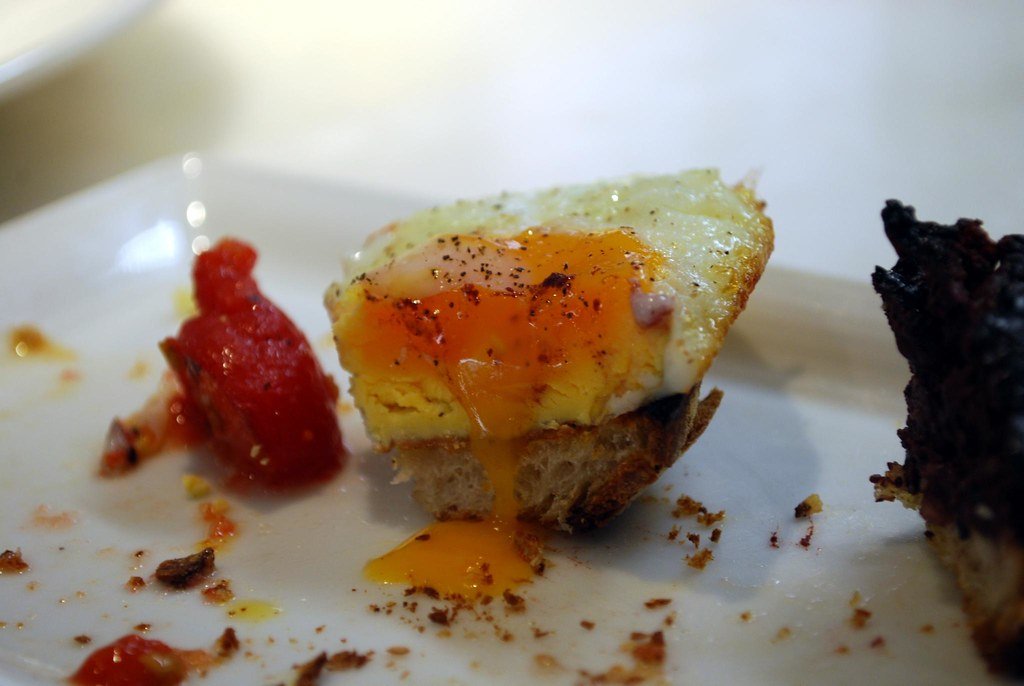
Photo: avlxyz via Flickr (CC BY-SA 2.0).
- Use an instant-read thermometer: First, insert the probe into the thickest part of a casserole, frittata, or quiche.
- Avoid the pan: Next, keep the tip away from the bottom of the dish, which reads hotter than the food.
- Check several spots: Then test the center and one edge, since ovens heat unevenly.
- Look for 160°F: Finally, remove the dish once the center reaches 160°F.
For boiled, poached, and fried eggs, a thermometer is not practical. Instead, judge by texture: whites should be fully set and opaque, and yolks should be firm if you want them fully cooked.
A Quick Rule of Thumb
If you remember only three numbers, make them these. First, whites start to set at about 144°F. Second, yolks set between about 149 and 158°F. Third, 160°F is the safety target for egg dishes. With those in mind, you can adjust any recipe or method with confidence, whether you are boiling, poaching, frying, or baking.
Common Temperature Mistakes
- Cooking too hot: In fact, very high heat makes whites rubbery and can scorch the bottom of fried eggs.
- Ignoring carryover heat: Eggs keep cooking after you remove them, so pull them slightly early or chill them in ice water.
- Overcooking boiled eggs: As a result, sulfur in the white reacts with iron in the yolk and forms a green ring, according to the University of Arkansas Cooperative Extension Service.
- Not checking casseroles: Instead, use a thermometer to confirm 160°F in the center.
- Forgetting altitude: Similarly, mountain kitchens need longer cooking times.
What Temperature Do Eggs Cook At in an Air Fryer or Microwave?
Air fryers and microwaves heat eggs differently, but the same internal targets apply. An air fryer works like a small convection oven, circulating hot air around the food, so baked eggs and egg bites cook quickly from the outside in. To understand power levels, see our guide on the best wattage for an air fryer.
Microwaves, on the other hand, heat the water inside the egg directly, which can cook unevenly and build steam. For that reason, pierce yolks, cover loosely, and cook in short bursts. Also, never microwave a whole egg in its shell. For more on steam-based microwave cooking, see our guide on how to use a microwave steamer.
Storage Temperatures for Raw and Cooked Eggs
Temperature matters before and after cooking too. In the United States, eggs are washed and should be kept refrigerated at 40°F or below. Likewise, cooked eggs should go back in the refrigerator promptly. According to the American Egg Board, hard-boiled eggs in the shell keep for up to one week, while peeled eggs are best eaten the same day.
Frequently Asked Questions
What temperature do eggs cook at?
According to the American Egg Board, egg whites coagulate at about 144 to 149°F and yolks at about 149 to 158°F. For safety, cook egg dishes to 160°F.
What temperature should eggs reach to be safe?
The Egg Safety Center says hard-cooked eggs should reach more than 160°F inside. Likewise, casseroles and other egg dishes should reach 160°F.
Why does the white set before the yolk?
The white’s proteins begin to coagulate at a lower temperature, about 144°F, while yolk proteins need about 149 to 158°F.
Does adding milk change the cooking temperature?
It changes the texture. Diluting eggs spreads out the proteins, so the mixture sets more gently. Meanwhile, the American Egg Board notes that sugar raises the coagulation temperature.
What temperature do eggs cook at in boiling water?
Boiling water is about 212°F at sea level. However, the inside of the egg rises gradually, so the white sets first, around 144 to 149°F, and the yolk follows at about 149 to 158°F. That is why time in the water controls doneness.
What is the best pan temperature for fried eggs?
Generally, low to medium heat gives tender whites and a soft yolk. Higher heat creates crisp, browned edges but can toughen the white, so adjust based on the texture you like.
Do brown and white eggs cook at different temperatures?
No. Shell color depends on the breed of hen, and it does not change how the egg cooks. Instead, egg size and starting temperature matter far more.
Are sous vide eggs safe?
Many sous vide settings are below 160°F, so they may not fully destroy bacteria. Therefore, use pasteurized eggs for higher-risk groups.
Final Thoughts
So, what temperature do eggs cook at? Egg whites begin to set at about 144°F, yolks at about 149 to 158°F, and egg dishes are safest at 160°F. Once you understand those numbers, every cooking method makes more sense. Use gentle heat for tender whites, watch your timing for the yolk you want, and check casseroles with a thermometer. With that approach, you can cook eggs that are both delicious and safe.

Hey, My name is MAMON. I am a SEO content creator and affiliate marketer with over 8 years of experience. I create honest product reviews, in-depth buying guides, and practical how-to articles to help readers make informed decisions. My mission is to provide trustworthy, research-backed content that delivers real value.
Leave a Reply