Air fryers have become a kitchen staple. They cook with little to no oil and use less energy than a full-size oven. But to get good results, you first need to answer one question: what is best wattage for air fryer use in your kitchen? This guide covers air fryer power ranges by size, how wattage affects cooking and cost, and how to pick the right wattage for your household.
Key Takeaways
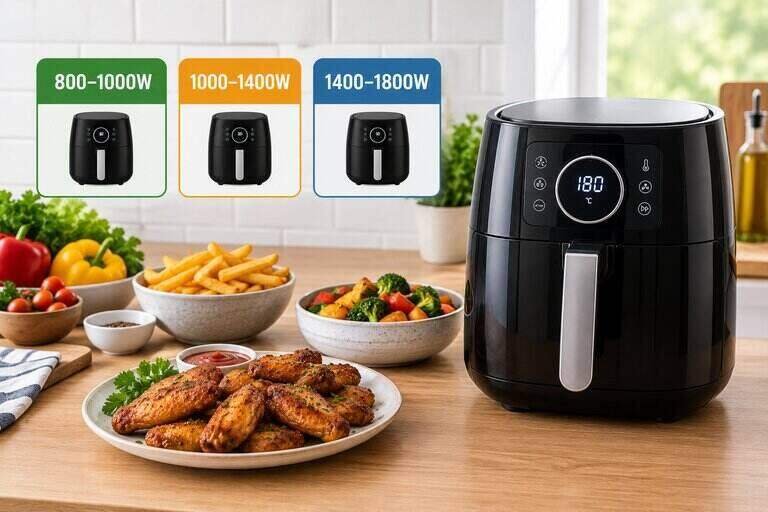
- Air fryers typically range from 800 to 2,000 watts, depending on size and model.
- Small air fryers (1 to 3 quarts) use about 800 to 1,200 watts.
- Medium models (3 to 6 quarts) run 1,200 to 1,600 watts. Large air fryers (6 to 10+ quarts) often use 1,600 to 2,000 watts.
- Wattage affects cooking speed and energy use, but more watts doesn’t always mean better results.
- Air fryers are generally more energy-efficient than ovens, which typically draw 2,000 to 5,000 watts.
- Answering what is best wattage for air fryer use comes down to matching wattage to your household size and cooking habits.
Understanding Air Fryer Power Consumption Basics
Knowing how much power an air fryer uses helps with kitchen setup, circuit planning, and predicting your energy bill. Air fryers cook by circulating hot air around food. That’s part of why they use less energy than a traditional oven. If you’re also weighing capacity, our guide on how big of an air fryer you need pairs well with the wattage breakdown below, since size and wattage tend to move together.
How Air Fryers Work With Electricity
Most air fryers use between 800 and 2,000 watts. A typical 4-quart model needs about 1,500 watts. Wattage affects how quickly an air fryer heats up and how fast it cooks food.
Why Wattage Matters in Air Fryers
An air fryer’s wattage drives both its power use and its cooking speed. Higher wattage generally means faster cooking, but it also draws more power. Lower wattage takes a bit longer while using less electricity per session.
The Impact of Voltage on Air Fryer Performance
Voltage affects how much amperage, or current, an air fryer draws. A 120V air fryer pulls more amps than a 240V unit at the same wattage. The formula is Amps (A) = Watts (W) / Voltage (V). On a standard 120V household circuit, most air fryers draw roughly 6.5 to 17 amps, depending on wattage.
| Wattage | Voltage | Amperage |
|---|---|---|
| 1,500 watts | 120V | 12.5A |
| 1,500 watts | 240V | 6.25A |
Small Air Fryer Wattage Requirements and Benefits
Models with 1 to 3 quarts of capacity typically need only 800 to 1,200 watts. These smaller air fryers work well for singles or small families. They heat up quickly without pulling much power.
Small air fryers suit homes with one or two people especially well. They can also run on smaller off-grid power setups, which is handy for camping or a power outage. If budget matters as much as wattage, our roundup of the best air fryers under $100 covers several efficient small and mid-size options.
These smaller models also take up very little counter space, which suits compact kitchens well.
| Air Fryer Capacity | Wattage Range | Ideal for |
|---|---|---|
| 1 to 3 quarts | 800 to 1,200 watts | Individuals, small families |
Small air fryers are energy-smart, space-saving, and well-suited to small households.
Medium-Sized Air Fryer Power Specifications
Medium-sized air fryers hold 3 to 6 quarts and typically need 1,200 to 1,600 watts. They suit small to medium-sized families, balancing capacity with energy use.
Ideal Usage Scenarios for 1,200 to 1,500 Watt Air Fryers
Air fryers in the 1,200 to 1,500 watt range hit a good middle ground. They run quieter than large units but cook faster than small ones, holding 3 to 5 quarts of food.
Energy Efficiency in Mid-Range Models
Medium-sized air fryers use more power than small ones. But they’re generally more efficient than large ones for everyday portions, since they cook quickly and evenly.
Cooking Capacity vs Power Consumption
A 1,200 to 1,600 watt air fryer can handle a good amount of food efficiently. That makes it a solid choice for many households.
| Air Fryer Model | Wattage | Capacity | Typical Price |
|---|---|---|---|
| Instant Pot Vortex Plus 6-Quart | 1,700 watts | 6 quarts | ~$80 – $100 |
| Cosori TurboBlaze Air Fryer | 1,725 watts | 6 quarts | ~$90 – $120 |
| Breville Smart Oven Air Fryer Pro | 1,800 watts | ~24 quarts (1 cu. ft.) | ~$350 – $400 |
Street prices shift with sales and retailer. Treat these as a starting point, not an exact quote, especially for a full-size convection unit like the Breville, which costs considerably more than a basket-style air fryer at a similar wattage.
What Is Best Wattage for Air Fryer
So, what is best wattage for air fryer use, exactly? It depends mostly on your household size and cooking habits, not just raw power. For singles or couples, an 800 to 1,200 watt air fryer works well. Families of 3 to 4 often do better with a 1,200 to 1,600 watt model. Larger families or frequent hosts may want 1,600 watts or more.
Finding the right balance between power and energy efficiency matters more than chasing the highest number. Think about your typical batch sizes, how often you cook, and your energy costs.
What Is Best Wattage for Air Fryer by Household Size
- Small air fryers (800 to 1,200 watts) are great for singles or small families.
- Medium-sized air fryers (1,200 to 1,600 watts) suit families of up to 4.
- Large air fryers (1,600 to 2,000 watts) are best for bigger families or heavy, frequent use.
Most air fryers fall between 1,400 and 2,000 watts. For typical households, though, 1,500 to 1,700 watts tends to be the practical sweet spot: enough power to cook efficiently without wasting electricity.
Brands like Nuwave, Cosori, and Philips offer air fryers across this range, so it’s worth comparing a few models at your target wattage before deciding.
If you’d like to see how wattage plays out in real cooking, this video breaks down what is best wattage for air fryer models and how it affects results:
Large Air Fryer Power Requirements and Capabilities
Large air fryers are built for big families or commercial use. They typically need 1,800 watts or more. These models can cook up to 8 quarts of food, and some commercial units handle up to 20 quarts, which suits large households, food trucks, or restaurants.
Commercial vs Home Use Power Needs
Large air fryers use more energy than smaller ones. But they still tend to cook food more efficiently than a full oven. Some commercial units draw over 2,000 watts to cook large batches evenly.
Maximum Wattage Considerations
- Higher-wattage air fryers heat up faster and cook food quicker.
- For the best results, look for at least 1,500 watts per 4 quarts of capacity.
- Lower-wattage air fryers may struggle to crisp foods that start frozen or wet.
- Two-basket air fryers can cook less evenly, since total wattage is split between baskets.
- Small-capacity air fryers can turn out soggy fries or sides if overloaded.
When picking a large air fryer, weigh wattage, capacity, and intended use together. That combination determines whether it actually meets your needs.
Energy Consumption Factors in Air Fryers
Several factors affect how much energy an air fryer uses. Knowing them keeps cooking cheaper and lighter on the environment. For a deeper breakdown of running costs, see our guide on how much electricity an air fryer uses.
An air fryer’s power rating is the starting point. It usually runs from 800 to 2,000 watts, with many mid-size models landing around 1,500 watts. The higher the wattage, the more electricity it draws per hour.
How long you run it matters too. A single session can use roughly 0.2 to 1.8 kWh, depending on wattage and cook time. A 1,500-watt air fryer run for a full hour costs about 27 cents at the national average residential electricity rate of about 18 cents per kWh, per the U.S. Energy Information Administration.
Temperature and food quantity affect energy use too. Cooking at higher temperatures or with a full basket uses more energy than a quick, lightly loaded batch. Some air fryers are still designed to hold efficiency even at higher temperatures.
| Appliance | Power Rating | Typical Energy Use (per hour) | Cost per Hour (@ $0.18/kWh) |
|---|---|---|---|
| Air Fryer | 1,400-1,800 watts | 1.4 kWh – 1.8 kWh | $0.25 – $0.32 |
| Electric Oven | 2,000-2,400 watts | 2.0 kWh – 2.4 kWh | $0.36 – $0.43 |
| Induction/Ceramic Cooktop | 1,500-2,000 watts | 1.5 kWh – 2.0 kWh | $0.27 – $0.36 |
Understanding these factors helps you use your air fryer wisely, saving both money and energy.

How Temperature Settings Affect Power Usage
Your air fryer’s temperature setting plays a big role in how much power it draws. Higher temperatures generally need more energy. For energy-conscious cooking, aim for 300°F to 400°F (150°C to 200°C) whenever the recipe allows it.
Optimal Temperature Ranges for Energy Efficiency
Most air fryers perform best within a range that balances cooking quality with energy use:
- 300°F to 350°F (150°C to 175°C): Good for longer-cooking foods like root vegetables, using less power over a longer stretch.
- 350°F to 400°F (175°C to 200°C): The sweet spot for common dishes like chicken and fish.
- 400°F to 450°F (200°C to 230°C): Useful for quick, high-heat cooking, but it draws more power.
Impact of Cooking Duration on Power Consumption
Cooking time also affects total energy use. Longer cook times mean more energy drawn overall, so cooking in efficient batches helps keep usage down.
| Air Fryer Wattage | Estimated Annual Energy Usage (1 hour per day) | Estimated Annual Energy Cost (@ $0.18/kWh) |
|---|---|---|
| 1,200 watts | 438 kWh | $79 |
| 1,500 watts | 548 kWh | $99 |
| 1,800 watts | 658 kWh | $118 |
Knowing how temperature and cook time affect power use helps you save energy while still getting the results you want.
Maintenance Tips for Optimal Power Efficiency
Keeping your air fryer in good shape helps it run efficiently and last longer. A few simple habits go a long way.
Cleaning the Air Fryer
- Clean the basket, tray, and interior after each use to stop grease and food buildup. Our guide on cleaning grease from an air fryer basket walks through the easiest method.
- Check and clean the heating element and fan regularly so they keep working as intended.
- Use warm, soapy water or a mild detergent on non-stick parts. Avoid harsh chemicals or abrasive cleaners.
Ensuring Proper Ventilation
Good airflow keeps your air fryer working efficiently. A few things to check:
- Keep a clear area around the air fryer while it’s running so air can move freely.
- Keep the unit’s own air intake and exhaust vents free of grease and dust buildup.
- Avoid tight corners or spots near other heat sources that restrict airflow.
Electrical Safety Checks
Check the power cord and plug periodically for wear or damage. If you spot fraying, replace the cord rather than continuing to use it.
Proper Usage Habits
A few everyday habits can also help save energy:
- Use appropriate cookware and avoid overloading the basket, since overcrowding extends cooking time.
- Experiment with different temperatures and cook times to find what works for your usual recipes.
- Keep your air fryer clean and well-maintained so it performs at its best.
These habits can make your air fryer more energy-efficient over time, often meaning faster cooking and a longer-lasting appliance.
Comparing Air Fryer Energy Usage to Traditional Ovens
Air fryers generally use less energy than traditional ovens. An air fryer typically draws 1,400 to 1,800 watts, while a full-size oven often uses 2,000 to 5,000 watts.
For example, an air fryer used 30 minutes daily might use around 21 kWh in a month. An oven used the same way could use 75 kWh or more. At the national average rate of about 18 cents per kWh, that puts the air fryer at roughly $3.78 a month, versus $13.50 or more for the oven.
Environmental Impact Considerations
Air fryers are generally better for the environment too. Using less energy means a lower carbon footprint.
Air fryers also cook food faster and typically skip preheating, which saves additional energy. This makes them a greener choice than a full-size oven for most everyday cooking tasks.
Choosing between an air fryer and an oven comes down to your cooking needs and budget. But for most everyday cooking, air fryers offer real energy and cost savings.
Conclusion
Choosing the right air fryer comes down to several factors, wattage among them. The wattage you need depends on household size, cooking habits, and energy goals. Small air fryers, at 800 to 1,200 watts, suit singles or couples well. Medium models, from 1,200 to 1,600 watts, fit most small families.
For bigger households or commercial use, higher-wattage air fryers (1,600 watts or more) tend to be the better choice. Air fryers save energy compared to traditional ovens, though temperature and cook time still affect how much power they use.
Regular maintenance and sensible daily habits can meaningfully improve an air fryer’s energy efficiency. Weigh your household’s needs, energy costs, and how often you’ll use it when picking a model.
Now that you know what is best wattage for air fryer models across every household size, you’re in a good position to choose one that fits your cooking habits and your energy budget.

Hey, My name is MAMON. I am a SEO content creator and affiliate marketer with over 8 years of experience. I create honest product reviews, in-depth buying guides, and practical how-to articles to help readers make informed decisions. My mission is to provide trustworthy, research-backed content that delivers real value.
Leave a Reply