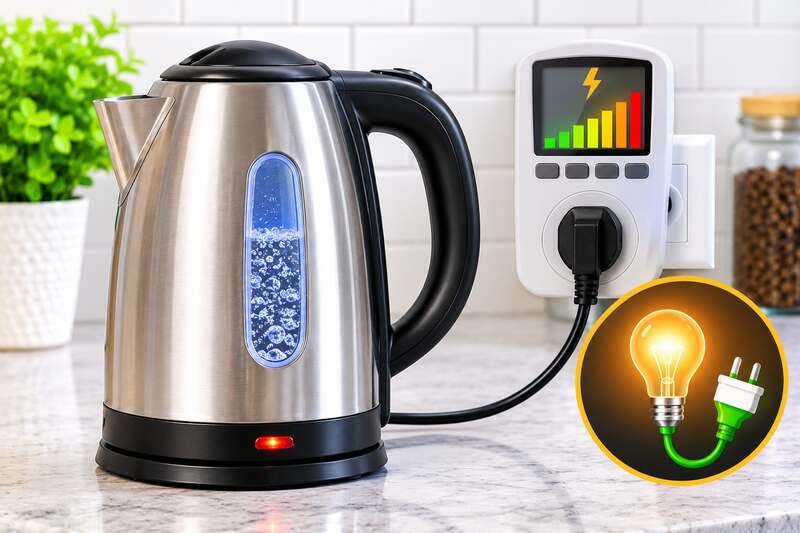
How many watts does an electric kettle use? Most full-size electric kettles sold in the U.S. use between 1,000 and 1,500 watts, while travel and low-watt models often run at 600 to 1,000 watts. Wattage controls how fast the kettle boils, how much current it draws from your outlet, and whether it can share a circuit with other appliances. In this guide, we break down typical kettle wattages, explain watts versus amps, calculate the real cost per boil using the latest U.S. electricity prices, and help you pick the right wattage for your kitchen, dorm, or RV.
Key Takeaways
- Most U.S. electric kettles use 1,000 to 1,500 watts. Some travel models use as little as 600 watts.
- A 1,500-watt kettle draws about 12.5 amps on a 120-volt outlet, which is most of a standard 15-amp circuit.
- Boiling 1 liter takes about 0.093 kWh in ideal conditions, or roughly 1.7 cents at the U.S. average residential price of 18.16 cents per kWh reported by the EIA for August 2026.
- Higher wattage boils faster, but it uses about the same total energy per liter.
- Above all, choose lower wattage only when your outlet, circuit, or power source requires it.
How Many Watts Does an Electric Kettle Use?
The short answer to how many watts does an electric kettle use is 1,000 to 1,500 watts for most home models. However, the exact number depends on the kettle’s size and purpose. Fortunately, you can usually find it on a label under the base or in the product listing.
| Kettle Type | Typical Wattage | Typical Capacity |
|---|---|---|
| Full-size standard kettle | 1,200–1,500 W | 1.5–1.8 L |
| Temperature-control kettle | 1,100–1,500 W | 1.0–1.7 L |
| Gooseneck kettle | 1,000–1,200 W | 0.8–1.0 L |
| Compact kettle | 800–1,200 W | 0.5–1.0 L |
| Travel or mini kettle | 600–1,000 W | 0.3–0.6 L |
| 12-volt car kettle | About 150–200 W | Small |
Keep in mind that these ranges reflect common models on the U.S. market rather than a formal industry standard. Still, the pattern is clear: bigger kettles generally use more watts, so they can heat more water in a reasonable time.
Why U.S. Kettles Usually Stop at 1,500 Watts
Many people wonder how many watts does an electric kettle use in other countries. If you have used a kettle in the U.K. or Europe, you may have noticed it boiled faster. That is because most homes there run on about 230 volts, so kettles can draw around 3,000 watts. In contrast, U.S. kitchens run on 120 volts.
Typically, a standard U.S. kitchen outlet sits on a 15-amp or 20-amp circuit. Using the formula watts equal volts times amps, a 15-amp circuit supplies up to 1,800 watts. Therefore, most U.S. kettle makers cap their models around 1,500 watts, leaving some headroom on the circuit.
Video: Ask Bloop explains why U.S. kettles boil more slowly than kettles in 230-volt countries.
Watts vs. Amps: What Your Outlet Can Handle
To begin with, watts tell you how much power the kettle uses, while amps tell you how much current it pulls from the circuit. To convert, divide watts by volts. We calculated the current for common kettle sizes on a 120-volt outlet.
| Kettle Wattage | Current at 120 V | Share of a 15 A Circuit | Share of a 20 A Circuit |
|---|---|---|---|
| 600 W | 5 A | 33% | 25% |
| 1,000 W | 8.3 A | 56% | 42% |
| 1,200 W | 10 A | 67% | 50% |
| 1,500 W | 12.5 A | 83% | 63% |
As a result, a 1,500-watt kettle plus a toaster or microwave on the same 15-amp circuit can easily trip the breaker. Our guides on how many watts a toaster uses and how much electricity a microwave uses show how quickly those loads add up.
Does Higher Wattage Boil Faster?
Photo: Martin Cathrae via Flickr (CC BY-SA 2.0).
Yes, because wattage is the rate of energy delivery, so a higher-wattage kettle pushes heat into the water faster. We calculated ideal boiling times from room-temperature water, assuming no heat loss.
| Wattage | 2 Cups (0.5 L) | 4 Cups (1 L) | 7 Cups (1.7 L) |
|---|---|---|---|
| 600 W | 4.7 min | 9.3 min | 15.8 min |
| 1,000 W | 2.8 min | 5.6 min | 9.5 min |
| 1,200 W | 2.3 min | 4.7 min | 7.9 min |
| 1,500 W | 1.9 min | 3.7 min | 6.3 min |
Real kettles take somewhat longer, because some heat escapes into the kettle body and the air. Even so, the table shows why 1,500-watt kettles feel noticeably quicker than 1,000-watt models.
Does Higher Wattage Use More Electricity?
Not really, and this surprises many people who ask how many watts does an electric kettle use. After all, the energy needed to boil water depends on how much water you heat and how hot it gets, not on the kettle’s wattage. In other words, a 1,500-watt kettle simply delivers that energy faster.
For example, boiling 1 liter of room-temperature water takes about 0.093 kWh in ideal conditions. A 1,000-watt kettle and a 1,500-watt kettle both need roughly that amount. The faster kettle may even lose a little less heat, because the water spends less time warming up. Therefore, wattage mainly affects speed and circuit load, not your electric bill.
How Much Does It Cost to Run an Electric Kettle?
Photo: Ed Bierman via Flickr (CC BY 2.0).
To estimate cost, we first used the U.S. average residential electricity price of 18.16 cents per kWh for August 2026, from the U.S. Energy Information Administration’s Electric Power Monthly, Table 5.3. For comparison, the EIA’s 2025 annual average was 17.23 cents per kWh.
| Amount Boiled | Energy (ideal) | Cost per Boil at 18.16¢/kWh |
|---|---|---|
| 2 cups (0.5 L) | 0.047 kWh | About 0.85¢ |
| 4 cups (1 L) | 0.093 kWh | About 1.7¢ |
| 7 cups (1.7 L) | 0.158 kWh | About 2.9¢ |
Real-world costs run somewhat higher because of heat loss. Still, the numbers are small overall. For instance, boiling 1 liter twice a day uses about 68 kWh per year in ideal conditions, which comes to roughly $12 per year at the August 2026 average price. Your local rate may be higher or lower, so check your utility bill for your exact price per kWh.
What About Keep-Warm Mode?
On the other hand, keep-warm mode adds energy use, because the kettle reheats the water from time to time to hold your chosen temperature. Overall, the total depends on the kettle’s insulation, the temperature, and how long you hold it. Generally, double-wall kettles lose heat more slowly, so they need less reheating. If you only want one cup, it is usually more efficient to boil fresh water when you need it than to hold a full kettle warm for an hour.
Real-Life Boil Times vs. Ideal Times
The ideal times above assume every watt goes into the water. In practice, however, some heat warms the kettle body, the lid, and the surrounding air. As a result, real boil times usually run longer than the math suggests. Also, starting water temperature matters, since cold winter tap water takes longer to heat than summer tap water. In addition, high altitude lowers the boiling point, so kettles in mountain towns may click off a little sooner. Therefore, treat the ideal table as a fair comparison between wattages rather than a stopwatch promise.
Kettle Wattage by Household Size
Your household size also shapes the best answer to how many watts does an electric kettle use in your home. For example, a single person who heats one mug at a time can be happy with a 1,000-watt compact kettle, because small amounts boil quickly anyway. Meanwhile, a family that fills a 1.7-liter kettle several times a day will notice the speed of a 1,500-watt model. Similarly, households that brew pour-over coffee often choose a 1,000 to 1,200-watt gooseneck, since precise pouring matters more than raw speed. In short, match the wattage to how much water you heat and how often.
Low-Watt Electric Kettles: When You Need One
A low-watt kettle makes sense when your power supply is limited, so knowing how many watts does an electric kettle use matters here. Common situations include:
- Dorm rooms: First, some dorms limit appliance wattage, so check your housing rules.
- Offices: Also, shared office circuits may already carry computers and printers.
- RVs and campers: In addition, smaller generators and inverters may not handle 1,500 watts.
- Older homes: Meanwhile, older wiring may be more prone to tripping.
- Solar or battery power: Finally, lower wattage reduces the peak load on a battery system.
However, the trade-off is speed. A 600-watt kettle takes more than twice as long as a 1,500-watt model to boil the same amount. If you are shopping for low-power appliances, our guide to the low-wattage coffee maker covers similar options.
Sizing a Generator, Inverter, or Power Station
If you plan to run a kettle off-grid, how many watts does an electric kettle use becomes the most important number on the box. Your power source must handle the kettle’s full wattage for several minutes, not just a quick burst.
- Generators: First, choose one whose running watts, not just starting watts, exceed the kettle’s rating with some headroom.
- Inverters: Next, pick a pure sine wave inverter rated above the kettle’s wattage, since heating elements draw steady, high power.
- Portable power stations: In addition, check both the continuous output rating and the battery capacity in watt-hours.
- Battery math: For example, boiling 1 liter uses about 93 watt-hours in ideal conditions, so a 500 Wh station could, in theory, handle only a few boils after conversion losses.
Therefore, for RVs and camping, a lower-wattage kettle or a stovetop kettle is often more practical than a 1,500-watt model.
Common Myths About Kettle Wattage
- Myth: Higher watts waste electricity. In fact, energy per liter stays about the same; only speed changes.
- Myth: Low-watt kettles are always cheaper to run. However, they take longer, and slower heating can lose slightly more heat.
- Myth: Any outlet can run any kettle. Instead, a shared 15-amp circuit can trip with a kettle plus another appliance.
- Myth: Wattage tells you the boil time exactly. Similarly, starting water temperature, altitude, and fill level all change the result.
Tips to Get the Most From Your Kettle’s Wattage
- First, boil only the water you need, since every extra cup adds time and energy.
- Then keep the lid closed while heating to reduce heat loss.
- Next, descale regularly, because scale can slow heat transfer.
- After that, plug the kettle into its own outlet when possible.
- Finally, skip long keep-warm holds if you only need one cup.
How to Find Your Kettle’s Wattage
- Check the base label. First, flip the kettle or base and look for a rating such as “120V 60Hz 1500W.”
- Read the manual. Then look in the specifications section.
- Check the product listing. Next, search the model number online.
- Measure it. Finally, a plug-in watt meter shows the actual power draw while it heats.
Also, if a label lists amps instead of watts, multiply the amps by 120 to estimate watts.
Electric Kettle Wattage vs. Other Appliances
Next, it helps to see how a kettle compares with other common kitchen appliances. As a guide, the ranges below reflect typical U.S. models.
| Appliance | Typical Wattage | Typical Run Time |
|---|---|---|
| Electric kettle | 1,000–1,500 W | 2–7 minutes |
| Drip coffee maker | 600–1,200 W | 5–10 minutes brewing |
| Microwave | 600–1,200 W cooking power | 1–5 minutes |
| Toaster | 800–1,500 W | 2–4 minutes |
For a detailed look at coffee makers, see our guide on how many watts a coffee maker uses.
Choosing the Right Wattage
- Most kitchens: In general, choose 1,500 watts for the fastest boil on a dedicated circuit.
- Shared or older circuits: Instead, consider 1,000 to 1,200 watts.
- Dorms and offices: Meanwhile, pick a compact 800 to 1,000-watt kettle that follows local rules.
- RVs and camping: Finally, match the kettle to your generator, inverter, or battery capacity.
If you are shopping now, our guide to the best electric kettle lists the wattage for each pick.
FAQ
How many watts does an electric kettle use on average?
On average, most full-size U.S. electric kettles use about 1,000 to 1,500 watts, with 1,500 watts being the most common for fast models.
Is a 1,500-watt kettle too much for one outlet?
No, since a standard 15-amp kitchen outlet can handle it. However, avoid running other high-wattage appliances on the same circuit at the same time.
Does a 1,000-watt kettle save electricity?
Not much, because it uses about the same energy to boil the same amount of water, but it takes longer.
How much does it cost to boil a kettle in the U.S.?
Boiling 1 liter costs roughly 1.7 cents in ideal conditions at the August 2026 U.S. average price of 18.16 cents per kWh. Your local price may differ.
Can I use a 3,000-watt kettle from Europe in the U.S.?
Generally, no, because kettles built for 230 volts are not designed for U.S. 120-volt outlets and may not work properly or safely.
Why does my kettle say 1,500 watts but heat slowly?
Usually, the cause is heavy scale, very cold water, or a large fill. In addition, a weak or overloaded circuit can lower performance, so try a different outlet and descale the kettle.
Do temperature-control kettles use more watts?
Not necessarily, because most use similar heating elements. However, keep-warm modes add energy over time, so the total use per day can be higher if you hold water hot for long periods.
Is it cheaper to boil water in a kettle or on the stove?
In most homes, the kettle wins, because its element heats the water directly with little wasted heat. In contrast, a gas burner loses much of its heat around the sides of the pot, so it typically uses more energy for the same cup.
Final Thoughts
So, how many watts does an electric kettle use? For most U.S. homes, the answer is 1,000 to 1,500 watts, with 1,500 watts offering the fastest boil a standard outlet can comfortably support. In short, wattage mainly changes speed and circuit load, while the energy per liter stays about the same. At current U.S. prices, each boil costs only a few cents. Therefore, pick the highest wattage your circuit can handle, boil only what you need, and enjoy faster tea and coffee.

Hey, My name is MAMON. I am a SEO content creator and affiliate marketer with over 8 years of experience. I create honest product reviews, in-depth buying guides, and practical how-to articles to help readers make informed decisions. My mission is to provide trustworthy, research-backed content that delivers real value.
Leave a Reply