
Getting a new sink home only to find it doesn’t fit the cutout, or the cabinet underneath, is one of the most avoidable mistakes in a kitchen project. Knowing how to measure a kitchen sink correctly comes down to three numbers: length, width, and depth. Take them from the right reference points and the rest of the project gets much easier. Whether you’re replacing an old sink, installing new countertops, or shopping for a sink before either project starts, the same core measurements apply.
This guide walks through measuring an existing sink, measuring a countertop cutout, and measuring for a brand-new installation. It also covers standard sizes and cabinet spacing rules, which make shopping for a replacement much less of a guessing game.
Key Takeaways
- Most single-bowl kitchen sinks measure 30-33 inches wide by 22 inches front-to-back, with a basin depth of 8-10 inches.
- Measure length and width from just above where the basin curves, not from the very top edge of the sink.
- A replacement sink should generally sit 2-4 inches narrower than your base cabinet’s interior width, per Home Depot’s official measuring guide.
- Undermount sinks need a different set of measurements than top-mount or drop-in sinks. The mounting method changes what “fits” actually means.
Tools You’ll Need
- A tape measure (a flexible fabric or metal one both work)
- Straightedge or ruler, for measuring basin depth accurately
- Pencil and paper to record each measurement as you go
- An extra pair of hands, especially if you’re measuring a removed sink or a countertop cutout alone
How to Measure a Kitchen Sink: Step-by-Step
Maybe you’re confirming your current sink works with a new countertop. Maybe you’re shopping for a like-for-like replacement. Either way, these three measurements are what you need.
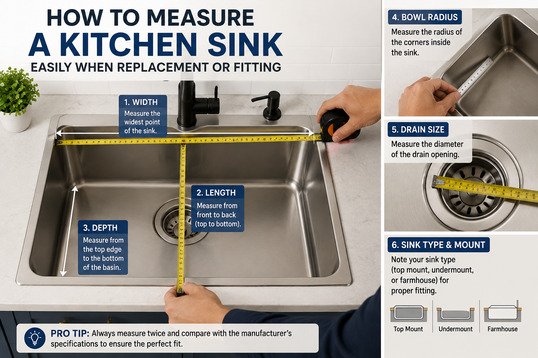
Step 1: Measure the Depth
Lay the straightedge across the top of the sink, spanning the rim from one side to the other. Hold the tape measure vertically from the straightedge down to the bottom of the basin. Record that distance as the depth. This matters more than people expect. Newer sinks often have deeper basins that can sit lower than older plumbing was designed to drain efficiently.
Step 2: Measure the Length
Starting from the bottom-left edge of the sink, run the tape measure across to the bottom-right edge. Take the measurement from a point just above where the basin begins to curve, not from the very top lip. Use the same reference point on both sides so the number reflects the actual usable basin length.
Step 3: Measure the Width
Width runs front to back rather than side to side. Place the tape measure at the back bottom edge of the sink, just above the curve. Measure straight across to the front bottom edge. As with length, staying just above the curve on both ends keeps the measurement accurate.
Step 4: Measure the Lip (Top-Mount and Drop-In Sinks Only)
Top-mount and drop-in sinks have a lip that rests on top of the counter. This measurement matters if you own one. Flip the sink over and place a ruler against the basin, measuring out to the edge of the lip. Record this separately from the basin measurements, since it factors into how much of the cutout the lip will cover.
Step 5: Measure the Cabinet Opening
Don’t skip the cabinet itself. Crawl underneath and measure from the left top corner of the cabinet opening to the right top corner. Your new sink’s overall width needs to stay within this number, or it won’t sit inside the cabinet correctly. That’s true no matter how well it matches the countertop cutout.
How to Measure the Countertop Cutout for a Replacement Sink
Once the old sink is out, you’re measuring an empty hole rather than a physical object, which is actually simpler in some ways. Removing a sink is a two-person job in most cases, since sinks are heavy and awkward. You also don’t want to chip or crack the countertop while working it loose, so have one person work from underneath while the other guides it from above.
With the sink out, measure the length of the opening from the right edge to the left. Then measure the width from front to back. Bring both numbers with you when shopping. Sink packaging lists exact dimensions, so you can compare before buying rather than guessing at the store. A store associate can also help match a sink to your cutout measurements if you’re unsure.
- Top-mount sinks: the basin on your new sink can be slightly smaller than the cutout, since the lip covers the gap.
- Undermount sinks: these attach directly beneath the countertop, so the basin needs to match the cutout closely. There’s no lip to hide a mismatch.
How to Measure for a New Countertop Installation
If you’re installing new countertops around an existing or new sink, the process runs in reverse. Many new sinks come with a paper or cardboard template made for tracing the cutout onto the counter before it’s cut. Use it if you have one. It removes most of the guesswork.
Without a template, you can make your own. Place the sink upside-down on the counter where it will sit. Leave roughly 1.5 inches of space between the back of the sink and the backsplash. Trace the outline with a pencil or marker, then carefully move the sink out of the way once the outline is complete.
For a top-mount sink, add one more step. Measure to the edge of the lip while the sink is still upside-down on the counter, then subtract about 1/8 inch from that lip width. Mark that smaller measurement inside your traced outline. That slightly narrower line becomes the actual cut line, so the lip has a small ledge to rest on instead of falling straight through the hole.
Standard Kitchen Sink Sizes and Cabinet Guidelines
Knowing typical sizes helps you sanity-check your own measurements and narrow down options before you shop. These are general ranges, not exact specs for every brand:
| Sink Type | Typical Width | Front-to-Back | Depth |
|---|---|---|---|
| Single-bowl (standard) | 30-33 in | 22 in | 8-10 in |
| Double-bowl (standard) | 33 in | 22 in | 8-10 in |
| Double-bowl (large) | 36 in | 22 in | 9-10 in |
| Bar or prep sink | 15-18 in | N/A | 5.5-8 in |
For cabinet fit, a common rule of thumb is that your base cabinet’s interior width should run 2-4 inches wider than the sink itself. A 30-inch sink generally calls for a 33-inch cabinet, and a 33-inch sink calls for a 36-inch cabinet. Home Depot’s official sink measuring guide recommends measuring your cabinet’s full width and depth first, then subtracting a few inches on each side to land on your maximum sink dimensions. That beats assuming a size and hoping it fits.
Common Measuring Mistakes to Avoid
Most people who get this wrong aren’t bad at math, they’re just skipping a step somewhere in the process of learning how to measure a kitchen sink correctly. These are the mistakes that come up most often:
- Measuring from the very top edge instead of just above the curve. This adds extra length and width that isn’t actually part of the usable basin, throwing off your numbers.
- Skipping the cabinet measurement entirely. A sink can match the countertop cutout perfectly and still be too wide for the cabinet underneath.
- Forgetting the lip measurement on top-mount sinks. Without it, your template or cutout can end up too large.
- Only measuring once. Small errors compound fast. A quarter-inch can be the difference between a clean fit and a sink that rocks in place.
- Assuming all sink types measure the same way. Undermount, top-mount, and farmhouse sinks all have slightly different measuring priorities, covered below.
Undermount vs. Top-Mount vs. Farmhouse: Why the Sink Type Changes the Measurements
Not every sink measures the same way. Mixing up the method for your sink type is one of the most common replacement mistakes. Top-mount and drop-in sinks rest their lip on top of the counter, so the visible cutout can be a bit larger than the basin without any gap showing. Undermount sinks attach beneath the counter with no lip at all. That means the cutout has to closely match the basin’s actual dimensions, since there’s nothing to hide a mismatched edge.
Farmhouse, or apron-front, sinks add another variable: the front face of the sink extends past the cabinet face rather than sitting behind it. That means measuring the cabinet opening isn’t enough on its own. You also need the sink’s total height and apron depth. Those confirm the cabinet has been built or modified to accommodate an exposed front panel. If you’re planning a farmhouse installation, check your cabinet manufacturer’s spec sheet before cutting anything. Retrofitting a standard cabinet for an apron-front sink usually means removing the front face frame entirely.
Watch: How to Measure for an Undermount or Farmhouse Sink
This walkthrough from Kohler covers undermount and farmhouse measuring specifically. Those two styles trip up more first-time installers than standard top-mount sinks do. Once you’ve settled on a size, our kitchen sink buyer’s guide can help you compare materials and features within that range.
Frequently Asked Questions
How to measure a kitchen sink without removing it
Measure length and width from just above the curve on each side, using a tape measure across the top of the basin. Measure depth by laying a straightedge across the rim and dropping a tape measure down to the bottom. None of this requires removing the sink first.
What is the standard size of a kitchen sink?
Most single-bowl sinks measure 30-33 inches wide by 22 inches front-to-back, with a basin depth of 8-10 inches. Double-bowl sinks typically run 33-36 inches wide at the same depth range.
How much smaller should a sink be than the cabinet?
A common guideline is 2-4 inches narrower than the cabinet’s interior width. A 30-inch sink generally fits a 33-inch cabinet, and a 33-inch sink fits a 36-inch cabinet.
Do undermount sinks need to be measured differently than top-mount sinks?
Yes. Undermount sinks need a cutout that closely matches the basin, since there’s no lip to cover any gap. Top-mount and drop-in sinks have some room for a slightly larger cutout. The lip rests on top and hides the edge.
What tools do I need to measure a kitchen sink?
A tape measure and a straightedge or ruler cover most of it. Pencil and paper to record each number as you go, plus an extra pair of hands for removed sinks or countertop cutouts, make the process considerably easier.
How do I know if a new sink will fit my existing countertop cutout?
Measure the existing cutout’s length and width, then compare those numbers to the packaging specs on the new sink. For undermount sinks, the basin should closely match the cutout. For top-mount sinks, the basin can run slightly smaller than the cutout since the lip covers the difference.
Conclusion
Whatever the project, whether you’re cutting a hole for a new sink, replacing an old one, or planning new countertops, knowing how to measure a kitchen sink accurately keeps the process from turning into a return trip to the store. Depth, length, width, the cabinet opening, and the lip on top-mount styles cover nearly every situation you’ll run into. Take each measurement twice and note your sink type before you start. Do both, and you’ll have a new sink that fits the first time.

Hey, My name is MAMON. I am a SEO content creator and affiliate marketer with over 8 years of experience. I create honest product reviews, in-depth buying guides, and practical how-to articles to help readers make informed decisions. My mission is to provide trustworthy, research-backed content that delivers real value.
Leave a Reply