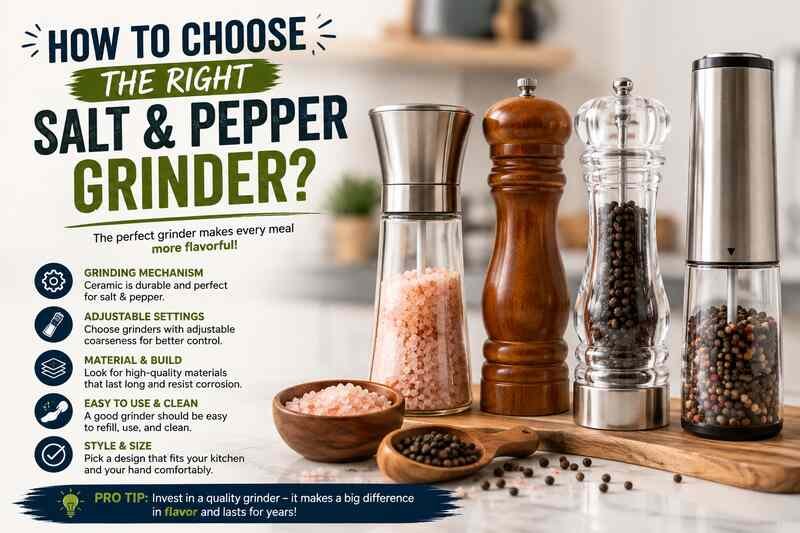
Here’s how to choose the right salt and pepper grinder: decide between manual and electric, then pick a material that matches how much care you’re willing to give it. Prioritize a wide fill opening with clearly marked, adjustable grind settings over brand name or looks. Get those things right, and almost any grinder in your price range will serve you well for years.
This guide covers the types, materials, and features that actually matter. It also covers the buying mistakes that send grinders to the back of a cabinet.
Key Takeaways
- Manual grinders offer better control and grind quality. Electric grinders are faster and easier for one-handed use, but need batteries and more upkeep.
- Stainless and carbon steel mechanisms are the most durable. Ceramic works well for both salt and pepper. Wood looks great but needs the most care.
- America’s Test Kitchen’s equipment testing found the best pepper mills share three traits: a wide fill opening around 2 inches, clearly marked grind settings, and a mechanism that turns smoothly.
- Cheap plastic mechanisms are the most common reason a grinder ends up unused within a year, no matter how good the brand name looks on the box.
- A good grinder should match your cooking habits first and your kitchen’s decor second, not the other way around.
Manual vs. Electric: Which Type Fits Your Kitchen
Every salt and pepper grinder on the market is either manual or electric. That choice shapes almost everything about how you’ll use it day to day.
Manual grinders give you direct control over grind size. You can feel the resistance change as peppercorns crush, and most cooks find they produce a more consistent grind than electric models. They also never need batteries. The tradeoff is effort: grinding enough pepper for a big batch of food takes more twisting than pressing a button.
Electric grinders trade some control for speed and convenience. A single press seasons a dish in seconds, which matters if you’re cooking one-handed or seasoning a large pot. Battery life, motor noise, and extra moving parts are the tradeoffs. If you’re leaning electric, our full guide to electric salt and pepper grinders covers specific models and what to look for in a motor and battery setup.
Neither type is objectively better. A home cook who seasons a few dishes a day usually prefers the feel and control of a manual mill. Someone cooking for a crowd, or seasoning one-handed while the other hand holds a pan, often prefers electric.
Choosing the Right Material
The material a grinder is built from affects how it performs and how long it lasts.
Stainless steel and carbon steel mechanisms cut through peppercorns cleanly and hold up to years of daily use. They’re the standard choice for a reason: they resist wear better than plastic or ceramic and rarely need replacing.
Ceramic mechanisms work well for both salt and pepper. That matters because table salt corrodes plain steel over time. If you want one grinder that handles both jobs reliably, look for a ceramic mechanism specifically rated for salt. Not sure which salt to use? Our guide to what kind of salt goes in a salt grinder covers the specifics.
Wood bodies add warmth and a classic look to a kitchen counter. They also need the most care of the three materials: no dishwasher, no soaking, and regular drying to prevent warping. If low maintenance matters more to you than looks, steel or ceramic housings are the easier choice.
What to Look For: The Features That Actually Matter
Once you’ve picked a type and a material, a handful of practical features separate a grinder you’ll actually use from one that ends up in a drawer.
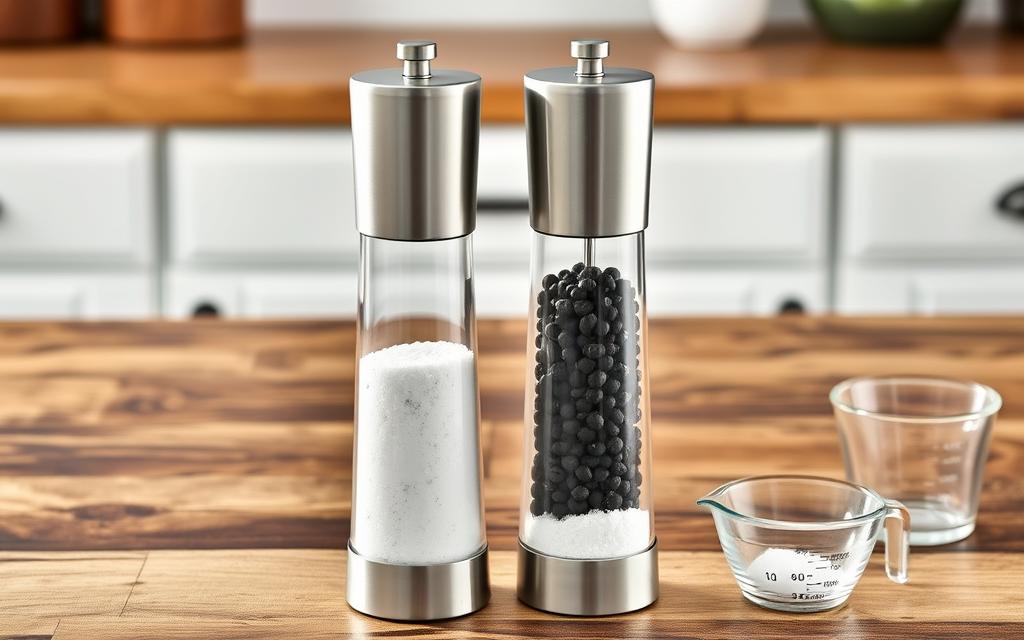
A wide fill opening matters more than most buyers expect. America’s Test Kitchen’s pepper mill testing found that mills with openings around two inches, plus a top-loading design, were far easier to refill than narrow, side-loading models that need a funnel. A hassle to refill means you’ll refill less often, and a half-empty grinder makes weak, inconsistent seasoning.
Clearly marked grind settings beat unmarked adjustment knobs. The same testing found that mills with a visible dial outperformed mills where you have to guess and check. Look for a labeled dial or numbered ring rather than a plain knob with no markings.
A smooth-turning mechanism is worth checking in person if you can. A stiff, hard-to-turn grinder gets used less. Grind quality often gets worse too, as steel mechanisms wear unevenly under excess force.
Capacity should match how often you cook. A single person seasoning food a few times a week doesn’t need the same capacity as a family that cooks daily. Oversized grinders sitting mostly empty waste counter space, and undersized ones mean refilling constantly.
Weight and grip matter more than they seem to on a spec sheet. A grinder that’s too heavy gets left on the counter instead of brought to the table. One that’s awkward to hold makes one-handed seasoning over a pan frustrating. Hold a floor model before buying if you can, especially if you’ll use it standing at the stove.
This video from America’s Test Kitchen covers what their testers look for in a pepper mill, including grind consistency and ease of use:
Why Freshly Ground Beats Pre-Ground
Pre-ground pepper loses its aromatic oils within weeks of grinding. That’s why it tastes flat compared to pepper you grind yourself right before cooking.
Grinding releases those oils and aromatic compounds the moment you use them. The flavor hits your food at its peak, instead of after months sitting in a shaker. This is true of salt too, though the effect is subtler since salt doesn’t carry the same volatile oils.
Adjustable grind settings add real versatility here. Fine pepper disappears into a sauce or dressing. Coarse pepper adds texture and a stronger hit of flavor to a steak crust or a finished salad. A grinder that handles both settings well earns its space on your counter far more than one stuck at a single grind size.
Matching Your Grinder to Your Kitchen
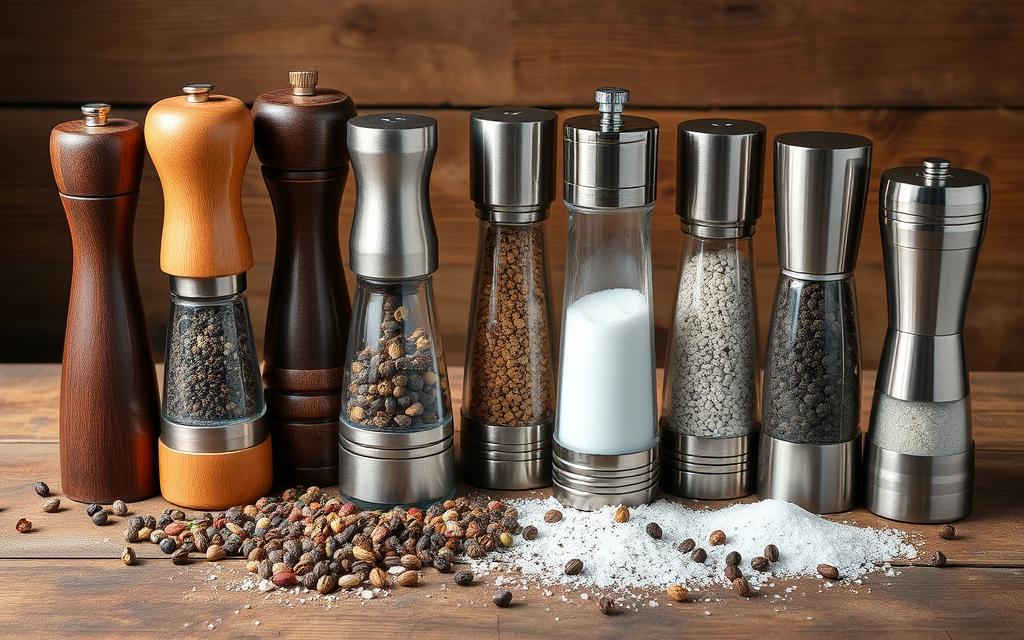
Function should come first here, but style still matters if the grinder sits out on your counter every day.
Stainless steel and matte black finishes suit modern kitchens and hide fingerprints better than polished chrome. Wood bodies, especially beech or acacia, fit farmhouse and traditional kitchens well and add warmth next to stone counters. Clear acrylic bodies work well in contemporary spaces too, since they let you see how full the grinder is at a glance.
If your kitchen already has a dominant metal finish, try to match your grinder to it, like brushed nickel to brushed nickel hardware. It makes the kitchen read as more intentional. But don’t let style override function. A beautiful grinder with a narrow fill opening and an unmarked dial will frustrate you daily, no matter how well it matches your cabinets.
Buying Mistakes to Avoid
Choosing on price alone. A cheap grinder with plastic gears is the single most common reason people replace a grinder within a year. Plastic mechanisms wear down fast and produce inconsistent grind sizes almost from day one.
Trusting brand name over build quality. A well-known brand doesn’t guarantee a better mechanism. Compare the actual material and construction of the mechanism itself before you buy, not just the logo on the box.
Ignoring capacity until it’s a problem. A grinder that’s constantly running low means constant refilling, and that eventually leads to it sitting unused. Match capacity to how often you actually cook, not to how impressive a large mill looks in the store.
Buying a single-purpose grinder when you need two functions. If you plan to grind both salt and pepper, make sure the mechanism is rated for both. Plain steel mechanisms can corrode from prolonged contact with salt.
Skipping a hands-on test when you can get one. Grind resistance, weight, and feel are hard to judge from a product photo. Testing a floor model at a specialty kitchen shop tells you more than any spec sheet.
Where to Buy Salt and Pepper Grinders
Online retailers offer the widest selection and the easiest price comparison, along with reviews you can filter by verified purchases. The tradeoff is you can’t test the mechanism in your hand first.
Specialty kitchen shops let you test a grinder’s weight, grind resistance, and turning smoothness before you commit. Staff can usually tell you which mechanisms hold up best over time, though selection is typically smaller than online.
Whichever route you choose, check the return policy and warranty before buying, especially above the budget tier. Our roundup of specific salt and pepper grinder models is a good next stop if you want exact picks rather than general buying criteria.
Maintaining Your Grinder Once You’ve Chosen One
The right grinder still needs basic care to perform well for years. Rinse ceramic mechanisms occasionally, and keep wood bodies away from water entirely. Our full guide on how to clean a pepper grinder covers the steps by material type in more detail than we can here.
Steel mechanisms exposed to salt corrode over time if you don’t dry them thoroughly after cleaning. Already seeing spotting? Our guide to preventing rust in salt and pepper grinders covers what to do before it gets worse.
Refilling technique matters more than people expect too. Overfilling, or forcing peppercorns into a narrow opening, can jam a mechanism that was working fine. Our guide on how to refill a salt and pepper grinder covers the technique that avoids this.
Has a grinder you already own come apart, or won’t it reassemble correctly? Our step-by-step guide on putting a pepper grinder back together covers the most common models. That includes OXO.
Frequently Asked Questions
Is a manual or electric salt and pepper grinder better?
Neither is better across the board. Manual grinders give more control and consistency and never need batteries. Electric grinders are faster and easier for one-handed use. Choose based on how you actually cook, not on which seems more modern.
What’s the best material for a salt and pepper grinder?
Stainless or carbon steel mechanisms are the most durable choice for pepper. For a grinder that handles salt too, look for a ceramic mechanism, since salt corrodes plain steel over time.
How big of a grinder do I actually need?
Match capacity to your cooking frequency rather than buying the largest one available. A single person or couple cooking a few times a week rarely needs a large-capacity mill. A household cooking daily benefits from one that doesn’t need refilling every few days.
Do expensive salt and pepper grinders actually grind better?
Not automatically. Price often reflects materials and brand reputation more than grind performance. A mid-range grinder with a quality mechanism and a wide fill opening frequently outperforms an expensive model with a narrow opening or unmarked settings.
Can I use the same grinder for both salt and pepper?
Only if the mechanism is specifically rated for salt, usually ceramic. Plain steel mechanisms corrode when exposed to salt regularly, so check the manufacturer’s specs before using one grinder for both.
Should I buy a salt and pepper grinder set or two separate grinders?
Either works. A matched set looks more cohesive on the counter. Two separate grinders let you pick the ideal mechanism, material, and capacity for each job rather than compromising on one set for both.
How long should a good salt and pepper grinder last?
A quality steel or ceramic mechanism, kept dry and cleaned occasionally, can last a decade or longer. Cheap plastic mechanisms often wear out or crack within a year or two, which is the main reason it’s worth spending a bit more up front.
What grind size should I use for most cooking?
A medium grind works for most everyday cooking, since it dissolves quickly enough to season evenly without disappearing entirely. Save the fine setting for dressings and sauces. Switch to coarse for finishing a steak or salad where you want a visible, crunchy bite of pepper.

Hey, My name is MAMON. I am a SEO content creator and affiliate marketer with over 8 years of experience. I create honest product reviews, in-depth buying guides, and practical how-to articles to help readers make informed decisions. My mission is to provide trustworthy, research-backed content that delivers real value.
Leave a Reply