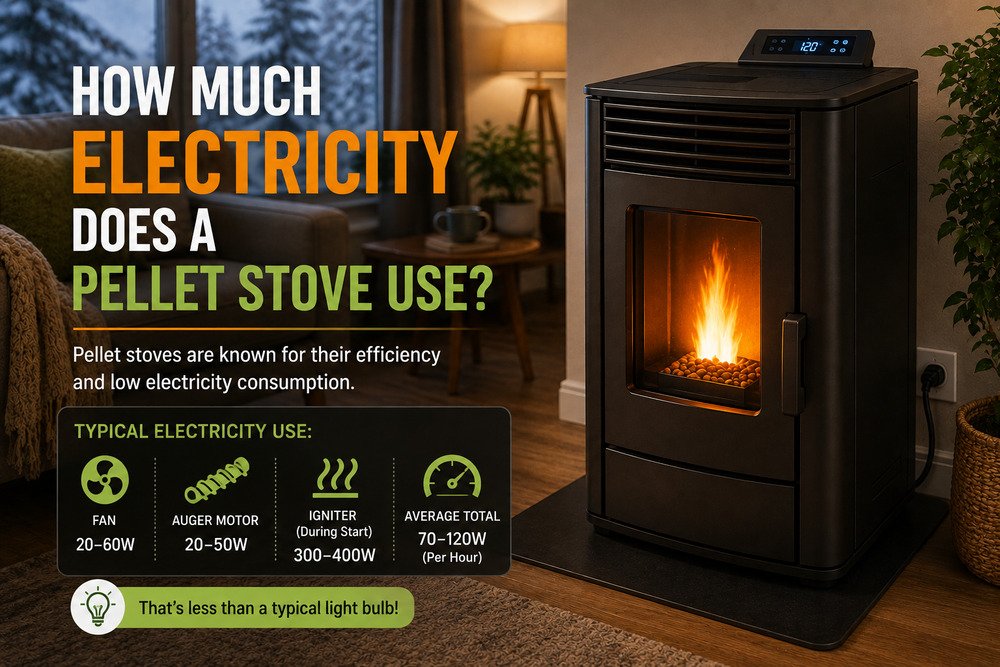
If you’re considering a pellet stove for your home, you’re probably wondering: how much electricity does a pellet stove use? It’s a fair question. These stoves plug into a standard wall outlet, even though they burn wood pellets, not electricity, to actually produce heat.
The short answer is not much. Below, we’ll break down the actual wattage and what it costs to run one over a month. We’ll also cover the factors that push that number up or down, and what happens if the power goes out while it’s running.
Key Takeaways
- Most pellet stoves draw 125-200 watts during normal operation and 300-425 watts during startup ignition.
- Running one 8 hours a day typically costs $6-$7 a month at current U.S. electricity rates.
- Pellet stoves cannot run without electricity. The auger, igniter, and blower all depend on it.
- During a power outage, the fire goes out within minutes once the fans and auger stop, not hours.
How Much Electricity Does a Pellet Stove Use?
The amount of electricity your pellet stove uses varies by model. Pellet stoves are still efficient compared to most other electric heating appliances, though. Most units draw between 125 and 200 watts during normal operation. Startup and ignition briefly pull 300 to 425 watts before settling down. On a standard 120-volt household circuit, that works out to roughly 2.5 to 3 amps while running.
At the current U.S. average residential electricity rate of about 18 cents per kilowatt-hour, running a pellet stove at 150 watts for 8 hours a day uses about 1.2 kWh daily. That comes out to roughly 36 kWh a month, or around $6.50. Run it closer to 24/7 during the coldest stretch of winter, and monthly electricity costs land closer to $19-$20. Either way, that’s a fraction of what pellets themselves cost to keep the stove fed.
Factors That Affect How Much Electricity Your Pellet Stove Uses
The Size of the Stove
Larger pellet stoves generally draw more power than smaller ones. That’s mainly because they run a bigger auger motor and blower fan to move more heat through a larger space.
Heat Output
Every pellet stove has a heat output rating measured in BTUs. Higher BTU output usually means a larger blower fan working harder. That pulls more electricity, though the difference is still modest compared to most other heating appliances.
Model and Technology
Not all pellet stove models are equally efficient. Some use smarter ignition systems and variable-speed blowers that only draw power as needed, rather than running at a fixed speed continuously. If energy use matters to you, compare the wattage specs across models in our best pellet stove reviews before buying.
Pellet Stove Electricity Use vs. Other Heating Appliances
| Appliance | Typical Wattage | Approx. Monthly Cost (8 hrs/day) |
|---|---|---|
| Pellet stove | 125-200W running | $6-$7 |
| Electric fireplace | 1,500W on heat setting | $65-$70 |
| Electric space heater | 1,500W | $65-$70 |
| Electric baseboard heater | 1,000-2,000W | $43-$87 |
A pellet stove’s electricity draw is a fraction of what a true electric-resistance heater like a space heater or electric fireplace uses. That’s because a pellet stove burns fuel for heat and only uses electricity to run the feed system and fan. If you’re weighing that trade-off, our guide on how to use an electric fireplace safely breaks down what that alternative actually costs to run.
Are Pellet Stoves Energy Efficient?
Yes. According to the EPA’s guidance on pellet stoves, EPA-certified models typically fall in the 70% to 83% efficiency range. That’s among the highest of any solid-fuel heating appliance. That efficiency figure describes how much of the fuel’s heat actually warms your home rather than escaping unused. It’s separate from the small amount of electricity the stove itself consumes to run the auger and blower. For a deeper look at how pellet stoves compare to other heating options, see the pros and cons of a pellet stove.
Can a Pellet Stove Work Without Electricity?
No. A pellet stove depends on electricity for every function that keeps it running. That includes feeding pellets from the hopper, igniting the fire, and circulating warm air. Without power, none of those steps can happen.
If you live somewhere prone to outages, a battery backup or portable power station is worth having on hand. Look for one rated for at least 500 watts, since that’s enough to cover the startup surge and keep the stove running through a shorter outage.
What Happens to My Pellet Stove During a Power Outage?
When the power cuts out, the auger stops feeding pellets and the fans stop circulating air. The fire goes out within minutes rather than continuing to burn for hours. That’s different from what many people assume, since a wood stove would keep burning logs already sitting in the firebox. A pellet stove’s automated feed system simply can’t function without electricity, so there’s no meaningful residual burn time once the power drops.
If backup heat matters to you, look into a dedicated pellet stove battery backup system. Size it to your stove’s amp draw, which you can typically find in the owner’s manual. A properly sized battery bank can keep a stove running for 8 to 24 hours during an outage, depending on its capacity.
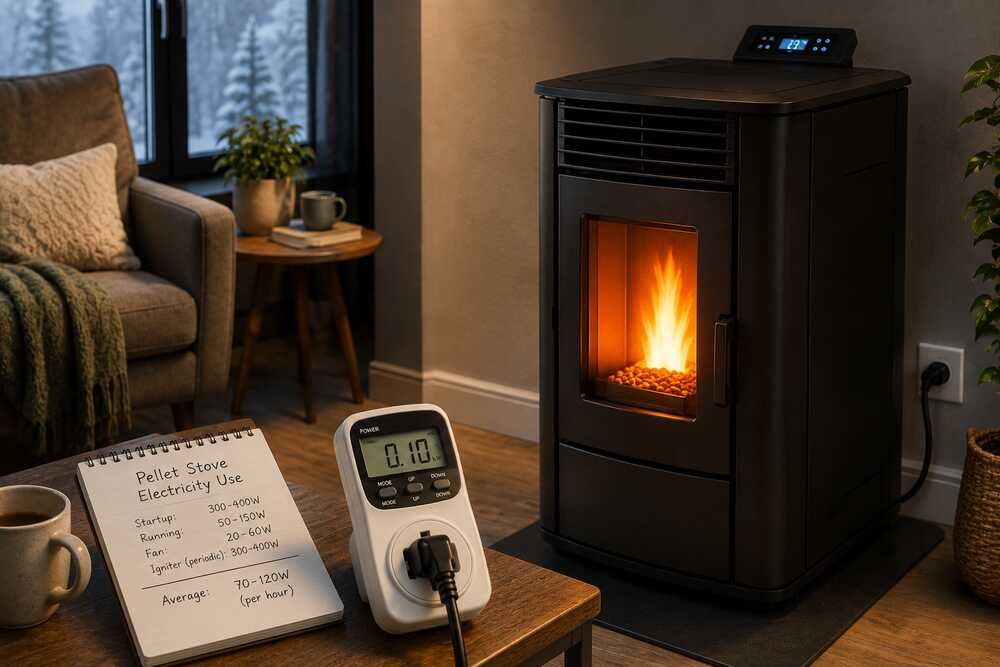
Once power is lost, a pellet stove’s fire dies out within minutes without a battery backup.
How to Reduce a Pellet Stove’s Electricity Use
A few habits can trim the electricity a pellet stove draws without affecting how well it heats your home.
Run the blower on a lower fan speed when the room is already comfortable. A lower speed setting pulls noticeably less power than the highest setting. Keep the auger and burn pot clean, too. A stove working harder to feed pellets through buildup draws more power than one that’s properly maintained. Our guide on how to clean your pellet stove safely and effectively covers that process. Avoid running the stove continuously in a room that’s already warm enough, as well. A thermostat-controlled model will cycle less often once it reaches the set temperature.
Signs Your Pellet Stove Is Drawing More Power Than It Should
A pellet stove pulling noticeably more power than its rated wattage is usually a maintenance problem rather than a normal variation. A dirty burn pot or clogged auger forces the motor to work harder, which draws more current over time. Dust or debris buildup on the blower fan has a similar effect, since the fan has to spin faster to move the same amount of air.
Watch for an electric bill that climbs more than expected during heating season. A stove that feels louder or hotter than usual at the same settings is another sign. So is a blower that seems to run constantly at full speed even when the room has already reached a comfortable temperature. Check the basics first before assuming the unit itself is failing. For a full walkthrough of what to check and when to call a professional, see how long pellet stoves last.
Are Pellet Stoves Cheaper to Run Than Electric Heaters?
Yes, when you factor in total heating cost rather than just electricity. A pellet stove’s own electricity draw is minimal, generally under $10 a month in most households. Where the real savings come from is the fuel itself. On a cost-per-BTU basis, pellets are typically cheaper than running an electric resistance heater to produce the same amount of heat, especially over a full winter season.
How to Calculate Your Own Pellet Stove’s Electricity Cost
The formula is simple once you know your stove’s wattage and your local electricity rate. Multiply the wattage by the hours you run it daily. Divide that number by 1,000 to convert watts to kilowatts, then multiply by your electricity rate per kWh.
For example, a 175-watt stove run 6 hours a day works out to 1.05 kWh daily (175 x 6 ÷ 1,000). At 18 cents per kWh, that’s about 19 cents a day, or roughly $5.70 over a 30-day month. Your stove’s exact wattage is usually printed on a label near the power cord or listed in the owner’s manual. Check there first rather than relying on general averages if you want a precise number for your specific model and local rate.
Watch: How Much Electricity Does a Pellet Stove Really Use?
Video: “How much electricity does a pellet stove use, are they efficient (Harman P68)” by DIY JIM
Frequently Asked Questions About How Much Electricity a Pellet Stove Uses
How much electricity does a pellet stove use per day?
At a typical 125-200 watt running draw, an 8-hour day of use consumes roughly 1-1.6 kWh. That costs somewhere around 18-29 cents at current U.S. electricity rates.
Do pellet stoves need a dedicated electrical circuit?
Most don’t require one, since they run on a standard 110/120-volt household outlet. A dedicated circuit is still a good idea if you’re running the stove for long stretches, to avoid tripping a breaker shared with other appliances.
How many amps does a pellet stove draw?
Most models draw around 2.5 to 3 amps during normal operation, with a brief higher draw during ignition. Check your specific model’s manual for exact figures, since this varies by size and design.
Will a generator run a pellet stove during an outage?
Yes, as long as the generator’s output comfortably exceeds the stove’s startup wattage. Look for at least 500 watts of surge capacity. Most portable generators handle this easily.
Is a pellet stove worth it if my electricity rates are high?
Usually, yes. The stove’s own electricity draw is small enough that even high local electricity rates won’t meaningfully change your total heating cost. Pellets, not electricity, make up the bulk of what you’ll actually spend.
Does a pellet stove use more electricity in extremely cold weather?
Slightly, yes. Colder outdoor temperatures mean the stove’s thermostat calls for heat more often, which keeps the auger and blower running for a larger share of the day. The per-hour wattage itself doesn’t change, but the total hours of runtime, and therefore total electricity used, goes up.
Final Thoughts
So, how much electricity does a pellet stove use? Not much. Typically 125-200 watts running, plus a brief surge during startup, adding up to somewhere between $6 and $20 a month depending on how many hours a day you run it. That modest electricity draw is one more reason pellet stoves remain one of the more cost-effective ways to heat a home.
The pellet stove you buy will still shape your total cost. Size, heat output, and technology all affect efficiency. If lowering your energy costs is the goal, prioritize a model with a strong efficiency rating and size it correctly for the space you’re heating.

Hey, My name is MAMON. I am a SEO content creator and affiliate marketer with over 8 years of experience. I create honest product reviews, in-depth buying guides, and practical how-to articles to help readers make informed decisions. My mission is to provide trustworthy, research-backed content that delivers real value.
Leave a Reply