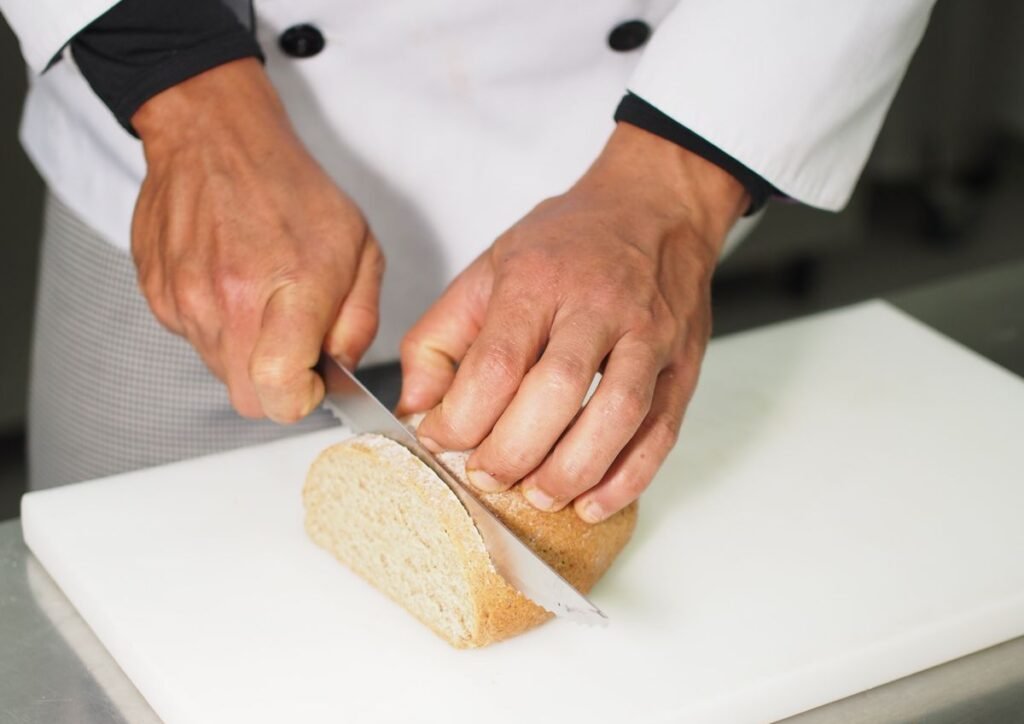
Knives come in a huge range of widths, lengths, and blade styles. Each design exists for a specific job. Paring knives peel and handle small produce. Chef’s knives take on most everyday chopping. But what is a slicer knife used for, specifically?
It’s a term many home cooks search for the tool more properly called a slicing knife. This guide covers what it is and what it does best. It also covers where it falls short and how it compares to the carving knife it’s often confused with.
Key Takeaways
- A slicing knife (sometimes searched as a “slicer knife”) is long, thin, and flexible, built for clean cuts through meat, bread, and produce, not bone
- Granton (scalloped) edges reduce drag and keep food from sticking to the blade, especially on moist or fatty cuts
- A slicing knife is not the same as a carving knife; carving knives are stiffer and suited to bone and joints
- Never use a slicing knife on frozen food or bone, and never as a mincing or prying tool
- Match blade length to what you cut most: 8-9 inches for everyday cuts, 10-12 for turkeys and hams, 12-14 for whole briskets
What Is a Slicer Knife?
A slicing knife has a thin, narrow blade that’s longer than most other kitchen knives, typically 8 to 14 inches. That extra length matters. It lets the blade span a large roast, brisket, or loaf in a single pass instead of sawing back and forth. That single pass is what produces clean, even slices instead of ragged ones. Most slicing knives also have some flex in the blade, more than a rigid carving knife. That flex helps the edge follow the contour of whatever you’re cutting.
Many slicing knives come with a Granton edge: shallow scalloped indentations along the blade. These create small air pockets between the steel and the food. Those pockets reduce suction and drag. That matters most on moist or fatty foods like ham or brisket. Without it, the food would cling to a flat blade and tear instead of releasing cleanly.
What Is a Slicer Knife Used For?
A slicing knife is built for cutting cooked and raw meats, soft bread and bakery items, and soft fruits and vegetables into clean, even widths. Its primary job is carving meat away from the bone at a controlled thickness, from paper-thin to a heartier cut. It’s genuinely versatile within that lane. It’s not an all-purpose knife, though, and using it outside that lane is where problems start.
Jobs to avoid with a slicing knife: the blade is thin and long, so it can’t cut through bone or frozen meat. Forcing it through either can chip the edge or snap the tip. It also puts your hand at real risk if the blade skates off an unexpectedly hard surface. It’s the wrong tool for mincing or prying, too. Other knives exist specifically for those jobs. Reaching for a slicer instead just wears out a blade that isn’t built for that kind of load.
How to Choose the Right Slicing Knife
Blade length is the first real decision. It should match what you actually cut most often, not the biggest number available. Thinking through what is a slicer knife used for in your own kitchen starts with matching length to task.
An 8- to 9-inch blade suits smaller roasts, poultry breasts, and everyday produce work. It won’t feel unwieldy in a home kitchen. A 10- to 12-inch blade is the standard choice for full turkeys, hams, and larger roasts. It’s long enough to clear the food in one pass. Anything in the 12- to 14-inch range is really a specialist’s tool, built for whole briskets and other oversized cuts. Even a 10-inch blade would force two overlapping strokes on a cut that size.
Blade steel matters here just as much as it does for a chef’s knife. A slicing knife needs enough flexibility to follow a roast’s contour. It also needs enough hardness that it won’t lose its edge. Our guide on what material is best for a kitchen knife covers how carbon content and hardness affect edge retention and flex. That applies just as directly to a slicer as it does to any other blade in a knife roll. A comfortable, secure handle matters more than it might seem, too. Long single strokes rely on a steady grip, not a series of short, controlled ones.

Slicing Knife vs. Carving Knife: What’s the Difference
The two get confused constantly, and for good reason: they overlap in length and general purpose. The real difference comes down to rigidity and tip shape. A slicing knife typically has more flex and a rounded or slightly curved tip. It’s built for long boneless cuts, where control over slice thickness matters more than piercing power. A carving knife runs stiffer, with a sharper point. It’s designed to work around joints and bone on a roast or whole bird, where the tip needs to pierce and navigate rather than glide through.
In practice, a slicing knife performs better on boneless cuts requiring long, clean strokes. A carving knife performs better working around bone and joints. According to America’s Test Kitchen’s testing of slicing knives, the pointed tips on carving knives are often “virtually useless” in practice. They sit at the end of a blade too long to control for anything intricate. That’s part of why a dedicated slicer earns its place for big boneless cuts like brisket, pork loin, or a turkey breast off the bone.
More Specific Uses for a Slicer Knife
Beyond the basics, what is a slicer knife used for in a more specialized sense? Slicing knives are also excellent stand-ins for a home meat slicer. They handle most of what a manual or electric slicer would, with more control in exchange for more effort. Our guide on how to slice meat thin at home covers the knife-only technique step by step.
- Creating uniform slices across a batch of food
- Cutting meat into paper-thin, deli-style pieces
- Preparing potato slices for scalloped or casserole dishes
- Portioning pastries, pies, loaves of bread, and other bakery items
- Cutting cured or hard meats like pepperoni and salami into a uniform meat and cheese tray
- Arranging appetizers with a consistent look on a serving tray
- Slicing boiled eggs cleanly without crushing the yolk
Slicing Knives Come in Specific Styles
Not every slicing knife is built the same way. The right style depends on what you’re cutting most often.
Bread knives are long, thin slicers with serrations that bite into a crust instead of crushing it. That’s why a straight-edge slicer tends to tear delicate loaves and pastries that a serrated one handles cleanly. Electric slicers, often used for meats, tend to be thinner and may or may not have serrations. They lean on consistent, razor sharpness rather than serration for effective cutting. For fruits and vegetables, smaller slicers with slight serrations do better than a full-size meat slicer. Thicker blades tend to crush and tear delicate produce rather than cut it cleanly. A lightweight, genuinely sharp blade outperforms a heavier one in nearly every one of these categories.
How to Get the Best Results From a Slicer Knife
Technique matters as much as the knife itself. Use one long, continuous stroke rather than a sawing motion. Sawing is what a serrated bread knife is built for. On a flexible slicing blade, it tends to tear rather than cut. Let the blade’s length do the work: draw it across the full span of the food in a single pass instead of repeated short strokes.
Keep the food steady with your guiding hand held flat, well clear of the blade’s path. Use the claw grip technique the same way you would with any other kitchen knife. Our guide to preventing kitchen cuts covers that grip and other safe knife habits in more depth.
A slicing knife also depends on staying sharp to do any of this well. A dull slicer drags and crushes exactly the kind of soft, moist foods it’s meant to handle cleanly. If you’re building out a full knife set, our guide on what a chef’s knife is used for covers where a slicer fits into that lineup. Our guide on what grit whetstone to use for kitchen knives covers keeping that edge in shape once you have one.
Caring for a Slicer Knife
A slicing knife earns its keep through length and a keen edge. Storage and maintenance matter more than they might for a stubbier utility knife. Store it in a knife block, a blade guard, or an in-drawer tray rather than loose. A blade this long is easy to nick against other tools if it isn’t protected. Hand wash and dry it immediately, the same as any other kitchen knife. That’s especially true if the blade is carbon or high-carbon steel rather than fully stainless.
Surface rust from a missed drying step doesn’t mean the knife is done for. A paste of baking soda and water, worked gently along the blade with a soft cloth, lifts light surface rust without damaging the thin edge. Rinse and dry the blade thoroughly afterward, and it should come back to normal. Answering what is a slicer knife used for well over the long term comes down to this: use it for its intended jobs, keep it sharp, and store it properly.
Frequently Asked Questions
What is a slicer knife used for that a chef’s knife can’t do as well?
Spanning large cuts of meat or bread in a single stroke. A chef’s knife is shorter, so it doesn’t reach across a whole brisket or loaf without multiple overlapping cuts. That’s where seams and uneven slices come from.
Can I use a slicing knife instead of a carving knife?
For boneless cuts, yes, often better. For anything involving bone or joints, like a whole turkey or a bone-in ham, a carving knife is the better tool.
Why does my slicing knife have dimples along the blade?
That’s a Granton edge. The scalloped indentations create small air pockets that reduce suction and drag. This keeps food from sticking to the blade, especially on moist or fatty cuts.
Is it safe to use a slicer knife on frozen meat?
No. The blade is thin and somewhat flexible by design. Forcing it through frozen food risks chipping the edge or snapping the tip. It can also make the blade skate off the surface into your hand.
What blade length should I buy if I only want one slicing knife?
A 10-inch blade is the most versatile single choice. It’s long enough to handle a full turkey or ham in one pass. It’s still short enough to feel manageable on smaller everyday cuts.
Do I need a serrated or straight-edge slicing knife?
It depends on what you cut most. Straight edges give cleaner cuts on meat and produce. Serrations handle crusty bread and delicate baked goods without crushing them. Many kitchens benefit from having one of each.
Is a slicer knife the same thing as a meat slicer?
No. A slicing knife is a handheld blade; a meat slicer is a powered appliance with a rotating blade. Our guide on using a meat slicer safely covers the appliance version if you’re deciding between the two.
Final Thoughts
So, what is a slicer knife used for, in the simplest terms? Precision. These specialty tools exist to make food preparation easier and the results better looking. That’s true whether it’s a clean cut of raw or cooked meat, bread, pastries, or produce, and it’s a level of consistency that’s hard to match with a general-purpose knife.
Whether you reach for an 8-inch version for produce or a 14-inch one for a holiday roast, a slicing knife earns its place in a kitchen precisely because it isn’t trying to do everything. Used for what it’s built for, it’s one of the more satisfying tools in a knife roll to actually use.

Hey, My name is MAMON. I am a SEO content creator and affiliate marketer with over 8 years of experience. I create honest product reviews, in-depth buying guides, and practical how-to articles to help readers make informed decisions. My mission is to provide trustworthy, research-backed content that delivers real value.
Leave a Reply