Knife friendly cutting boards can add months, or even years, to the life of a sharp edge. That is because every time your blade hits the board, the very tip of the edge bends or wears a little. On a soft surface, that damage is tiny. On a hard one, however, it adds up fast. So, in this guide, we rank common board materials using independent lab data, explain why some surfaces dull knives faster, and show you how to pick the best cutting board for knives in your kitchen. Along the way, we also share simple habits that keep your edges sharper, whatever board you use.
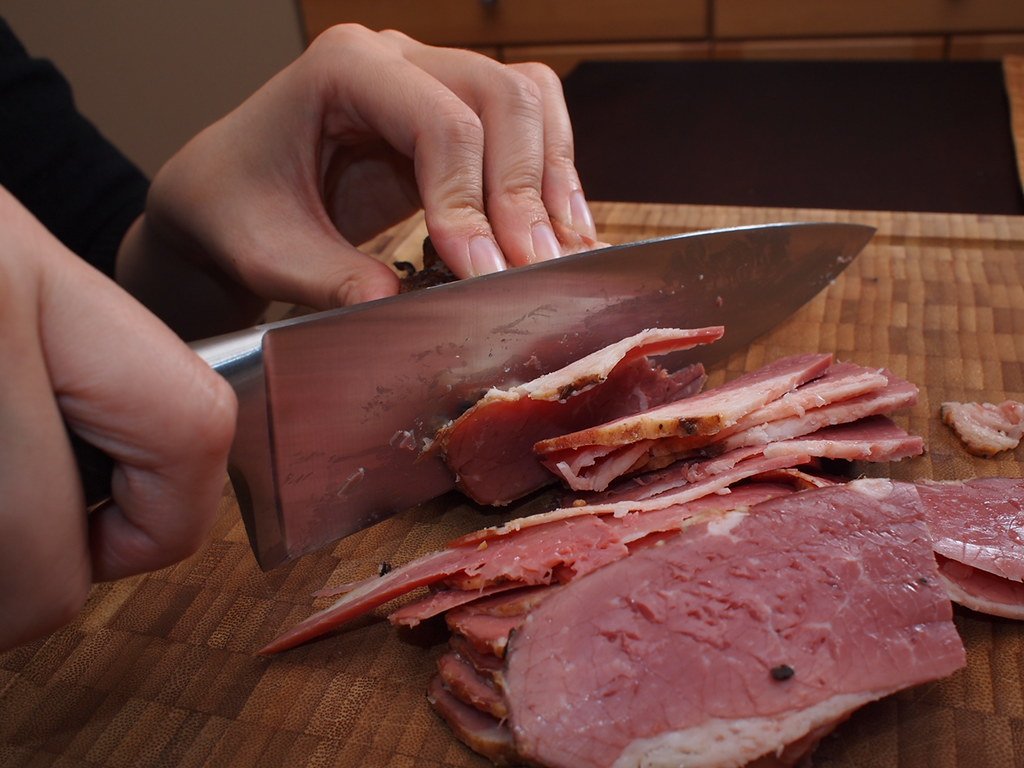
Photo: Wilson Hui via Flickr (CC BY 2.0).
Key Takeaways
- Above all, in lab testing, rubber was the most knife-friendly surface, followed closely by wood.
- Plastic and bamboo were in the middle, while composite boards dulled knives faster.
- Stainless steel and titanium were the worst, with steel causing about 18 times more edge loss than rubber.
- Glass, marble, and stone boards are also very hard on knives, so use them only for serving.
- Even on a good board, slicing technique and regular honing matter just as much.
Why Some Cutting Boards Dull Knives
To begin with, a sharp knife edge is incredibly thin, often just a few microns wide at the very tip. When that edge strikes a surface, it either sinks in slightly or stops dead. On a soft surface, the board gives way, so the edge stays straight. On a hard surface, by contrast, the board pushes back, and the edge rolls, flattens, or chips.
In other words, the best cutting board for knives is one that is a little softer than the blade but firm enough to give you a stable cut. That is why knife makers and chefs generally favor wood and rubber, while they avoid glass and metal.
Knife Friendly Cutting Boards Ranked: The Lab Data
So, to move past opinions, we looked at independent test results. Prudent Reviews made 300 rocking cuts and 300 chops on ten board materials, including several knife friendly cutting boards. Then they measured each knife with a BESS edge tester, which reports sharpness in points. In this test, a larger point loss means the board dulled the knife more. Here are the results:
| Rank | Board Material | Sharpness Lost (BESS Points) | Knife Friendliness |
|---|---|---|---|
| 1 | Rubber | 10 | Excellent |
| 2 | Teak, maple, walnut (wood) | 15 to 42 | Very good |
| 3 | Bamboo | 55 | Fair |
| 4 | Plastic | 65 | Fair |
| 5 | Composite (Richlite) | 117 | Poor |
| 6 | Stainless steel | 184 | Very poor |
| 7 | Titanium | Worst in test | Very poor |
The gap is striking. For example, stainless steel caused about 18 times more edge loss than rubber and roughly 4 to 12 times more than wood. Meanwhile, plastic and bamboo landed in the middle. Therefore, if your main goal is a long-lasting edge, rubber and hardwood are the clear winners.
Other testers reached similar conclusions. For instance, America’s Test Kitchen found that every metal board it tested dulled a brand-new chef’s knife, and one did so within four uses. By comparison, the knife used on its wooden control board stayed close to new.
The Most Knife-Friendly Materials Explained
1. Rubber
Rubber boards, such as those from Asahi and Hi-Soft, absorb the impact of the blade better than anything else. As a result, they topped the lab test by a wide margin. They are also non-porous and very quiet. On the downside, however, they are heavy, expensive, and sensitive to heat. Still, if you own premium Japanese knives, rubber is hard to beat.
2. Wood
Hardwoods are the classic knife friendly cutting boards, and the data supports them. In particular, closed-grain species such as maple, walnut, and cherry strike a great balance between firmness and give. For context, hard maple rates about 1,450 lbf on the Janka hardness scale, walnut about 1,010 lbf, and cherry about 995 lbf. Softer woods like walnut and cherry are especially gentle. Also, for a full species comparison, see our guide to the best wood for cutting boards.
3. End Grain Wood
End grain boards deserve special mention. Because the wood fibers stand upright, the blade slips between them instead of cutting across. Consequently, the surface “self-heals,” and edges stay sharp longer. So, if knife care is your top priority, an end grain board is the best wood option. You can learn more in our guide to end grain cutting boards.
4. Plastic
By contrast, plastic sits in the middle of the pack. It is softer than composite or metal, so it is reasonably kind to edges. In addition, it is cheap and dishwasher safe, which makes it ideal for raw meat. However, plastic scars over time, and deep grooves can trap bacteria.
5. Bamboo
Interestingly, bamboo is technically a grass, and it contains natural silica. As a result, it is harder on knives than most hardwoods, according to the test data. It is still far better than metal or glass, though. For more details, read whether bamboo cutting boards are safe.
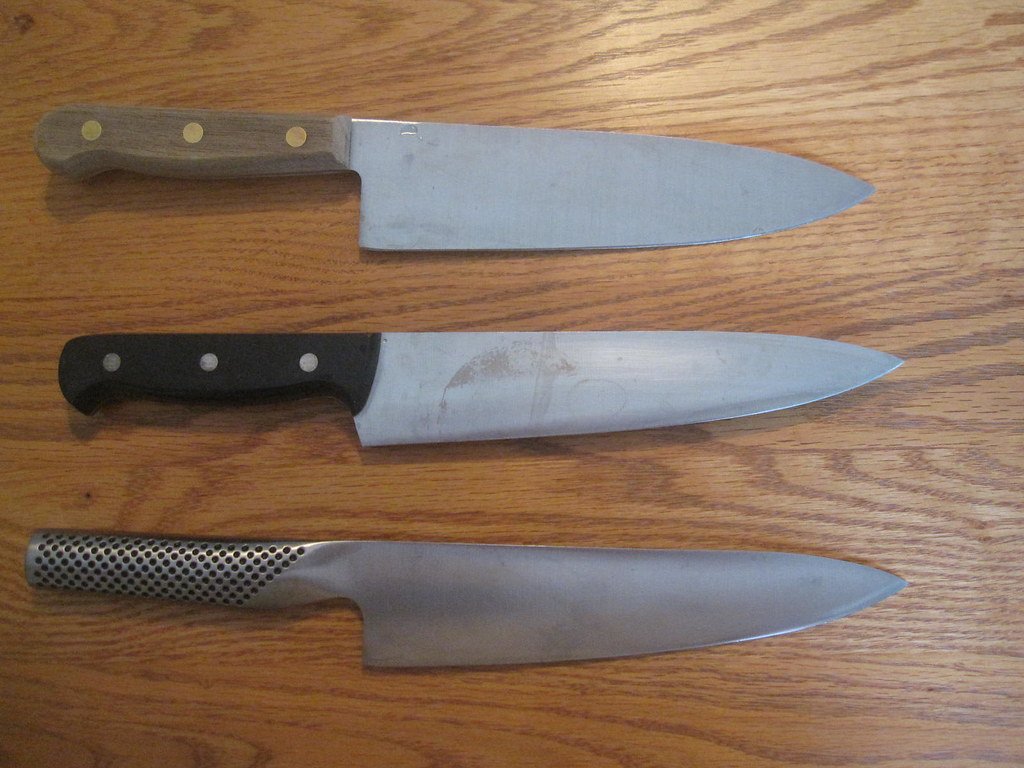
Photo: trenttsd via Flickr (CC BY 2.0).
Boards That Are Hard on Knives
Some popular boards look great but punish your edges. So, here are the ones to avoid for regular chopping:
- Stainless steel and titanium. In fact, these were the worst performers in the lab test. Moreover, they are loud and often slippery.
- Glass. Tempered glass is extremely hard, so the blade skids instead of biting. It is fine for serving, but not for daily prep.
- Marble, granite, and slate. Admittedly, stone boards are beautiful for cheese and pastry. Even so, they quickly roll a sharp edge.
- Composite boards. Although they are convenient and dishwasher safe, they caused nearly twice the edge loss of plastic in testing.
In short, the harder the board, the faster your knife dulls. So, keep hard boards for serving and use softer ones for chopping.
How to Choose the Best Cutting Board for Knives
In general, the right board depends on your knives, your cooking style, and how much maintenance you want. Use this table as a quick guide:
| Your Situation | Best Choice | Why |
|---|---|---|
| You own premium Japanese knives | Rubber or end grain wood | Gentlest on thin, hard edges |
| You want one all-around board | Edge grain maple or walnut | Knife-friendly and durable |
| You cut a lot of raw meat | Plastic (for meat only) | Dishwasher safe, easy to sanitize |
| You want low maintenance | Rubber or plastic | No oiling needed |
| You are on a budget | Plastic or edge grain wood | Good value per year of use |
In addition, think about thickness and stability. For example, a thin board that slides around forces you to press harder, which can damage your edge. Therefore, choose a board that is heavy enough to stay put, or place a damp towel underneath.
Video: Prudent Reviews compares plastic, wood, and titanium cutting boards.
Cutting Board for Knives: Edge Grain vs. End Grain
If you choose wood, you will also need to pick a construction style. Here is how the two main types of knife friendly cutting boards compare for knife care:
| Feature | Edge Grain | End Grain |
|---|---|---|
| Fiber direction | Horizontal | Vertical |
| Knife friendliness | Very good | Excellent |
| Shows knife marks | Some | Few |
| Oiling needs | Moderate | Higher |
| Price | Moderate | Higher |
Overall, end grain is the most knife-friendly wood option, while edge grain offers a lower price and easier care. Either way, both are far better for your knives than glass or metal.
Habits That Protect Your Knife Edge
However, even the best board cannot save a knife from bad technique. Fortunately, a few simple habits make a big difference:
- Slice, do not slam. Use smooth rocking or pulling cuts instead of hard, straight-down chops.
- Never scrape with the edge. When you move food across the board, flip the knife and use the spine. Alternatively, use a bench scraper.
- Hone regularly. Even a few passes on a honing rod straighten a rolled edge between sharpenings.
- Sharpen when needed. When honing no longer helps, it is time to sharpen. For help, our whetstone grit guide explains which grits to use.
- Keep knives out of the dishwasher. Instead, hand wash and dry them, since banging against dishes and harsh detergent dull edges.
- Store knives safely. For instance, a block, magnetic strip, or edge guard keeps blades from knocking into other tools.
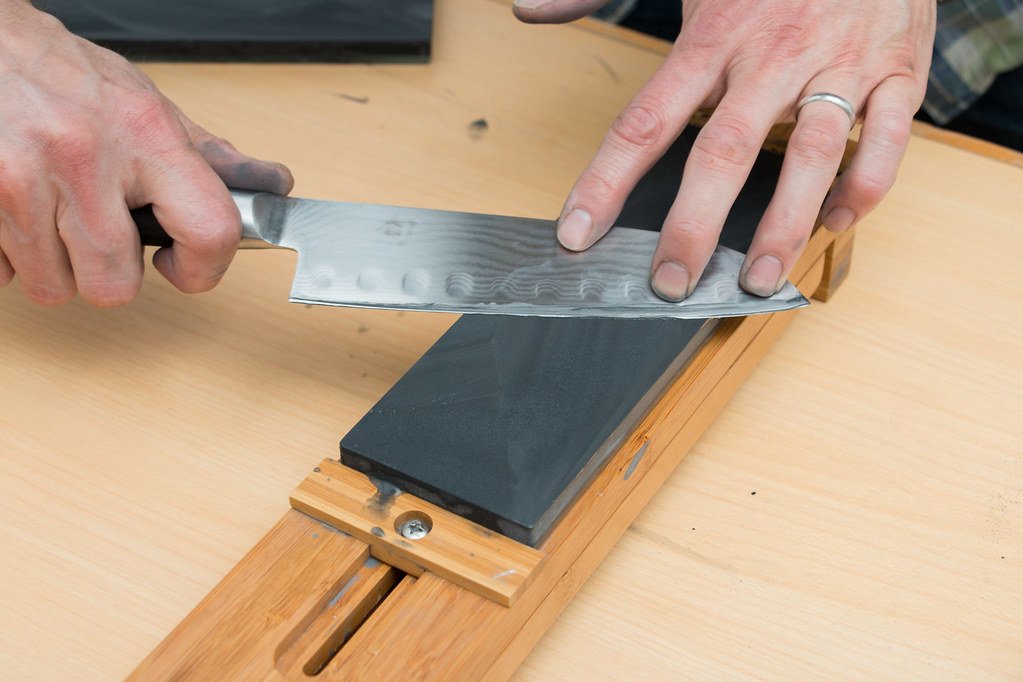
Photo: Didriks via Flickr (CC BY 2.0).
Does Your Knife Steel Matter?
Yes, it does. Harder Japanese steels hold a very fine edge, but they are also more brittle. Consequently, they can chip on hard boards more easily than softer German-style steels, which tend to roll instead. In practice, that makes knife friendly cutting boards even more important for Japanese knives. Also, for more on blade materials, see our guide to the best materials for kitchen knives. In addition, if you are shopping for a new blade, our list of the best chef knife under $100 is a good starting point.
Balancing Knife Care and Food Safety
Still, the most knife-friendly board is not always the best choice for every task. For example, wood and rubber protect edges well, while plastic is easier to sanitize after raw chicken. That is why many cooks use two boards: a wood or rubber board for produce and cooked foods, and a plastic board for raw meat. In fact, our guide on how to prevent cross contamination with cutting boards explains this system. In addition, see our guide on how to disinfect cutting boards for cleaning steps.
Signs Your Cutting Board Is Dulling Your Knives
Not sure whether your current board is the problem? Watch for these warning signs:
- Your knife stops slicing tomatoes cleanly. If the blade skids on tomato skin soon after sharpening, the board may be too hard.
- You hear a loud click with every chop. In general, a sharp, hard sound means the surface is pushing back against the edge.
- The board shows almost no knife marks. Surprisingly, a board that never scars is often too hard for your blade.
- You need to sharpen every few weeks. By comparison, on knife friendly cutting boards, many home cooks can go several months between sharpenings.
- Small chips appear on the edge. This is especially common with thin Japanese knives on glass or stone.
If you notice two or more of these signs, switching to a wood or rubber board is likely to help.
Knife Friendly Cutting Boards for Different Knife Types
Different knives have different needs, so it helps to match the board to the blade.
- Japanese gyuto and santoku. These thin, hard blades are prone to chipping. Therefore, rubber or end grain wood is the safest choice.
- German chef’s knives. Softer, thicker steel is more forgiving, so edge grain maple or walnut works very well.
- Paring knives. Small tasks are fine on a small wood or plastic board.
- Serrated bread knives. These tolerate harder surfaces better, so a composite or plastic board is acceptable.
- Cleavers. For heavy bone chopping, use a thick end grain block that can absorb strong blows.
In short, the more delicate and expensive the knife, the softer the board should be.
Common Mistakes to Avoid
- Chopping on a plate or countertop. Ceramic, granite, and quartz are much harder than any cutting board, so they dull knives fast.
- Using a glass board for daily prep. Instead, save glass for serving cheese or bread.
- Buying a board only for looks. Marble and slate are beautiful, but they are poor cutting surfaces.
- Letting the board slide. Otherwise, a slipping board makes you press harder, which strains both the knife and your hands.
- Ignoring deep grooves. Over time, a heavily scarred board catches the edge, so sand or replace it.
How to Care for a Knife-Friendly Board
Knife friendly cutting boards stay that way only with good care. Here is a simple routine for the top materials:
- Wood: First, hand wash, dry upright, and oil monthly with food-grade mineral oil. For details, our guide on how to take care of a wooden cutting board covers every step.
- Rubber: Hand wash, keep it away from high heat, and flip it often so both sides wear evenly.
- Plastic: Similarly, wash it in the dishwasher, and replace it once deep grooves appear.
Also, store boards upright so they dry fully. A cutting board organizer makes this easy.
FAQ
What is the most knife-friendly cutting board?
Rubber, based on lab data. In Prudent Reviews’ testing, rubber caused only 10 points of edge loss, compared with 15 to 42 for wood.
Is wood or plastic better for knives?
Wood is better. In the same test, hardwoods caused 15 to 42 points of edge loss, while plastic caused 65.
Do bamboo boards dull knives?
More than most hardwoods. That is because bamboo contains silica, and it caused 55 points of edge loss in testing.
Are glass cutting boards bad for knives?
Yes. Glass is extremely hard, so it rolls and chips edges quickly. Therefore, use it only for serving.
What cutting board do chefs use?
In general, many professional chefs use hardwood or rubber boards for knife work, along with color-coded plastic boards for raw proteins.
How often should I sharpen my knives?
It depends on use, but most home cooks sharpen every few months and hone weekly. Notably, on knife friendly cutting boards, you will sharpen less often.
Final Thoughts
Choosing knife friendly cutting boards is one of the easiest ways to keep your knives sharp. Based on the data, rubber and hardwood are the best choices, plastic and bamboo are acceptable, and metal, glass, and stone should be avoided for chopping. Pair a good board with smooth slicing, regular honing, and smart storage, and your edges will last much longer. Finally, for a full look at board materials, read our main guide to cutting boards that are the safest and healthiest.

Hey, My name is MAMON. I am a SEO content creator and affiliate marketer with over 8 years of experience. I create honest product reviews, in-depth buying guides, and practical how-to articles to help readers make informed decisions. My mission is to provide trustworthy, research-backed content that delivers real value.
Leave a Reply