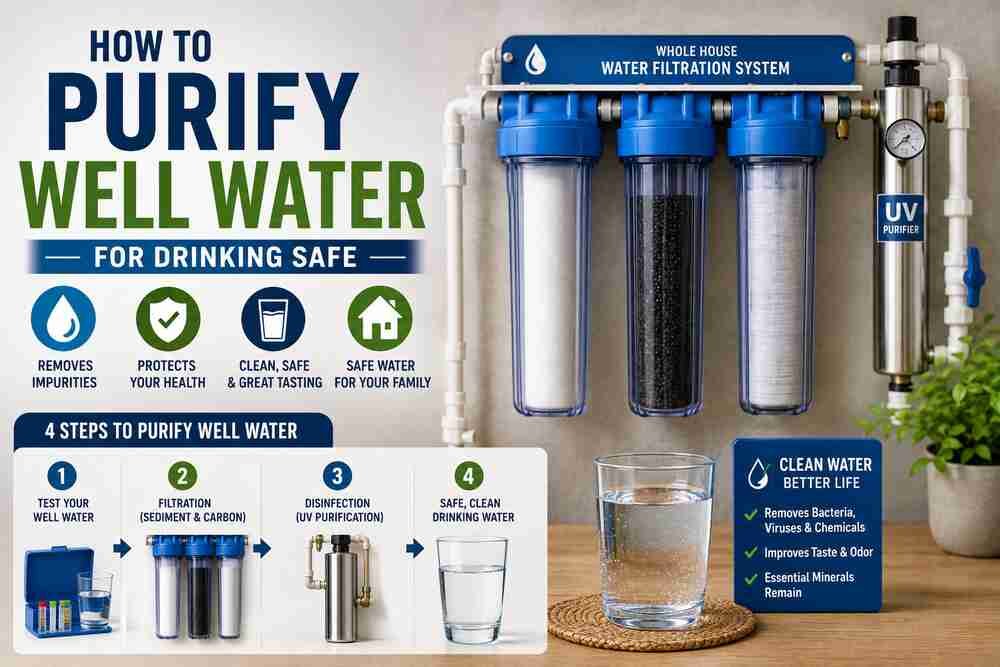
Key Takeaways
- About 23 million U.S. households rely on private wells, and the EPA does not regulate or test private well water the way it does public water systems — that responsibility falls on you.
- Learning how to purify well water for drinking starts with a lab test, not a filter purchase, because the right treatment depends entirely on what is actually in your water.
- The five most reliable purification methods are filtration (including reverse osmosis), water softening, distillation, chlorination, and ultraviolet (UV) disinfection.
- The CDC recommends testing private well water at least once a year for bacteria and nitrates, and more often if you notice changes in taste, smell, or color.
- Most homeowners end up combining two methods, such as a whole-house filter plus UV disinfection, to handle both chemical and biological contaminants.
Roughly 15% of Americans get their drinking water from a private well, according to the CDC, and that share is even higher in rural states. Well water can be a cost-effective, reliable water source, but unlike municipal water, it is not treated or monitored by any government agency before it reaches your tap. That means knowing how to purify well water for drinking safely is entirely up to you as the homeowner.
In this guide, you will learn why purification matters, how to test your well before choosing a treatment method, and which of the five proven purification options fits your household’s water quality, budget, and maintenance preferences.
Why Well Water Needs to Be Purified Before You Drink It
Well water travels through soil and rock before it reaches your pump, which means it can pick up minerals, microorganisms, and chemical residues along the way. Two facts make purification especially important for well owners in the United States.
The EPA Does Not Regulate Private Wells
The U.S. Environmental Protection Agency (EPA) regulates public water systems under the Safe Drinking Water Act, but that law does not cover privately owned wells. If you own a well, you — not a utility or a government agency — are responsible for testing and treating your water.
Common Contaminants Found in U.S. Well Water
Depending on your region, geology, and nearby land use, well water can contain any of the following:
- Total coliform bacteria and E. coli — often from septic system runoff or surface water intrusion.
- Nitrates and nitrites — commonly linked to agricultural fertilizer or livestock runoff.
- Arsenic and radon — naturally occurring in bedrock in parts of the Northeast, Midwest, and Southwest.
- Lead and other heavy metals — from older plumbing or natural mineral deposits.
- Hardness minerals (calcium and magnesium) — which don’t pose a health risk but affect taste, appliances, and plumbing.
You cannot see, smell, or taste most of these contaminants. Clear water can still be unsafe, which is exactly why testing comes before treatment.

Where You Live Affects What’s in Your Well Water
Geography plays a bigger role than most homeowners realize. Wells in New England and parts of the Southwest are more likely to have naturally elevated arsenic and radon due to local bedrock. Midwestern and agricultural regions see higher nitrate levels from fertilizer runoff. Coastal wells can experience saltwater intrusion, raising sodium and chloride levels. Older homes anywhere in the country may also have lead solder or fixtures that leach into the water supply. Knowing your region’s common risk factors helps you and your testing lab decide which contaminants to prioritize.
Test Your Well Water Before Choosing a Purification Method
Some homeowners skip testing because a neighbor’s well tested clean. That is a mistake. Even wells in the same neighborhood can differ significantly because of well depth, construction, age, maintenance history, and nearby land use.
How Often Should You Test Your Well Water?
The CDC recommends testing private well water at least once a year for total coliform bacteria, E. coli, and nitrates. Test more frequently, or immediately, if any of these happen:
- You notice a change in taste, color, or odor
- A household member has recurring, unexplained gastrointestinal illness
- You have a new baby in the home (nitrate exposure is particularly risky for infants)
- Flooding or heavy rain occurred near the wellhead
- You just moved into a home with an existing well
What a Well Water Test Should Cover
A basic annual test typically covers bacteria and nitrates. Many state health departments and university extension offices also recommend periodically testing for arsenic, lead, radon, and total dissolved solids (TDS), especially if you live in an area known for those contaminants. Certified labs and USDA-approved county extension offices can run these tests for a modest fee, usually well under $200 for a standard panel.
The short video below from the Minnesota Department of Health walks through how a residential well test actually works, from collecting the sample to reading the results.
5 Proven Methods to Purify Well Water for Drinking
Once your test results identify what’s actually in your water, you can match the contaminant to the right treatment. Here are the five methods most commonly used in U.S. households.
1. Water Filtration Systems
Filtration is the most versatile category, and it covers several sub-types that handle different problems:
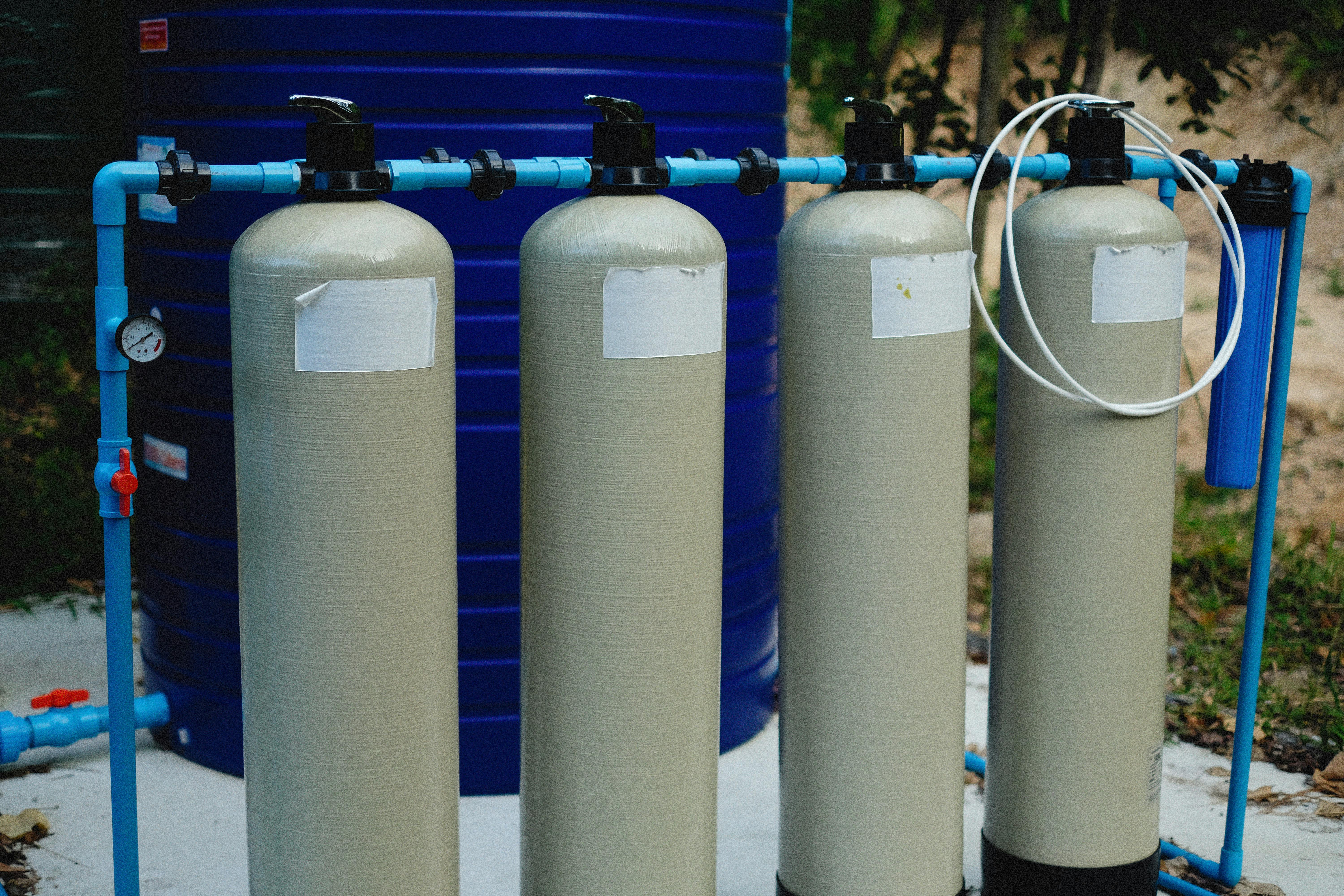
- Whole-house filters treat every tap in the home and are a good starting point if your test shows sediment, chlorine byproducts, or general organic contaminants. See our guide on how to install a whole-house water filter on a well for the full walkthrough.
- Under-sink reverse osmosis (RO) systems push water through a semi-permeable membrane that removes up to 99% of dissolved contaminants, including arsenic, nitrates, and heavy metals, without producing wastewater in newer tankless models.
- Countertop filters are the lowest-cost, lowest-maintenance option and work well for households that only need to treat drinking and cooking water rather than the whole house. Compare options in our best countertop water filter reviews.
For a side-by-side comparison of filtration technologies before you buy, our drinking water filtration system reviews and buyer’s guide breaks down which system fits which contaminant profile.
2. Water Softeners
If your test comes back showing hard water (high calcium and magnesium), a water softener won’t remove health-related contaminants, but it will:
- Prolong the lifespan of water heaters, dishwashers, and pipes by reducing scale buildup
- Prevent white mineral stains on fixtures, dishes, and shower doors
- Make soap and shampoo lather more easily, which is gentler on skin and hair
Since well water is especially prone to hardness, see our dedicated guide to the best water softener for well water for models built to handle iron and sediment along with hardness minerals.
3. Distillation Systems
Distillation boils water and condenses the steam in a separate chamber, leaving contaminants, minerals, and most microorganisms behind. It is one of the most thorough purification methods available for a home system, though it is slower and uses more electricity than filtration. If you’re weighing this option, our countertop water distiller reviews and buying guide compares the top units, and our step-by-step guide to distilling your own water explains the process in detail.
4. Chlorination
Chlorination is the standard method for treating bacterial contamination in well water. Chlorine breaks down the cell membranes of bacteria, viruses, and other microorganisms, neutralizing them before the water reaches your tap. The CDC’s guidelines for treating well water outline the correct chlorine dosage for shock-treating a contaminated well, which is a process best done carefully and, in most cases, with guidance from a licensed well contractor.
5. Ultraviolet (UV) Disinfection
UV systems pass water past a UV lamp that disrupts the DNA of bacteria and viruses, neutralizing them without adding any chemicals to your water. UV disinfection is a popular add-on for well owners because it targets the same biological contaminants as chlorination, but leaves no taste or odor behind. It is typically installed alongside a sediment or carbon filter, since UV light only works effectively on clear water.
How to Choose the Right Well Water Purification Method
There is no single “best” method — the right choice depends on what your test results show. Use this table as a starting point:
| If your test shows… | Best treatment method |
|---|---|
| Bacteria or E. coli | Chlorination or UV disinfection |
| Nitrates, arsenic, or heavy metals | Reverse osmosis filtration or distillation |
| Hardness (calcium/magnesium) | Water softener |
| Sediment, rust, or cloudiness | Whole-house sediment filter |
| Bad taste or odor only, no contamination | Countertop or under-sink carbon filter |
Many households combine two methods — for example, a whole-house sediment filter plus UV disinfection, or a water softener plus an under-sink RO system for drinking water. For more on evaluating your options before you commit to a system, our guide on what to consider when buying a home water purification system is a useful next step.
Frequently Asked Questions
Is well water safe to drink without any treatment?
Sometimes, but you can’t know that without testing. Because private wells aren’t regulated or monitored by the EPA, the only way to confirm your water is safe is to have it tested by a certified lab at least once a year.
How much does it cost to purify well water for drinking?
Costs vary widely by method. A countertop filter can cost under $100, while a whole-house filtration system with UV disinfection can run $1,000–$3,000 installed. Annual well water testing typically costs $50–$200 depending on how many contaminants you test for.
Can I use a standard pitcher filter, like a Brita, on well water?
Pitcher filters can improve taste and reduce chlorine or sediment, but they are not certified to remove bacteria, nitrates, arsenic, or other health-related contaminants commonly found in well water. They should not be relied on as your sole treatment method.
How do I know if my well water is contaminated?
You often can’t tell from taste, smell, or appearance alone. Warning signs like cloudy water, a sulfur smell, or unexplained illness in the household are worth investigating, but the only reliable way to know is a certified water test.
Does boiling well water make it safe to drink?
Boiling kills most bacteria and viruses, but it does not remove nitrates, arsenic, lead, or other chemical contaminants — and boiling can actually concentrate some of them as water evaporates. Boiling is a short-term emergency measure, not a substitute for proper filtration or treatment.
How often should I replace my well water filter?
It depends on the filter type and your household’s water usage. Sediment and carbon cartridges in whole-house systems typically need replacement every three to six months, RO membranes last one to two years, and UV lamps are usually rated for about 9,000 to 12,000 hours (roughly one year of continuous use). Check your manufacturer’s guidelines, and replace filters sooner if you notice reduced water pressure or a change in taste.
The Bottom Line
If you’re still asking how to purify well water for drinking safely, start with a certified test, not a purchase. Once you know what’s actually in your water, matching it to the right method — filtration, softening, distillation, chlorination, or UV disinfection — is straightforward. For most households, a combination of a whole-house filter and a targeted treatment like UV disinfection or an under-sink RO system delivers the most reliable, great-tasting water for drinking and cooking.

Hey, My name is MAMON. I am a SEO content creator and affiliate marketer with over 8 years of experience. I create honest product reviews, in-depth buying guides, and practical how-to articles to help readers make informed decisions. My mission is to provide trustworthy, research-backed content that delivers real value.
Leave a Reply