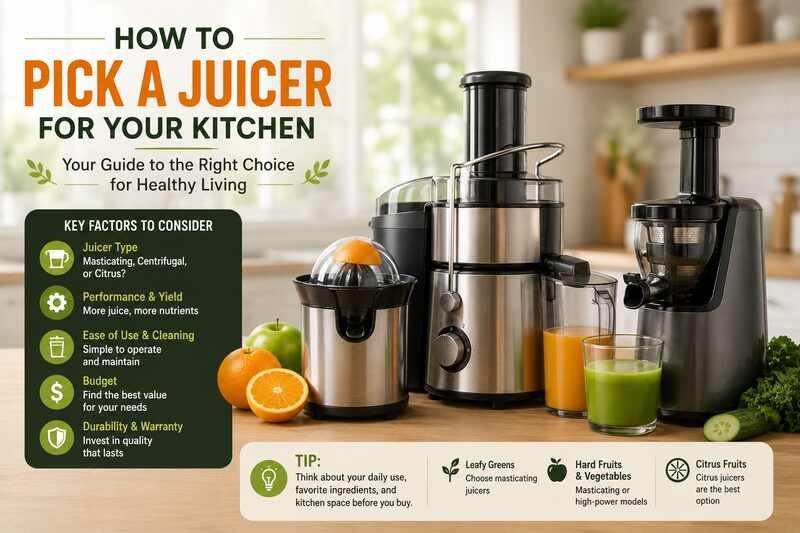
Picking a juicer comes down to four things: how much you want to spend, how much counter and storage space you have, how often you’ll actually use it, and how much noise and cleanup you’re willing to put up with. Get those right and almost any juicer in your price range will work well. Get them wrong, and even an expensive one ends up in a cabinet after a month.
This guide walks through how to pick a juicer for your kitchen without falling for marketing claims that don’t hold up, plus a budget breakdown, a buying checklist, and the mistakes that send juicers straight to the back of the cupboard.
Key Takeaways
- The right juicer depends on your budget, kitchen space, how often you’ll juice, and your tolerance for noise and cleanup, not just which type has the best marketing.
- Centrifugal juicers cost less and juice fast; masticating and twin-gear juicers cost more, run quieter, and handle leafy greens better.
- Consumer Reports testing found no significant difference in vitamin C, antioxidants, or other nutrients between cold-press and centrifugal juice, so “more nutrients” alone isn’t a reason to pay double.
- Expect to spend $75-$300 for a solid centrifugal juicer, $200-$750 for masticating, and $300-$1,200+ for twin-gear or commercial-grade models.
- Check a model’s warranty length and CPSC recall history before buying, not just after something breaks.
How to Pick a Juicer: Start With These Five Questions
Before you compare brands or read a single review, answer these five questions. They’ll narrow the field faster than any spec sheet.
What’s Your Budget?
Juicer prices span from under $50 for a basic centrifugal model to well over $1,000 for a commercial-grade twin-gear machine. Decide what you’re comfortable spending before you start browsing, since it’s easy to get talked into features you won’t use.
How Much Space Do You Have?
Measure your available counter and storage space, including room for the pulp container and feed chute, before you buy. Masticating and twin-gear juicers tend to be taller and heavier than centrifugal models, and some don’t fit easily in a lower cabinet if you’re not planning to leave them out.
How Often Will You Realistically Juice?
Be honest here. If you’re juicing once or twice a week, a simpler centrifugal model is plenty. If you’re juicing daily, or juicing large batches for a family, the faster wear on a budget centrifugal machine and the better yield of a masticating juicer start to matter more.
How Much Noise and Cleanup Can You Tolerate?
Centrifugal juicers are notably louder, since they’re built around a spinning blade, and cleanup on juicers in general tends to be a hassle regardless of type, though it varies by model. If you’re juicing before the rest of the house wakes up, or you don’t want a 10-minute teardown after every glass, weigh this as heavily as price.
What Will You Actually Be Juicing?
This one gets overlooked constantly. If your routine is mostly apples, carrots, celery, and citrus, almost any juicer will handle it fine, including a basic centrifugal model or even a manual citrus press for orange and grapefruit juice. If wheatgrass, spinach, kale, or other leafy greens are a regular part of your routine, a centrifugal juicer will frustrate you fast – those fibrous, low-liquid ingredients are exactly what masticating and twin-gear juicers are built to handle.
Centrifugal vs. Masticating vs. Twin-Gear: The Short Version
Every juicer on the market is a variation on three basic mechanisms. Centrifugal juicers spin produce against a mesh screen at high speed. Masticating juicers use a single slow-turning auger to crush and press. Twin-gear juicers use two interlocking gears to grind produce even more thoroughly. For a full breakdown of how each mechanism actually works, see our guide to what a juicer does and how it works.
For picking a juicer, what matters is the tradeoff: centrifugal models are fast, loud, and the cheapest to buy; masticating models are slower, quieter, and better with leafy greens; twin-gear models push that further at a higher price and a bigger time commitment per batch.
| Type | Speed | Noise | Best For | Price Range (USD) |
|---|---|---|---|---|
| Centrifugal | Fast | Loud | Hard produce, quick juicing | $75-$300 |
| Masticating | Slow | Quiet | Leafy greens, longer shelf life | $200-$750 |
| Twin-Gear | Slowest | Quiet | Maximum yield, daily/heavy use | $300-$1,200+ |
A few real-world examples make this easier to picture. Someone juicing an orange and a grapefruit most mornings before work is well served by an inexpensive centrifugal model, or even a manual citrus press, since speed and low cost matter more than nutrient retention for that use case. A household juicing a mix of kale, spinach, celery, and apples several times a week will get noticeably better yield and less foam from a masticating juicer, and will likely find the quieter motor worth the extra cost. Someone running a small juice bar or juicing daily for a large family is the target buyer for a twin-gear or commercial-grade machine, where the higher price spreads out over far more use.
Don’t Overpay for “More Nutrients” – What the Research Actually Shows
A lot of juicer marketing leans hard on the idea that slow, cold-press juicing preserves dramatically more nutrients than fast centrifugal juicing. That claim is worth a second look before it justifies a few hundred extra dollars.
Consumer Reports has tested juicers directly on this question, and found no significant differences in vitamin C, phenolic compounds, carotenoids, or antioxidant capacity between the two extraction methods. In their testing, how you store the juice afterward mattered more for nutrient retention than which machine made it.
That doesn’t mean the type of juicer doesn’t matter at all. Masticating and twin-gear juicers really do produce less oxidized juice that keeps longer in the fridge, they’re quieter, and they handle wheatgrass and leafy greens far better than centrifugal models. Those are legitimate reasons to spend more. “It has more nutrients” on its own isn’t one of them, at least not based on the available testing.

Juicer Buying Checklist: Features That Actually Matter
Once you’ve settled on a type and a budget, these are the specs worth comparing model to model:
- Feed chute size – a wide chute lets you juice whole produce without pre-cutting, which saves real time if you juice often.
- Parts count and dishwasher-safe components – fewer parts means faster cleanup; check whether the pulp screen and auger are dishwasher-safe or need hand-washing.
- RPM or extraction speed – higher RPM means faster juicing and more noise; lower RPM means quieter operation and typically less oxidation.
- Warranty length – centrifugal juicers commonly carry 1-3 year warranties, while many masticating and twin-gear models come with 10-15 year warranties, which says something about how the manufacturer expects the motor to hold up.
- Pulp container size – a small pulp bin means more mid-batch stops to empty it, which adds up if you’re juicing for more than one person.
- Footprint and storage – measure your counter and cabinet space against the juicer’s actual dimensions, not just the marketing photo.
- Number of speed settings – some centrifugal models offer two or more speeds, letting you slow down for softer produce and speed up for harder items, which can improve yield without switching machines.
None of these specs matter equally to every household. A single person juicing citrus a couple of mornings a week doesn’t need the same feature list as a family running a pound of kale through the machine every day. Rank this checklist against your own answers to the five questions above rather than trying to max out every spec.
Budget Guide: What You Get at Each Price Point
| Price Range | Typical Type | What You Get |
|---|---|---|
| Under $150 | Centrifugal | Fast juicing, easy cleanup, best for occasional use |
| $150-$500 | Masticating | Quieter operation, better leafy-green handling, longer juice shelf life |
| $500+ | Twin-Gear / Commercial | Maximum yield and juice quality, built for daily or heavy use |
At the low end, a $75-$150 centrifugal juicer from a brand like Breville or Cuisinart will juice hard produce quickly with minimal fuss, and it’s a reasonable way to find out whether juicing sticks as a habit before spending more. In the $200-$500 range, masticating juicers from brands like Hurom or Omega start adding real quality-of-life improvements: quieter motors, better yield from leafy greens, and juice that holds up in the fridge longer. Above $500, you’re generally paying for twin-gear extraction, commercial-grade build quality, or both, and that tier makes the most sense for people juicing daily or running a small juice business. Our juicer cost breakdown goes deeper on pricing by feature if you want more detail.
If you’ve already decided masticating is the way to go, our roundup of the best masticating juicers and our Omega juicer reviews are good next stops for specific model picks.
Buying Mistakes to Avoid
Buying based on nutrition claims alone. As covered above, “preserves more nutrients” isn’t well supported as a reason by itself to pick one juicer type over another. Weigh noise, cleanup, and juice yield instead.
Skipping the recall check. Before buying a specific model, especially a used or older one, it’s worth a quick search of the Consumer Product Safety Commission’s recall database for that brand and model name. It takes under a minute and can save you from a known fire, burn, or laceration hazard.
Underestimating cleanup time. If you’re not willing to disassemble and rinse several parts after every use, a juicer with a lot of components will end up unused. Read a few reviews specifically about cleanup before buying, not just about juice quality.
Buying more juicer than you’ll use. A commercial-grade twin-gear machine sitting mostly unused is a worse outcome than a $100 centrifugal juicer that actually gets used three times a week. Match the machine to your realistic habits, not your aspirational ones.
Ignoring warranty and parts availability. Juicers with hard-to-find replacement parts, or warranties under a year, are a bigger risk than the sticker price suggests, especially for masticating and twin-gear models with more moving parts.
Where to Go Next
If you want to understand the extraction mechanics in more depth before deciding, our guide to what a juicer does and how it works covers that separately from this buying guide. Once you’re juicing regularly, our guide to how long fresh juice actually lasts will save you some trial and error.
Frequently Asked Questions
Is a more expensive juicer always better?
Not necessarily. A higher price usually buys you quieter operation, better yield from leafy greens, and a longer warranty, but Consumer Reports’ testing found no meaningful nutrient advantage from cold-press extraction alone. If you mainly juice hard produce like apples and carrots, a mid-range centrifugal juicer may serve you just as well.
What’s the best juicer for a beginner?
A centrifugal juicer in the $75-$150 range is usually the easiest starting point. It’s affordable, fast, and simple to clean, which makes it easier to find out whether juicing becomes a regular habit before you invest more.
Do I need a masticating juicer to juice leafy greens?
Not strictly, but it helps a lot. Centrifugal juicers can struggle with wheatgrass, spinach, and kale, often producing less juice and more foam. Masticating and twin-gear juicers extract leafy greens far more efficiently.
How long should a good juicer last?
With regular cleaning and normal use, a well-maintained centrifugal juicer typically lasts a few years, while masticating and twin-gear models, often backed by 10-15 year warranties, can last well over a decade.
Can I return a juicer if it doesn’t work out?
Most major U.S. retailers offer a 30 to 90-day return window on small kitchen appliances, though a used or visibly worn unit may only qualify for store credit. Keep the original box for at least the first few weeks of use in case you need to return it, and check the specific retailer’s policy before buying rather than assuming it matches a general rule of thumb.
Is a juicer worth it if I could use a blender instead?
It depends on what you want out of it. A blender purees the whole fruit or vegetable, fiber included, which is a different result than a juicer’s clear, fiber-free extraction. If you specifically want juice rather than a smoothie, or you’re trying to juice large quantities of produce efficiently, a dedicated juicer is worth the counter space.

Hey, My name is MAMON. I am a SEO content creator and affiliate marketer with over 8 years of experience. I create honest product reviews, in-depth buying guides, and practical how-to articles to help readers make informed decisions. My mission is to provide trustworthy, research-backed content that delivers real value.
Leave a Reply