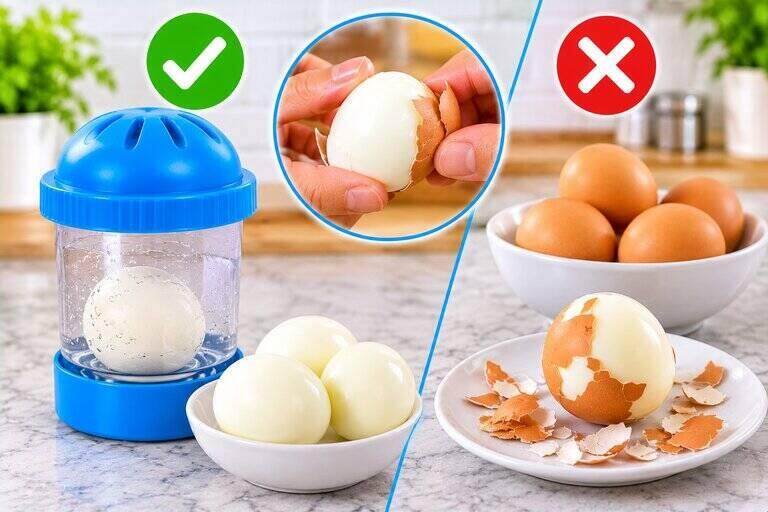
If you have ever lost half an egg white to a stubborn shell, a boiled egg peeler probably sounds tempting. These gadgets promise clean, smooth eggs in seconds, from shaker cups to electric peelers and egg cookers that crack shells for you. But do boiled egg peelers really work, or are they just another drawer-cluttering unitasker? In this guide, we look at what published tests and hands-on reviews found, explain the science of why eggs stick, and help you decide whether a peeler is worth buying or whether better technique will do the job.
Key Takeaways
- Shaker-style peelers can work well. A reviewer at The Kitchn reported that the shell slid off “every single time” using a Negg peeler with 1/4 cup of water.
- The basic cup-shake hack is less reliable. In Milk Street’s tests, it worked about 60 percent of the time and only with warm eggs.
- Egg age matters more than any gadget. The American Egg Board suggests boiling eggs that are 7 to 10 days old.
- Steaming eggs makes peeling easier with or without a peeler, according to Milk Street’s testing.
- A boiled egg peeler is most worth it for people who make deviled eggs or meal-prep eggs often.
Why Boiled Eggs Are Hard to Peel
Before judging any boiled egg peeler, it helps to understand the problem it is trying to solve. Just inside the shell are two thin membranes. In very fresh eggs, the cooked white tends to bond tightly to the inner membrane. So, when you pull the shell away, pieces of white come with it.
As eggs age, that bond weakens. According to the Egg Quality Handbook published by The Poultry Site, the white of a freshly laid egg has a pH of about 7.6 to 8.5, and it rises to around 9.4 after 21 days of storage as carbon dioxide escapes through the shell. A more alkaline white is less likely to cling to the membrane. That is why the American Egg Board recommends buying eggs 7 to 10 days before you plan to boil them.
In other words, no peeler can completely fix a very fresh egg. However, a good tool and good technique together can make a big difference.
Types of Boiled Egg Peelers
| Type | How It Works | Pros | Cons |
|---|---|---|---|
| Shaker peeler | Egg and a little water are shaken in a textured container | Fast, no electricity | One egg at a time; another gadget to store |
| Cup or jar shake | Egg is shaken in a covered cup with water | Free; uses a mug or jar | Worked about 60% of the time in testing |
| Electric peeler | Motorized rollers or brushes rub off the shell | Hands-off for batches | Results vary; needs cleaning |
| Egg cooker with shaker | Cook, then shake the cooker to crack shells | Two jobs in one | Usually small capacity |
| Spoon method | A teaspoon slides between shell and white | No gadget needed | Can gouge fresh eggs |
Do Shaker-Style Boiled Egg Peelers Work?
Shaker peelers are the most popular type. The best-known is the Negg, a small egg-shaped container with bumps and indents inside. You add a little water and a cooked egg, close the lid, and shake.
The results can be impressive. Writing for The Kitchn, reviewer Katie Workman boiled eggs for 11 to 12 minutes, cooled them in an ice bath, added each egg to the Negg with 1/4 cup of water, and shook it a few times. She reported that the shell “actually does slide off — every single time.” She credited the container’s bumps and indents for cracking the shell so it released cleanly.
However, she also noted the main downside: it is a single-purpose tool that takes up space. Her conclusion was that its value depends on how often you make hard-boiled eggs.
Video: Hey It’s Honeysuckle tests a shaker egg peeler.
Does the Free Cup-Shake Hack Work?
Before buying a gadget, many people try the free version: put an egg in a cup with some water, cover it with your hand, and shake. Milk Street tested this hack extensively and found that it worked about 60 percent of the time.
Its testing also revealed a few conditions that improved the odds:
- Warm eggs only: The trick worked with warm eggs straight from the pan and never with eggs shocked in ice water.
- Steamed eggs: Steamed eggs’ shells slipped off, while boiled eggs’ shells only cracked.
- Short, squat cups: Mugs and rocks glasses worked best.
- Some water: Filling the cup about halfway with water gave good results.
Interestingly, these findings differ from The Kitchn’s Negg review, where ice-bath-cooled eggs peeled well. A likely reason is the textured interior of a dedicated peeler, which cracks the shell more thoroughly than a smooth mug. In short, a purpose-built shaker may be more forgiving than the free hack.
Do Electric Egg Peelers Work?
Photo: jules:stonesoup via Flickr (CC BY 2.0).
Electric egg peelers use spinning rollers or brushes to rub the shell off while water helps rinse it away. They are designed for people who peel many eggs at once, such as for parties or meal prep.
In practice, results vary more than with shaker peelers. Electric models still depend on egg age and cooking method, so very fresh eggs can still tear. They also have more parts to clean. Therefore, an electric peeler makes the most sense if you regularly peel a dozen or more eggs and want to save hand time.
Egg Cookers That Help With Peeling
Some egg cookers include features that make peeling easier. For example, the Eggpod by Emson is a microwave egg cooker that, according to the brand, cracks the shells when you shake it at least 10 times after cooking. Meanwhile, most electric egg cookers steam eggs rather than boil them, and Milk Street’s testing found that steamed eggs peel more easily.
In addition, many egg cookers include a piercing pin on the measuring cup. Making a tiny hole in the large end of the shell can reduce cracking during cooking. If you already own a rice cooker with a steam tray, you can steam eggs there too; see our guide on how to steam using a rice cooker.
The Best Technique: Peeling Without a Gadget
For most home cooks, technique works just as well as a boiled egg peeler. Here is a method that combines advice from the American Egg Board and Milk Street:
- Use older eggs: First, choose eggs that have been refrigerated for 7 to 10 days.
- Steam or start hot: Next, steam the eggs for 12 minutes over 1 inch of boiling water, or lower them into water that is already boiling. To heat water quickly, see our guide to the best electric kettle.
- Cool briefly: Then cool the eggs in ice water for a few minutes if you plan to peel by hand.
- Crack all over: After that, tap the egg on the counter until the shell is finely cracked, then roll it gently.
- Peel from the wide end: Finally, start where the air pocket sits, and peel under cold running water.
According to the American Egg Board, peeling right after cooling works best, since the shell has contracted slightly.
How Cooking Method Affects Any Boiled Egg Peeler
The way you cook an egg can matter as much as the tool you use to peel it. Milk Street compared several methods and found that steaming gave the most reliable peeling. Its recommended method is to steam eggs for 12 minutes over about 1 inch of boiling water. Because steam surrounds the egg with intense, even heat, the white sets quickly against the membrane and then releases more cleanly.
On the other hand, the American Egg Board method starts eggs in cold water, brings it to a boil, and then lets the eggs stand off the heat. Its recommended standing times are 9 minutes for medium eggs, 12 minutes for large eggs, and 15 minutes for extra-large eggs. This approach is gentle and helps prevent overcooking. However, cold-start eggs can be harder to peel when they are very fresh.
| Cooking Method | Time (Large Eggs) | Peeling Notes | Source |
|---|---|---|---|
| Steaming | 12 minutes over 1 inch of water | Peeled most easily in testing | Milk Street |
| Cold start, then stand | 12 minutes standing | Gentle; use older eggs | American Egg Board |
| Boiling start | 12 minutes for hard | Lowering eggs into boiling water helps release | Eggland’s Best |
| Electric egg cooker | Set by water level | Steams eggs, which tends to help | Manufacturer manuals |
Pressure cooking is another option many home cooks use for batches, since it also cooks eggs in steam. Our guide on how to use a pressure cooker covers the basics of safe pressure release. Either way, the takeaway is the same: steam-based methods give any boiled egg peeler a head start.
Boiled Egg Peeler vs. Hand Peeling: Time and Effort
Speed is the main selling point of a peeler. With a shaker, you add water, close the lid, and shake for a few seconds. By comparison, hand peeling a stubborn egg can take a minute or more, especially if you are picking off small shell fragments. That difference adds up when you are making two dozen deviled eggs for a holiday party.
Still, there are trade-offs. Most shaker peelers handle one egg at a time, so you repeat the process for every egg. They also need to be rinsed and dried after use. Meanwhile, hand peeling needs no extra cleanup beyond the sink. For a few eggs on a weekday morning, then, hand peeling under running water is often just as fast overall.
Food safety is the other factor. The Egg Safety Center recommends refrigerating hard-cooked eggs in the shell and using them within one week. So, if you meal-prep a dozen eggs on Sunday, you may not need to peel them all at once. Peeling a few each day with a quick shake can keep your eggs fresher for longer.
Is a Boiled Egg Peeler Worth Buying?
Whether a boiled egg peeler is worth it depends on how you cook. Here is a quick guide:
| If You… | Recommendation |
|---|---|
| Make deviled eggs often | A shaker peeler is worth trying |
| Peel a dozen or more eggs weekly | Consider a shaker or electric peeler |
| Boil eggs occasionally | Use technique and a mug |
| Have little storage space | Skip the gadget; steam your eggs instead |
| Use farm-fresh eggs | Wait a week before boiling, gadget or not |
Tips to Get the Most From Any Boiled Egg Peeler
- Use the right amount of water: For example, The Kitchn’s reviewer used 1/4 cup in the Negg.
- Do not overcook: In addition, cook eggs fully but not excessively, since overcooking can cause a green ring and a rubbery white.
- Peel promptly: Peel soon after cooking rather than the next day.
- Shake gently at first: Start with a few gentle shakes, then increase only if needed.
- Rinse off shell bits: Finally, a quick rinse removes tiny fragments before serving.
Common Peeling Mistakes
Photo: jules:stonesoup via Flickr (CC BY 2.0).
- Using very fresh eggs. As a result, the white sticks no matter which tool you use.
- Starting at the narrow end. Instead, begin at the wide end, where the air pocket makes it easier to get under the membrane.
- Peeling dry. In fact, running water helps lift the membrane.
- Shocking eggs before the cup hack. According to Milk Street, the cup trick works best with warm eggs.
- Forgetting storage rules. Peeled eggs should be eaten the same day, according to the American Egg Board.
Storing Eggs After Peeling
Once your eggs are peeled, plan to use them quickly. The American Egg Board advises eating peeled hard-boiled eggs the same day, while eggs in the shell keep in the refrigerator for up to one week. So, for meal prep, keep most eggs in their shells and peel only what you need. If you pack egg salad for lunch, our guide on how to keep sandwiches from getting soggy can help. Also, if frequent boiling leaves a chalky film on your pot, see our guide on cleaning discolored stainless steel pots.
Frequently Asked Questions
Do boiled egg peelers really work?
Shaker-style peelers can work well. For example, The Kitchn’s reviewer said the Negg’s shell slid off every time. However, egg age and cooking method still matter.
Does the cup-shake method work?
Sometimes. In Milk Street’s tests, it worked about 60 percent of the time and only with warm eggs.
What is the best way to peel a hard-boiled egg?
Use eggs that are 7 to 10 days old, steam them, cool them briefly, crack the shell all over, and peel from the wide end under running water.
Are electric egg peelers worth it?
They can help if you peel many eggs at once. For a few eggs, however, a shaker or good technique is usually enough.
Why do my eggs still stick with a peeler?
Usually, the eggs are very fresh. Fresh egg whites have a lower pH and cling to the membrane, so wait a week before boiling.
Can I use a boiled egg peeler on soft-boiled eggs?
It is not a good idea. Soft-boiled eggs have a delicate white and a runny yolk, so shaking them can break the egg. Instead, tap the top with a spoon and scoop the egg out, or simply serve it in an egg cup.
How much water should go in a shaker peeler?
Follow the maker’s instructions first. As a reference point, The Kitchn’s reviewer used 1/4 cup of water in the Negg, which was enough to help the cracked shell slide away from the white.
Final Thoughts
So, does a boiled egg peeler work? A good shaker-style peeler can, especially if you make deviled eggs or meal-prep eggs often. However, the free cup-shake hack is hit or miss, and no tool can fully fix very fresh eggs. For most cooks, the best results come from a simple routine: use week-old eggs, steam them, cool them briefly, and peel from the wide end under running water. Add a peeler only if you want an extra shortcut for big batches.

Hey, My name is MAMON. I am a SEO content creator and affiliate marketer with over 8 years of experience. I create honest product reviews, in-depth buying guides, and practical how-to articles to help readers make informed decisions. My mission is to provide trustworthy, research-backed content that delivers real value.
Leave a Reply