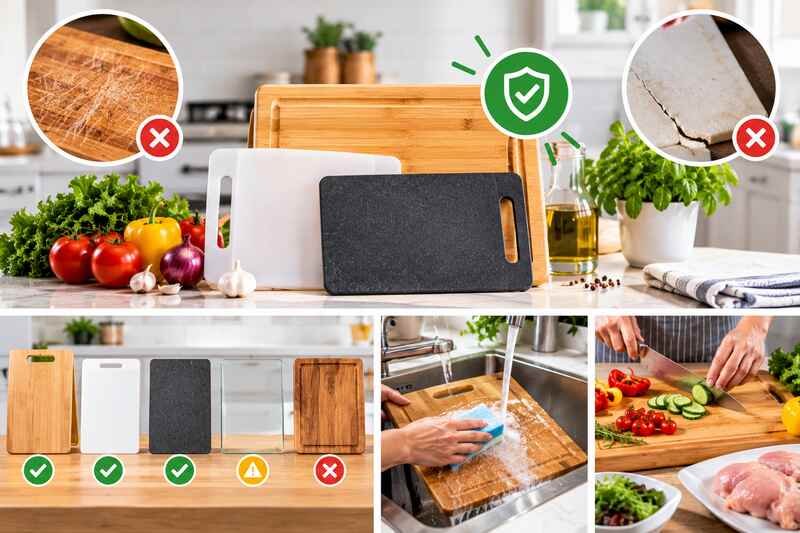
Choosing a cutting board might seem like a small kitchen decision, but it can affect food preparation, knife performance, cleanup, and everyday food safety. A board that is difficult to clean or has deep grooves can become a problem, especially when you prepare raw meat, seafood, fruits, and vegetables on the same surface. That is why many home cooks search for the cutting boards safest and healthiest for everyday use. However, there is no single material that automatically makes a cutting board the safest choice. Glass, plastic, bamboo, titanium-composite, and natural wood boards all have different advantages and drawbacks. Proper cleaning, separate food-preparation surfaces, and regular replacement matter just as much as the material.
For this guide, we reviewed 10 cutting boards from the supplied Amazon product list. The selection includes two tempered-glass options, practical plastic boards, titanium-style boards, and several bamboo and acacia wood choices. We considered their listed materials, dimensions where available, design features, cleaning requirements, and suitability for common kitchen tasks.
This is a specification-based editorial review, not a laboratory test or hands-on product test. Product descriptions and availability can change, so check the current Amazon listing before ordering.
Affiliate Disclosure: KitchenRank may earn a commission when you purchase through links in this article, at no additional cost to you. Our product selections and editorial discussion are based on listed product features and practical considerations for home kitchens.

Fresh ingredients arranged on a wooden cutting board. Photo: Unsplash.
Key Takeaways
- No cutting board material is automatically safest in every situation. Cleanliness, condition, and correct use are essential.
- Plastic and other nonporous boards are generally easier to clean than wood, according to USDA guidance.
- Use separate boards for raw meat, poultry, and seafood and for ready-to-eat foods such as fruits, vegetables, and bread.
- Glass boards have smooth, nonporous surfaces but are very hard on knife edges and may be less comfortable for regular chopping.
- Bamboo and wood boards offer a natural cutting surface but generally require handwashing and careful drying.
- Titanium-style boards should be checked carefully for their actual construction; some products combine a metal surface with plastic or other materials.
- Replace any board that becomes excessively worn, cracked, or difficult to clean.
What Makes a Cutting Board Safe and Healthy?
A cutting board comes into direct contact with the food you prepare. That makes its material, surface condition, and cleaning routine important considerations. A good board should provide a stable preparation surface, be suitable for its intended foods, and be easy enough to clean properly after use.
Before comparing products, it helps to understand the main materials and what each one offers.
1. Plastic Cutting Boards
Plastic cutting boards are popular because they are lightweight, practical, and generally easy to clean. Many are made from polyethylene or other food-contact plastics. Their nonporous surfaces are easier to wash than wood, and some models are dishwasher-safe.
The USDA notes that nonporous materials, including plastic, are easier to clean than wood. This makes a suitable plastic board a practical choice for raw meat and other foods, particularly when it can be washed thoroughly after use.
However, plastic boards are not maintenance-free. Repeated chopping creates knife marks and grooves. Food residue can collect in deep cuts, making the surface harder to clean. A plastic board should be replaced when it becomes excessively worn or develops grooves that cannot be cleaned effectively.
Best for: Everyday food preparation, raw meat preparation when kept separate from ready-to-eat foods, and people who prefer easy cleanup.
2. Wooden Cutting Boards
Wooden cutting boards are valued for their appearance, durability, and comfortable cutting surface. Depending on the type of wood and construction, they can be suitable for everyday chopping, slicing, and serving.
Wood is porous, so it needs appropriate care. Wash it with hot, soapy water, avoid leaving it submerged, and dry it thoroughly. Some wooden boards also need periodic conditioning with a product recommended by the manufacturer.
Not every wooden board has the same construction. Solid hardwood, laminated wood, and bamboo products have different care requirements. Always follow the manufacturer’s instructions rather than assuming every board can be treated identically.
Best for: Home cooks who prefer a natural cutting surface and are willing to maintain it properly.
3. Bamboo Cutting Boards
Bamboo boards are often marketed as an alternative to traditional hardwood. They are generally lightweight, have a natural appearance, and are available in sets with different sizes.
Bamboo boards usually require handwashing and thorough drying. Their construction can involve adhesives, so buyers should check the manufacturer’s material and food-contact information rather than assuming every bamboo product has identical properties.
Like wood, bamboo can develop grooves and surface damage with repeated use. Inspect it regularly and replace it if it becomes cracked or difficult to clean.
Best for: Everyday vegetable preparation, serving, and households that want several board sizes.
4. Glass Cutting Boards
Tempered-glass cutting boards have a smooth, nonporous surface. They can be convenient to wipe clean and may also serve as a trivet or serving surface when the manufacturer permits those uses.
Their biggest disadvantage is the hard cutting surface. Glass does not provide much give when a knife strikes it, which can dull knife edges faster than more forgiving materials. It can also be noisy and less comfortable for extended chopping.
A glass board may be useful for certain kitchen tasks, but it is not necessarily the best everyday surface for someone who regularly uses sharp chef’s knives.
Best for: Occasional food preparation, serving, and people who prioritize a smooth, easy-to-wipe surface over knife comfort.
5. Titanium and Titanium-Composite Cutting Boards
Titanium cutting boards have become more visible in online kitchen product listings. Some are marketed as easy-to-clean alternatives to traditional boards. However, the word “titanium” does not always mean that every surface or component is made from solid titanium.
Some double-sided products combine a titanium surface with polypropylene (PP) or other materials on the opposite side. Others use different constructions. Buyers should read the complete materials description and care instructions before purchasing.
A hard metal cutting surface may also feel different from wood or plastic and may not be ideal for preserving knife edges. Do not assume that a titanium label alone proves a product is safer or healthier than every other material.
Best for: Buyers interested in alternative board designs who are comfortable checking material details and following the manufacturer’s care instructions.
The 10 Cutting Boards Reviewed
Here are the 10 products from your supplied Amazon list. Each review focuses on the product description, listed features, practical uses, and points worth considering before buying.
1. Murrey Home Tempered Glass Cutting Board

Photo amazon
Best for: Buyers looking for a decorative glass countertop or preparation surface
The Murrey Home tempered-glass cutting board is the first glass option in this selection. Its original product listing identifies it as a tempered-glass product, with a decorative kitchen and tableware focus. Glass boards can appeal to shoppers who want a smooth surface that is easy to wipe down and that can also complement the look of a kitchen countertop.
A smooth glass surface has a practical advantage: it does not have the same porous structure as unfinished wood, and visible food residue can generally be wiped away. Depending on the manufacturer’s instructions, a glass board may also be used as a serving or countertop-protection surface.
However, there is an important distinction between a glass board used as a decorative surface and one used for frequent chopping. Glass is very hard. Repeated knife contact can dull knife edges faster than a more forgiving wood or plastic surface. It can also make chopping noisier.
The available product information for this specific listing is limited, so check the Amazon page for the current dimensions, finish, care instructions, and included features before purchasing. Do not assume that it has the same specifications as other glass boards in this review.
Pros
- Tempered-glass construction is identified in the product listing
- Smooth surface can be easy to wipe clean
- Decorative appearance may suit countertop or serving use
- Glass is a nonporous material
Cons
- Hard surface may dull knives
- Can be noisy during chopping
- Available specification details should be checked before ordering
- Requires careful handling
Our take: The Murrey Home board may suit buyers who want a glass kitchen surface with a decorative purpose. If you plan to use a board for frequent knife work, consider pairing it with a more knife-friendly plastic or wood option.
2. Tempered Glass Cutting Board – 16 x 20 Inches

Photo amazon
Best for: A large, smooth, easy-to-wipe preparation or serving surface
This tempered-glass cutting board is one of the largest options in this selection, with a listed size of 16 x 20 inches. That extra surface area can be useful when preparing several ingredients at once or arranging food before cooking.
Its glass construction gives it a smooth, nonporous surface. Compared with a deeply scored board, a smooth surface can be easier to wipe down and inspect for visible residue. The product listing also describes the board as scratch-, heat-, and shatter-resistant and dishwasher-safe. Those are manufacturer-listed features, so buyers should still follow the care instructions and avoid assuming that tempered glass is unbreakable.
One advantage of a glass board is its versatility. Depending on the manufacturer’s instructions, it may also work as a serving surface or a protective surface for certain kitchen tasks.
There is an important trade-off, though. Glass is very hard, and repeated knife contact can dull a blade more quickly than cutting on a suitable wood or plastic board. It may also make chopping noisier and less comfortable.
For that reason, this board may be more appropriate for occasional preparation, serving, or tasks that do not involve frequent knife work. If you cook every day and regularly chop vegetables with a chef’s knife, a more forgiving surface may be a better primary board.
Pros
- Large 16 x 20-inch listed size
- Smooth, nonporous surface
- Listed as dishwasher-safe
- Can be useful for serving as well as preparation
- Easy to wipe down when the surface is in good condition
Cons
- Hard surface can dull knife edges
- May be noisy during chopping
- Glass requires careful handling despite tempered construction
- Not the most comfortable choice for extended knife work
Our take: Consider this board if you want a large glass surface for occasional preparation or serving. For everyday chopping, pair it with a knife-friendlier board.
3. OXO Good Grips Plastic Carving and Cutting Board

Photo amazon
Best for: Everyday kitchen preparation and carving
The OXO Good Grips Carving and Cutting Board is a practical option for households that want a large plastic board with features designed to make food preparation easier.
Its listed dimensions are approximately 14.34 x 21.11 inches, giving you plenty of room for slicing vegetables, preparing ingredients, or carving cooked meat. The product description highlights a double-sided cutting surface, non-slip base, and deep juice grooves.
The juice grooves are particularly useful when carving meat or cutting juicy ingredients. They are intended to collect liquid and help reduce spills across the countertop. The board also has tapered edges and easy-pour corners, which can make it more convenient to move chopped ingredients into a pot or bowl.
Its plastic construction is another practical advantage. Nonporous plastic boards are generally easier to clean than wood, and the product is listed as dishwasher-safe. This can be helpful for people who want a straightforward cleaning routine.
The non-slip features are worth considering as well. A board that stays in place is more comfortable to work on than one that slides while you chop. Even so, always check that the countertop and board are dry and stable before using a knife.
The main limitation is that plastic surfaces can develop knife marks over time. Deep grooves should not be ignored. Inspect the board regularly and replace it if the surface becomes excessively worn or difficult to clean.
Pros
- Large preparation surface
- Double-sided design
- Non-slip base
- Deep juice grooves for carving
- Listed as dishwasher-safe
- Tapered edges and easy-pour corners
Cons
- Large size may require considerable storage space
- Plastic can develop knife marks with use
- Needs replacement if deep grooves become difficult to clean
Our take: This is a strong everyday option for shoppers who want a roomy plastic board with carving-friendly features and convenient cleanup.
4. San Jamar Saf-T-Grip Plastic Cutting Board

Photo amazon
Best for: A straightforward plastic board with grip features
The San Jamar Saf-T-Grip cutting board is a practical choice for people who prefer a dedicated plastic preparation surface. The listed size is 12 x 18 x 0.5 inches, making it a manageable option for everyday kitchen tasks without taking up as much space as an oversized board.
The product is described as a green co-polymer board with anti-slip grip corners and a safety hook. The grip features are intended to help keep the board in place during food preparation. Stability is important because a moving board can make knife work more difficult.
Its half-inch thickness gives it a substantial profile compared with thin flexible cutting mats. The product listing also describes it as warp-resistant and dishwasher-safe. Buyers should check the current listing for the precise care instructions and material details.
The green color may also be useful in a kitchen where boards are assigned to different food groups. Color coding is not a substitute for cleaning, but it can make it easier for household members to remember which board is intended for a particular task.
A key point applies to all plastic boards: the surface will eventually show wear. Even if the board is dishwasher-safe, regular washing does not make a deeply scored surface new again. Replace it when grooves become difficult to clean.
Pros
- Practical 12 x 18-inch size
- Listed half-inch thickness
- Grip corners designed to reduce movement
- Safety hook for storage
- Dishwasher-safe according to the listing
- Green color can support a color-coded kitchen system
Cons
- Smaller than some large carving boards
- Plastic may develop knife marks over time
- Color coding only works when household members follow the system
Our take: The San Jamar board is worth considering if you want a simple, practical plastic board with grip features and a convenient size.
5. SUMZZZ Titanium Cutting Board – Double-Sided Design

Photo amazon
Best for: Buyers interested in a two-sided alternative to conventional boards
This SUMZZZ cutting board is marketed as a double-sided product with titanium and polypropylene (PP) construction. The listing describes separate preparation surfaces for raw and cooked foods and highlights an odor-resistant, easy-to-clean design.
The listed size is approximately 16 x 11 inches, making it suitable for many routine kitchen tasks. A two-sided layout may help users keep different preparation activities separate, provided they consistently assign each side to a specific food category and clean it appropriately.
It is important to understand the material description. This product should not automatically be treated as a solid titanium board. The listing describes a titanium/PP combination, so check the exact materials and which side is intended for each use before purchasing.
The hard-surface question is also worth considering. Metal cutting surfaces can feel different from traditional wood or plastic, and frequent knife contact may be less forgiving for blade edges. If preserving your knives is a priority, this is something to weigh against the product’s cleaning convenience.
A double-sided board does not eliminate cross-contamination by itself. If one side is used for raw meat and the other for ready-to-eat foods, keep the sides clearly assigned and wash them according to the manufacturer’s instructions after use.
Pros
- Double-sided preparation design
- Listed titanium and PP construction
- Separate surfaces may help organize food preparation
- Compact size for everyday kitchen use
- Marketed as easy to clean and odor-resistant
Cons
- Mixed-material construction may not suit buyers seeking a fully titanium board
- Hard cutting surface may be less forgiving on knives
- Users must understand and maintain the separate sides
- Care instructions should be checked before purchase
Our take: This product may appeal to shoppers curious about titanium-style boards. Read the materials and care information carefully, and do not treat the two-sided design as a replacement for proper food-safety practices.
6. Titanium Cutting Board Set of 3 – M, L, and XL

Photo amazon
Best for: Households that want several board sizes
A set of three cutting boards can be useful when you prepare different ingredients throughout the day. This listing describes a double-sided titanium cutting board set with medium, large, and extra-large sizes.
The biggest advantage of a multi-size set is flexibility. A smaller board can be convenient for slicing a lemon, chopping herbs, or preparing a quick snack. A medium board can handle everyday vegetables, while a larger one gives you more space for bigger ingredients.
The product is marketed as dishwasher-safe and designed for different food-preparation tasks. However, the listing title and material claims should be checked carefully before ordering. The term “titanium” can be used in product titles for different constructions, and buyers should confirm whether the boards are fully metal or combine multiple materials.
A set may also help you establish a separate-board routine. For example, you could dedicate one board to produce and another to raw meat. The third can be reserved for bread or other ready-to-eat foods. This only works if the boards remain clearly assigned and are cleaned properly after each use.
Remember that a larger set requires storage space. Check the dimensions and thickness shown on the current Amazon page before deciding whether all three boards will fit comfortably in your kitchen.
Pros
- Three sizes for different preparation tasks
- Double-sided design
- Can support a separate-board routine
- Listed as dishwasher-safe
- Useful for households that prepare several ingredients
Cons
- Requires more storage space than a single board
- Exact construction should be verified
- Hard surfaces may not be ideal for knife-edge preservation
- More pieces mean more items to wash and store
Our take: A three-piece set may be convenient if you want several dedicated preparation surfaces. Confirm the material composition and cleaning directions before buying.
7. ROYAL CRAFT WOOD Bamboo Cutting Board Set

Photo amazon
Best for: A natural-looking multi-board set for everyday food preparation
The ROYAL CRAFT WOOD bamboo cutting board set is designed for households that prefer a natural-looking kitchen accessory and want several board sizes in one purchase.
The listing describes a three-piece set with boards measuring approximately 15 x 10, 12 x 8, and 9 x 6 inches. This size range gives you options for different jobs. The largest board can be used for meal preparation, the medium board for everyday chopping, and the smallest for quick tasks such as slicing fruit or preparing garnishes.
The product description also highlights deep juice grooves and side handles. Juice grooves can help catch liquid from juicy ingredients, while handles make it easier to lift or move the boards. These features can be useful when transferring prepared ingredients from the counter to a serving area.
Bamboo boards need a different care routine from dishwasher-safe plastic boards. Unless the manufacturer explicitly says otherwise, handwash bamboo with mild dish soap and water, avoid soaking it, and dry it thoroughly. Putting a bamboo board in the dishwasher can cause damage, including cracking or warping.
Another consideration is surface wear. Bamboo is still a cutting surface, so repeated knife use can leave marks. Inspect the boards regularly and replace any piece that becomes cracked or difficult to clean.
Pros
- Three sizes for different kitchen tasks
- Natural bamboo appearance
- Deep juice grooves
- Side handles for easier lifting
- Can be used for preparation and serving
Cons
- Requires more careful cleaning than dishwasher-safe plastic
- Should not be soaked
- Needs thorough drying after washing
- Surface may develop knife marks over time
Our take: This set is a useful option for buyers who want multiple bamboo boards and are comfortable with handwashing and regular maintenance.
8. Ziruma Non-Toxic Acacia Wood Cutting Board

Photo amazon
Best for: Buyers looking for a single acacia board with a specified natural finish
The Ziruma cutting board stands out from the other products in this list because it is made from acacia wood and is marketed with a mineral-oil-free finish.
The listing describes a 16 x 11-inch board made from FSC-certified acacia wood. It also identifies a finish made with beeswax, flaxseed oil, and lemon oil. Buyers who prefer to avoid mineral oil in their board’s finish may find these details worth considering.
Acacia has an attractive grain pattern, so the board can also work as a serving surface for bread, cheese, or other foods. Its listed size provides a useful amount of room for regular preparation without being as oversized as some carving boards.
The natural-wood construction does require care. This board should be handwashed according to the listing, not left soaking in a sink, and dried thoroughly after cleaning. Avoid putting it in the dishwasher unless the manufacturer specifically changes or confirms its care instructions.
The product’s “non-toxic” wording is a manufacturer marketing claim, not an independent laboratory certification of every possible safety characteristic. If material and finish composition are important to you, review the current listing and contact the manufacturer for details that are not clearly explained.
Pros
- Acacia wood construction
- Listed 16 x 11-inch size
- Marketed with a mineral-oil-free finish
- Finish described as beeswax, flaxseed oil, and lemon oil
- Natural appearance suitable for preparation and serving
Cons
- Requires handwashing and careful drying
- Not as convenient as a dishwasher-safe plastic board
- Needs regular inspection for cracks and deep cuts
- Finish and material claims should be checked with the manufacturer if you need additional assurance
Our take: The Ziruma board is an interesting choice for shoppers who prefer acacia wood and want a product listing that specifies its finish ingredients. Its maintenance requirements make it better suited to someone willing to care for a wooden board.
9. SMIRLY Three-Piece Bamboo Cutting Board Set with Stand

Photo amazon
Best for: Organized kitchen storage and multiple board sizes
The SMIRLY cutting board set is a bamboo option designed for households that want more than one preparation surface. The listing describes three boards with a stand, handles, and juice grooves.
Having different board sizes can make meal preparation more organized. Rather than washing the same board repeatedly while preparing an entire meal, you can assign separate boards to different ingredients. For example, one board can be used for vegetables, another for bread, and a third for a different preparation task.
The included stand is another practical feature. Proper storage matters because a damp board left flat on a counter may not dry evenly. A storage stand can help keep the boards organized and may make it easier for air to circulate around them. Still, make sure the boards are dry before storing them.
The juice grooves and handles add convenience. Grooves can help catch liquid, while handles make it easier to lift a board from the counter. These features do not remove the need to clean the surface thoroughly after each use.
As with other bamboo products, follow the manufacturer’s cleaning directions. Handwashing and thorough drying are generally the safer approach unless the listing specifically states otherwise.
Pros
- Three-piece bamboo set
- Includes a storage stand
- Handles for easier lifting
- Juice grooves for liquid collection
- Different sizes for different kitchen tasks
Cons
- Requires more storage room than a single board
- Bamboo needs careful drying
- Not a substitute for separate food-preparation practices
- Should be inspected for cracks and deep grooves
Our take: The SMIRLY set is worth considering if you want a coordinated bamboo set with a stand. Its storage features may be especially useful in kitchens where countertop organization matters.
10. Keechee Three-Piece Bamboo Cutting Board Set

Photo amazon
Best for: Everyday bamboo preparation boards in multiple sizes
The Keechee bamboo cutting board set is another multi-size option for home kitchens. Its listing describes a three-piece set made from carbonized bamboo, with built-in handles and deep juice grooves.
The product information identifies sizes of approximately 15 x 10, 12 x 8, and 9 x 6 inches. This gives you a useful range for preparing everything from small garnishes to larger batches of vegetables.
The built-in handles can make the boards easier to move around the kitchen. Deep grooves are intended to collect liquid from ingredients such as tomatoes, fruit, and cooked meat. As with any grooved board, clean the grooves carefully so food residue does not remain trapped.
The carbonized bamboo construction gives the set a darker appearance than some lighter bamboo boards. That may appeal to buyers who want a coordinated look with other kitchen accessories.
The main consideration is care. Bamboo boards should generally be handwashed, dried promptly, and stored in a dry place. Avoid leaving them submerged in water or putting them in the dishwasher unless the manufacturer explicitly approves that method.
A three-piece set can help you keep foods separate, but only if you use each board consistently for its assigned task. After preparing raw meat, poultry, or seafood, wash the board thoroughly before it is used again.
Pros
- Three sizes for flexible food preparation
- Carbonized bamboo appearance
- Built-in handles
- Deep juice grooves
- Useful for both preparation and serving
Cons
- Requires handwashing and thorough drying
- Needs enough storage space for three boards
- Bamboo can crack or warp if poorly maintained
- Grooves require careful cleaning
Our take: The Keechee set is a practical choice for shoppers who want several bamboo boards with handles and juice grooves. Its value depends on whether you will use and maintain all three sizes.

Preparing fresh vegetables on a wooden cutting board. Photo: Jun Ren via Unsplash.
Cutting Board Comparison Table
The table below summarizes the main differences among the 10 products. Product details are based on the supplied product listings; check Amazon for current specifications, variants, and availability.
| Product | Material listed | Main features | Cleaning considerations |
|---|---|---|---|
| Murrey Home | Tempered glass | Decorative glass board | Check current listing |
| Tempered Glass 16 x 20 | Tempered glass | Large, smooth surface | Listed dishwasher-safe |
| OXO Good Grips | Plastic | Large, double-sided, juice grooves, non-slip base | Listed dishwasher-safe |
| San Jamar Saf-T-Grip | Co-polymer plastic | 12 x 18 in; grip corners; safety hook | Listed dishwasher-safe |
| SUMZZZ Titanium Board | Titanium/PP | Double-sided; separate prep surfaces | Check current instructions |
| Titanium Set of 3 | Titanium in listing title | Three sizes; double-sided | Listed dishwasher-safe; verify construction |
| ROYAL CRAFT WOOD | Bamboo | Three sizes; handles; juice grooves | Handwash and dry carefully |
| Ziruma | Acacia wood | 16 x 11 in; specified natural-oil and beeswax finish | Handwash only |
| SMIRLY | Bamboo | Three boards; stand; handles; grooves | Handwash and dry carefully |
| Keechee | Carbonized bamboo | Three sizes; handles; grooves | Handwash and dry carefully |
How to Choose the Safest Cutting Board
The best cutting board for your kitchen depends on how you cook, how much maintenance you are willing to do, and what foods you prepare most often. Consider these factors before choosing one.
1. Choose a Material That Fits Your Cleaning Routine
If you want a board that is easy to wash after preparing raw meat, a suitable nonporous plastic board may be a practical choice. Plastic boards are generally easier to clean than wood, and some can go in the dishwasher.
If you prefer wood or bamboo, be prepared to handwash and dry the board carefully. A natural material is not automatically a healthier option if it is poorly maintained.
Glass may be easy to wipe down, but its hard surface is not ideal for frequent knife work. Titanium-style boards also deserve a closer look at their actual construction and care requirements.
2. Look for a Stable Cutting Surface
A board should stay in place while you work. A sliding board can make chopping uncomfortable and increase the chance of an accidental cut.
Look for non-slip feet, grip corners, or a design that sits securely on your countertop. If your board does not have a non-slip base, place a clean, damp kitchen towel underneath it to help hold it steady.
For additional knife-safety advice, read KitchenRank’s guide on how to prevent cuts in the kitchen and use a kitchen knife safely.
3. Select the Right Size
A board that is too small can make food preparation messy. Ingredients may fall off the edges, and you may have to move chopped food repeatedly.
For everyday cooking, a medium or large board is often more convenient. Smaller boards are useful for quick tasks, while larger boards can be helpful when preparing several ingredients or carving meat.
If you have limited counter space, measure your available area before ordering. Also consider where you will store the board after washing.
4. Consider Juice Grooves and Handles
Juice grooves can help catch liquid from tomatoes, fruit, meat, and other ingredients. They are especially useful when carving or preparing foods that release moisture.
Handles can make a board easier to lift, move, and store. However, grooves and handle openings need to be cleaned properly. Do not overlook these areas when washing the board.
5. Check Dishwasher Compatibility
Dishwasher-safe construction can make cleanup easier, but not every material is suitable for machine washing.
The OXO, San Jamar, and glass listings in this selection describe dishwasher-safe designs. The bamboo and acacia boards should be treated according to their own care instructions. Do not assume that every board can safely go into a dishwasher.
When in doubt, follow the instructions supplied by the manufacturer.
6. Inspect the Surface and Replace Worn Boards
A cutting board does not last forever. Knife marks are normal, but deep grooves, cracks, and excessive wear can make a board difficult to clean.
The USDA advises replacing cutting boards when they become excessively worn or develop hard-to-clean grooves. This recommendation applies to all board materials, not only plastic.
7. Think About Using More Than One Board
One of the most useful ways to improve kitchen food safety is to use separate cutting boards for different food groups.
A simple home setup could include:
- One board for raw meat, poultry, and seafood.
- One board for fruits and vegetables.
- One board for bread and other ready-to-eat foods.
You do not need an expensive set to follow this practice. A clearly labeled or color-coded system can help everyone in the household remember which board to use.
How to Clean and Maintain Cutting Boards
Even a well-designed cutting board needs proper care. Cleaning after each use helps remove food residue, while correct storage reduces unnecessary wear.
Cleaning Plastic and Other Nonporous Boards
For everyday cleaning:
- Remove leftover food and scraps.
- Wash the board with hot, soapy water.
- Clean both sides, including edges, grooves, and handles.
- Rinse thoroughly.
- Allow the board to dry before storing it.
If the manufacturer says the board is dishwasher-safe, use the dishwasher according to its instructions. The FDA also advises washing plastic or other nonporous boards in the dishwasher after use.
Cleaning Bamboo and Wooden Boards
Wood and bamboo boards need a more careful routine:
- Remove food scraps immediately after use.
- Wash with mild dish soap and warm water.
- Avoid soaking the board in a sink.
- Rinse both sides.
- Dry with a clean towel.
- Allow it to finish air-drying before storage.
Do not put a wooden or bamboo board in the dishwasher unless its manufacturer explicitly says it is safe. Excessive heat and prolonged moisture can damage some wood products.
For more detailed maintenance advice, read KitchenRank’s guide on how to take care of a wooden cutting board.
Cleaning After Raw Meat Preparation
Raw meat, poultry, seafood, and their juices can spread harmful bacteria to other foods. Use a separate board for these ingredients whenever possible.
After handling raw meat:
- Wash the board with hot, soapy water.
- Clean the knife, utensils, and nearby surfaces.
- Wash your hands thoroughly.
- Use a clean board for cooked food or ingredients that will be eaten raw.
- Follow the board manufacturer’s instructions for dishwasher use or sanitizing.
The USDA recommends washing cutting boards, dishes, and countertops with hot, soapy water after preparing each food item. It also recommends separate boards for fresh produce and raw meat, poultry, and seafood when possible.
For additional guidance, see the USDA’s cutting board and cross-contamination advice and the FDA’s produce safety recommendations.

Kitchen knife and food preparation on a cutting board. Photo: Gretta Vosper via Unsplash.
Common Cutting Board Mistakes to Avoid
Even a good cutting board cannot protect food if it is used incorrectly. Avoid these common mistakes.
Using the Same Board for Raw Meat and Fresh Produce
This is one of the most important mistakes to avoid. Raw meat and seafood can carry harmful bacteria. If you cut raw chicken and then slice vegetables on the same unwashed surface, you may transfer germs to food that will not be cooked.
Use separate boards whenever possible. If you must reuse a board, wash it thoroughly with hot, soapy water first and follow appropriate sanitizing guidance.
Ignoring Deep Knife Grooves
Small knife marks are expected with regular use. However, deep grooves and cracks can make a board difficult to clean. Do not keep using a heavily damaged board simply because it still looks usable.
Replace boards that become excessively worn or have grooves that cannot be cleaned effectively.
Putting Every Board in the Dishwasher
Dishwasher convenience is useful, but it does not apply to every material. A plastic board labeled dishwasher-safe may be suitable for machine washing, while a bamboo or acacia board may need handwashing.
Always check the manufacturer’s instructions.
Storing a Board While It Is Still Wet
Putting a damp wooden or bamboo board away can encourage moisture-related problems. Dry it thoroughly before storage and avoid leaving it in a damp, poorly ventilated location.
Assuming a “Non-Toxic” Label Guarantees Safety
Product titles often use words such as “non-toxic,” “natural,” or “food-grade.” These phrases should not replace a careful look at the actual materials, finish, and manufacturer information.
No label makes a cutting board immune to contamination. Cleaning, proper use, and surface condition remain essential.
Choosing Appearance Over Practicality
A beautiful board may look great on a countertop, but it should also suit your cooking habits. Consider its size, stability, material, cleaning requirements, and storage needs before making a decision.
Frequently Asked Questions
1. What are the safest and healthiest cutting board materials?
There is no single material that is safest in every situation. Plastic and other nonporous surfaces are generally easier to clean than wood, according to USDA guidance. Wood and bamboo can also be used when properly cleaned and maintained. The most important factors are preventing cross-contamination, cleaning the board thoroughly, and replacing it when it becomes excessively worn.
2. Are wooden cutting boards healthier than plastic?
Not automatically. Wooden boards are popular because of their natural appearance and cutting feel, while plastic boards are generally easier to clean and may be dishwasher-safe. Both need proper maintenance. A damaged or poorly cleaned board of either material can create food-safety concerns.
3. Are bamboo cutting boards safe for food preparation?
Bamboo boards are commonly used for food preparation. Choose a product with clear material and food-contact information, follow its care instructions, and inspect it for cracks or deep grooves. Handwashing and thorough drying are generally appropriate unless the manufacturer provides different instructions.
4. Are glass cutting boards a good choice?
Glass boards have smooth, nonporous surfaces that can be easy to wipe clean. However, they are very hard and can dull knives more quickly than more forgiving cutting surfaces. They may be useful for occasional preparation or serving, but many home cooks prefer wood or plastic for regular chopping.
5. Are titanium cutting boards better than plastic boards?
Not necessarily. Titanium-style boards have different constructions, and some products combine titanium with polypropylene or other materials. Their cleaning and cutting characteristics may differ from traditional plastic boards. Check the actual material description, care instructions, and effect on your knives before choosing one.
6. Can I use one cutting board for meat and vegetables?
It is better to use separate boards. The USDA and FDA recommend keeping raw meat, poultry, and seafood separate from fresh produce and other ready-to-eat foods. If you use the same board for different foods, wash it thoroughly with hot, soapy water between tasks and follow appropriate sanitizing instructions.
7. How often should I replace a cutting board?
There is no universal replacement schedule. Replace a board when it becomes excessively worn, cracked, or develops deep grooves that are difficult to clean. Inspect it regularly rather than relying only on how long you have owned it.
8. Can I put a wooden cutting board in the dishwasher?
Do not assume that a wooden board is dishwasher-safe. Dishwasher heat and prolonged exposure to water can damage some wood products. Follow the manufacturer’s instructions. Many bamboo and acacia boards are intended for handwashing and thorough drying.
9. What is the best cutting board for raw meat?
A suitable, easy-to-clean nonporous board can be a practical choice for raw meat. Many households use a dedicated plastic board because it is relatively easy to wash and some models are dishwasher-safe. Keep it separate from boards used for fresh produce and ready-to-eat foods.
10. Do cutting boards need to be sanitized after every use?
They should always be washed thoroughly after use, especially after contact with raw meat, poultry, seafood, eggs, or their juices. Follow official food-safety guidance and the manufacturer’s instructions for sanitizing. Washing and sanitizing are not the same thing, so do not assume a quick rinse is enough.
11. Are juice grooves necessary on a cutting board?
No. Juice grooves are a convenience feature rather than a food-safety requirement. They can help collect liquid from meat, fruit, and vegetables, reducing spills on the counter. However, grooves need to be cleaned carefully so residue does not remain in them.
12. Should I choose a cutting board set or one large board?
It depends on your cooking habits. A set can make it easier to assign separate boards to different foods and preparation tasks. A single large board may be more convenient if you have limited storage space or prepare large meals on one surface. Whichever option you choose, make sure you can clean and store it properly.
Final Thoughts
Finding the cutting boards safest and healthiest for your kitchen is about more than choosing a material with an appealing label. A good board should fit your cooking routine, provide a stable surface, and be easy to maintain. More importantly, it should be used in a way that prevents cross-contamination.
Among these 10 products, the OXO Good Grips board is a practical everyday plastic option with a large surface, non-slip features, and juice grooves. The San Jamar Saf-T-Grip is worth considering if you prefer a more straightforward plastic board. For natural materials, the ROYAL CRAFT WOOD, SMIRLY, and Keechee sets offer multiple bamboo board sizes, while the Ziruma board provides an acacia option with a specified finish. The glass and titanium-style products may appeal to shoppers looking for alternative surfaces, but their knife compatibility and exact material construction deserve extra attention.
The two glass options, including the Murrey Home board and the larger 16 x 20-inch model, may appeal to buyers who prioritize a smooth surface or decorative use. However, glass is not the most forgiving choice for regular knife work.
There is no need to buy the most expensive board or the one with the boldest marketing claims. Choose a product with clear material information, suitable dimensions, and care instructions you can follow consistently.
Whichever board you choose, keep separate surfaces for raw meat and ready-to-eat foods, wash boards after each use, dry them properly, and replace them when they become excessively worn. Those everyday habits are central to a safer and more practical kitchen.

Hey, My name is MAMON. I am a SEO content creator and affiliate marketer with over 8 years of experience. I create honest product reviews, in-depth buying guides, and practical how-to articles to help readers make informed decisions. My mission is to provide trustworthy, research-backed content that delivers real value.
Leave a Reply