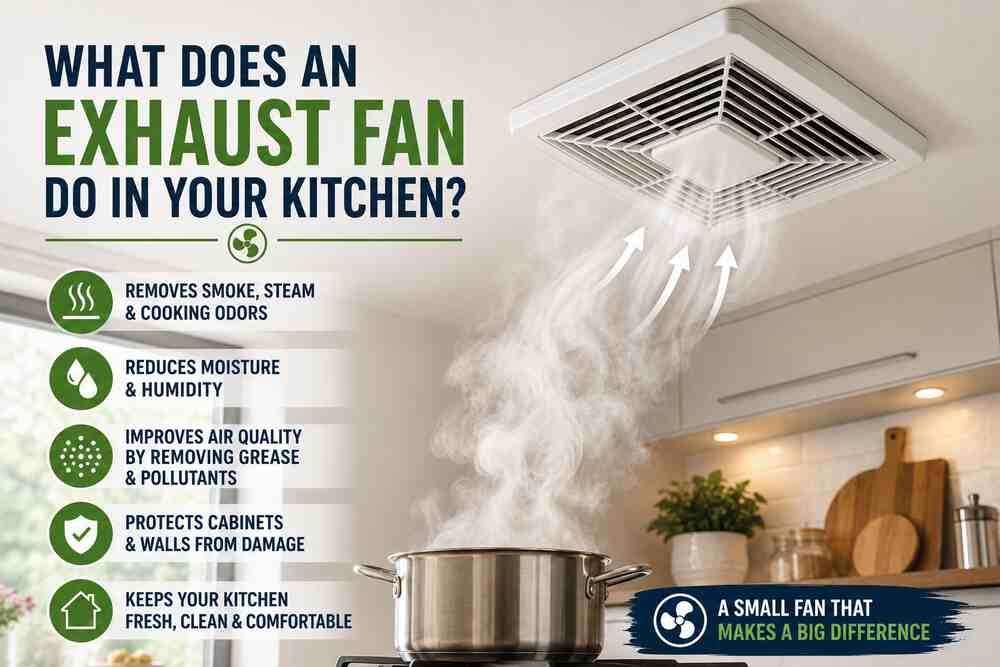
That loud fan buzzing above your stove is doing more than just making noise. If you’ve ever wondered what does an exhaust fan do beyond drowning out conversation, the honest answer is: quite a lot, most of it invisible. It’s pulling smoke, grease, moisture, and pollutants out of your kitchen air before you ever notice them building up. Here’s exactly how it works and why it matters more than most people realize. This guide also covers how to get the most out of the one in your kitchen.
Key Takeaways
- What does an exhaust fan do? It pulls smoke, steam, grease, and cooking pollutants out of your kitchen air. It either vents them outside or filters and recirculates them.
- Cooking, on gas or electric alike, produces fine particulate matter and other pollutants. These build up quickly without ventilation, according to state and federal health data.
- A ducted exhaust fan that vents outside is meaningfully more effective than a ductless, recirculating one.
- Using the fan every time you cook, on high for the first few minutes, does more for air quality than the unit’s size or price.
What Does an Exhaust Fan Actually Do?
At its core, a kitchen exhaust fan works by creating negative pressure. The fan motor pulls the warm, contaminated air rising off your cooktop up into the hood, through a grease filter. From there, it goes either outside through ductwork or through a charcoal filter that recirculates the cleaned air back into the room. That’s the entire mechanism: capture, filter, expel.
What it’s capturing matters. Cooking releases airborne grease that would otherwise coat your cabinets, backsplash, and walls over time. It releases steam and moisture that can encourage mold and mildew if it lingers. Depending on how and what you’re cooking, it also releases combustion byproducts, smoke particles, and odors. Without a fan, these would otherwise sit in your kitchen air for hours.
Range Hood vs. Exhaust Fan: Is There a Real Difference?
In everyday conversation, most people use “exhaust fan” and “range hood” interchangeably. For a kitchen appliance mounted above the stove, that’s a reasonable shorthand. Technically, a range hood refers to the full unit: the hood housing, the grease filter, the light, and the fan inside it. A generic wall or ceiling exhaust fan, the kind more common in bathrooms, is a simpler device. It has no filtration or capture hood, just a motor pulling room air out through a duct. For kitchen use specifically, the hood-style unit with a dedicated grease filter is the far more effective option. It captures pollutants right at the source instead of waiting for them to spread across the room.
Why Kitchen Ventilation Matters More Than People Think
Cooking is one of the most significant sources of indoor air pollution in an average home. It isn’t limited to gas stoves, either. According to the Washington State Department of Health, cooking on any stove type produces fine particulate matter (PM2.5). These are tiny particles that can be inhaled deep into the lungs, and long-term exposure is linked to increased risk of heart and lung conditions. Gas stoves add another layer. Burning natural gas releases nitrogen dioxide (NO2), and homes with gas stoves have measured NO2 levels roughly 1.5 to 4 times higher than homes with electric stoves, according to EPA-referenced research.
That’s exactly what an exhaust fan is built to counter. Using it every time you cook, especially for high-heat cooking like frying, searing, or broiling, meaningfully reduces the pollutants that accumulate indoors. A fan that only gets flipped on when the smoke alarm goes off is missing most of its actual job.
Ducted vs. Ductless: Not All Exhaust Fans Work the Same Way
How your exhaust fan disposes of the air it captures makes a real difference in how effective it is. A ducted (vented) exhaust fan pushes contaminated air through ductwork and out of the house entirely. It permanently removes heat, moisture, and pollutants from your indoor air. A ductless (recirculating) exhaust fan filters the air through a charcoal filter and blows it right back into the kitchen. It catches some grease and odor. But it does nothing for gases like NO2, which makes it a meaningfully weaker option overall. If you have the choice during a renovation or new install, a ducted system vented outside is the better investment for both air quality and grease control.
CFM and Sizing: Getting Enough Airflow
Exhaust fan power is measured in CFM, or cubic feet per minute. This tells you how much air the fan moves. A basic bathroom-style exhaust fan might move under 150 CFM. A proper kitchen range hood typically ranges from 300 to 1,200 CFM. The right number depends on the size of the cooktop and how much heat output it needs to handle. As a rough starting point, many contractors size a hood’s CFM to roughly match or slightly exceed the total BTU output of a gas cooktop, divided by 100. A range with a 60,000 BTU total burner output, for example, generally calls for a hood in the 600 CFM range or higher. Undersized fans struggle to fully capture the plume of heat and smoke rising off the cooktop. Some of it escapes into the room before the fan can pull it in.
Watch: How a Vent Hood Actually Works
This video breaks down the mechanical parts inside a range hood. It shows how the fan, filter, and ductwork work together.
Signs Your Exhaust Fan Isn’t Doing Its Job
A few warning signs suggest your exhaust fan isn’t performing the way it should, even if it still turns on and spins. Lingering smoke or cooking odors long after you’ve finished are the most obvious sign, and usually point to weak airflow or a clogged filter. Grease buildup on cabinets and walls near the stove, especially if it’s appeared gradually over months, means pollutants are escaping past the hood instead of being captured. A fan that sounds strained or noticeably weaker than it used to can indicate a struggling motor or a duct that’s become blocked or crushed somewhere along its run. Any of these are worth investigating rather than living with, since a fan that isn’t working at full capacity isn’t giving you the air quality benefit it’s designed for.
What Does an Exhaust Fan Do for Resale and Home Value?
Beyond air quality, a properly vented kitchen exhaust fan is something many buyers and inspectors specifically look for. Grease and moisture damage from years without ventilation can show up as discolored cabinetry, peeling paint, or even mold in more severe cases, all of which are visible red flags during a home inspection. A working, adequately sized exhaust system signals that a kitchen has been maintained with an eye toward long-term upkeep, not just appearance. It’s a relatively minor detail in the scope of a home sale, but it’s one more reason a functioning exhaust fan is worth taking seriously rather than treating as background noise.
Getting the Most Out of Your Exhaust Fan
A few habits make a real difference in how well your exhaust fan does its job. This guidance comes from state health departments.
- Turn it on before you start cooking, not after the smoke alarm complains. Running it a few minutes ahead helps establish airflow.
- Use the highest fan speed for high-heat cooking like frying, searing, or broiling. Switch to a lower setting for simmering or boiling.
- Cook on the back burners when possible. They sit closer to the hood’s capture area than the front burners do.
- Let it run for a few minutes after you’re done cooking to clear residual smoke and moisture.
- If you don’t have a working exhaust fan, open a nearby window. It creates airflow across the room as a partial substitute.

Maintenance Keeps It Working
An exhaust fan only performs as well as its filter allows. A grease-clogged filter restricts airflow and makes the fan work harder for a weaker result. Metal mesh or baffle filters should be washed regularly, typically monthly with normal use. Charcoal filters in ductless systems need periodic replacement, since they can’t be cleaned and reused. Neglecting this is one of the most common reasons a perfectly good exhaust fan starts to feel ineffective over time.
Frequently Asked Questions
What does an exhaust fan do differently from a range hood?
In everyday use, the terms are largely interchangeable for kitchen appliances mounted above a stove. Technically, “exhaust fan” can also refer to simpler wall or ceiling fans without a capture hood or grease filter, common in bathrooms. For kitchen ventilation specifically, the hood-style unit is the more effective choice.
What does an exhaust fan do that a window can’t?
An exhaust fan actively pulls pollutants out of the kitchen at the source, right above the cooktop. An open window relies on passive airflow instead, which is inconsistent and weather-dependent. A window helps as a backup, but it isn’t a substitute for a properly vented fan.
Do I need an exhaust fan if I cook on an electric stove?
Yes. Electric cooking still produces fine particulate matter and smoke, just without the added nitrogen dioxide from gas combustion. Ventilation matters for any stove type, not just gas.
Is a ductless exhaust fan worth installing if I can’t vent outside?
It’s better than nothing, since it does capture some grease and odor. But it’s meaningfully less effective at removing gases and fine particles than a ducted system. If outside venting is possible during a renovation, it’s the better long-term choice.
How often should I run my kitchen exhaust fan?
Every time you cook, ideally starting a few minutes before and continuing a few minutes after. This matters most for high-heat cooking like frying or searing.
What size exhaust fan do I need for my kitchen?
A common rule of thumb is roughly 1 CFM per 100 BTUs of your cooktop’s total burner output. Hood width and kitchen layout factor in too. A qualified installer can size it precisely for your setup.
Final Thoughts
So, what does an exhaust fan do? It quietly handles one of the more overlooked jobs in a kitchen: pulling grease, moisture, smoke, and airborne pollutants out before they settle into your cabinets, your walls, and your lungs. Whether you already have one installed or you’re weighing a new one, two habits matter more than almost anything else. Use it consistently, and keep the filter clean.
If you’re setting one up for the first time, see our guide to installing an exhaust fan in your kitchen. Once it’s in place, our guide to cleaning your kitchen exhaust fan covers the maintenance that keeps it working at full strength. For gas range ventilation requirements specifically, see our guide to whether gas ranges need to be vented.

Hey, My name is MAMON. I am a SEO content creator and affiliate marketer with over 8 years of experience. I create honest product reviews, in-depth buying guides, and practical how-to articles to help readers make informed decisions. My mission is to provide trustworthy, research-backed content that delivers real value.
Leave a Reply