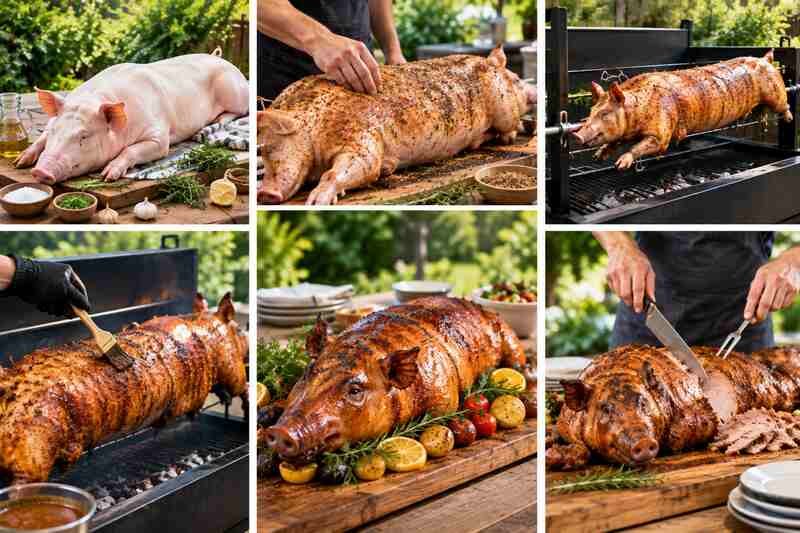
Learning how to roast a pig turns any backyard gathering into an event people remember. It also intimidates a lot of first-timers, and for good reason. You’re cooking 50 to 150 pounds of meat over live fire for most of a day. A mistake can mean a burnt outside with a raw center, or worse, meat that never reaches a safe temperature. The good news: with the right pig, the right gear, and a plan for timing, you can pull this off on your first attempt.
This guide covers everything you need to know about how to roast a pig safely and well. That includes how to pick and order the right pig, what equipment actually matters, how long to budget for cooking, the exact internal temperatures the USDA recommends, and what the whole project tends to cost in the U.S. in 2026.
Key Takeaways
- Plan on roughly 6 ounces of cooked meat per pound of live pig weight, and budget 1 to 2 hours of cook time per 10 pounds at 225-250°F.
- The USDA sets 145°F with a 3-minute rest as the safe minimum for pork cuts, but whole-hog cooks typically run hotter, into the 190-205°F range in the shoulder, so the meat pulls apart easily.
- A whole pig from a reputable farm or butcher typically runs $600-750 in 2026, plus $30-50 in charcoal for a full-day cook.
- Order your pig at least a week ahead. The farm or butcher needs time to slaughter, hang, and chill it properly.
How Much Pig Do You Need?
Start with your guest count, then work backward. A good rule of thumb: 1 pound of live pig weight yields about 6 ounces of cooked, debonded meat. So a 60-pound pig feeds roughly 40 people if you’re serving 6-8 ounces per plate alongside sides. For a crowd of 75-100, look for a pig in the 80-100 pound range.
Pig age changes the eating experience more than most people expect. A young pig, generally under six months, carries less fat and cooks up tender and juicy with a shorter roasting time. An older pig has more fat and connective tissue. That extra fat makes the meat richer but also tougher if you rush it, so older pigs do best with the slow, low-heat approach common in Southern barbecue.
Buy from a farm or butcher you trust, and ask how the animals are raised. A pig raised in clean, low-stress conditions carries a lower bacterial load, and that makes proper cooking temperatures matter less as your only safeguard. Order at least a week in advance. Most farms slaughter and hang pigs to order rather than keeping them in stock. Once you pick up the pig, keep it packed in ice and covered until it goes on the fire. Bacteria multiply fast in the 40-140°F “danger zone.” Minimizing the time your pig spends near room temperature matters as much as the cooking itself.
Equipment and Ingredients You’ll Need
The centerpiece is the spit, sometimes called a rotisserie rod, that holds the pig steady while it turns. If you bought your pig from a farm that specializes in whole-hog sales, ask if they rent spits. Most modern spits use a small electric motor to keep rotation even. Uneven rotation means uneven cooking, with some parts scorching while others lag behind.
An increasingly popular alternative for U.S. backyard cooks is a roasting box like those from La Caja China, a Miami-based company that’s built charcoal roasting boxes since the 1980s. Instead of a rotating spit over open coals, the pig sits skin-side up inside an insulated box while charcoal burns on a tray above it. It’s more forgiving for beginners. The box regulates heat more evenly than an open fire, and it needs less hands-on attention during the cook.
Whichever method you choose, here’s what to have on hand:
- Charcoal briquettes: Plan on 30-70 pounds depending on pig size and cook time. Stick with briquettes rather than lump hardwood charcoal. Lump charcoal burns hotter and faster, making it harder to hold a steady temperature over many hours.
- Chimney starter: Lets you light coals in batches without lighter fluid, which can taint the flavor.
- Long-handled tongs: For adding coals safely throughout the cook.
- Kosher salt: The simplest, most reliable seasoning. Salt the cavity and skin generously the night before if you can.
- Instant-read meat thermometer: Non-negotiable. You cannot judge doneness on a pig this size by look alone.
- Heavy-duty aluminum foil: Useful for shielding the ears and thinner cuts like the legs. Cover these spots if they start to darken faster than the rest of the pig.

How Long Does It Take to Roast a Whole Pig?
Cook time depends almost entirely on weight and your target temperature. As a general rule, budget 1 to 2 hours per 10 pounds of pig at a steady 225-250°F. Here’s a more specific breakdown for planning purposes:
| Pig Weight (live) | Approximate Cook Time |
|---|---|
| 20-40 lbs | 4-6 hours |
| 40-60 lbs | 6-8 hours |
| 60-80 lbs | 8-10 hours |
| 80-100 lbs | 10-12 hours |
These times assume a consistent fire. A 90-pound dressed pig cooked in a roasting box at around 275°F typically finishes in about 10 hours. That cook burns through roughly 60-70 pounds of charcoal along the way. Larger pigs cooked low and slow on an open spit, in the 200-210°F range, can take considerably longer. A very large hog can need 18-24 hours. Build in extra time no matter which method you use. A pig that finishes two hours early is much less stressful than one that’s still raw when guests arrive.
Step-by-Step: Roasting the Pig
Securing the pig to the spit takes real care. A dead pig is heavy and can shift or flop as you position it. Work with a helper rather than alone. Run the spit through the body cavity and truss the legs securely so the weight stays balanced as it rotates. An off-balance pig strains the motor and cooks unevenly.
Watch the skin closely during the first hour. If it darkens too fast or takes on a burnished look, your fire is running too hot. Slow down how quickly you add fresh coals, or raise the pig farther from the heat. The goal early on is slow, even color development, not a fast sear.
Keep the fire steady rather than hot. Add small batches of lit charcoal every 30-45 minutes rather than dumping in a large amount at once. Dumping in coal causes temperature spikes. If you’re using an electric-motor spit, check periodically that rotation stays smooth. If you’re hand-turning, rotate every 15-20 minutes for even cooking.
Baste occasionally if your recipe calls for it, but resist the urge to open a roasting box or move the pig around excessively. Every time you break the seal on a box cooker or stop rotation on a spit, you lose heat and add time to the cook. If this is your first whole hog, ask an experienced pit master or farm employee to walk you through your specific setup before you start. The fundamentals translate across methods, but every spit and box has its own quirks.
How to Know When the Pig Is Done
Temperature, not time, is what actually tells you the pig is safe and ready. The National Pork Board sets 145°F with a 3-minute rest as the USDA-recommended minimum internal temperature for pork cuts, and 160°F for ground pork. For whole-hog cooking, most experienced cooks push well past that minimum in the shoulder and ham. Those cuts are loaded with collagen that needs time and heat to break down.
Collagen begins converting to gelatin around 160°F and keeps breaking down as the internal temperature climbs toward 180°F and beyond. That’s why a whole hog’s shoulder is typically pulled around 195°F internal. A well-cooked brisket needs a similar 200-210°F before it shreds easily. Check multiple spots: shoulder, ham, and loin. The loin cooks faster and can dry out if you’re chasing the shoulder’s higher target. Insert your thermometer away from bone, since bone reads hotter than the surrounding meat and can give you a false high reading.
What Does a Whole Pig Cost?
Budget $600-750 on average for a whole pig from a U.S. farm or butcher in 2026. Pricing varies by region and by hanging weight, since pigs are typically priced per pound dressed rather than as a flat fee. Processing, which includes slaughter and cleaning, typically adds another $350-400 on top of the animal cost. A pig in the 80-100 pound live weight range generally yields 140-200 pounds of packaged, usable meat once processed.
Add charcoal (30-70 pounds at current retail prices), a spit or box rental if you don’t own one, and basic seasoning. Most home cooks land somewhere between $700 and $1,000 all-in for a hog that feeds 50-75 people comfortably. That works out to well under $15 per person for the meat alone, competitive with catering a much smaller gathering.
Best Side Dishes for a Pig Roast
A whole hog is rich and savory, so the best sides bring acidity or freshness to balance the plate:
- Cheese grits casserole
- Baked macaroni and cheese
- Roasted green beans
- Garlic mashed cauliflower
- Baked polenta with fresh tomatoes and parmesan
- Couscous fruit salad
- Fried cabbage with bacon
- Balsamic butternut squash with kale
For a pull-apart pork sandwich later in the week, shred leftover shoulder meat. If you want to tenderize smaller cuts you set aside before the main roast, our guide on the best way to tenderize meat covers methods that work well for quick prep sides.
Watch: Roasting a Whole Pig in a Box
This walkthrough from Tim Farmer’s Country Kitchen shows the La Caja China box method from setup through carving. It’s a helpful visual reference if you’re leaning toward that approach over an open spit.
Common Mistakes to Avoid
Most whole-hog disasters trace back to a handful of avoidable errors. Running the fire too hot early is the most common: it chars the skin before the interior has a chance to cook through. Lump hardwood charcoal is a frequent culprit here since it burns hotter and less predictably than briquettes.
Skipping a thermometer is another common mistake. A pig this size looks and smells done well before the shoulder and ham reach a safe, tender temperature. Guessing by time alone is how people end up serving undercooked meat near the bone.
Finally, don’t underestimate ice and cold storage before the cook. A pig that sits too long in the danger zone before it hits the fire creates food safety risk no cooking time can fully offset. Keep it iced and covered right up until it goes on the spit or into the box.
Looking for more smoke character in your barbecue beyond a whole-hog roast? Our guide on how to get more smoke flavor from a pellet grill covers techniques that apply to other cuts too. When it’s time to carve, a proper slicer knife makes clean work of portioning the meat for serving.
Frequently Asked Questions
How long does it take to roast a whole pig?
Most whole hogs take 1 to 2 hours per 10 pounds of live weight at 225-250°F. A 60-pound pig typically needs 6-8 hours, while a pig over 80 pounds can take 10-12 hours or more.
What temperature should a whole roasted pig reach?
The USDA minimum safe temperature for pork is 145°F with a 3-minute rest. For whole-hog cooking, most cooks target 190-205°F in the shoulder and ham so the collagen breaks down and the meat pulls apart easily.
How much does it cost to roast a whole pig?
A whole pig typically costs $600-750 in the U.S. in 2026, plus $350-400 for processing and $30-70 in charcoal, depending on size and cook length. Most home cooks spend $700-1,000 total for a pig that feeds 50-75 people.
Is it safe to roast a whole pig at home?
Yes. Source the pig from a reputable farm or butcher, keep it properly iced before cooking, and use a meat thermometer to confirm the shoulder and ham reach a safe internal temperature. Guessing by appearance alone is the biggest safety risk.
What’s the difference between a spit roast and a La Caja China box?
A spit rotates the pig over open coals and requires more hands-on attention to keep the fire even. A box like La Caja China holds the pig still under a tray of charcoal, which regulates heat more consistently and suits first-time whole-hog cooks well.
Conclusion
Now that you know how to roast a pig the right way, the project is far less intimidating than it looks. Respect three things: buy from a source you trust and keep the pig properly chilled, budget realistic time for the size of the animal, and cook to temperature rather than to a clock. Whether you choose an open spit or a roasting box like La Caja China, the fundamentals stay the same. Get those right, and you’ll end up with a centerpiece that’s worth every hour it takes.

Hey, My name is MAMON. I am a SEO content creator and affiliate marketer with over 8 years of experience. I create honest product reviews, in-depth buying guides, and practical how-to articles to help readers make informed decisions. My mission is to provide trustworthy, research-backed content that delivers real value.
Leave a Reply