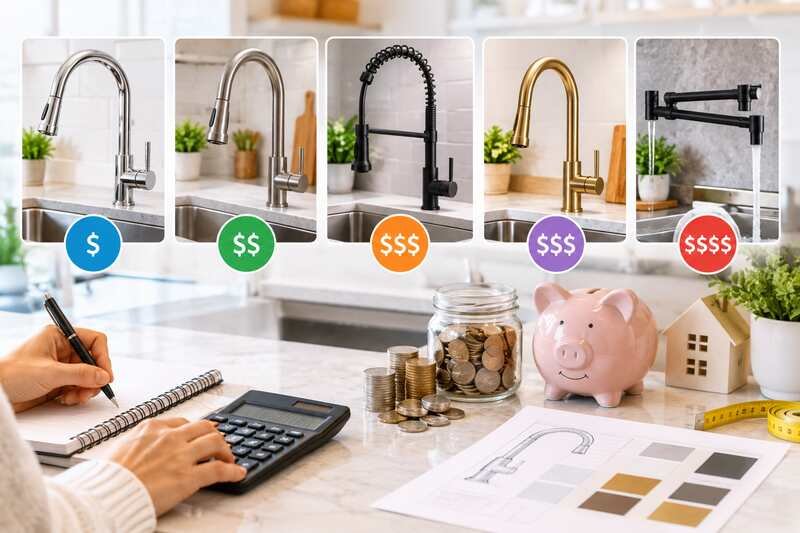
For most U.S. homeowners, the honest answer to how much should you spend on a kitchen faucet is somewhere between $150 and $600, faucet and installation combined. Most people land around $250 to $400 for a solid mid-range pull-down model. Where you land inside that range depends less on the brand name and more on the finish, the mechanism, and how long you actually want it to last before you’re back in this same aisle.
Key Takeaways
- Budget faucets run $70-$200, mid-range $200-$400, and high-end $400-$900+, according to HomeGuide.
- Professional installation typically adds $120-$480 in labor on top of the faucet itself, per Angi.
- Touchless and touch-activated faucets cost more upfront ($300-$700) but can be worth it for hygiene and convenience in a busy kitchen.
- A WaterSense-labeled faucet uses 1.5 gallons per minute or less, which the EPA estimates saves a household about 700 gallons of water a year.
How Much Should You Spend on a Kitchen Faucet? Quick Price Ranges
Before getting into the details, here’s the short version of how much should you spend on a kitchen faucet based on the tier you’re shopping in:
- Budget ($70-$200): Basic single-handle faucets in chrome or a simple finish. Functional, but often plastic or zinc-alloy internals that wear faster.
- Mid-range ($200-$400): The sweet spot for most households. Solid brass construction, a pull-down sprayer, and a finish that resists water spots.
- High-end ($400-$900+): Commercial-style, bridge, or touchless faucets with premium finishes and longer warranties.
- Installation labor: $120-$480 depending on whether it’s a straightforward swap or requires new plumbing lines.
What Actually Determines a Kitchen Faucet’s Price
Two faucets that look nearly identical in a showroom can be $150 apart once you check the price tag. Here’s what’s driving that gap.
Material
Solid brass faucets cost more but resist corrosion and hold up to daily use far longer than the zinc-alloy or plastic bodies used in cheaper models. A brass faucet with a durable finish is usually the difference between replacing your faucet in 5 years versus 15.
Finish
Chrome is the most affordable finish, typically adding $40-$200 to a faucet’s base price. Brushed nickel, matte black, and stainless steel finishes cost more, often $105-$750 depending on the base faucet, because they require additional plating processes to resist fingerprints and water spots.
Handle Type and Technology
A traditional single-lever faucet is the cheapest option. Touch-activated models, which turn on with a tap anywhere on the faucet body, add a premium for the internal sensor and solenoid valve. Fully touchless, motion-sensor faucets cost the most because they combine that technology with a battery or AC-powered control module.
Brand and Warranty
Established brands like Moen, Delta, and Kohler price similarly for comparable features, generally $60-$700 depending on the line, but the warranty length varies. Many mid-range and high-end faucets from major brands come with a limited lifetime warranty on the finish and function. That coverage matters more than the sticker price if you’re planning to stay in your home for a while.

Kitchen Faucet Types and What Each One Costs
1. Traditional Lever Handle Faucets
This is still the most common type and the least expensive to buy and install. A single lever controls both water flow and temperature, and many models include an ADA-friendly handle for easier operation. Expect to pay $120-$350 for a quality single-handle faucet, with double-handle and side-sprayer configurations landing near the top of that range. Our guide on how to tighten a loose kitchen faucet handle covers a common maintenance issue with this style.
2. Pull-Down and Pull-Out Faucets
The most popular style in U.S. kitchens today. The spray head detaches and extends on a hose, useful for rinsing large pots or washing produce. These run $175-$500, with the price climbing based on the hose’s retraction mechanism and the number of spray settings.
3. Touch-Activated Faucets
These add a sensor to a standard lever-handle design, so a single tap anywhere on the spout or handle turns the water on or off. That’s especially useful when your hands are covered in raw chicken or bread dough. Expect $250-$450, and look for a shiny brass or stainless steel finish at this price point for the best long-term durability. Our explainer on how a touch faucet works breaks down the sensor technology in more detail.
4. Touchless (Motion-Sensor) Faucets
The most advanced and most expensive standard option, using a motion sensor at the base to turn water on automatically when it detects your hands. Prices run $300-$700, and this style is worth the premium if hygiene is a priority or if anyone in the household has limited hand mobility.
5. Bridge and Commercial-Style Faucets
Bridge faucets have separate hot and cold handles connected by an exposed bridge. Commercial-style faucets use a pull-down coiled hose instead. Both sit in the higher-end category, running $400-$1,000, and are typically chosen for their look and heavy-duty spray function rather than any single practical advantage over a pull-down model.
What You’ll Pay by Brand
Brand alone doesn’t determine price nearly as much as the specific product line, but knowing where popular brands typically fall can help you set expectations before you start browsing. According to HomeGuide, here’s roughly where major brands land:
- Glacier Bay: $30-$200, a budget-focused house brand sold primarily through Home Depot.
- Pfister: $40-$600, spanning basic to premium lines with a strong mid-range selection.
- Moen: $60-$600, one of the most widely available brands with options at nearly every price point.
- Delta: $50-$700, known for touch and touchless technology across its mid-to-high-end lines.
- American Standard: $50-$400, generally positioned as a value-focused mid-range brand.
- Kohler: $100-$1,000, with a wide range from solid mid-tier options to premium designer collections.
- Grohe: $90-$600, a German brand known for engineering quality in the mid-to-high range.
None of these ranges tell you which specific faucet to buy, but they’re a useful gut check if a listing seems unusually cheap or expensive for the brand name attached to it.
How Long a Kitchen Faucet Should Last For the Price
A faucet’s expected lifespan is part of the real math behind how much should you spend on a kitchen faucet, since a cheaper unit that needs replacing twice as often isn’t actually saving you money.
- Budget faucets (under $200): Typically last 5-8 years before the finish wears or internal valves start leaking.
- Mid-range faucets ($200-$400): Solid brass construction usually lasts 10-15 years with normal use.
- High-end faucets ($400+): Premium ceramic disc valves and finishes can push lifespan to 15-20 years, backed by a limited lifetime warranty from most major brands.
If you’re replacing a faucet that failed well before its expected lifespan, it’s worth checking your local water hardness. Mineral buildup from hard water is one of the most common reasons a faucet’s internal valve fails early, regardless of price point.
Repair or Replace? When a New Faucet Actually Makes Sense
Not every dripping or wobbly faucet needs a full replacement, and figuring that out first can change how much should you spend on a kitchen faucet this year versus spending nothing at all.
- Repair instead: A single drip is often just a worn cartridge or O-ring, a $10-$30 part that a confident DIYer can swap in under an hour.
- Repair instead: A loose handle is usually a simple tightening job rather than a sign the whole unit is failing.
- Replace: If the finish is pitted, peeling, or stained no matter how much you clean it, that damage isn’t fixable and signals the faucet is near the end of its life.
- Replace: If you’re repairing the same faucet for the second or third time in a year, the cost of parts and your time has likely already exceeded what a new mid-range faucet would cost.
Installation Costs: DIY vs. Hiring a Plumber
A straightforward faucet swap, same location, same number of mounting holes, is a reasonable weekend DIY project if you’re comfortable with basic plumbing. If you’re paying a professional, Angi puts the average labor cost at $260-$480, while some plumbers charge a flat $120-$250 for a simple like-for-like replacement.
Installation costs climb when the project involves more than swapping the faucet itself:
- Changing the number of mounting holes in your sink or countertop.
- Running new supply lines, which can cost $2.50-$15 per linear foot.
- Replacing corroded shutoff valves under the sink.
- Adding a separate air gap or soap dispenser hole.
If you’re also updating supply lines or a disposal at the same time, our guide on how to plumb a kitchen sink with disposal and dishwasher is a useful companion resource before you start.
Is It Worth Spending More on a Kitchen Faucet?
For most households, yes, up to a point. A $250-$350 solid brass faucet from an established brand will typically outlast two or three $100 budget faucets, and the finish will still look new after years of daily use. Beyond about $500, though, you’re often paying for design and brand prestige rather than meaningfully better function.
A few things that do justify a higher spend:
- Household size: A busy family kitchen puts far more wear on a faucet than a single-person household, and it’s worth spending more for durability.
- Water efficiency: Look for the WaterSense label. These faucets are capped at 1.5 gallons per minute, roughly 30% less than a standard faucet. The EPA estimates that can save a household around 700 gallons of water a year without a noticeable drop in performance.
- Resale value: A dated or worn faucet is one of the first things buyers notice in a kitchen walkthrough. A mid-range upgrade can pay for itself if you’re planning to sell.
Watch: How to Choose the Right Kitchen Faucet
How to Get More Value at Any Budget
- Buy the faucet and sprayer as a matched set rather than mixing brands, which keeps warranty coverage intact if something fails.
- Choose a brushed or matte finish over polished chrome if you have hard water, since it hides mineral spots far better.
- Check the warranty terms before comparing price. A $300 faucet with a lifetime warranty can be a better value than a $200 faucet with a 5-year warranty.
- If your sprayer hose wears out before the rest of the faucet does, replacing just the hose is often cheaper than replacing the whole unit. See our guide on replacing a kitchen faucet sprayer hose.
- If you’re mounting a faucet on the wall instead of the countertop or sink deck, budget slightly more for installation. Our wall-mounted faucet installation guide walks through what’s different about that setup.
Frequently Asked Questions
How much should you spend on a kitchen faucet for an average home?
Most U.S. homeowners should budget $200-$400 for the faucet itself, which covers a durable, solid brass, pull-down model from an established brand, plus $120-$480 for professional installation if you’re not doing it yourself.
Is it worth buying a touchless kitchen faucet?
It can be, especially if hygiene is a priority or anyone in the household has limited hand mobility. Touchless models run $300-$700, more than traditional faucets, but many homeowners find the convenience worth the extra cost.
Do more expensive kitchen faucets actually last longer?
Generally yes, up to a point. Solid brass construction and a quality finish, common in the $200-$500 range, resist corrosion and wear far better than the zinc-alloy or plastic parts found in sub-$100 faucets. Spending well above $500 tends to buy design rather than additional durability.
Can I install a kitchen faucet myself to save money?
Yes, a straightforward one-for-one swap is a manageable DIY project for most homeowners and saves the $120-$480 labor cost. If the project involves new supply lines, a different number of mounting holes, or corroded shutoff valves, hiring a plumber is usually worth the cost.
What’s the difference between touch and touchless kitchen faucets in price?
Touch-activated faucets, which turn on with a tap anywhere on the body, typically cost $250-$450. Touchless, motion-sensor faucets cost more, usually $300-$700, because they use a more complex sensor and control module.
Does a more expensive kitchen faucet use less water?
Not automatically, but many mid-range and high-end faucets carry the WaterSense label, which caps flow at 1.5 gallons per minute. A budget faucet can also be WaterSense certified, so check for the label specifically rather than assuming a higher price means better water efficiency.
Conclusion
So, how much should you spend on a kitchen faucet? For most U.S. households, $200-$400 on a solid brass, pull-down faucet from an established brand hits the sweet spot between durability, warranty coverage, and price. Go higher if you want touchless convenience or a commercial-style look, and factor in $120-$480 for installation if you’re hiring it out. Whatever tier you land in, prioritize solid construction and a real warranty over finish trends, since that’s what actually determines whether you’re back in the faucet aisle in five years or fifteen.

Hey, My name is MAMON. I am a SEO content creator and affiliate marketer with over 8 years of experience. I create honest product reviews, in-depth buying guides, and practical how-to articles to help readers make informed decisions. My mission is to provide trustworthy, research-backed content that delivers real value.
Leave a Reply