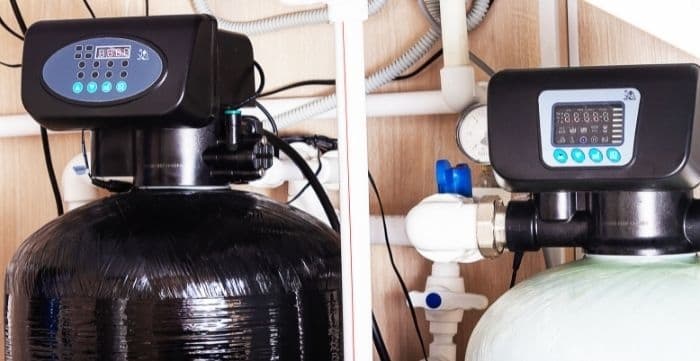
How does a commercial water softener work? It pulls hard water through a tank of resin beads that swap out calcium and magnesium for sodium, then periodically flushes and recharges that resin with a salt brine solution so it can keep doing the job. That’s the short answer. The longer answer matters a lot more if you’re running a hotel, restaurant, laundromat, or manufacturing facility, because getting the sizing, tank configuration, and regeneration schedule right is the difference between protected equipment and a scale problem that shows up in your utility bills.
Roughly 85% of U.S. households and businesses deal with some degree of hard water, according to USGS measurements, and commercial operations feel the cost more than most, since scale builds up faster in equipment that runs water constantly, like dishwashers, boilers, and laundry machines. Below, we’ll break down exactly how commercial softeners work, how they differ from the residential unit in your neighbor’s basement, and what to know about sizing one for your business.
Key Takeaways
- Commercial water softeners use ion exchange: resin beads coated in sodium ions trade places with the calcium and magnesium ions that make water “hard.”
- Water above 7 grains per gallon (120 mg/L) is classified as hard by USGS standards, and most commercial equipment benefits from softening above that threshold.
- Commercial units differ from residential softeners mainly in sizing, metered regeneration, and multi-tank configurations that guarantee soft water around the clock.
- Sizing depends on daily water usage in gallons and incoming hardness in grains per gallon; undersized systems run out of capacity mid-day, and oversized ones waste salt and water on unnecessary regeneration cycles.
What is hard water, and why does it matter for businesses?
Hard water contains dissolved calcium and magnesium minerals picked up as water moves through limestone and chalk deposits underground. These minerals are harmless to drink, but they cause real operational problems: calcium carbonate scale builds up inside boilers, dishwashers, water heaters, and pipes, which makes equipment work harder, use more energy, and fail sooner.
Water hardness is measured in grains per gallon (gpg) or parts per million (ppm), where 1 gpg equals roughly 17.1 ppm. USGS classifies water hardness into four tiers: soft (0 to 3.5 gpg), moderately hard (3.5 to 7 gpg), hard (7 to 10.5 gpg), and very hard (above 10.5 gpg). Most commercial operations start seeing real scale problems once incoming water crosses 7 gpg, which describes a large share of municipal and well water supplies across the Midwest and Southwest United States.
How does a commercial water softener work?
The core process behind how a commercial water softener works is called ion exchange, and it’s the same principle whether you’re softening water for a single-family home or a 300-room hotel, just scaled up. Hard water enters a tank packed with thousands of small polystyrene resin beads. Each bead carries a negative charge and is coated with sodium ions. Because calcium and magnesium ions carry a stronger positive charge than sodium, they displace the sodium on contact with the resin, effectively trading places with it as water flows through the bed.
As water passes through the resin bed, its velocity slows and spreads across a wider surface area of beads, which gives the hardness minerals more contact time to bind to the resin. Water exits the tank stripped of calcium and magnesium, carrying a small amount of sodium instead, with essentially no drop in water pressure if the system is sized correctly.
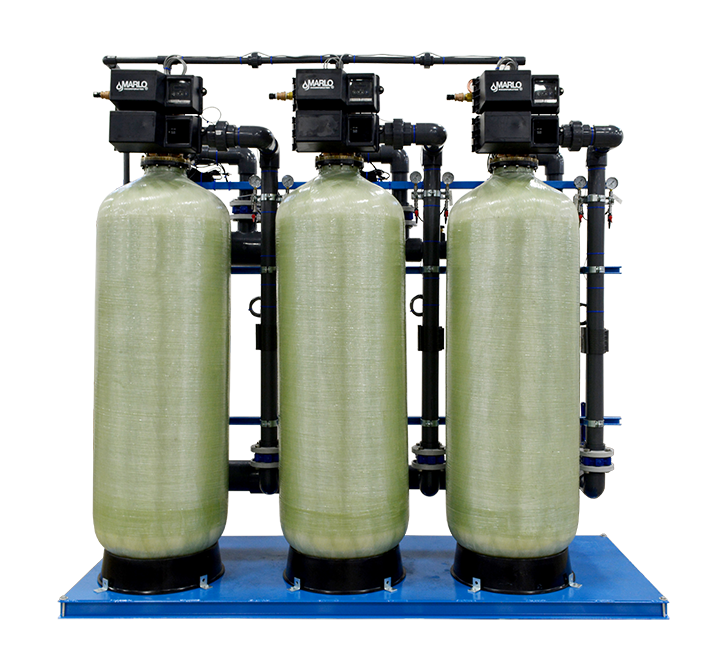
The two core components
- The resin tank: Holds the porous resin beads that attract and hold calcium, magnesium, and some iron as water flows through at a controlled rate.
- The brine tank: Stores a concentrated salt solution, typically sodium chloride, used later to flush the resin bed clean and recharge it with fresh sodium ions.
Regenerating the resin bed
Every resin bead has a finite capacity. Once enough beads are saturated with calcium and magnesium, the system stops softening effectively and needs to regenerate. During regeneration, concentrated brine from the salt tank is drawn through the resin bed. Because the brine solution has a much higher sodium concentration than what’s on the resin, it reverses the original exchange: sodium displaces the accumulated calcium and magnesium, which then get flushed down the drain as wastewater, and the resin comes out recharged with fresh sodium ions ready for another cycle.
Frequency depends on incoming water hardness, daily water volume, and the size of the resin bed. According to University of Nebraska–Lincoln Extension research, the regeneration cycle itself typically takes 60 to 120 minutes to pass brine through the unit and flush the tank before soft water is available again, which is why most single-tank commercial systems are programmed to regenerate overnight when demand is lowest.
Commercial vs. residential water softeners
A commercial water softener and the unit in a typical house rely on the same ion exchange chemistry, but they differ in three practical ways:
- Sizing: Commercial systems are sized around daily gallons used and peak-hour demand rather than an average household’s usage, since a hotel or restaurant’s water draw is far less predictable and much higher in volume.
- Metering: Commercial control valves track exactly how much water passes through the system, triggering regeneration based on actual usage rather than a fixed timer, which conserves salt and water compared to older timer-based residential units.
- Continuous availability: Many commercial applications can’t tolerate an hour or two without soft water, so businesses often install twin-tank or multi-tank systems where one tank softens water while the other regenerates, guaranteeing an uninterrupted supply.
Sizing a commercial water softener
Once you understand how a commercial water softener works at the chemistry level, sizing is the next practical question. It starts with two numbers: your incoming water hardness in grains per gallon, and your average daily water usage in gallons. Multiplying the two gives your daily grain requirement, which determines how much resin capacity you need before the next regeneration.
Commercial capacities commonly range from 30,000 grains for a small operation up to several hundred thousand grains for hotels, food processing plants, and industrial boiler systems. A useful example: a 120-room hotel with 10 gpg hardness water using roughly 70 gallons per room per day would need well over 100,000 grains of daily capacity, which typically calls for a twin-tank configuration to keep soft water flowing without interruption during regeneration.
Businesses that need this level of planning include hotels, restaurants, nursing homes, laundromats, car washes, manufacturing plants, and apartment complexes, essentially any operation where hard water would otherwise scale up dishmachines, boilers, laundry equipment, or cooling towers faster than they’d wear out on their own.
What untreated hard water costs a business
Scale buildup from hard water isn’t just cosmetic. It insulates heating elements in boilers and water heaters, forcing them to use more energy to reach the same temperature, and it narrows pipe diameters over time, reducing flow and increasing pump strain. In commercial kitchens specifically, hard water leaves spots and film on glassware and flatware, reduces the effectiveness of dish detergent, and shortens the working life of dishwashers and steamers. For a closer look at how hard water affects dishwashing specifically, see our guide on cleaning hard water deposits from a dishwasher.
Watch: how a water softener works
This engineering walkthrough from a major softener manufacturer covers the ion exchange and regeneration process in more visual detail, which is useful context whether you’re troubleshooting an existing system or specifying a new one.
Maintaining a commercial water softener
- Keep the brine tank stocked. Running low on salt is the most common reason a commercial softener stops performing, since there’s not enough brine to fully regenerate the resin.
- Watch the resin bed for fouling. Iron, sediment, and chlorine can coat resin beads and reduce their exchange capacity over time. Our guide on cleaning a water softener resin tank covers the signs and the process.
- Confirm the regeneration schedule matches usage. A system regenerating too often wastes salt and water; one regenerating too rarely lets hard water slip through before the next cycle. See our guide on how often to regenerate a water softener for guidance on setting this correctly.
- Test output water periodically. A simple hardness test confirms the system is still performing to spec, especially useful after any change in incoming water quality or usage volume.
Salt-based vs. salt-free systems for commercial use
Traditional ion exchange softeners require sodium chloride and produce a wastewater discharge during regeneration, which some municipalities regulate or restrict. Salt-free conditioners use a different approach, typically template-assisted crystallization, to prevent scale from adhering to surfaces without actually removing hardness minerals from the water. They avoid the sodium and wastewater discharge concerns but don’t produce the same true “soft” water feel or protect against scale as reliably in high-hardness applications. Our saltless water softener reviews and buyer’s guide covers how these systems compare for businesses weighing the tradeoff.
Frequently asked questions
A few more questions that come up once businesses understand how does a commercial water softener work and start planning an installation.
How often does a commercial water softener regenerate?
It depends on usage and hardness, but most commercial systems regenerate anywhere from daily to a few times per week, scheduled overnight or during low-demand hours to avoid interrupting operations. Metered systems trigger regeneration based on actual water processed rather than a fixed calendar schedule, which is more efficient for businesses with variable daily usage.
Do commercial water softeners need a permit or drain connection?
Most installations require a drain line for regeneration wastewater and, depending on local regulations, may need a permit given the volume of salt brine discharged. Check with your municipal water authority before installation, since some areas restrict or regulate softener discharge.
Is the sodium added by a water softener a health concern?
Softened water does contain added sodium, roughly 8 mg per liter for every grain per gallon of hardness removed, which is a modest amount for most people but worth discussing with a doctor for anyone on a strict sodium-restricted diet. Businesses in food service can also route an unsoftened cold-water line to drinking taps if this is a concern for customers or staff.
How long does a commercial water softener system last?
Resin media typically lasts 10 to 15 years with proper maintenance, though tanks, valves, and control heads can last longer or need earlier replacement depending on water quality and usage volume. Iron, chlorine, and infrequent maintenance all shorten resin lifespan.
Final thoughts
So, how does a commercial water softener work in practice? It relies on the same ion exchange chemistry as a residential unit, resin beads trading sodium for hardness minerals, then regenerating with brine, just built and sized for continuous, high-volume commercial demand. Getting the sizing, tank configuration, and maintenance schedule right protects dishmachines, boilers, and laundry equipment from costly scale damage and keeps operations running smoothly. For businesses like hotels, restaurants, and manufacturing facilities, a properly specified commercial water softener typically pays for itself in reduced energy use, lower detergent costs, and fewer equipment repairs over its lifespan.

Hey, My name is MAMON. I am a SEO content creator and affiliate marketer with over 8 years of experience. I create honest product reviews, in-depth buying guides, and practical how-to articles to help readers make informed decisions. My mission is to provide trustworthy, research-backed content that delivers real value.
Leave a Reply