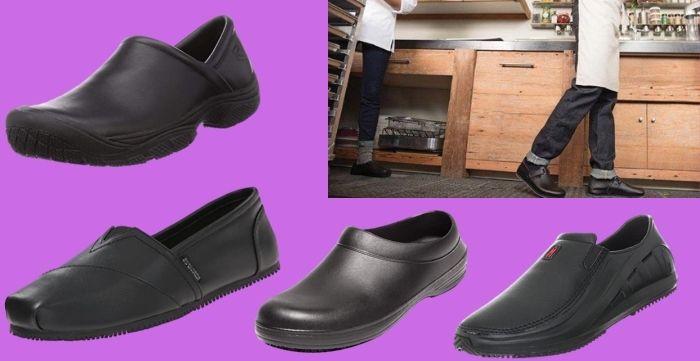
The short answer: the shoes you wear in a kitchen should be slip-resistant, closed-toe, easy to clean, and free of loose laces — whether you’re cooking at home or working a line in a commercial kitchen. Beyond that baseline, the right pair depends on how long you’re on your feet and what hazards your kitchen actually has (grease, knives, heavy pots, hot spills).
Key Takeaways
• Slip-resistant outsoles are non-negotiable — footwear with a certified slip-resistant sole meaningfully cuts kitchen slip injuries compared to regular shoes, per CDC/NIOSH research on food-service workers.
• Closed-toe, slip-on styles (clogs or chef sneakers) beat laced shoes for kitchen use, since laces are a tripping hazard around hot pans.
• Commercial kitchen employees may be legally required to wear compliant protective footwear under OSHA’s foot protection standard (29 CFR 1910.136).
• Water resistance, ventilation, and removable cushioned insoles matter most for anyone standing multiple hours a day.
Why the Right Kitchen Shoes Actually Matter
This isn’t just comfort talk. Kitchens are one of the most slip-prone environments there is: hot oil, wet floors from mopping, dropped ice, spilled sauces. A CDC/NIOSH-backed cluster trial of school food-service workers found that providing slip-resistant footwear at no cost reduced slip-related workers’ compensation claims dramatically compared to workers wearing regular shoes — a real, measured drop, not a marketing number.
If you work in a professional kitchen, this also isn’t optional in the eyes of the law. Under OSHA’s foot protection standard (29 CFR 1910.136), employers must ensure employees use protective footwear whenever there’s a danger of foot injury — that includes wet, greasy kitchen floors, falling pots, and knife-related puncture risks. Footwear meeting ASTM F2412/F2413 or ANSI Z41 standards satisfies the requirement.
For home cooks, none of that is legally mandatory, but the physics of a wet tile floor doesn’t care whether you’re clocked in or not.
What Kinds of Shoes Can I Wear in a Kitchen? The Core Checklist
If you’re asking yourself this question before buying a pair, here’s what actually separates a safe kitchen shoe from a shoe that just happens to be in your closet.
1. Slip-resistant outsoles
This is the single most important feature. Kitchen floors are wet or greasy at some point almost every shift — from spills, mopping, or condensation near the dishwasher. A standard rubber or foam sole isn’t built for that; kitchen-rated outsoles use a softer rubber compound with a tread pattern designed to channel liquid away from the contact point, similar to a car tire in the rain.
Look for a sole labeled slip-resistant and, ideally, tested to a coefficient of friction of 0.40 or higher on wet surfaces (the ASTM F2913 benchmark). Our non-slip kitchen shoes guide breaks down specific tested pairs if you want to skip the research.
2. Ventilation and breathability
A kitchen runs hot — ovens, stovetops, dishwashers, and bodies in motion all raise the ambient temperature well above a normal room. Shoes with no airflow trap heat and sweat, which leads to discomfort, odor, and eventually blistering or fungal issues if it’s a daily occurrence. Mesh panels, perforated uppers, or breathable synthetic leather all help here — just make sure ventilation doesn’t come at the cost of water resistance.
3. Water and oil resistance
Standing in a puddle for eight seconds is different from standing in one for eight hours. Shoes that absorb moisture keep your feet damp all shift, which is both uncomfortable and a genuine skin-health issue. Look for uppers made from treated leather, rubber, or coated synthetics rather than untreated canvas or fabric, which will soak through the first time you’re near the dish pit.
4. Toe protection
If your kitchen involves lifting stockpots, cases of product, or anything with real weight, a reinforced or steel/composite toe cap is worth the extra cost. Even outside of heavy lifting, closed, structured toes protect against dropped knives — a genuinely common kitchen injury. Open-toe shoes, sandals, and flip-flops should be a hard no in any working kitchen, home or commercial.
5. Slip-on over laced
Laces are a liability in a kitchen. An untied lace near a hot pan, a full tray, or a busy pass-through is a fall waiting to happen — for you and for whoever’s walking behind you. Most professional kitchen shoes are built as slip-on clogs or zip/velcro sneakers for exactly this reason. If you do prefer a laced style, tuck and tape the laces, or choose elastic no-tie laces designed for work shoes.
6. Insoles and cushioning
Anyone standing more than a couple of hours a day needs real cushioning, not the thin factory foam that comes in a lot of budget shoes. Look for shoes with multiple insole layers and, ideally, a removable footbed so you can swap in orthotic support or replace worn cushioning without replacing the whole shoe. This is where a lot of otherwise-good kitchen shoes fall short — the outsole is rated correctly, but the insole gives out after a few months of daily wear.
Types of Kitchen Shoes, and Which Fits Your Situation
Not every kitchen shoe is the same shape. A few common categories:
- Kitchen clogs — open-backed, slip-on, easy to kick off between shifts. The most popular choice among line cooks and dishwashers because they’re fast to put on and clean.
- Chef sneakers — look like a normal athletic sneaker but built with a kitchen-rated slip-resistant sole underneath. A good pick if you want something that also looks fine outside the kitchen.
- Chef boots — higher-cut, more ankle coverage and protection against spills or dropped items, favored in busier, higher-hazard kitchens.
- Waterproof kitchen shoes — built from fully sealed materials for kitchens with heavy wet work (dishwashing stations, seafood prep, outdoor catering setups).
For a full side-by-side of specific tested models across these categories, see our best kitchen shoes reviews and buyer’s guide.
Home Cook vs. Professional Kitchen: Does It Change What You Need?
If you’re cooking at home a few times a week, you likely don’t need OSHA-grade compliance — but the core features still apply. A pair of slip-resistant clogs or sneakers you keep by the back door for cooking is a low-effort upgrade from bare feet or slippers, especially if your kitchen floor is tile or hardwood that gets slick when wet.
If you work in a professional kitchen, the calculation is different: you’re on your feet for full shifts, around commercial equipment, moving fast, often carrying hot or heavy items past coworkers. That’s where the ASTM/OSHA-rated end of the market earns its higher price tag. It’s also worth pairing the right footwear with good habits — our guide on how to prevent cuts in the kitchen covers the other side of kitchen safety that shoes alone won’t fix.
Getting the Fit Right
Even the best-rated kitchen shoe fails at its job if it doesn’t fit properly. A few fit-specific things worth checking before you buy:
- Try them on (or size up) at the end of the day. Feet swell slightly over hours of standing, which is exactly the condition you’ll be wearing kitchen shoes in. A shoe that feels snug in the morning can feel tight by hour six.
- Leave a thumb’s width at the toe. Enough room to wiggle your toes without the shoe being loose enough to slip at the heel — a loose heel is its own trip hazard on a wet floor.
- Check the width, not just the length. Kitchen shoes are on your feet for long, sweaty shifts, so a too-narrow fit will cause blistering faster than almost any other footwear use case. Many kitchen-shoe brands offer wide-width versions specifically because of this.
- Break them in before a full shift. Wear a new pair around the house or on a short prep shift first, rather than debuting them on a 10-hour service — new outsoles and stiff uppers need a little time to soften up.
Maintenance and Care Tips
A great pair of kitchen shoes loses its protection over time if it isn’t looked after:
- Clean outsoles regularly. Grease and food residue can build up in the tread and reduce slip resistance — the exact protection you bought the shoe for.
- Rotate two pairs if you wear them daily. This lets each pair fully dry out between shifts, which cuts down on odor and extends the life of the cushioning.
- Replace insoles periodically rather than the whole shoe, if they’re removable.
- Inspect the outsole for wear. Smoothed-down tread means reduced grip — treat it the same as a worn tire and replace it.
Frequently Asked Questions
Can I wear regular sneakers in the kitchen?
Only if they have a genuinely slip-resistant outsole. Most everyday sneakers don’t — their soles are designed for dry pavement grip, not wet, greasy tile, so they can actually be more dangerous than a proper kitchen shoe.
Are Crocs okay to wear in a kitchen?
Standard Crocs with the vented “classic clog” holes aren’t ideal for professional use since hot liquid or dropped items can get through the vents. Crocs makes a separate closed, slip-resistant “Bistro” line designed specifically for kitchen use, which is a better fit.
Do I need steel-toe shoes for home cooking?
Not usually. Steel toes matter most where you’re lifting heavy stockpots or working around falling equipment — a real risk in a commercial kitchen, less so for home cooking. A closed, slip-resistant shoe is enough for most home kitchens.
How often should I replace kitchen shoes?
As a general guideline, most kitchen shoes worn daily in a working kitchen need replacing every six to twelve months, since outsole tread wears down with regular exposure to grease and heat well before the upper looks worn out. Home cooks using them a few times a week can usually get well past a year out of a single pair. Either way, judge by the tread, not the calendar: if the outsole pattern is visibly smoothed down, it’s time for a new pair regardless of how new the shoe otherwise looks.
Bottom line
What kinds of shoes can I wear in a kitchen? Slip-resistant, closed-toe, water-resistant, well-cushioned, and preferably slip-on. Those five features matter more than brand name or price point. Whether you’re outfitting a home kitchen or a commercial one, start with slip resistance — it’s the single feature most directly tied to preventing the accidents that make “kitchen shoes” worth buying in the first place.

Hey, My name is MAMON. I am a SEO content creator and affiliate marketer with over 8 years of experience. I create honest product reviews, in-depth buying guides, and practical how-to articles to help readers make informed decisions. My mission is to provide trustworthy, research-backed content that delivers real value.
Leave a Reply