A coffee warmer plate is one of the simplest kitchen tools, yet it is often misunderstood. Some coffee warmer plates sit under a glass carafe on a drip coffee maker, while others are stand-alone pads that keep a single mug warm at your desk. Both use the same basic idea, a heated surface that slows cooling, but they reach very different temperatures and affect flavor in different ways. In this guide, we explain how each type works, what temperatures they hold, how much electricity they use, and when a thermal carafe or mug warmer is the better choice.
Key Takeaways
- First, there are two main types: carafe warming plates built into coffee makers, and stand-alone mug warmer plates for a single cup.
- For example, the Moccamaster KBG’s hot plate holds coffee at 175°F to 185°F and shuts off after 100 minutes, according to a retailer listing.
- However, Breville notes that warming plates on cheaper machines can be inconsistent, sometimes scorching coffee or letting it cool too much.
- Mug warmer plates run cooler at the drink. In CNN Underscored’s testing, several basic plates kept coffee at or below about 120°F to 130°F.
- Finally, a 17-watt mug plate costs about 2.5 cents per 8-hour day at the EIA’s projected 2026 average electricity price.
What Is a Coffee Warmer Plate?
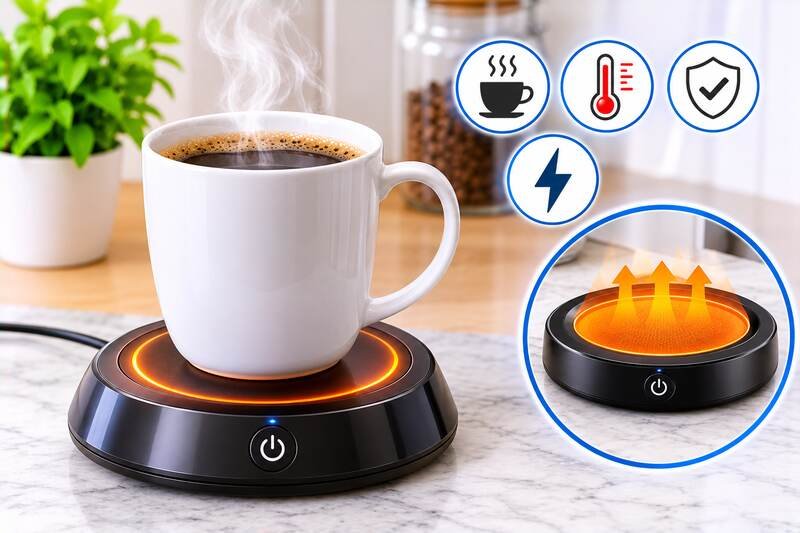
A coffee warmer plate is a flat, heated surface designed to keep brewed coffee warm. In most cases, it uses a small electric heating element under a metal or glass top. When a carafe or mug sits on it, heat moves by conduction into the container and then into the coffee. As a result, the coffee cools more slowly than it would on a counter.
Despite the simple idea, there are two very different kinds. On one hand, carafe warming plates sit under the glass pot of a drip coffee maker and are designed to keep a full batch hot. On the other hand, mug warmer plates are small, stand-alone pads that keep one cup warm at a desk. Because they serve different purposes, they reach different temperatures and come with different trade-offs.
Carafe Warming Plates on Coffee Makers
Most drip coffee makers with glass carafes include a warming plate. After brewing, the plate stays on to keep the pot hot. In general, these plates run much hotter than mug warmers, because they need to keep a large volume of coffee near serving temperature.
For example, a retailer listing for the Technivorm Moccamaster KBG says its hot plate has an independent heating element that holds coffee at 175°F to 185°F and shuts off automatically after 100 minutes. The same listing says the hot plate draws 70 watts while brewing and 25 to 70 watts afterward. That temperature range lines up with the National Coffee Association’s serving recommendation of 180°F to 185°F, as cited by Breville.
However, not every coffee maker is so well designed. According to Breville, warming plates on cheaper machines can be inconsistent, sometimes scorching coffee and sometimes letting it cool too much. For that reason, many coffee lovers prefer a thermal carafe for keeping a full pot warm.
Stand-Alone Mug Warmer Plates
A mug warmer plate is a small pad, usually 3.5 to 5.2 inches across, that keeps a single mug warm. Most use between 16 and 50 watts, and smart models reach 75 watts. Because the plate heats only the bottom of the mug, the drink settles well below the plate setting.
Here are listed settings for popular mug warmer plates, based on their Amazon listings in November 2026:
| Model | Power | Listed Settings |
|---|---|---|
| Mr. Coffee MWBLK | 17 W | Single setting |
| SWEETFULL DS1295 | 36 W | 130, 150, 176°F |
| BEARWIND | 50 W | 125–176°F |
| KitchekShop | Not listed | 131–185°F |
| iKago | 75 W | 105–175°F in 1°F steps |
Even so, independent tests show the drink runs cooler. For instance, in CNN Underscored’s test, several basic plates kept coffee at or below about 120°F to 130°F, while the 75-watt iKago smart plate reached 130°F in under 20 minutes.
Carafe Plate vs. Mug Warmer Plate
| Feature | Carafe Warming Plate | Mug Warmer Plate |
|---|---|---|
| Purpose | Keep a full pot hot | Keep one cup warm |
| Typical coffee temperature | Near serving temperature, e.g., 175–185°F on Moccamaster | Often 120–140°F in the cup |
| Power | Often tens of watts | About 16–75 W |
| Flavor risk | Can scorch coffee over time | Lower, since temperatures are gentler |
| Auto shut-off | Varies by machine | Common, often after 4 hours |
Does a Coffee Warmer Plate Affect Flavor?
Yes, it can. Coffee is at its best soon after brewing. When it sits on a hot carafe plate for a long time, it keeps losing water through evaporation and can develop a flat or burnt taste. That is why Breville warns that warming plates on cheaper machines can scorch coffee.
By contrast, mug warmer plates run gentler, so they are less likely to scorch a single cup. However, they still cannot keep coffee as fresh as a newly brewed cup. In short, any coffee warmer plate is best for short holding times rather than all-day storage.
Video: Danny Pops compares glass and thermal carafes on a Moccamaster.
Coffee Warmer Plate vs. Thermal Carafe
If you brew full pots, the biggest decision is often between a glass carafe on a warming plate and a thermal carafe. According to Breville, thermal carafes hold heat much better than glass and do not need a warming plate at all, since insulated carafes are not affected by outside heat. Breville also recommends a carafe that is insulated, airtight, heavy-bottomed, and sized to your batch.
On the other hand, a glass carafe on a good warming plate keeps coffee very hot and lets you see how much is left. So, the best choice depends on how long the pot sits. For short holding times, a quality warming plate works fine. For longer holding times, however, a thermal carafe usually preserves flavor better.
How Much Electricity Does a Coffee Warmer Plate Use?
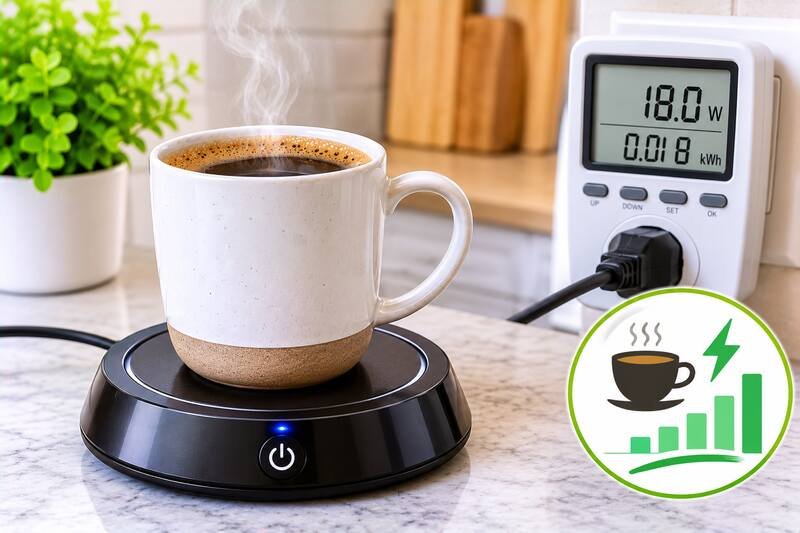
Electricity use depends on the type. Mug warmer plates use very little. For example, a 17-watt plate running 8 hours uses about 0.136 kWh, or about 2.5 cents at the EIA’s projected 2026 average residential price of 18.2 cents per kWh. A 36-watt plate uses about 0.288 kWh, or about 5.2 cents.
Carafe plates vary. For instance, the Moccamaster listing says its hot plate draws 25 to 70 watts after brewing. At 70 watts for its full 100-minute hold time, that would be about 0.117 kWh, or roughly 2 cents per pot. These are our estimates. In other words, the cost is small either way, but auto shut-off still matters for safety and savings. For a broader look, see our guide on how many watts a coffee maker uses.
Types of Coffee Warmer Plates You Can Buy
Basic Mug Warmer Plates
These are small, low-wattage pads with an on/off switch. They are inexpensive and simple. However, many lack auto shut-off, so you need to remember to turn them off.
Mug Plates With Settings and Timers
These offer several temperature settings and a timer, often with a default 4-hour shut-off. As a result, they are safer for long workdays and more flexible for different drinks.
Smart Mug Plates
Smart plates use sensors to hold an exact temperature and pause heating when you lift the cup. For example, the iKago plate lets you set 105°F to 175°F in 1°F steps.
Carafe and Pot Warmer Plates
Stand-alone carafe warmers are also sold for keeping a pot or teapot warm. For instance, some mug warmer brands also market their plates for small pots. In addition, teapot warmers often use candles or electric bases. Before buying, check that the plate is large enough and rated for the weight of a full pot.
How Long Can Coffee Sit on a Warming Plate?
There is no single rule, but a few clues help. For example, Moccamaster designs its hot plate to shut off after 100 minutes, which suggests the brand sees that as a reasonable holding window for its glass-carafe models. In addition, Breville recommends brewing smaller batches more often rather than keeping a large pot warm for hours. So, if your coffee regularly sits longer than an hour or two, consider brewing less at a time or switching to a thermal carafe.
With a mug warmer, the timing is more flexible, since the temperatures are gentler. Still, coffee slowly loses freshness as it sits, so even a mug on a warmer tastes best within the first hour or two. If a cup has gone fully cold, it is usually better to reheat it gently or brew a fresh one. To see what reheating costs, check our guide on how much electricity a microwave uses.
Safety Tips for Warming Plates
Warming plates are generally safe when used correctly, but they do get hot. For context, the U.S. Consumer Product Safety Commission reports that water at 140°F can cause third-degree burns in adults in about 6 seconds, and at 150°F in about 2 seconds. Because carafe plates can hold coffee near 175°F to 185°F, spills and hot surfaces deserve care. Therefore, keep plates away from the counter edge, do not touch the surface right after use, and keep paper towels and napkins clear of the heated area. In addition, never leave an empty carafe on a hot plate, since that can damage the glass.
How to Choose a Coffee Warmer Plate
- Match the job: First, decide whether you need to keep one mug or a full pot warm.
- Check the size: Next, make sure the plate fits your mug base or carafe.
- Look for auto shut-off: Also, choose a model that turns off on its own after a few hours.
- Consider settings: In addition, multiple settings help if you drink both coffee and tea.
- Look for a safety listing: Finally, UL or ETL marks show the product was tested by a recognized lab.
Tips for Using a Coffee Warmer Plate
- Brew smaller batches. First, Breville recommends brewing less coffee more often rather than keeping a large pot warm for hours.
- Use a lid or cover. Next, covering a mug reduces heat loss and evaporation.
- Choose a flat-bottomed mug. Also, full contact with the plate improves heat transfer.
- Start with fresh coffee. In addition, plates keep coffee warm better than they reheat it.
- Clean the plate when cool. Finally, unplug it and wipe it with a damp cloth to remove coffee rings.
For a hotter start, see our guide on what coffee maker makes the hottest coffee. Also, if you want a simpler brewer, our best coffee maker under $50 guide covers affordable options.
Common Mistakes With Coffee Warmer Plates
- Leaving a pot on the plate for hours. As a result, the coffee may scorch and taste bitter.
- Using an empty carafe on a hot plate. Instead, turn off the plate when the pot is empty.
- Heating insulated mugs. In fact, double-wall mugs block heat from the plate.
- Ignoring spills. Otherwise, burnt-on coffee can stain the plate and smell.
- Using the highest setting by default. Rather, start in the middle, since a 2008 study in the journal Burns found an optimal drinking temperature of about 136°F.
Frequently Asked Questions
What is a coffee warmer plate?
It is a heated surface that keeps brewed coffee warm, either under a coffee maker’s carafe or as a stand-alone pad for a single mug.
Does a coffee warmer plate make coffee taste burnt?
It can, if coffee sits on a hot carafe plate for a long time. Breville notes that plates on cheaper machines can scorch coffee, so a thermal carafe is better for long holds.
How hot does a coffee warmer plate get?
Carafe plates can hold coffee around 175°F to 185°F, as on the Moccamaster. Mug plates are usually set around 130°F to 185°F, but the drink stays cooler.
Is a thermal carafe better than a warming plate?
For long holding times, yes. According to Breville, thermal carafes hold heat much better than glass carafes and need no warming plate.
Can I use a mug warmer plate for a teapot?
Sometimes. Check the plate size and weight rating first, and use a heat-safe teapot with a flat base.
Do all coffee makers have a warming plate?
No. Coffee makers with thermal carafes usually skip the warming plate, since the insulated carafe keeps coffee hot on its own. By contrast, most machines with glass carafes include one.
How do I clean a warming plate?
First, unplug it and let it cool completely. Then, wipe it with a damp cloth and a little mild dish soap, and dry it well. Avoid abrasive pads, which can scratch the surface.
Final Thoughts
A coffee warmer plate is a handy way to slow cooling, whether it sits under a carafe or under your mug. Carafe plates keep a full pot near serving temperature, but they can scorch coffee if it sits too long. Meanwhile, mug warmer plates are gentler and cheaper to run, though the drink stays cooler than the setting. So, use a carafe plate for short holds, switch to a thermal carafe for longer ones, and choose a mug plate with auto shut-off for your desk. That way, your coffee stays warm without losing its flavor.

Hey, My name is MAMON. I am a SEO content creator and affiliate marketer with over 8 years of experience. I create honest product reviews, in-depth buying guides, and practical how-to articles to help readers make informed decisions. My mission is to provide trustworthy, research-backed content that delivers real value.
Leave a Reply