More families are replacing classic Teflon-style cookware, and electric griddles are next on the list. A non-toxic electric griddle uses a PFAS-free ceramic coating or no coating at all, so you can cook pancakes, eggs, and burgers without worrying about “forever chemicals.” However, marketing terms such as “PFOA-free” and “healthy ceramic” can be confusing, and not every label means what shoppers assume. In this roundup, we compare seven PFAS-free and uncoated griddles on Amazon, and we explain the science behind the labels using data from the U.S. Environmental Protection Agency, America’s Test Kitchen, and peer-reviewed research.
Key Takeaways
- The GreenLife 20″ is our best non-toxic electric griddle overall, with a PFAS-, PFOA-, lead- and cadmium-free ceramic coating.
- For no coating at all, the BALMUDA The Teppanyaki uses an aluminum-stainless clad plate, which produced the most consistent temperatures in America’s Test Kitchen testing.
- “PFOA-free” does not mean PFAS-free: a PTFE coating can be PFOA-free yet still be a PFAS.
- Minnesota banned the sale of cookware with intentionally added PFAS in 2025, and Colorado and Maine followed in 2026.
- Electric griddle thermostats typically cap at 400°F to 450°F, far below the 680°F at which PTFE broke down in a 2001 study.
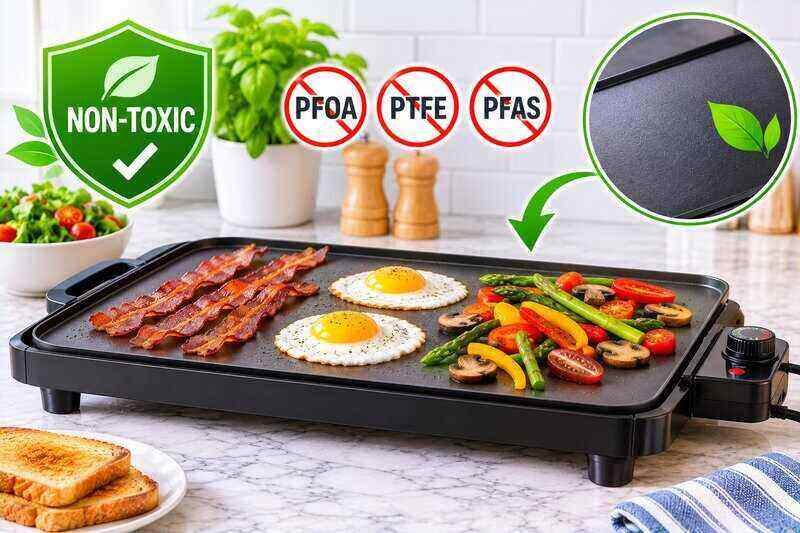
Quick Picks: Best Non-Toxic Electric Griddle at a Glance
| Pick | Best For | Surface Type |
|---|---|---|
| GreenLife 20″ | Best overall | PFAS-free ceramic |
| BALMUDA The Teppanyaki | Best uncoated | Aluminum-stainless clad |
| GreenPan Advanced + Drawer | Warming drawer | PFAS-free ceramic |
| GreenPan Healthy Ceramic 20″ | Most durable ceramic | Diamond-infused ceramic |
| GreenPan Elite | Removable plate | Diamond-infused ceramic |
| Hamilton Beach 38522 | Dishwasher safe | PFAS-free Durathon ceramic |
| Elite Gourmet EGR2888 | Budget PFAS-free | PFAS-free Ceralast ceramic |
As a result, each pick below is the best non-toxic electric griddle for a specific need.
What Makes an Electric Griddle Non-Toxic?
In practice, “non-toxic” means the cooking surface is made without PFAS, the large family of per- and polyfluoroalkyl substances. According to the EPA, there are thousands of different PFAS, and many break down very slowly and can build up in people, animals, and the environment over time. Because of that persistence, they are often called “forever chemicals.”
The EPA also lists health effects linked to exposure to certain levels of some PFAS. These include reproductive effects, developmental effects in children, an increased risk of some cancers such as prostate, kidney, and testicular cancer, a weaker immune response, interference with hormones, and higher cholesterol or obesity risk. Importantly, nonstick cookware is only one of many exposure sources the EPA names, alongside drinking water, food packaging, stain-resistant fabrics, and dust.
In cookware, the best-known PFAS is PTFE, the slick fluoropolymer behind classic nonstick. Therefore, a truly non-toxic electric griddle uses either a ceramic coating made without PFAS or an uncoated metal surface. Here is how the main options compare.
| Surface | Contains PFAS? | Strengths | Trade-Offs |
|---|---|---|---|
| PTFE nonstick (classic) | Yes (PTFE is a fluoropolymer) | Best food release, durable | Restricted in some states; avoid overheating |
| Ceramic (sol-gel) nonstick | No, when made without added PFAS | Good release, PFAS-free | Slickness fades faster; needs gentle heat |
| Stainless or clad steel | No coating | No coating to wear; very even heat when clad | Needs oil; food can stick |
| Cast iron or carbon steel | No coating (seasoned) | Durable, high heat | Needs seasoning; can rust |
For a deeper look at ceramic, including how long it lasts, see our breakdown of ceramic cookware pros and cons.
How to Read Non-Toxic Labels
Labels are where most shoppers get confused. For example, “PFOA-free” sounds reassuring, but PFOA is just one PFAS that was once used to make PTFE. U.S. manufacturers voluntarily phased it out by 2015, according to Live Science, so nearly every modern nonstick pan is PFOA-free, including PTFE models. Use this table to decode common terms.
| Label Wording | What It Means |
|---|---|
| PFOA-free | Made without one specific PFAS. The coating may still be PTFE, which is a PFAS. |
| PTFE-free | No classic Teflon-type coating. Usually ceramic or uncoated. |
| PFAS-free | No PFAS family chemicals in the coating, according to the maker. |
| Made without intentionally added PFAS | Matches the wording many state laws use; trace contamination is not covered. |
| Lead- and cadmium-free | Addresses heavy metals sometimes found in glazes and pigments. |
In short, look for “PFAS-free” or “made without intentionally added PFAS,” and ideally a statement about lead and cadmium as well. Every pick in this roundup meets that bar or uses no coating at all.
State PFAS Cookware Laws in 2026
Regulation is pushing the market toward PFAS-free surfaces. Minnesota became the first state to ban the sale of cookware with intentionally added PFAS on January 1, 2025. Colorado and Maine followed on January 1, 2026, and Rhode Island’s ban begins January 1, 2027. Meanwhile, Connecticut and Vermont have later dates, and California vetoed a cookware ban in 2025. For the full state-by-state list, read our guide to PFAS cookware bans by state.
Importantly, these laws cover new sales. They do not require you to throw away cookware you already own. However, if you live in one of these states, a PFAS-free electric griddle is increasingly what you will find on store shelves.
How We Chose the Best Non-Toxic Electric Griddle Picks
To be clear, we did not run our own lab tests. Instead, we combined four types of evidence:
- Coating disclosure: First, we only included griddles whose makers state the surface is PFAS-free, made without intentionally added PFAS, or uncoated.
- Independent testing: Next, we used results from America’s Test Kitchen, which measured surface temperature at five spots every five minutes and noted which coatings contained PFAS.
- Usability: Finally, we compared size, temperature range, warming features, and dishwasher safety.
We also excluded every griddle featured in our other electric griddle guides. Notably, ATK reported that one popular premium griddle, the Zojirushi Gourmet Sizzler, contains PFAS, which is why it does not appear here.
The 7 Best Non-Toxic Electric Griddles Reviewed
1. GreenLife 20″ Extra Large Electric Griddle: Best Overall

Image: Amazon
Best for: Most families who want a PFAS-free coating, a big surface, and a fair price
The GreenLife 20-inch griddle is our best non-toxic electric griddle overall because it pairs the clearest coating disclosure with the strongest buyer track record in this category. GreenLife states that its ceramic nonstick is free of PFAS, PFOA, lead, and cadmium, and the most of any PFAS-free griddle we found.
Size is another strength. The 10.5- by 20-inch cooking surface provides 210 square inches, which is slightly above the 200-square-inch benchmark that America’s Test Kitchen says fits about seven pancakes or six large burgers. As a result, it handles a full family breakfast in one or two rounds. In addition, the griddle has stay-cool handles, adjustable temperature control, and a removable drip tray that the listing describes as dishwasher safe.
GreenLife is the more affordable sister brand of GreenPan, and both use sand-derived ceramic coatings rather than PTFE. That means the surface releases eggs and pancakes well when new, but it needs gentle care to stay slick. Specifically, use medium heat, avoid metal utensils, and skip aerosol cooking sprays, which can leave a sticky film on ceramic.
On the downside, ceramic coatings in general lose slickness faster than PTFE, so expect gradual wear even with good care. Still, for most households that want to move away from PTFE without paying premium prices, it is the best place to start.
In short: 10.5 x 20 in (210 sq in) | PFAS-, PFOA-, lead- and cadmium-free ceramic
Pros:
- Above all, clear PFAS-free disclosure
- Most ratings among PFAS-free griddles
- Family-size 210-square-inch surface
Cons:
- However, ceramic needs gentle care
- Slickness can fade over time
2. BALMUDA The Teppanyaki: Best Uncoated Griddle

Image: Amazon
Best for: Cooks who want no coating at all and the most even heat
If you want to avoid coatings entirely, the BALMUDA The Teppanyaki is the standout. Instead of nonstick, it uses a 6.6-millimeter clad plate of aluminum and stainless steel. Because there is no coating to scratch or wear out, the surface is even safe for cutting food directly on the plate, according to BALMUDA.
Independent testing backs up the design. In fact, America’s Test Kitchen found that the uncoated clad plate produced more consistent temperatures than coated rivals, and it rated the griddle Recommended with Reservations. The plate measures about 15 by 9.6 inches, and four settings cover 320°F, 360°F, 400°F, and 430°F, so you can move from crepes to seared steak.
The rimless design turns it into a tabletop cooking station, much like a teppanyaki restaurant. In addition, it includes a precision spatula and an oil tray. It is newer on Amazon than most picks, but ATK’s test gives us useful independent data.
However, the reservations are real. ATK noted that it had the smallest surface in its test, at about 142 square inches, no walls to stop food from sliding off, and only four temperature settings. It is also expensive, with ATK listing it at $449 before a sale price of about $405. Therefore, it suits small households and enthusiasts more than big families.
In short: ~15 x 9.6 in | 320/360/400/430°F | uncoated aluminum-stainless clad plate
Pros:
- Above all, no coating at all
- Most consistent temperatures in ATK testing
- Knife-safe surface
Cons:
- However, it is expensive
- Small surface with no walls
3. GreenPan Advanced 10.5″ x 20″ Griddle With Warming Drawer: Best With Warming Drawer

Image: Amazon
Best for: Families who want PFAS-free cooking plus a place to keep food hot
The GreenPan Advanced griddle adds a feature that is rare on PFAS-free models: a built-in warming drawer. As a result, you can slide finished pancakes or bacon underneath while the next batch cooks, so the whole family eats together. The 10.5- by 20-inch surface provides 210 square inches, the same as the GreenLife.
GreenPan says the ceramic nonstick is made without intentionally added PFAS, which is the same wording many state laws use. In addition, a single temperature knob keeps controls simple, and the listing describes the griddle as dishwasher safe, which is unusual for an electric griddle.
The model also appears in independent owner reviews on YouTube, including the hands-on video we include below. In addition, the clay color option suits kitchens where the griddle stays out on the counter.
On the other hand, the warming drawer adds height and weight, so storage takes more planning. Also, the single knob offers less precise control than models with marked temperature settings. For families who value convenience and a clear PFAS disclosure, though, it is an excellent choice.
In short: 10.5 x 20 in (210 sq in) | warming drawer | made without intentionally added PFAS
Pros:
- Above all, built-in warming drawer
- Dishwasher safe, per the listing
- Clear PFAS disclosure
Cons:
- However, it is bulky to store
- Simple knob without marked settings
4. GreenPan Healthy Ceramic 20″ Electric Griddle: Most Durable Ceramic

Image: Amazon
Best for: Heavy users who want a tougher ceramic coating
Ceramic durability is the biggest concern with any non-toxic electric griddle, and this GreenPan model targets that problem directly. It uses Thermolon Volt, a diamond-infused ceramic nonstick that GreenPan says is specially designed to withstand the strain of modern appliances. In other words, it is built for daily griddle use rather than occasional cooking.
GreenPan states that the coating is free of PFAS, PFOA, lead, and cadmium. Furthermore, the 10.5- by 20-inch surface offers 210 square inches, and stay-cool handles plus a removable drip tray round out the design.
Keep in mind that the durability claim comes from GreenPan rather than an independent long-term test. Also, like all ceramic, it performs best at low to medium heat. Even so, if you cook on your griddle several times a week, the tougher coating is worth considering.
In short: 10.5 x 20 in (210 sq in) | Thermolon Volt diamond-infused ceramic
Pros:
- Above all, coating built for appliance use
- PFAS-, PFOA-, lead- and cadmium-free
- Stay-cool handles
Cons:
- However, durability is a maker claim
5. GreenPan Elite Electric Griddle: Best Removable Plate

Image: Amazon
Best for: Cooks who want easy sink cleanup and a wide temperature range
The GreenPan Elite is the newest model in this roundup, and its standout feature is a removable plate. Because you can lift the plate off the base, cleaning is far easier than with fixed-plate griddles. In addition, it uses the same diamond-infused Thermolon Volt ceramic, made without intentionally added PFAS.
Temperature range is another advantage. Specifically, the dial runs from a warm setting at 200°F up to a 450°F sear setting, which is 50°F higher than most ceramic griddles. GreenPan also says an embedded heating element delivers fast cook times and even heat across the surface.
Therefore, we include it based on its specs and GreenPan’s track record rather than buyer data.
On the downside, ceramic coatings generally prefer moderate heat, so frequent use at 450°F may shorten the coating’s life. Also, the lack of reviews means early buyers take more risk. For cooks who want the newest PFAS-free design with a removable plate, it is worth a look.
In short: Removable plate | 200–450°F | Thermolon Volt ceramic | New listing (no ratings yet)
Pros:
- Above all, removable plate for easy cleaning
- Widest range among ceramic picks
- Embedded heating element
Cons:
- However, it has no reviews yet
- High heat can wear ceramic
6. Hamilton Beach 200 Sq. In. Durathon Ceramic Griddle (38522): Best Dishwasher-Safe Pick

Image: Amazon
Best for: Busy households that want the easiest possible cleanup
The Hamilton Beach 38522 is the most practical pick for cleanup. The griddle lifts off its base, and the listing says it is dishwasher safe, so you can skip hand scrubbing entirely. In addition, the reversible design lets you plug the cord in on either side, which helps in tight kitchens.
Hamilton Beach uses its Durathon ceramic coating, which it describes as PFAS-free and four times more durable than traditional nonstick. The surface provides 200 square inches, right at ATK’s benchmark for about seven pancakes, and the temperature dial runs from 200°F to 400°F.
Moreover, an indicator light turns off when the griddle reaches the set temperature, so you know exactly when to start cooking.
However, the durability claim is the manufacturer’s own, and 400°F limits hard searing. Still, for families who want a PFAS-free surface that goes straight into the dishwasher, it is a smart, affordable option.
In short: 200 sq in | 200–400°F | PFAS-free Durathon ceramic | dishwasher safe
Pros:
- Above all, dishwasher-safe griddle plate
- Reversible cord placement
- Ready light for preheating
Cons:
- However, it tops out at 400°F
- Durability is a maker claim
7. Elite Gourmet EGR2888 Ceralast Griddle: Best Budget PFAS-Free
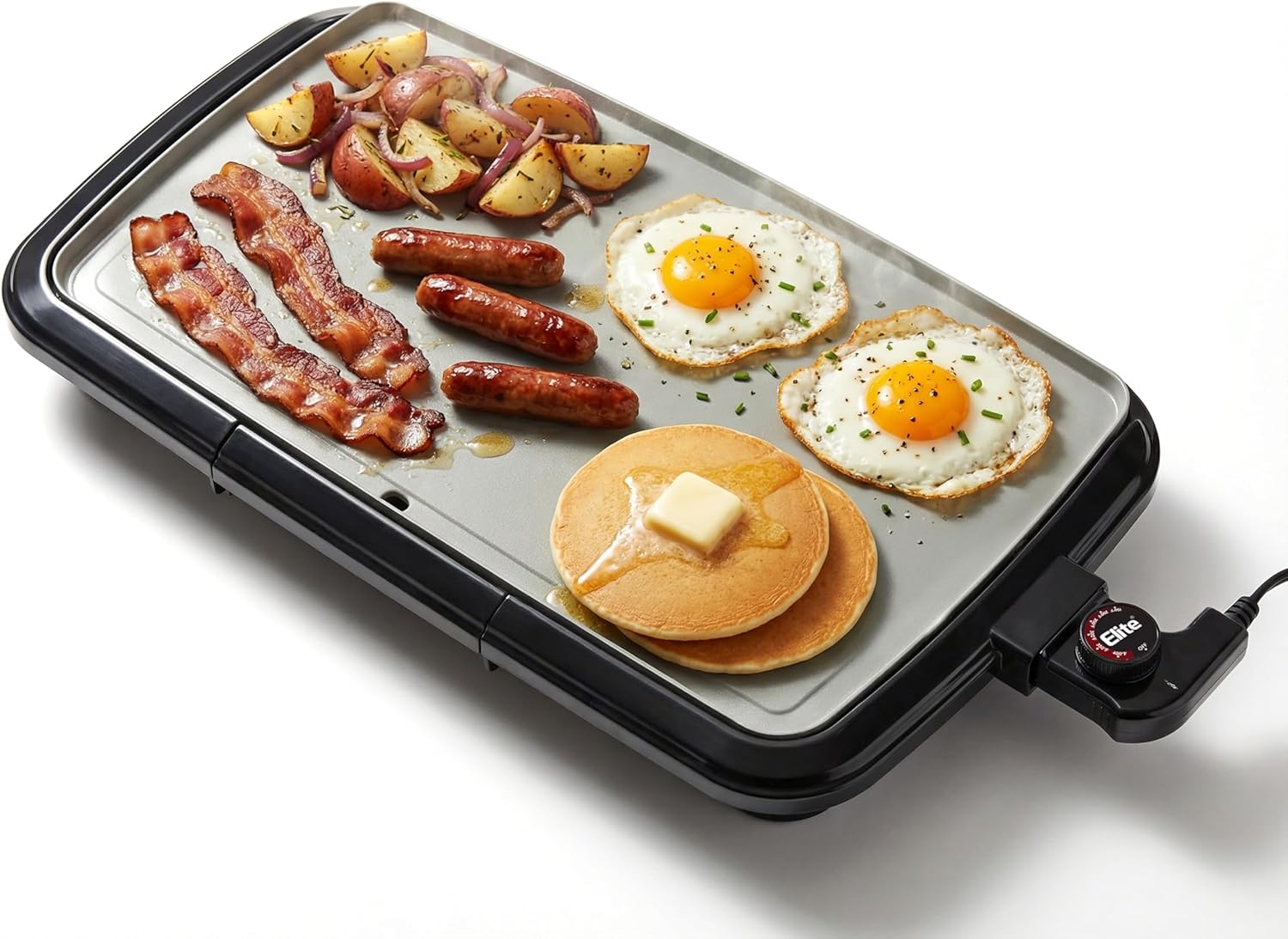
Image: Amazon
Best for: Budget shoppers who want a PFAS-free surface at the lowest cost
The Elite Gourmet EGR2888 is the budget pick for a PFAS-free surface. It uses Elite’s Ceralast ceramic nonstick on a 10- by 20-inch plate, or 200 square inches, and a 1,500-watt element that heats from 150°F to 400°F.
Unusually, the listing includes clear care instructions. Specifically, Elite says to season the surface with a light coat of oil before first use and to use only nylon or heat-safe plastic utensils. In addition, a built-in channel directs grease into a slide-out drip tray that is dishwasher safe on the top rack.
The downside is limited buyer data. It has the lowest average in this roundup. Therefore, consider it a value option rather than a proven favorite.
Even so, the 150°F low setting is handy for keeping food warm, and the cool-touch design adds safety. If budget is your main concern and you follow the care steps, it delivers a PFAS-free surface for less.
In short: 10 x 20 in (200 sq in) | 1,500 W | 150–400°F | PFAS-free Ceralast
Pros:
- Above all, budget PFAS-free option
- Low 150°F warming setting
- Clear care instructions
Cons:
- However, it has few ratings
Does Heat Make Nonstick Coatings Unsafe?
This is one of the most common questions about griddles, and the answer depends on temperature. According to Live Science, a 2001 study in Nature found that PTFE broke down at 680°F, while a 2017 study in Environmental Science and Pollution Research found that a coated pan could reach 750°F after eight minutes on high on a stovetop. Breathing fumes from badly overheated PTFE can cause polymer fume fever, a flu-like illness that Live Science describes as rare.
| Temperature | What Happens | Source |
|---|---|---|
| 400–450°F | Typical maximum on our electric griddle picks | Manufacturer listings |
| 680°F | PTFE broke down in a 2001 lab study | Nature (2001), via Live Science |
| 750°F | A coated pan reached this after 8 minutes on high on a stovetop | Environmental Science and Pollution Research (2017), via Live Science |
Here is the key point for griddle shoppers: electric griddles have thermostats. Every pick in this roundup tops out between 400°F and 450°F, well below the temperatures in those studies. In other words, an electric griddle is far less likely to overheat than an empty pan on a high burner. Even so, many families choose PFAS-free surfaces for broader reasons, such as manufacturing and disposal concerns, state laws, or simple peace of mind.
How to Choose a Non-Toxic Electric Griddle
Once you have narrowed your options to PFAS-free or uncoated models, five practical factors decide which non-toxic electric griddle fits your kitchen. Above all, start with the coating, then work through size and features.
1. Coating Type and Disclosure
Start with the label. Ceramic is the most common PFAS-free choice and offers good food release. Alternatively, an uncoated clad plate like the BALMUDA avoids coatings entirely but needs oil. Either way, choose a brand that states exactly what the surface is made without.
2. Surface Size
Most PFAS-free griddles measure about 10 by 20 inches, or roughly 200 to 210 square inches. That fits about seven pancakes, based on ATK’s benchmark. If you need more space, see our separate guide to extra large models, or plan to cook in batches.
3. Temperature Range
Ceramic performs best at low to medium heat, so a range of about 200°F to 400°F covers most needs. However, if you want to sear, the GreenPan Elite reaches 450°F and the BALMUDA reaches 430°F.
4. Cleanup
Ceramic lasts longer when you clean it gently. For that reason, removable or dishwasher-safe plates, like those on the GreenPan Elite and Hamilton Beach 38522, make daily cleanup easier. Still, hand washing with a soft sponge is the gentlest option for any coating.
5. Warming and Extras
Finally, consider extras. A warming drawer, like the one on the GreenPan Advanced, keeps food hot while you cook in batches. Meanwhile, a removable plate or reversible cord adds convenience in small kitchens.
How to Make a Ceramic Griddle Last Longer
Ceramic coatings release food beautifully when new, but they tend to lose slickness faster than PTFE if you treat them roughly. Fortunately, a few habits make a big difference:
- Use medium heat. First, most foods cook well between 300°F and 375°F, so save the highest settings for short sears.
- Skip aerosol sprays. Instead, brush on a little oil or butter, because many ceramic makers warn that sprays leave a sticky residue.
- Choose soft tools. In addition, use silicone, nylon, or wood. For example, Elite Gourmet tells owners to use only nylon or heat-safe plastic utensils.
- Cool before washing. Then, let the plate cool to avoid thermal shock, and wash with a soft sponge.
- Store with care. Finally, avoid stacking heavy items on the surface; see our tips on storing nonstick cookware.
Some makers, such as Elite Gourmet, also recommend wiping the surface with a light coat of oil before first use. For comparison, our ceramic frying pan reviews show how similar coatings hold up in everyday pans.
Cooking on an Uncoated Griddle
An uncoated stainless or clad plate, like the BALMUDA, behaves differently from nonstick. Above all, preheat fully and add a thin layer of oil before food goes on, because a hot, oiled surface releases food far better than a cold one. In addition, let proteins sear until they release naturally rather than forcing them loose.
Cast iron and carbon steel griddles are another uncoated option, although most are stovetop pans rather than plug-in appliances. If you go that route, a good seasoning layer is essential; our guide on seasoning cast iron explains the basics. For eggs on any uncoated surface, see our tips on cooking eggs without sticking.
Non-Toxic Electric Griddle Cost and Power
Most PFAS-free griddles draw about 1,200 to 1,500 watts, the same as conventional models. For example, the Elite Gourmet uses 1,500 watts, which works out to about 12.5 amps at 120 volts, so plug it directly into a wall outlet. At the U.S. Energy Information Administration’s 2026 residential forecast of about 18.2 cents per kWh, 30 minutes at full power costs roughly 14 cents.
Price is where the categories differ most. Budget ceramic griddles like the GreenLife and Elite Gourmet cost about the same as classic nonstick models. In contrast, premium uncoated options like the BALMUDA cost several times more, with ATK listing it at $449 before a sale price of about $405.
Common Mistakes With PFAS-Free Griddles
- Trusting “PFOA-free” alone. As explained above, a PFOA-free coating can still be PTFE.
- Cooking on maximum heat. Unfortunately, high heat shortens the life of ceramic coatings.
- Using cooking spray. Instead, use a brush of oil to avoid sticky buildup.
- Scrubbing with steel wool. Rather than abrasives, use a soft sponge and warm, soapy water.
- Expecting uncoated plates to act like nonstick. In fact, stainless needs oil and patience to release food.
Non-Toxic Electric Griddle vs Ceramic Pan vs Cast Iron Griddle
If your main goal is PFAS-free cooking, an electric griddle is only one option. Here is how the three most common choices compare for everyday breakfasts.
- Non-toxic electric griddle: First, it offers about 200 square inches of space and a thermostat, so you can cook a full breakfast at a set temperature. However, it takes counter and cabinet space.
- Ceramic frying pan: In contrast, a 12-inch pan offers at most about 113 square inches, roughly half the space, but it stores easily and works on any burner.
- Cast iron griddle pan: Meanwhile, a two-burner cast iron griddle has no coating at all and tolerates high heat, yet it is heavy, needs seasoning, and depends on your burners for even heat.
In short, a non-toxic electric griddle is the best fit for families who cook big breakfasts often, while a ceramic pan suits one or two people. A cast iron griddle, on the other hand, appeals to cooks who want zero coatings and do not mind the extra care.
Which Non-Toxic Electric Griddle Should You Buy?
- No coating at all: BALMUDA The Teppanyaki, for even heat from a clad plate.
- Keeping food warm: GreenPan Advanced, with its warming drawer.
- Daily heavy use: GreenPan Healthy Ceramic 20″, for its tougher coating.
- Easiest cleaning: GreenPan Elite or Hamilton Beach 38522.
- Tightest budget: Elite Gourmet EGR2888.
FAQ
What is the best non-toxic electric griddle?
For most families, the GreenLife 20″ is the best non-toxic electric griddle. It has a ceramic coating free of PFAS, PFOA, lead, and cadmium and a 210-square-inch surface.
Are ceramic electric griddles really non-toxic?
Generally, yes, when the maker states the coating is made without PFAS. Ceramic nonstick is typically silica-based rather than a fluoropolymer. Still, check for lead and cadmium statements as well.
Is a PFOA-free griddle PFAS-free?
Not necessarily. PFOA is one PFAS that U.S. makers phased out by 2015. A PFOA-free griddle can still use PTFE, which is a PFAS under most state laws.
Are Teflon electric griddles dangerous?
At normal settings, the risk is low. Electric griddles typically max out at 400°F to 450°F, while PTFE broke down at 680°F in a 2001 study. However, some shoppers prefer PFAS-free surfaces for environmental and regulatory reasons.
Which states ban PFAS cookware?
As of 2026, Minnesota, Colorado, and Maine ban sales of cookware with intentionally added PFAS, and Rhode Island follows in 2027. Connecticut and Vermont have later dates.
How long does a ceramic griddle coating last?
It varies with use and care. Ceramic usually loses slickness faster than PTFE, but medium heat, soft tools, and no aerosol sprays can extend its life significantly.
Can you use metal utensils on a non-toxic electric griddle?
Usually not on ceramic. Metal can scratch ceramic coatings, so most makers recommend silicone, nylon, or wood. Uncoated clad plates like the BALMUDA are more forgiving, and BALMUDA even calls its surface knife-safe.
Is a stainless steel electric griddle safer than ceramic?
Both avoid PFAS. Stainless and clad plates have no coating to wear off, which some shoppers prefer. However, ceramic releases food more easily, so the better non-toxic electric griddle depends on whether you value convenience or durability.
Final Thoughts
In the end, the best non-toxic electric griddle depends on how far you want to go. If you want no coating at all, the BALMUDA The Teppanyaki delivers the most even heat in independent testing, though at a premium price. Meanwhile, the GreenPan and Hamilton Beach models add warming drawers, removable plates, and dishwasher-safe cleanup. Whichever you choose, read the label carefully, cook at moderate heat, and treat the surface gently so it stays safe and slick for years.

Hey, My name is MAMON. I am a SEO content creator and affiliate marketer with over 8 years of experience. I create honest product reviews, in-depth buying guides, and practical how-to articles to help readers make informed decisions. My mission is to provide trustworthy, research-backed content that delivers real value.
Leave a Reply