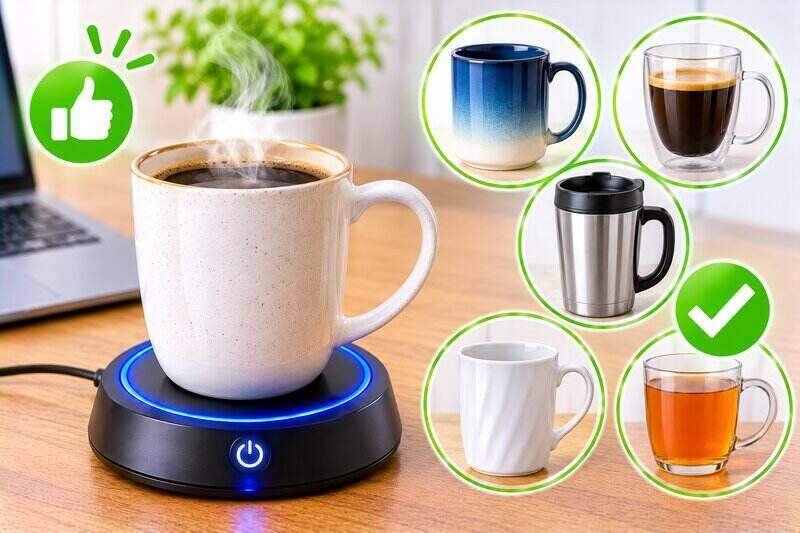
The right flat bottom mug can make a cheap mug warmer feel twice as powerful. That is because a warming plate only heats what it touches, so the shape, thickness, and material of your mug decide how much heat reaches your coffee. In fact, many mug warmer brands now print specific mug rules in their listings, from minimum weights to warnings about insulated cups. In this guide, we pull those requirements together, explain the science of heat transfer in plain terms, and show you how to pick the best mugs for a mug warmer, whether you prefer ceramic, glass, or stainless steel.
Key Takeaways
- First, a flat bottom mug with full contact on the plate transfers heat far better than a mug with a raised foot or ring base.
- Thin walls help. For example, VOBAGA recommends thin-walled, flat, or slightly concave-bottomed mugs for best results.
- However, double-wall insulated mugs block heat from the plate, and several brands warn against using them.
- Some sensor-based warmers need a minimum weight. Bestinnkits says its gravity switch needs at least 0.8 lb (13 oz), and Cosori says its plate needs a cup weighing at least 10.4 oz.
- Finally, stainless steel conducts heat roughly 10 times better than ceramic or glass, based on standard engineering values.
Why a Flat Bottom Mug Matters So Much
A mug warmer works by conduction. Simply put, heat moves from the hot plate into whatever touches it. So, if only a thin ring of your mug touches the plate, very little heat gets through. On the other hand, if the whole base sits flat against the plate, heat flows in across a much larger area.
At the same time, your coffee keeps losing heat through the sides and open top. As a result, the drink settles where heat coming in equals heat going out. Because most warmers use only 17 to 50 watts, small differences in contact area can make a big difference in the final temperature. That is why the same warmer can seem great with one mug and useless with another.
Independent testers have seen this too. In CNN Underscored’s testing, several basic plates kept coffee at or below about 120°F to 130°F. Meanwhile, matched mug-and-warmer sets and smarter plates performed better. Therefore, choosing a good flat bottom mug is one of the cheapest upgrades you can make.
What Mug Warmer Brands Say About Mugs
Many brands now include mug guidance in their product listings. Here is a summary of what popular models recommend, based on their Amazon listings checked in November 2026.
| Brand | Mug Guidance |
|---|---|
| VOBAGA | Use thin-walled, flat, or slightly concave-bottomed mugs; avoid double-layer insulation cups |
| Bestinnkits | Thin-walled, flat-bottom mugs work best; gravity switch needs at least 0.8 lb (13 oz); raised, concave, or insulated mugs may warm less |
| Cosori Digital | Pressure sensor starts heating only with a cup of at least 10.4 oz (295 g) |
| Home-X | For use with ceramic or glass mugs only |
| House Gem | Fits most flat-bottom ceramic, glass, and stainless steel mugs; flat, thin bottoms transfer heat best |
| “You Are Awesome” Set | Not suitable for plastic cups or double-insulation mugs |
Similarly, CNN Underscored’s review of the Misby warmer noted that mugs must weigh over 13 ounces to trigger its heating switch, and that it works with glass, stainless steel, and ceramic. In short, the brands agree on three rules: flat, thin, and not insulated.
The 5 Features of the Best Mugs for a Mug Warmer
1. A Truly Flat Bottom
Above all, look for a flat bottom mug with a wide, smooth base. To check, set the mug on a table and look at it from the side. If you see a gap or a raised foot ring, only part of the base will touch the plate. In addition, a slightly concave base is acceptable for some warmers, according to VOBAGA, but a raised foot is not.
2. Thin Walls and Base
Next, thinner material lets heat pass through faster. Thick stoneware mugs hold heat well once warm, but they slow heat transfer from the plate. So, for a warmer, a thinner mug usually wins.
3. Single-Wall Construction
Also, avoid double-wall and vacuum-insulated mugs on a plate warmer. Insulation is designed to block heat flow, so it blocks heat coming in from the plate as well as heat escaping. As a result, the warmer barely affects the drink.
4. Enough Weight for Sensors
If your warmer uses a gravity or pressure sensor, check the minimum weight. For instance, Bestinnkits requires at least 0.8 lb, and Cosori requires at least 10.4 oz. Otherwise, a light mug may not switch the warmer on.
5. A Matching Lid
Finally, a lid keeps heat from escaping out the top. In CNN Underscored’s heated-mug testing, lids roughly doubled or tripled run time. Although plates work differently, the same principle applies to any mug on a warmer.
Ceramic vs. Glass vs. Stainless Steel
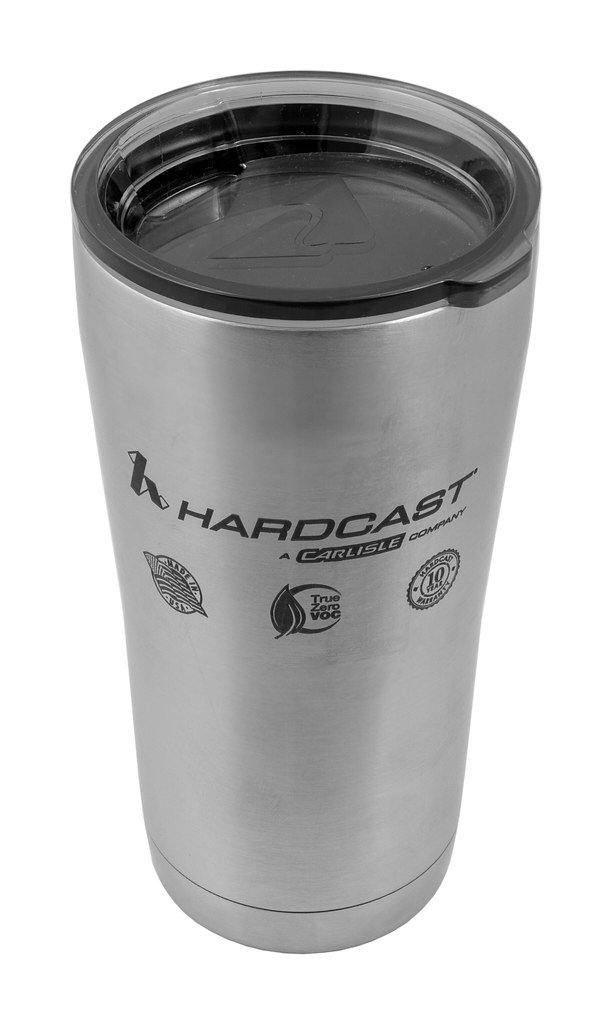
Photo: Hardcast65 via Flickr (CC BY 2.0).
Material changes how fast heat moves through the base. Engineers measure this with thermal conductivity, in watts per meter-kelvin (W/m·K). Based on standard published engineering values, stainless steel conducts heat at roughly 15 to 16 W/m·K, while glass and ceramic are closer to about 1 to 1.5 W/m·K. In other words, steel moves heat roughly 10 times faster.
| Material | Approx. Thermal Conductivity | On a Warmer |
|---|---|---|
| Stainless steel (single-wall) | About 15–16 W/m·K | Fastest heat transfer |
| Porcelain or ceramic | About 1–1.5 W/m·K | Good if thin and flat |
| Glass | About 1 W/m·K | Good if thin and flat |
| Double-wall insulated | Very low (vacuum gap) | Poor; avoid |
| Plastic | Low | Poor; several brands warn against it |
That said, conductivity is not the whole story. Thickness and contact area matter just as much. For example, a thin, flat ceramic mug can outperform a thick steel mug with a raised base. That is also why Cosori pairs its warmer with a stainless steel mug, which it says retains heat better than other mugs.
Ceramic Mugs
Ceramic is the most popular choice. It looks good, feels familiar, and is usually dishwasher safe. However, many ceramic mugs have a raised foot ring, so check the base carefully. A thin porcelain mug with a flat glazed base is ideal.
Glass Mugs
Glass mugs let you see your drink, which is nice for lattes and tea. Most are thin, which helps heat transfer. On the other hand, choose tempered or heat-resistant glass, and avoid double-wall glass, which acts like insulation.
Stainless Steel Mugs
Single-wall stainless steel transfers heat best and resists breaking. However, it gets hot to the touch on a warmer, so a mug with a handle is safer. Meanwhile, most stainless travel mugs are double-wall insulated, so they are not a good match for a plate.
Video: Crane Reviews tests mug warmers with ordinary cups.
Choosing the Right Flat Bottom Mug Size
Size matters as well as shape. First, the mug base should be close to the size of the warming plate. Plates in popular models range from about 3.5 inches across on the Home-X to about 5.2 inches on the SWEETFULL and House Gem warmers. So, a base that is much smaller than the plate wastes heat, while a base much larger than the plate leaves part of the mug unheated.
Next, think about capacity. Larger mugs hold more coffee, which cools more slowly simply because there is more liquid. However, a very tall, narrow mug has more side area for heat to escape. In general, a 12- to 16-ounce mug with a wide, flat base is a practical balance for desk use.
Finally, consider the shape of the opening. A wide-mouth mug lets more steam and heat escape from the surface. By contrast, a mug that narrows slightly at the top, or one with a lid, keeps heat in longer.
How Mug Shape Affects Heat Loss
Even with a perfect flat bottom mug, the rest of the mug affects how warm your coffee stays. For example, heat escapes mostly through the open top and the side walls. Therefore, a short, wide mug with a lid often stays warmer on a plate than a tall, open mug of the same volume. In addition, handles help you avoid touching hot walls, which is especially useful with stainless steel.
Flat Bottom Mug for Warmer: Quick Shopping Checklist
- Base: First, flat and smooth, with no raised foot ring.
- Walls: Next, thin, single-wall ceramic, glass, or stainless steel.
- Size: Also, a base close to your plate’s diameter.
- Weight: In addition, heavy enough to trigger any gravity or pressure sensor.
- Lid: Ideally, a matching lid to trap heat.
- Care: Finally, dishwasher safe if you want easy cleanup.
Mugs to Avoid on a Mug Warmer
- Footed mugs. As a result of the raised ring, only a small area touches the plate.
- Double-wall insulated mugs and tumblers. In fact, the insulation blocks heat from the plate.
- Plastic cups. Several brands warn that plastic can soften or warp on a hot plate.
- Paper cups. Similarly, paper insulates poorly for heat transfer and can scorch.
- Very thick stoneware. Although it holds heat, it slows heat from the plate.
- Mugs with metallic trim. Finally, metallic decoration is a known microwave hazard; for example, the CPSC announced a 2020 recall of holiday travel mugs after their metallic print could spark in a microwave. So, if you also reheat in a microwave, skip metallic trim.
Should You Buy a Mug Warmer Set?
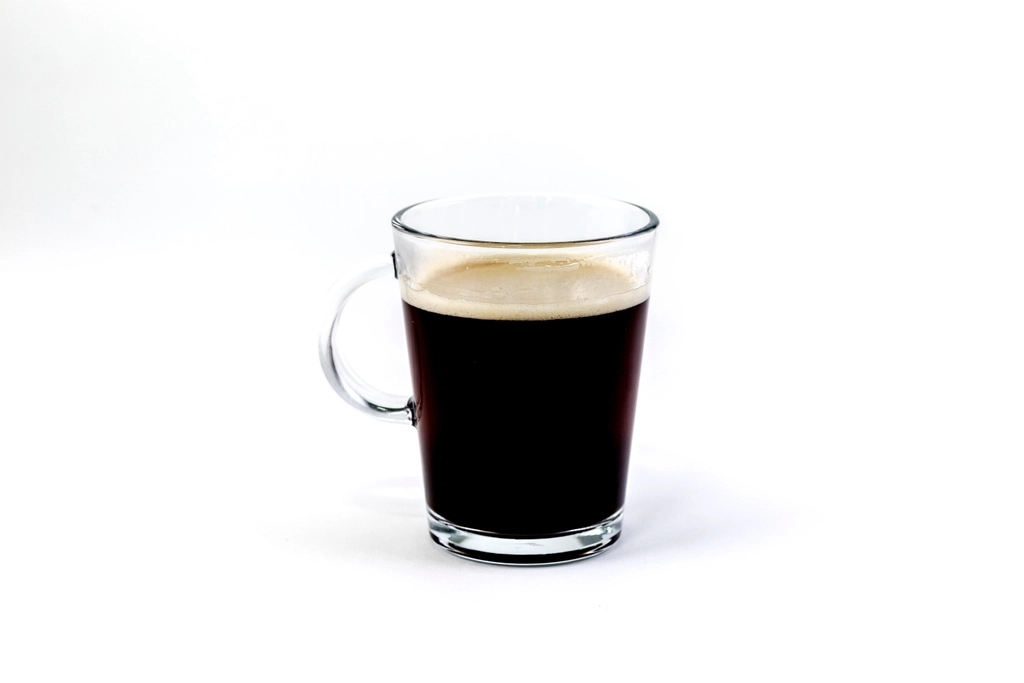
Photo: rawpixel (CC0).
If you do not want to test your own mugs, a mug warmer set solves the problem. These sets include a flat bottom mug sized for the plate, and many add a lid. For example, HOWAY says its matched flat-bottomed mug helps heat reach the drink, even on cold days. On the other hand, if you already own a thin, flat-bottomed mug, a plate alone works just as well and costs less.
How to Test Your Mug at Home
Not sure if your favorite mug will work? Try this quick test:
- Check the base. First, place the mug on a flat table and look for gaps under the bottom.
- Do the coin test. Next, try sliding a thin coin under the center. If it slides in easily, the base is not flat.
- Weigh it. Then, if your warmer has a sensor, weigh the mug on a kitchen scale and compare it with the brand’s minimum.
- Measure the temperature. After that, fill it with fresh coffee, set it on the warmer with a lid, and check with a thermometer after 30 minutes.
- Compare mugs. Finally, repeat with a second mug to see which holds heat better.
What Temperature Should You Aim For?
Even with the perfect mug, you do not need extreme heat. In a 2008 study in the journal Burns, Fredericka Brown and Kenneth Diller calculated an optimal coffee drinking temperature of about 136°F (PubMed). So, with a good flat bottom mug and a lid, a middle setting is usually enough. If you reheat coffee often, see how much electricity a microwave uses. For more on starting hot, see our guide on what coffee maker makes the hottest coffee.
Tips for Better Results
- Preheat the mug. First, rinse it with hot water before pouring. An electric kettle makes this quick; see the best electric kettle.
- Center the mug. In addition, keep the base centered on the plate for even contact.
- Keep the base dry. Also, wipe the bottom of the mug before setting it down.
- Use a lid. Then cover the mug to keep heat in.
- Start hot. Finally, place the mug on the warmer right after brewing.
For a sense of power costs across your coffee setup, see how many watts a coffee maker uses.
Frequently Asked Questions
Do I need a special mug for a mug warmer?
Not necessarily. Any thin, flat bottom mug made of ceramic, glass, or single-wall stainless steel usually works. However, avoid footed, insulated, and plastic cups.
Why is my coffee lukewarm on my mug warmer?
Most often, the mug is the problem. A raised foot, thick walls, or double-wall insulation all reduce heat transfer.
Can I use a travel mug on a mug warmer?
Usually not well. Most travel mugs are double-wall insulated, which blocks heat from the plate.
Is a stainless steel mug better than ceramic on a warmer?
Single-wall stainless steel conducts heat faster. Still, a thin, flat ceramic mug can perform very well, and it is often more comfortable to hold.
Does mug weight matter?
It does for sensor-based warmers. For example, Bestinnkits needs at least 0.8 lb, and Cosori needs at least 10.4 oz, to switch on.
Can I use a mug with a slightly curved bottom?
Sometimes. VOBAGA, for example, says slightly concave bottoms can work. However, a raised foot ring will not, so check that the base still touches the plate across most of its area.
Final Thoughts
The best mugs for a mug warmer share a few simple traits: a flat bottom mug base with full contact, thin walls, single-wall construction, enough weight for any sensor, and ideally a lid. Ceramic and glass work well when thin and flat, while single-wall stainless steel transfers heat fastest. Avoid footed, insulated, and plastic cups. Get the mug right, and even an inexpensive warmer will keep your coffee near that comfortable 136°F much longer.

Hey, My name is MAMON. I am a SEO content creator and affiliate marketer with over 8 years of experience. I create honest product reviews, in-depth buying guides, and practical how-to articles to help readers make informed decisions. My mission is to provide trustworthy, research-backed content that delivers real value.
Leave a Reply