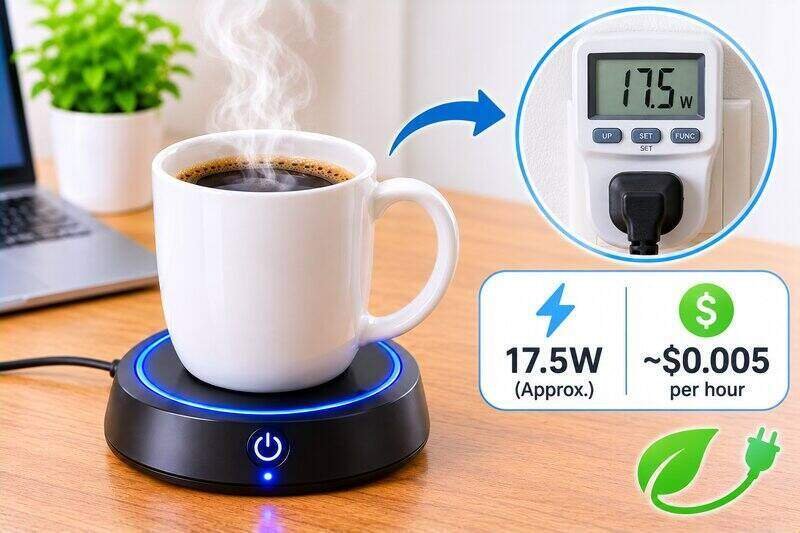
How much electricity does a mug warmer use? Very little. Most plug-in mug warmers draw between 16 and 75 watts, so running one for a full 8-hour workday uses roughly 0.13 to 0.6 kilowatt-hours. At the U.S. Energy Information Administration’s projected 2026 average residential price of 18.2 cents per kWh, that works out to about 2.5 to 11 cents a day. In this guide, we break down the wattage of popular models, show daily and yearly costs, compare state electricity rates, and explain how self-heating mugs, microwaves, and coffee makers stack up.
Key Takeaways
- First, most mug warmers use 16 to 75 watts, according to their Amazon listings.
- A 17-watt warmer uses about 0.136 kWh in 8 hours, or roughly 2.5 cents a day at 18.2 cents per kWh.
- Over 250 workdays, yearly costs range from about $6 for a 17-watt model to about $27 for a 75-watt model at full power.
- However, leaving a 36-watt warmer on 24/7 would cost about $57 a year, so auto shut-off matters.
- Finally, charging a self-heating mug once costs well under 1 cent, based on its battery size.
How Much Electricity Does a Mug Warmer Use? The Short Answer
In short, a mug warmer uses about as much power as a bright LED desk lamp or less. Typically, most models fall between 16 and 50 watts, while a few smart plates reach 75 watts. Because the heater also cycles on and off once it reaches temperature on many models, real-world use is often lower than the maximum.
To calculate how much electricity does a mug warmer use, multiply its wattage by the hours you run it, then divide by 1,000 to get kilowatt-hours (kWh). For example, a 17-watt warmer running for 8 hours uses 17 × 8 ÷ 1,000 = 0.136 kWh. Then, multiply by your electricity rate to get the cost. So, once you know the wattage, the math takes only seconds.
Why Mug Warmers Use So Little Power
A mug warmer has a much easier job than most kitchen appliances. For example, a coffee maker has to heat water from tap temperature to nearly boiling, and a microwave has to heat food quickly. By contrast, a mug warmer only needs to replace the heat your coffee loses while it sits. Because that heat loss is fairly slow, a small heating element is enough.
In addition, many modern warmers use a thermostat. Once the plate reaches its set temperature, the heater switches off, and it turns back on only when the plate cools slightly. As a result, a warmer rated at 36 watts may average well below 36 watts over an hour. That is also why a plug-in watt meter often shows lower real-world use than the label suggests.
Of course, low power has a trade-off. Since a warmer delivers so little energy, it is good at keeping hot coffee warm but slow at reheating cold coffee. So, the same feature that makes it cheap to run also limits how fast it can warm a drink.
Wattage of Popular Mug Warmers
To start, here are the listed wattages of popular mug warmers on Amazon, based on product listings checked in November 2026.
| Model | Listed Power | Type |
|---|---|---|
| Tsmsv Cup Warmer Set | 16 W | Plate + mug |
| Mr. Coffee MWBLK | 17 W | Basic plate |
| Home-X Mug Warmer | 17 W | Basic plate |
| Bestinnkits Mug Warmer | 19 W | Gravity-sensor plate |
| Cafzed 6-Temp | 30 W | Plate with settings |
| BONTIME Mug Warmer | 35 W | Plate with settings |
| SWEETFULL DS1295 | 36 W | Plate with timer |
| BEARWIND | 50 W | High-power plate |
| iKago Warmer & Mug Set | 75 W | Smart plate |
Interestingly, the BONTIME listing states it consumes 0.035 kWh per hour, which matches its 35-watt rating. In general, you can use the wattage on the label to estimate energy use the same way. That is the simplest way to answer how much electricity does a mug warmer use for your own model.
How Much Electricity Does a Mug Warmer Use per Day and Year?
The table below shows our estimates for 8 hours a day at full power, using the EIA’s projected 2026 average residential price of 18.2 cents per kWh and 250 workdays a year.
| Wattage | kWh per 8 Hours | Cost per Day | Cost per Year (250 Days) |
|---|---|---|---|
| 17 W | 0.136 | About 2.5 cents | About $6.19 |
| 19 W | 0.152 | About 2.8 cents | About $6.92 |
| 30 W | 0.24 | About 4.4 cents | About $10.92 |
| 36 W | 0.288 | About 5.2 cents | About $13.10 |
| 50 W | 0.4 | About 7.3 cents | About $18.20 |
| 75 W | 0.6 | About 10.9 cents | About $27.30 |
Keep in mind that these figures assume the heater runs nonstop. In practice, thermostatic warmers switch off when the plate reaches temperature, so your actual cost may be noticeably lower.
Monthly Energy Use in Plain Numbers
Sometimes a monthly figure is easier to picture, since that is how your electric bill arrives. Assuming about 21 workdays a month and 8 hours a day, here is what common warmers would add to a typical bill. Again, these are our full-power estimates at 18.2 cents per kWh.
| Wattage | kWh per Month | Cost per Month |
|---|---|---|
| 17 W | About 2.9 | About 52 cents |
| 36 W | About 6.0 | About $1.10 |
| 50 W | About 8.4 | About $1.53 |
| 75 W | About 12.6 | About $2.29 |
In other words, even the most powerful warmer here adds only a couple of dollars a month. For most households, that amount is too small to notice on a bill, especially if the warmer cycles off once it reaches temperature.
How Your State’s Electricity Rate Changes the Cost
However, electricity prices vary widely across the U.S. For example, EIA data for March 2026, compiled by Jouleio, showed residential prices of about 42.23 cents per kWh in Hawaii and 33.35 cents in California, compared with about 11.95 cents in North Dakota. As a result, the same mug warmer can cost several times more to run in one state than another.
| State | Price (March 2026) | Yearly Cost, 36 W Warmer |
|---|---|---|
| Hawaii | 42.23¢/kWh | About $30.41 |
| California | 33.35¢/kWh | About $24.01 |
| U.S. average (2026 forecast) | 18.2¢/kWh | About $13.10 |
| North Dakota | 11.95¢/kWh | About $8.60 |
Note that these yearly costs assume 8 hours a day for 250 days, or 72 kWh a year. To find your own cost, check the price per kWh on your electric bill and multiply it by 72 for a 36-watt warmer.
Video: Techtalk reviews a 50-watt mug warmer.
The Real Cost Risk: Leaving It On
The biggest cost mistake is not choosing a high-wattage warmer; instead, it is forgetting to turn one off. For instance, a 36-watt warmer left on 24 hours a day, every day, would use about 315 kWh a year. At 18.2 cents per kWh, that is roughly $57 a year, or more than four times the workday estimate.
Fortunately, most modern warmers include an auto shut-off. Many turn off after 4 hours by default, and some let you set a timer from 2 to 12 hours. On the other hand, basic plates like the classic Mr. Coffee have no auto shut-off, so you need to switch them off yourself. Therefore, if you are forgetful, an auto shut-off model can save both energy and worry.
How Much Electricity Does a Self-Heating Mug Use?
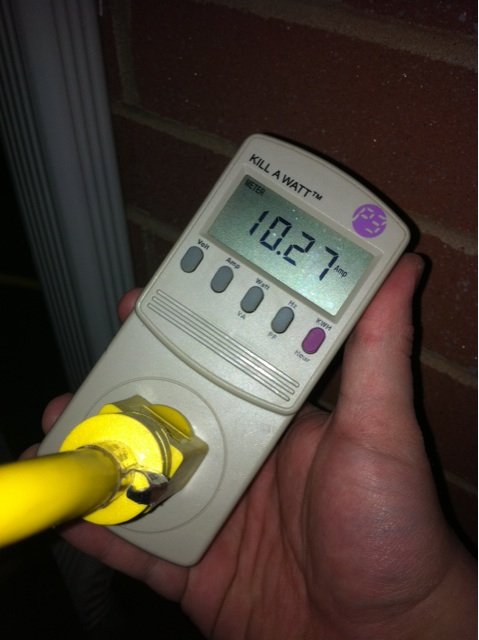
Photo: Porkrind via Wikimedia Commons (CC BY-SA 3.0).
By contrast, self-heating mugs run on rechargeable batteries, so their electricity use comes from charging. For example, the Happiness self-heating mug lists a 4,000 mAh battery. At a typical 3.7 volts, that stores about 14.8 watt-hours, or roughly 0.015 kWh. Charging it fully once would cost about 0.27 cents at 18.2 cents per kWh. Even after allowing for charger losses, that is well under 1 cent per charge. These are our estimates.
However, if you leave the mug on its coaster all day, the coaster keeps powering the heater, so use rises. Still, because these mugs are small and insulated, daily costs remain in the range of a few cents.
Mug Warmer vs. Microwave vs. Coffee Maker
To put mug warmer energy use in context, here is how it compares with other ways of keeping or making hot coffee. These are our estimates at 18.2 cents per kWh.
| Appliance and Use | Energy | Estimated Cost |
|---|---|---|
| 17 W mug warmer, 8 hours | 0.136 kWh | About 2.5 cents |
| 1,000 W microwave, 1-minute reheat | About 0.017 kWh | About 0.3 cents |
| Microwave, 4 reheats a day | About 0.067 kWh | About 1.2 cents |
| Self-heating mug, one full charge | About 0.015 kWh | Under 1 cent |
As you can see, all of these costs are tiny. In fact, the choice comes down to convenience and taste more than money. For deeper comparisons, see our guides on how much electricity a microwave uses and how many watts a coffee maker uses.
Does a Higher Setting Use More Electricity?
Yes, generally. Specifically, on models with thermostats, a higher setting keeps the heater on for longer before it cycles off. As a result, energy use rises with the setting. However, the maximum is still capped by the wattage rating. In other words, a 36-watt warmer can never use more than 36 watts, no matter which setting you choose.
Interestingly, a higher setting is often unnecessary. A 2008 study in the journal Burns calculated an optimal coffee drinking temperature of about 136°F, so a middle setting usually keeps coffee comfortable while using less power.
How to Measure Your Mug Warmer’s Electricity Use
If you want exact numbers, however, a plug-in watt meter is the easiest tool. Here is how to use one:
- Plug in the meter. First, insert the watt meter into a wall outlet.
- Connect the warmer. Next, plug the mug warmer into the meter.
- Run a normal session. Then use the warmer as you usually would, for a few hours.
- Read the kWh. After that, note the total kWh shown on the meter.
- Calculate the cost. Finally, multiply the kWh by your rate from your electric bill.
Best of all, this method captures thermostat cycling, so it is usually more accurate than a wattage-based estimate.
Is a Mug Warmer Worth the Electricity?
For most people, yes. Even at the high end, a 75-watt warmer used every workday costs about $27 a year at the projected 2026 average rate. Meanwhile, a typical 17- to 36-watt model costs about $6 to $13 a year. In comparison, a single coffee shop drink often costs more than a whole year of running a basic warmer.
Moreover, a warmer can reduce waste. If you often pour cold coffee down the drain and brew a fresh cup, a warmer may save both coffee and the energy needed to brew it again. Therefore, when people ask how much electricity does a mug warmer use, the more useful question is often whether it helps them finish the coffee they already made.
Mug Warmer Electricity Use at Home vs. at the Office
At home, you pay the electricity bill directly, so the figures above apply to you. In an office, on the other hand, your employer pays, and the cost of one warmer is tiny compared with lighting and computers. Still, some offices limit personal appliances for safety reasons, so check your workplace policy first. In either setting, an auto shut-off model is the smart choice, since it prevents a forgotten warmer from running all night or over a weekend.
Tips to Use Less Electricity
- Choose auto shut-off. First, a 4-hour shut-off prevents all-day or overnight waste.
- Use a lid. In addition, a lid reduces heat loss, so the heater cycles less.
- Start with hot coffee. Also, the warmer works less when the drink is already hot.
- Pick a moderate setting. Similarly, a middle setting near drinking temperature uses less power.
- Unplug at day’s end. Finally, unplugging removes any standby draw from lights or displays.
Starting with a hotter brew also helps. Our guide on low wattage coffee makers covers brewers that pair well with a low-power warmer. Likewise, for fast hot water, see the best electric kettle.
Frequently Asked Questions
How much electricity does a mug warmer use per hour?
Simply put, it uses its wattage in watt-hours. For example, a 17-watt warmer uses 0.017 kWh per hour, while a 36-watt warmer uses 0.036 kWh per hour.
Is it expensive to leave a mug warmer on all day?
Not for a workday. In fact, a 36-watt warmer costs about 5 cents for 8 hours. However, leaving it on 24/7 could cost about $57 a year.
Do mug warmers use electricity when turned off?
Possibly. Models with a display or indicator light may draw a tiny amount while plugged in. So, unplugging is the surest way to use zero power.
Which uses more electricity, a mug warmer or a microwave?
Per minute, a microwave uses far more. Over a full day, however, a mug warmer and a few microwave reheats cost about the same, only a few cents.
How much does it cost to charge a self-heating mug?
Very little. For example, a 4,000 mAh battery stores about 0.015 kWh, so a full charge costs well under 1 cent at average U.S. rates.
Does a cordless mug warmer use less electricity?
Generally, yes, but only because it has less power to give. For example, a 10,000 mAh battery stores about 37 watt-hours, so a full charge costs well under 1 cent. However, that also means less heat than a plug-in plate.
How can I find my exact electricity rate?
First, look at your latest electric bill for the price per kWh. Then, multiply it by the kWh figures in this guide. As a result, you will get a cost that matches your own utility instead of the national average.
Final Thoughts
So, how much electricity does a mug warmer use? Usually between 0.13 and 0.6 kWh per 8-hour day, which costs about 2.5 to 11 cents at the projected 2026 U.S. average. Over a year of workdays, that is roughly $6 to $27, depending on wattage and your state’s rates. The bigger risk is leaving a warmer on around the clock, so choose a model with auto shut-off. Beyond that, a lid, hot coffee, and a moderate setting will keep both your drink and your bill comfortable.

Hey, My name is MAMON. I am a SEO content creator and affiliate marketer with over 8 years of experience. I create honest product reviews, in-depth buying guides, and practical how-to articles to help readers make informed decisions. My mission is to provide trustworthy, research-backed content that delivers real value.
Leave a Reply