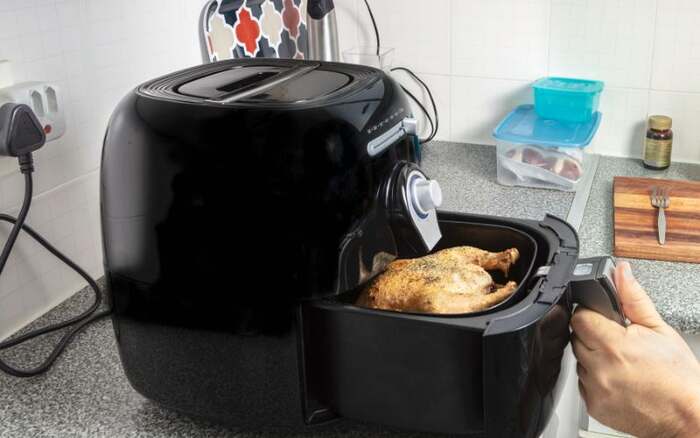
If you’re thinking about replacing your deep fryer or oven with an air fryer, one of the first questions worth answering is how much electricity it actually uses. The short answer: most air fryers draw between 800 and 1,800 watts, and a typical 20 to 30 minute cook session costs somewhere between 6 and 25 cents depending on your air fryer’s size and your local electricity rate.
Key Takeaways
- Air fryers use 800 to 1,800 watts depending on size, with most mid-size models drawing 1,200 to 1,500 watts.
- A 1,500-watt air fryer run for 30 minutes uses about 0.75 kWh, which costs roughly 14 cents at the current U.S. average residential rate of 18.83 cents per kWh.
- Air fryers generally use about half the energy of a full-size electric oven for the same meal, largely because they cook faster and don’t need to heat a large cavity.
Not all air fryers use the same amount of power. Brand, model, and basket size all affect the wattage rating, and that number directly determines how much of an impact the appliance has on your monthly energy bill. Here’s how to figure out exactly what your air fryer costs to run.
How Much Electricity Does an Air Fryer Use?
Air fryers typically draw between 800 and 1,800 watts of power, depending on their capacity. A small 1 to 2-quart air fryer uses closer to 800 to 1,000 watts, a medium 2 to 4-quart model uses 1,200 to 1,400 watts, and a large 4-quart-or-more air fryer can use 1,600 to 1,800 watts or more. The larger and more powerful the unit, the more electricity it draws while it’s running, though it also tends to cook larger batches at once.
Air Fryer Power: Watts vs. Amps
To understand how much electricity your air fryer is using, it helps to know the difference between watts and amps. Watts measure the total amount of power an appliance draws, while amps measure the strength of the electrical current flowing through it. Multiplying amps by voltage (typically 120V in U.S. homes) gives you the wattage, which is the number that actually determines your energy cost.
Small Air Fryers
The type of food you plan to cook usually determines the air fryer size you need. If you’re cooking a single serving of fries for one person, a small air fryer with a 1 to 2-quart capacity is usually enough, and its power requirements are correspondingly lower.
- Serves 1 to 2 people
- 800 to 1,000 watts of power
Medium Air Fryers
If you’re regularly cooking for 2 to 4 people, a medium air fryer with a 2 to 4-quart capacity is usually the next step up. These need more power to heat a larger cooking chamber.
- Serves 1 to 4 people
- 1,200 to 1,400 watts of power
Large Air Fryers
For households of 4 or more, or if you want to cook chicken, fish, pork, vegetables, and baked goods in larger batches, a large air fryer with a 4-quart or bigger capacity is the better fit. These draw the most power of the three sizes.
- Serves 4 or more people
- 1,600 to 1,800 watts of power
| Air Fryer Size | Capacity | Typical Wattage | Cost per 20-Minute Cook* |
|---|---|---|---|
| Small | 1-2 quarts | 800-1,000W | $0.05-$0.06 |
| Medium | 2-4 quarts | 1,200-1,400W | $0.08-$0.09 |
| Large | 4+ quarts | 1,600-1,800W | $0.10-$0.11 |
*Estimated using the U.S. average residential electricity rate of 18.83 cents per kWh.
How to Calculate Your Air Fryer’s Electricity Usage
The formula for working out exactly how much electricity your air fryer uses is straightforward:
Energy (kWh) = Wattage ÷ 1,000 × Hours of use
For example, a 1,500-watt air fryer run for 30 minutes (0.5 hours) uses:
1,500 ÷ 1,000 × 0.5 = 0.75 kWh
Once you know the kWh figure, multiply it by your electricity rate to find the cost. At the national average rate of 18.83 cents per kWh, that 30-minute cook session costs about 14 cents. Run the same air fryer for just 15 minutes and the cost drops to roughly 7 cents.
What Does It Cost to Run an Air Fryer?
Your actual bill depends heavily on how often you use the air fryer and what you pay per kilowatt-hour. Electricity rates vary a lot by state, from around 12 cents per kWh in North Dakota to over 45 cents in Hawaii, so your real-world cost could be noticeably higher or lower than the national average.
Here’s what a mid-size 1,400-watt air fryer costs to run at different usage levels, based on the U.S. average rate:
| Usage Frequency | kWh per Month | Estimated Monthly Cost |
|---|---|---|
| Twice a week, 20 min/session | ~1.9 kWh | ~$0.36 |
| 4 times a week, 25 min/session | ~6.1 kWh | ~$1.15 |
| Daily, 30 min/session | ~13 kWh | ~$2.45 |
| Daily, 1 hour/session | ~26 kWh | ~$4.90 |
Even with heavy daily use, an air fryer typically adds only a few dollars to your monthly electricity bill, which is one reason it’s become such a popular replacement for both the oven and the deep fryer for everyday cooking.
Air Fryer vs. Oven: Which Uses Less Electricity?
This is where air fryers really shine. A 1,500-watt air fryer run for 30 minutes uses about 0.75 kWh, while a typical 3,000-watt electric oven running for the same 30 minutes uses about 1.5 kWh, roughly double. According to Kiplinger’s cost comparison, air fryers generally use about half the total energy of an electric oven for a comparable meal, and that’s before accounting for the fact that ovens also need time to preheat, which adds even more to the total energy used per meal.
Gas ovens tend to be cheaper to operate than either electric ovens or air fryers, since natural gas typically costs less per unit of energy than electricity. But if your kitchen runs on electric appliances, swapping oven use for air fryer use on smaller meals is one of the more reliable ways to trim your cooking-related electricity costs.
Factors That Affect Your Air Fryer’s Electricity Usage
Beyond the wattage rating printed on the box, a few other things influence how much your air fryer actually costs to run day to day.
Cooking temperature. Higher temperatures require more energy to reach and maintain, so a recipe cooked at 400°F will use more electricity than the same food cooked at 350°F, all else being equal.
Cooking time. Since cost is a function of both wattage and time, a longer cook time at a lower wattage can sometimes cost about the same as a shorter cook time at a higher wattage. This is part of why larger, more powerful air fryers don’t always cost dramatically more to run than smaller ones; they often finish the job faster.
Preheating. Many air fryers don’t strictly need preheating, unlike ovens. Skipping an unnecessary preheat cycle can shave a couple of minutes, and a bit of cost, off every cook.
Frequency of use. A large air fryer used once a week will almost always cost less over a month than a small air fryer used every single day. Frequency matters more than size for your total bill.
Tips to Reduce Your Air Fryer’s Electricity Use
- Match the size to your household. A large air fryer bought for a household of two will spend most of its life partially empty and drawing more power than necessary for the portion size.
- Skip unnecessary preheating. Check your manual. Many foods, especially frozen items, don’t need a preheated basket to cook properly.
- Cook in batches strategically. Running one full basket is more efficient than running two half-full batches back to back.
- Keep the basket and heating element clean. Grease buildup can reduce airflow and force the unit to run longer to reach the same result.
- Use the lowest effective temperature. If a recipe gives a temperature range, starting at the lower end and adding time as needed can use less energy than cooking hot and fast.
Frequently Asked Questions
Does an air fryer use more electricity than a microwave?
Yes, generally. Microwaves usually draw less wattage and cook in shorter bursts, so they tend to cost less per use than an air fryer. However, air fryers often replace longer oven sessions, which can make them the more efficient choice overall for a full meal.
Is it cheaper to run an air fryer than an electric stove?
For most single-dish meals, yes. An air fryer’s smaller cooking chamber and shorter cook times generally use less total energy than a stovetop burner running for the same or longer period, especially for foods like fries, wings, or vegetables that would otherwise need a pan and more oil.
Do bigger air fryers always cost more to run?
Not necessarily. A larger air fryer draws more watts, but it can also cook a full batch faster than running two smaller batches back to back in a small unit, which can even out the total cost.
How can I check my exact electricity cost?
Look up your air fryer’s wattage on the rating label or manual, then use the formula above with your own utility rate, which is listed on your electric bill or through your provider’s account portal.
Is an Air Fryer Worth It Just for the Electricity Savings?
If you’re weighing a new air fryer purely on energy savings, it’s worth doing the math against the appliance’s price tag. Say you replace three oven-cooked dinners a week with an air fryer, saving roughly 0.5 to 0.75 kWh per swap. At the national average rate, that’s a savings of around $1 to $1.50 a week, or roughly $50 to $75 a year. A budget air fryer typically costs $40 to $80, so the electricity savings alone could pay for a smaller model within a year of regular use.
That said, most people don’t buy an air fryer purely to cut their electricity bill. The bigger draws are usually speed, convenience, and the ability to get crispy results without a full basin of oil. The energy savings are a genuine bonus rather than the main reason to buy one, and they add up faster the more often you use the air fryer in place of a full oven cycle rather than alongside it.
Conclusion
How much electricity does an air fryer use? For most households, the answer is: not much. A typical mid-size air fryer costs a few cents per use and only a few dollars a month even with frequent use, making it one of the more electricity-efficient ways to cook a meal at home. If you’re deciding between air fryer sizes, our guide on how big of an air fryer you need and our breakdown of the best wattage for an air fryer can help you match a model to your household size and cooking habits.
Looking for a specific model? Check out our reviews of the Dash Air Fryer, the Cosori Air Fryer, and the Bella Air Fryer, or browse our roundup of the best air fryers under $100 if you’re shopping on a budget. And if you’re still on the fence about whether an air fryer is worth adding to your kitchen, our post on 5 reasons every household should have an air fryer covers the other benefits beyond electricity savings.
For the most current electricity rates in your area, the U.S. Energy Information Administration’s Electric Power Monthly report publishes updated state-by-state averages that you can use to refine any of the cost estimates above.

Hey, My name is MAMON. I am a SEO content creator and affiliate marketer with over 8 years of experience. I create honest product reviews, in-depth buying guides, and practical how-to articles to help readers make informed decisions. My mission is to provide trustworthy, research-backed content that delivers real value.
Leave a Reply