If your egg cooker turns out runny yolks one day and chalky ones the next, the problem is almost always the water. In an electric egg cooker, the amount of water you pour onto the heating plate is the timer. So, getting egg cooker water measurements right is the single most important step. In this guide, we explain how the water system works, compare the two main types of measuring cups, share real figures from manufacturer manuals, and show you how to build your own reliable chart. We also cover what to do if your measuring cup is lost or the markings have worn off.
Key Takeaways
- More water means more steam time and firmer eggs; less water means softer yolks.
- Some cups have one line per doneness level, while others are marked by both doneness and number of eggs.
- In egg-count charts, more eggs often need less water per batch, so always read the right line.
- Kalorik’s manual lists about 55 ml (1.9 fl oz) of water for poaching, and one 8-egg model lists 140 ml for 6 to 8 eggs.
- Water boils at about 203°F at 5,000 feet, so cooks at altitude often need a little extra water.
Why Water Controls Doneness
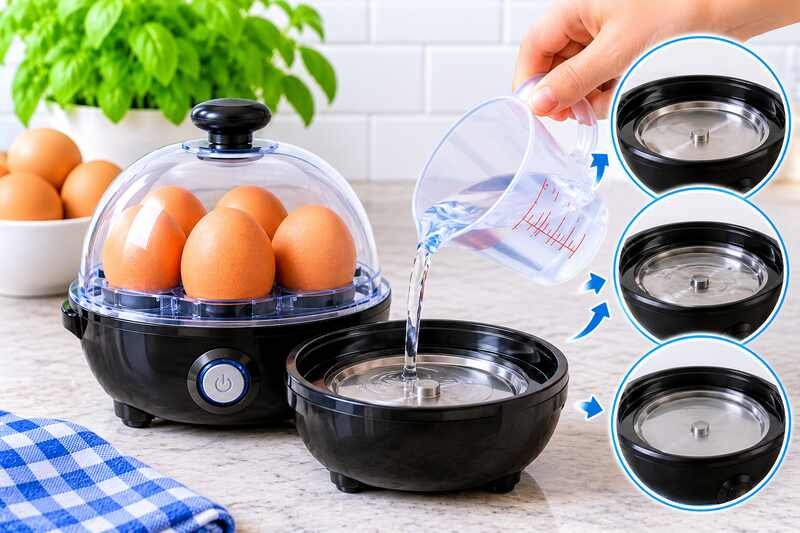
Surprisingly, an electric egg cooker does not have a clock inside. Instead, it relies on a simple physical process. You pour a measured amount of cold water onto a heating plate, and the plate turns that water into steam. The steam cooks the eggs. Then, once the water has fully evaporated, the plate heats up quickly, and a thermostat senses the change and shuts the unit off.
For example, the Dash Rapid Egg Cooker manual, as reproduced on Manuals+, explains that the unit turns off automatically once the water has evaporated and the buzzer sounds. In other words, every extra milliliter of water adds steam time. That is why egg cooker water measurements matter far more than the number of minutes on a kitchen timer.
Two Types of Measuring Cups
However, not all egg cookers measure water the same way. Before using any chart, check which system your cup uses.
| Cup Type | How It Is Marked | Example |
|---|---|---|
| Doneness lines | One line each for soft, medium, and hard, plus a poach or omelet line | Dash “Omelette/Poached” line; Elite Gourmet firmness markings |
| Egg-count scale | Separate scales for soft, medium, and hard, each numbered by egg count | Kalorik: “fill the measuring cup up to the number 2 of the SOFT level” for 2 soft eggs |
With a doneness-line cup, you use the same line whether you cook 2 eggs or a full tray. However, with an egg-count cup, you must find both your doneness level and your number of eggs. Confusing the two systems is one of the most common reasons for inconsistent results.
Why More Eggs Can Need Less Water
This surprises many people. In egg-count charts, the water amount often goes down as the number of eggs goes up. For example, the water table in Salton’s EG2LT manual lists smaller water amounts for larger batches at each doneness level.
A likely reason is that a full tray of cold eggs surrounds the steam with more mass, and the eggs sit closer together, so they cook efficiently in a shorter steam cycle. Whatever the exact physics, the practical lesson is simple: if your cup has an egg-count scale, always fill to the number that matches your batch.
Egg Cooker Water Measurements From Real Manuals
Unfortunately, because each cooker is calibrated differently, there is no universal chart of egg cooker water measurements. Still, real manufacturer figures give a helpful sense of scale.
| Brand and Model | Listed Water Amount | Use |
|---|---|---|
| Kalorik EK 35321 | About 55 ml (1.9 fl oz), half the beaker | Poached eggs, up to 4 |
| Annie & Mia 8-egg cooker | 140 ml | 6 to 8 eggs, per the Amazon listing |
| Dash Rapid | “Omelette/Poached” line on cup | Poached eggs and omelets |
| Salton EG2LT | Measured in tablespoons by egg count | Soft eggs in about 5 minutes; 7 hard eggs in about 15 |
Sources: Kalorik and Salton manuals via ManualsOnline and ManualsDir; Annie & Mia Amazon listing; Dash manual via Manuals+.
As you can see, amounts range from a few tablespoons for poaching to more than half a cup for big batches of hard eggs. Therefore, never borrow a chart from another brand.
Video: TX1Will shows a common problem with worn measuring cup markings.
Handy Water Conversion Chart
Since manuals use different units, a quick conversion table helps. These are standard U.S. kitchen measurements.
| Tablespoons | Fluid Ounces | Milliliters (approx.) |
|---|---|---|
| 1 Tbsp | 0.5 fl oz | 15 ml |
| 2 Tbsp | 1 fl oz | 30 ml |
| 4 Tbsp (1/4 cup) | 2 fl oz | 59 ml |
| 8 Tbsp (1/2 cup) | 4 fl oz | 118 ml |
| About 9.5 Tbsp | 4.7 fl oz | 140 ml |
How to Build Your Own Egg Cooker Water Chart
Photo: .Larry Page via Flickr (CC BY 2.0).
Because every kitchen, egg size, and cooker is a little different, the most reliable chart is one you make yourself. Here is a simple method:
- Start with the manual: First, use the line your manual recommends for medium eggs.
- Measure precisely: Next, pour the water from the cup into a kitchen measuring spoon set or a small liquid measuring cup and note the amount in tablespoons or milliliters.
- Cook and check: Then cook your usual number of eggs, cool them, and cut one open.
- Adjust in small steps: After that, add or remove about 1 tablespoon (15 ml) next time, depending on whether you want firmer or softer yolks.
- Record the result: Finally, write down the amount, egg size, egg count, and result on a card or a note taped inside a cabinet.
After a few batches, you will have personal egg cooker water measurements that work every time, even if your measuring cup goes missing.
Egg Cooker Water Measurements by Doneness: What to Expect
Even though exact egg cooker water measurements vary by brand, the results follow the same pattern. Use this table to judge whether you need more or less water next time.
| Cup Line | White | Yolk | Best For |
|---|---|---|---|
| Soft | Set but tender | Runny | Toast soldiers, egg cups |
| Medium | Firm | Jammy center | Ramen, salads, grain bowls |
| Hard | Firm | Fully set | Deviled eggs, egg salad, snacks |
| Poach or omelet | Set | Soft to set | Eggs Benedict, quick omelets |
If your result falls between two rows, adjust by about 1 tablespoon in the right direction. Over a few batches, you will find the exact amount for your favorite yolk.
Tips for Accurate Egg Cooker Water Measurements
- Read at eye level: First, set the cup on the counter and bend down to read the line, since looking from above makes it easy to overfill.
- Use a level surface: Next, make sure the cooker sits flat, so the water spreads evenly across the plate.
- Pour it all: Then empty the cup completely onto the plate rather than leaving drops behind.
- Start dry: Also, wipe off leftover water from the last batch, since extra water adds steam time.
- Use the same eggs: Finally, test your chart with the egg size you usually buy.
A Simple Personal Chart Template
Copy this layout onto a card and fill it in as you test. Here is one example row to show the format:
| Eggs | Size | Water Used | Result |
|---|---|---|---|
| 6 | Large | Medium line (record your ml) | Jammy yolk, easy peel |
Lost or Worn Measuring Cup?
Over time, printed markings can fade with repeated washing. In fact, “egg cooker measuring cup replacement” is a common search for exactly this reason. You have a few options:
- Buy a replacement: Many brands, including Dash, sell replacement measuring cups for their models.
- Use your own chart: If you built a chart in tablespoons or milliliters, any kitchen measuring spoon set will work.
- Re-mark the cup: Before the lines fade completely, measure each line with water and mark it on the outside with a permanent marker or a small piece of tape.
- Hand-wash the cup: Finally, washing by hand instead of in the dishwasher may help printed lines last longer.
Keep in mind that the piercing pin is usually built into the bottom of the cup. So, if you replace the cup, make sure the new one includes a pin, or use a clean pushpin instead.
Does the Number of Eggs Change Anything on a Doneness-Line Cup?
With a doneness-line cup, such as those from Dash or Elite Gourmet, you use the same line whether you cook one egg or a full tray. That said, many owners notice small differences between tiny and full batches. If that happens to you, simply add or remove a little water and note the result in your personal chart. In practice, most people settle on one or two amounts they use every week, which makes the routine fast and predictable.
Adjusting for Egg Size
Typically, most charts assume large eggs. However, USDA grading rules set minimum weights per dozen, and larger sizes weigh noticeably more. For example, a dozen large eggs must weigh at least 24 ounces, while a dozen extra-large eggs must weigh at least 27 ounces. Accordingly, the Dash manual notes that extra-large or jumbo eggs may need additional time or water. As a rule of thumb, start with about 1 extra tablespoon for extra-large eggs and test.
Adjusting for Altitude
In addition, altitude changes the math. According to Colorado State University Extension, water boils at about 203°F at 5,000 feet and about 198°F at 7,500 feet, compared with 212°F at sea level. Because the steam is cooler, eggs cook more slowly. So, if you live at elevation and your eggs come out soft, add a little water and test again.
Troubleshooting Water Problems
Photo: moonlightbulb via Flickr (CC BY 2.0).
| Problem | Likely Water Issue | Fix |
|---|---|---|
| Yolks too runny | Too little water | Add about 1 tablespoon |
| Green ring around yolk | Too much water | Use less water and chill eggs right away |
| Results change batch to batch | Wrong scale or warm water | Use cold water and the correct egg-count line |
| Unit shuts off too fast | Mineral scale on plate | Descale with diluted vinegar |
| Poached eggs runny | Below the poach line | Fill exactly to the poach line |
The University of Arkansas Cooperative Extension Service explains that the green ring comes from a reaction between sulfur in the white and iron in the yolk, usually from overcooking. Meanwhile, the Dash manual recommends cleaning mineral spots with 10 parts water to 1 part vinegar. If you have hard water, our comparison of a water descaler vs water softener explains long-term fixes.
Why Cold Water Matters
Notably, most manuals, including Dash’s, call for cold water. That is because charts are calibrated for water that starts cold. If you use hot tap water, it reaches a boil sooner, shortens the steam cycle, and gives softer eggs. Similarly, starting with warm water from a kettle is helpful on the stovetop, but not in an egg cooker. For stovetop boiling, our guide to the best electric kettle covers fast options.
Water Measurements for Other Egg Appliances
The same water-timing idea applies to other steam-based cookers. For instance, a rice cooker with a steam tray cooks eggs with steam from the inner pot; our guide on how to steam using a rice cooker explains the setup. Similarly, microwave steamers rely on a small amount of water to create steam, as covered in our guide on how to use a microwave steamer. By contrast, oven-baked eggs use dry heat and no water at all, which is why our guide on how to cook eggs in a toaster oven focuses on temperature instead.
Frequently Asked Questions
How much water do I put in an egg cooker for hard-boiled eggs?
Use the hard line on the measuring cup that came with your cooker. Since amounts vary by brand and batch size, do not use another brand’s chart.
Why does my chart use less water for more eggs?
Some egg-count charts, such as Salton’s, list less water for larger batches. So, always fill to the number that matches how many eggs you are cooking.
How much water do I use for poached eggs?
Use the poach line on your cup. For example, Kalorik’s manual lists about 55 ml, or half the beaker, for poaching.
Can I use a regular measuring cup instead?
Yes, if you know the amount in tablespoons or milliliters. Otherwise, build your own chart by measuring the lines on your original cup.
Should I use cold or warm water?
Generally, use cold water, since the charts assume it. Warm water shortens cooking and gives softer eggs.
Do egg cooker water measurements change with egg size?
Yes. Larger eggs need a bit more steam time, so the Dash manual notes that extra-large or jumbo eggs may need additional water. Therefore, start with about 1 extra tablespoon and test.
Does mineral buildup affect the water timing?
It can. In fact, scale on the heating plate can change how quickly the water evaporates, which affects doneness. So, descale regularly with diluted vinegar to keep results consistent.
Do I need more water at high altitude?
Often, yes. Because water boils at a lower temperature at elevation, eggs cook more slowly, so a little extra water may help.
Final Thoughts
Getting egg cooker water measurements right is the key to perfect eggs. First, identify whether your cup uses doneness lines or an egg-count scale. Then use cold water, fill to the exact line, and adjust by about a tablespoon at a time. Finally, record what works in a simple chart, so you never have to guess again, even if your measuring cup wears out.

Hey, My name is MAMON. I am a SEO content creator and affiliate marketer with over 8 years of experience. I create honest product reviews, in-depth buying guides, and practical how-to articles to help readers make informed decisions. My mission is to provide trustworthy, research-backed content that delivers real value.
Leave a Reply