

Hard water leaves white crust on faucets, spots on dishes, and scale inside your water heater. The two most common fixes are a descaler and a softener. The water descaler vs water softener choice matters because they work in very different ways. One removes hardness minerals. The other only changes how they behave. This guide explains the difference, what independent testing shows, and which one fits your home.

Key Takeaways
- A water softener removes calcium and magnesium using salt and resin. It produces truly soft water.
- A water descaler leaves the minerals in the water. It aims to stop them from sticking as hard scale.
- In an Arizona State University study, template assisted crystallization (TAC) cut scale by more than 88%. Electronic and electromagnetic units cut it by about 50%.
- Only a softener gives you soft-water benefits like better soap lather and fewer spots.
- Descalers need no salt and no drain, which helps where salt-based softeners are restricted.
Quick Answer: Descaler or Softener?
If your main goal is soft water, choose a softener. It is the only option that actually removes hardness. You will notice softer skin, better lather, and fewer water spots.
If your main goal is protecting pipes and appliances from scale, a descaler can help. A quality TAC system is the best-tested type. It uses no salt, wastes no water, and needs little upkeep. In the water descaler vs water softener debate, the right answer depends on which problem bothers you most.
Signs You Have Hard Water
Before comparing a water descaler vs water softener, confirm that hard water is really the problem. Common signs include:
- White, chalky crust on faucets and showerheads.
- Cloudy spots on glasses after the dishwasher runs.
- Soap that will not lather well and leaves a film.
- Stiff laundry and dull-looking towels.
- A water heater that pops or rumbles from scale buildup.
- Dry skin and hair after showering.
These signs point to hardness, but only a test tells you how hard your water is.

First, How Hard Is Your Water?
Know your hardness level before you buy anything. The U.S. Geological Survey classifies water hardness like this, measured as calcium carbonate:
| Hardness Level | mg/L | Approx. Grains per Gallon |
|---|---|---|
| Soft | 0 to 60 | 0 to 3.5 |
| Moderately hard | 61 to 120 | 3.6 to 7 |
| Hard | 121 to 180 | 7.1 to 10.5 |
| Very hard | Over 180 | Over 10.5 |
One grain per gallon equals about 17.1 mg/L. City water users can find hardness in their utility’s annual water quality report. Well owners should test their water with a kit or a lab.
What Is a Water Softener?
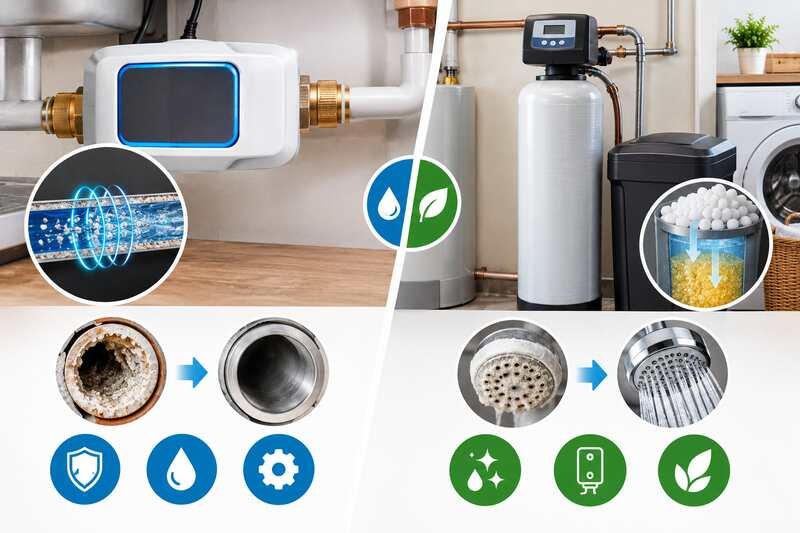
A traditional water softener uses ion exchange. Water flows through a tank of resin beads. The beads grab calcium and magnesium and release sodium or potassium in their place.
Over time, the resin fills up with hardness minerals. The softener then regenerates. It rinses the resin with salty brine and flushes the minerals down the drain. Our guide on how often to regenerate a water softener explains that cycle in detail.
The University of Nebraska–Lincoln Extension says ion exchange softeners can reach the soft range of 0 to 1 grain per gallon. That is something no descaler can do.
What Is a Water Descaler?
A water descaler, also called a salt-free conditioner, does not remove hardness. The calcium and magnesium stay in your water. Instead, the device tries to keep them from forming hard scale on surfaces.
There are three main types:
- Template assisted crystallization (TAC): Water passes through a tank of special media. The media turns dissolved minerals into tiny crystals that stay suspended and flow through pipes.
- Electronic or electromagnetic descalers: A unit clamps onto the pipe and sends a signal through wire coils. Makers say this changes how the minerals form scale.
- Magnetic descalers: Magnets attach to the pipe. This is the least proven type.
Because descalers leave minerals in the water, many water treatment experts call them conditioners, not softeners. Our saltless water softener reviews cover specific TAC and salt-free models.
What the Research Says
Independent testing is the key to the water descaler vs water softener question. The best-known U.S. study was led by Dr. Peter Fox at Arizona State University. Funders included the Bureau of Reclamation and California water agencies. The team used the German DVGW-W512 test protocol.
According to the WateReuse Research Foundation summary, the results were:
- TAC: reduced scale formation by more than 88%.
- Ion exchange and capacitive deionization: reduced scale efficiently.
- Electromagnetic and electrically induced precipitation: reduced scale by about 50%. The scale that did form was soft and easy to brush away.
Extension experts urge caution too. A University of Nebraska–Lincoln guide says few conclusive studies confirm how well these devices work in homes. It calls magnetic treatment unproven technology without a strong scientific basis.
The takeaway is clear. TAC has the strongest evidence among descalers. Electronic units show partial benefit. Magnetic units lack solid proof.
Water Descaler vs Water Softener at a Glance
| Feature | Water Softener | Water Descaler (TAC) |
|---|---|---|
| Removes hardness minerals | Yes | No |
| Reduces scale | Yes | Yes, by 88%+ in testing |
| Soft-feeling water and better lather | Yes | No |
| Prevents water spots | Yes, mostly | Little effect |
| Uses salt | Yes | No |
| Needs a drain and electricity | Yes, for most models | Usually no |
| Wastewater | Brine from regeneration | None |
| Typical installed cost | About $1,200 to $3,800 | About $1,500 to $4,500 (salt-free systems) |
| Yearly running cost | About $50 to $150 in salt | About $100 to $300+ in maintenance |
Cost ranges are national averages from HomeGuide and vary by system size and region.
10-Year Cost Example
Upfront price is only part of the water descaler vs water softener cost story. Here is a rough 10-year estimate using HomeGuide’s national ranges.
| Cost Item | Salt-Based Softener | Salt-Free System |
|---|---|---|
| Installed cost | $1,200 to $3,800 | $1,500 to $4,500 |
| Yearly running cost | $50 to $150 | $100 to $300+ |
| Estimated 10-year total | About $1,700 to $5,300 | About $2,500 to $7,500+ |
These are simple estimates, not quotes. Real costs depend on your hardness, household size, and the system you choose. Softener salt use rises with harder water. Descaler costs depend on how often the media needs replacing. Get at least two local quotes before you decide.
Pros and Cons of a Water Softener
Pros
- Removes hardness and delivers truly soft water.
- Soap and detergent lather better, so you may use less.
- Reduces spots on dishes, glass, and fixtures.
- Protects water heaters, dishwashers, and pipes from scale.
Cons
- Needs regular salt refills.
- Sends brine to the drain during regeneration.
- Adds some sodium to the water. Potassium salt is an alternative.
- Some California communities restrict salt-based softeners that discharge to sewers.
Running out of salt is a common problem. See what happens in our guide on when a water softener runs out of salt.

Pros and Cons of a Water Descaler
Pros
- No salt to buy or carry.
- No brine discharge and no wasted water.
- Most TAC systems need no electricity or drain.
- Leaves natural minerals in drinking water.
- Low maintenance, usually just a media change every few years.
Cons
- Does not soften water or improve lather.
- Water spots and film can still appear on glass and fixtures.
- Results vary by type. Magnetic units lack strong evidence.
- TAC makers often set limits for iron, manganese, and chlorine. Pre-filtration may be needed.
Water Descaler vs Water Softener: Which Should You Choose?
Choose a Water Softener If:
- Your water is hard or very hard, above about 7 grains per gallon.
- You want soft-feeling water for bathing and laundry.
- Water spots on dishes and shower glass bother you.
- You have a well with high hardness. Our best water softener for well water guide can help.
Choose a Water Descaler If:
- Your main concern is scale in pipes, water heaters, and appliances.
- Your local rules restrict salt-based softeners.
- You want no salt, no drain, and low upkeep.
- Your hardness is moderate and spots are not a big concern.
Some homes use both types of treatment in different places. For example, a descaler can protect the whole house while a point-of-use filter handles drinking water.
Where Each System Is Installed
Both whole-house systems usually go on the main water line, after the meter or pressure tank. That way, all the water in the house is treated. Many homeowners leave an outdoor spigot on untreated water for the lawn and garden.
A softener needs room for a resin tank and a brine tank, or one combined cabinet. It also needs a nearby drain for brine, and usually an outlet. A TAC descaler needs only a single tank and no drain in most cases. Clamp-on electronic units fit almost anywhere on the pipe. If space is tight, that difference alone may decide the matter.
Common Myths About Descalers and Softeners
- Myth: A descaler softens water. It does not. Hardness stays the same. Only the way minerals behave changes.
- Myth: Softened water is too salty to drink. Softeners add some sodium, but the amount depends on your hardness level. People on low-sodium diets can ask a doctor or use potassium salt.
- Myth: All descalers work the same. Testing shows big differences. TAC performed far better than electronic units.
- Myth: A softener never needs care. It needs salt refills and occasional resin cleaning.
Maintenance Tips for Both Systems
A little care keeps either system working well, whichever side of the water descaler vs water softener choice you pick.
- Softener: Check salt monthly. Break up salt bridges. Clean the brine tank about once a year.
- Softener resin: Resin can foul over time, especially with iron. Our guide on cleaning a water softener resin tank shows how.
- TAC descaler: Replace the media on the maker’s schedule, often every few years.
- Electronic descaler: Check that the unit has power and the indicator lights work.
- Both: Retest your water hardness once a year to confirm results.
Frequently Asked Questions
Is a water descaler as good as a water softener?
Not for soft water. A descaler can reduce scale, but it does not remove hardness. A softener does both.
Do electronic water descalers really work?
Partly. In the Arizona State University study, electromagnetic treatment reduced scale by about 50%. TAC performed much better, at over 88%.
Will a descaler stop spots on my dishes?
Usually not fully. The minerals are still in the water, so spots can form when water dries. A softener works better for spots. You can also treat existing buildup with our guide on cleaning hard water from a dishwasher.
Can I use a descaler with a tankless water heater?
Many TAC makers market their systems for tankless heaters. Check the heater maker’s water quality rules and warranty terms before you buy.
How long does a water softener last?
A well-kept softener can last many years. See our full guide on how long a water softener should last.
Final Verdict
The water descaler vs water softener choice comes down to your goal. If you want truly soft water with better lather and fewer spots, a salt-based softener is the proven solution. If you mainly want to protect pipes and appliances without salt, a TAC descaler is the best-tested option.
Start by testing your water hardness. Then match the system to your hardness level, local rules, and budget. That simple step will save you money and frustration.


Hey, My name is MAMON. I am a SEO content creator and affiliate marketer with over 8 years of experience. I create honest product reviews, in-depth buying guides, and practical how-to articles to help readers make informed decisions. My mission is to provide trustworthy, research-backed content that delivers real value.