

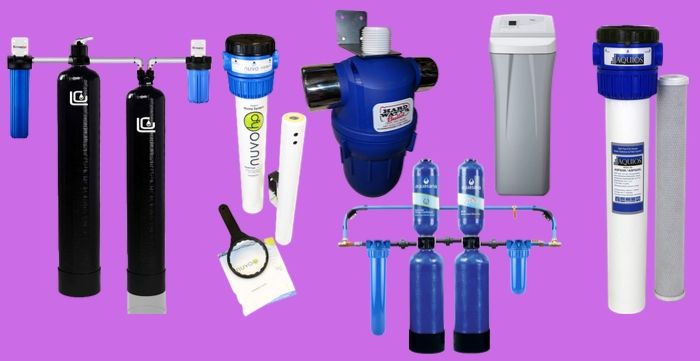

About 85% of U.S. households deal with hard water, according to the U.S. Geological Survey’s Water Science School. That’s the calcium and magnesium behind the scale on your showerhead. It’s also behind the spots on your glasses and the film that keeps soap from lathering. A saltless water softener won’t remove those minerals the way a traditional salt-based system does. Instead, it changes their structure so they stop sticking to your pipes, water heater, and fixtures.
These systems have also become the practical choice in parts of the country where salt-based softeners face restrictions. Under California’s Water Code §13148 (AB 1366), local water agencies can limit or ban self-regenerating salt-based softeners because of the chloride they discharge into wastewater. Over 25 California communities, including the Santa Clarita Valley, have restricted them since 2014. Salt-free systems, however, aren’t affected by these rules, which is one reason they’ve grown in popularity beyond just eco-conscious buyers.
Where Salt-Based Softeners Are Restricted in the U.S.
California isn’t the only state with local restrictions worth knowing about before you buy. Texas, for instance, passed a statewide law in 2001 barring salt-based softener discharge and reverse-osmosis backflush from entering septic systems. The goal was protecting on-site sewage facilities from high sodium loads. Since then, San Antonio and several surrounding utilities have added their own discharge rules on top of that. Meanwhile, Scottsdale, Arizona has banned salt-based systems outright, and parts of New Mexico enforce partial bans or discharge limitations tied to groundwater protection.
Most of these rules target brine discharge specifically. As a result, demand-initiated regeneration (DIR) softeners, which only regenerate when needed rather than on a fixed timer, sometimes remain compliant where older timer-based units aren’t. So if you’re renovating or moving into a home in a restricted area, check with your local water utility or wastewater district before installing any self-regenerating system. Rules vary by city, county, and even individual HOA. A saltless conditioner, on the other hand, sidesteps the question entirely, because it doesn’t discharge brine at all.
Key Takeaways
- Saltless (salt-free) systems condition water using TAC/NAC media or citrus-based filtration; they don’t remove hardness minerals, so a hardness test will read the same before and after.
- Independent testing from the WateReuse Research Foundation and Arizona State University, using the German DVGW W512 protocol, found TAC-based conditioners reduce scale formation by roughly 88-99%.
- They’re a strong fit for moderate-to-hard water (up to about 25 gpg) and for homes in areas that restrict salt-based softeners. Very hard water may still call for a traditional ion-exchange system.
Softener or Conditioner? A Quick Terminology Check
Every product on this list is marketed as a “saltless water softener,” but that’s technically a misnomer worth understanding before you buy. The Water Quality Association distinguishes true softeners, which remove hardness minerals via ion exchange, from conditioners. Conditioners instead use Template-Assisted Crystallization (TAC), Nucleation-Assisted Crystallization (NAC), or citric acid to keep minerals from bonding to surfaces without removing them. So you won’t get the slippery, soap-free rinse that comes with salt-based softening, but you will get meaningfully less scale buildup. For more on how the ion-exchange process itself works, see our guide to how a water softener works. If the silky feel of softened water matters more to you than scale prevention, a salt-based system may be the better fit.
This terminology mix-up isn’t just semantic pedantry; it actually affects how you should shop. Search “water softener” and most retailers, including several product listings above, use the word loosely to mean anything that treats hard water, softener or not. So if a listing promises softened water without salt, read the product description first. Look for TAC, NAC, or citric acid before assuming it removes minerals the way your parents’ softener did.


How TAC Conditioning Actually Works
Most of the systems on this list rely on TAC media rather than salt. Because of that, it’s worth understanding the mechanism instead of just taking “salt-free” at face value. Inside a TAC tank sits a bed of specially treated polymer beads covered in microscopic nucleation sites. As hard water flows through, dissolved calcium and magnesium ions attach to these sites. There, they grow into stable microscopic crystals rather than staying in their original ionic form. Once a crystal reaches a certain size, it releases from the bead and stays suspended in the water. That way, it avoids bonding to the nearest warm surface, which is usually a water heater element or the inside of a pipe.
This is the key distinction from ion exchange: the calcium and magnesium never actually leave the water. So a lab hardness test taken after a TAC system will read the same as one taken before it. In other words, what changes is the minerals’ behavior, not their concentration. That’s also why TAC systems can’t be verified with a standard hardness test strip, which sometimes confuses buyers expecting a “before and after” number to drop. Instead, the real-world evidence shows up as less scale on fixtures and appliances over time. That’s exactly what the DVGW W512 testing referenced above was designed to measure.
Quick Comparison
| Product | Technology | Capacity | Best For |
|---|---|---|---|
| Kenmore 350 | Salt-saving ion exchange | 32,000 grain | Whole-house hard water + iron |
| Aquasana EQ-1000-AST-UV | Salt-free + UV/Carbon/KDF | 1,000,000 gal | Contaminant removal + scale prevention |
| NuvoH2O DPHB | Citrus-based | Compact, 7 lbs | Mineral-retentive softening |
| Watts OFPSYS | TAC + carbon filter | Standard 1″ NPT | Scale prevention + taste improvement |
| WaterBoss WB-WH-DSCLR | Salt-free descaler | 600,000 gal / 6 yr | City and well water |
| H&G Lifestyles IWF022 | 2-stage filtration | Compact | Chlorine + heavy metal reduction |
| NuvoH2O DPNCB | Citrus + carbon, 2-stage | Whole-home | Mineral-retentive softening + filtration |
| NU Aqua WU-STG4-WTSF | 4-stage TAC + GAC/carbon | Whole-house | Heavy metals, chlorine, odor |
| Tier1 UP_0835_TAC12 | TAC, upflow | 900,000 gal | Long-lasting scale control |
| Aquasure AS-SF650 | Salt-free + pre-filter | 800,000 gal | Sediment + chlorine + scale |
1. Kenmore Water Softener System 350


Photo: Amazon
The Kenmore 350 is a true ion-exchange system, not a saltless conditioner. Still, it earns a spot here for its salt-saving regeneration cycle, which cuts salt use compared to older softeners. It’s the pick if you want actual hardness removal, meaning the soft, slippery feel, plus iron reduction, and you’re not in a jurisdiction that restricts self-regenerating softeners.
Pros:
- 32,000 grain capacity handles whole-house softening needs.
- Salt-saving technology reduces regeneration frequency and cost.
- Compact footprint for the capacity it offers.
- Removes iron along with hardness minerals.
Cons:
- About 80 lbs; installation is easier with two people.
- 47.75″ H x 16.5″ W x 19.75″ L may not fit very small utility spaces.
- Uses salt and requires a drain connection, unlike the saltless options below.
The 32,000 grain capacity handles high water usage without frequent regeneration. Meanwhile, the salt-saving technology lowers both the amount of salt used per cycle and the sodium discharged into wastewater. Removing iron alongside hardness minerals also means fewer rust-colored stains on fixtures and laundry. Most saltless conditioners can’t address that, since they don’t touch dissolved iron the way ion exchange does.
2. Aquasana Whole House Water Filter System EQ-1000-AST-UV

Photo: Amazon
This is less a softener and more a whole-house filtration system with a salt-free conditioning stage built in. If your main goal is removing chlorine and contaminants while also cutting scale, this system is a strong fit. The combination of UV, carbon, and KDF media makes it one of the more comprehensive options on this list.
Pros:
- Rated for up to 1,000,000 gallons before media replacement.
- Combines UV, carbon, and KDF filtration with scale conditioning.
- No added chemicals; salt-free conditioning stage.
- Fits standard utility spaces (69″H x 46″W x 9″L).
Cons:
- Larger footprint than a dedicated conditioner-only unit.
- Professional installation is recommended given the system’s size.
The UV, carbon, and KDF combination is doing real work here. UV neutralizes bacteria and viruses, KDF media reduces heavy metals and chlorine through a redox reaction, and carbon polishes taste and odor. Layering the salt-free conditioning stage on top means you’re addressing water quality broadly rather than just scale. That’s worth the larger footprint if contaminants beyond hardness are a concern in your area.
3. NuvoH2O Salt-Free Water Softener H2O DPHB

Photo: Amazon
NuvoH2O uses citric acid rather than TAC media, a different mechanism from most other entries on this list. This citric-based conditioning binds to hardness minerals and keeps them dissolved, which retains calcium and magnesium in the water rather than crystallizing them. So it’s a good option if you want to avoid both salt and TAC media specifically.
Pros:
- Citrus-based softening; retains calcium and magnesium.
- Compact and light at 7 lbs, 24″ x 5″ x 5″.
- Safe for septic systems.
Cons:
- The citrus cartridge needs periodic replacement, an ongoing cost salt-free TAC systems don’t have.
- Not rated for extremely hard water above roughly 25 gpg.
- Higher upfront cost than some traditional softeners.
Because citric acid works by chelation rather than crystallization, it’s chemically distinct from the TAC systems that dominate the rest of this list. That’s worth knowing if a previous saltless system didn’t work well for your water: a different mechanism sometimes performs differently, even on the same hardness level. The trade-off, however, is the recurring cartridge cost, which functions more like a filter subscription than a set-and-forget conditioner.
4. Watts Salt-Free Water Filtration System, OFPSYS

Photo: Amazon
Watts pairs TAC-based scale prevention with a carbon filter in one unit. As a result, you get scale control and better-tasting water from the same footprint. The standard 1″ NPT connections also make it one of the more plumbing-compatible options here.
Pros:
- TAC-based scale prevention plus carbon filtration for taste and odor.
- Standard 1″ NPT inlet/outlet simplifies installation.
- No salt, no electricity required.
- Compact at 9.2″ x 9.2″ x 19.3″, 15 lbs.
Cons:
- Carbon filter cartridges are a recurring replacement cost.
- Extremely hard water may need a supplemental treatment stage.
This dual-purpose design means one set of connections handles both scale prevention and taste improvement, which simplifies installation compared to running separate units. The 1″ NPT fitting is also common enough that most plumbers or DIY installers won’t need adapters. And because it’s compact, it fits under a sink or in a utility closet without the space demands of the larger whole-house systems on this list.
5. Water Boss Salt Free Descaler System WB-WH-DSCLR


Photo: Amazon
WaterBoss rates this unit at up to 600,000 gallons or 6 years, whichever comes first, and it’s built to work on both municipal and well water. That said, it’s purely a descaler, not a filter, so it won’t touch chlorine, sediment, or heavy metals. Pair it with a separate filter if water quality beyond scale is a concern.
Pros:
- Rated for city and well water alike.
- Up to 600,000 gallons or 6 years of treatment.
- Compact: 27″ H x 8.75″ W x 8.75″ L.
Cons:
- No filtration for sediment or heavy metals; descaling only.
- Doesn’t remove hardness minerals (no true “soft” feel).
WaterBoss built its reputation on well water compatibility specifically, since iron and sediment common in well systems can foul some TAC media faster than in municipal supplies. Also notable is the 6-year or 600,000-gallon rating, whichever comes first. It gives a predictable replacement window rather than an ambiguous “lasts a long time” claim, so budgeting for the next unit is straightforward.
6. H&G Lifestyles Saltless Water Softener IWF022
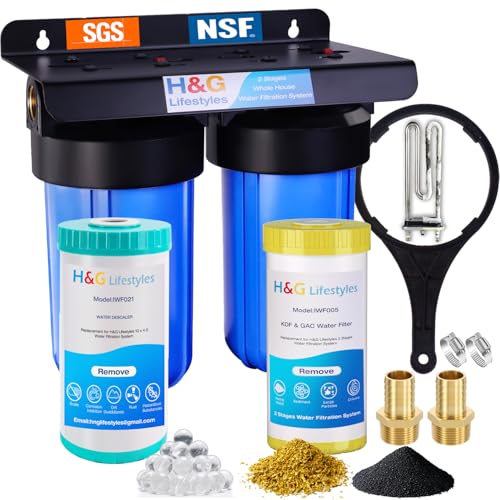
Photo: Amazon
This two-stage system combines scale conditioning with chlorine and heavy-metal reduction. It’s aimed at renters and homeowners who want broader water quality improvement, not just scale control, in one compact unit.
Pros:
- Two-stage filtration targets scale, chlorine, and heavy metals.
- Compact at 15.5″ x 7.5″ x 14.5″.
- No salt refills required.
Cons:
- Higher upfront cost than single-stage salt-based units.
- Extremely hard water may need additional treatment.
Its compact dimensions make this one of the easier units to fit into an apartment utility closet or rental property. That matters where a full whole-house install isn’t practical or permitted. Combining scale conditioning with chlorine and heavy-metal reduction in one two-stage cartridge also means less plumbing complexity. That’s simpler than running a separate descaler and carbon filter side by side.
7. NuvoH2O Salt-Free Water Softener DPNCB

Photo: Amazon
This is the whole-home version of NuvoH2O’s citrus-based system. It adds a carbon filtration stage on top of the citric-acid conditioning. That’s aimed at households that want both scale prevention and better-tasting water, without switching to TAC media.
Pros:
- 2-stage: citrus-based conditioning plus carbon filtration.
- Retains calcium and magnesium (no mineral stripping).
- Compact: 8″ x 8″ x 26″.
Cons:
- Ongoing citrus cartridge replacement cost.
- Not a substitute for a true softener in extremely hard water.
Pairing the citrus-based conditioning with a carbon stage addresses the two most common complaints about single-stage citrus systems: taste and odor from chlorinated municipal water. So it’s a reasonable middle ground between the compact DPHB above and a full multi-stage filtration system. Pick it if you want more than scale control but don’t need heavy-metal removal.
8. Nu Aqua Salt Free Water Softener WU-STG4-WTSF
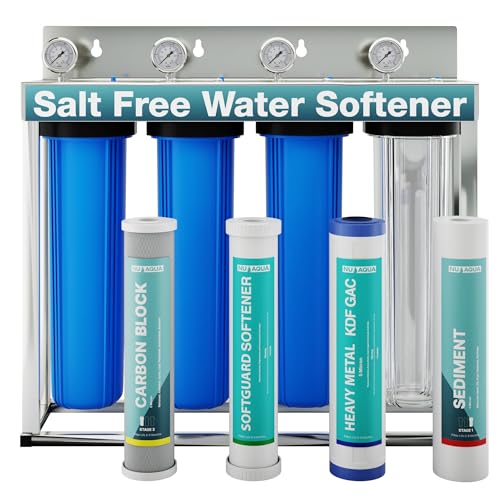
Photo: Amazon
Four filtration stages, sediment, TAC-based conditioning, heavy-metal KDF/GAC, and carbon block, make this the most layered system in this roundup. So it’s a reasonable choice if your water has more going on than just hardness.
Pros:
- 4-stage filtration: sediment, softener, KDF/GAC, carbon block.
- Reduces heavy metals, chlorine, and odor alongside scale.
Cons:
- 53 lbs; needs a sturdy, professionally installed mount.
- Doesn’t soften extremely hard water as thoroughly as a salt-based system.
Running water through sediment removal first protects the downstream TAC and KDF/GAC media from premature fouling. This, in turn, extends the working life of the more expensive filtration stages. The trade-off for that thoroughness, however, is weight and complexity: at 53 lbs, this isn’t a unit most homeowners will want to mount themselves.
9. Tier1 Whole House Salt-Free Descaler UP_0835_TAC12

Photo: Amazon
Tier1’s upflow TAC design pushes water upward through the media bed, which manufacturers claim improves contact time. At a rated 900,000-gallon capacity, it’s also the highest-capacity single-purpose descaler on this list.
Pros:
- 900,000-gallon TAC conditioner capacity.
- Upflow design; compact and light at 14 lbs.
Cons:
- Descaling only, no filtration for chlorine or sediment.
- Doesn’t remove hardness minerals.
Staying focused on descaling alone keeps the price down compared to multi-stage units. Meanwhile, the 900,000-gallon rating gives it the longest service window of any single-purpose descaler here. So if your municipal water is already reasonably clean and scale is your only real concern, skip the extra filtration stages. That money is better spent elsewhere.
10. Aquasure Salt-Free Water Conditioning Descaler AS-SF650

Photo: Amazon
Aquasure adds a triple-purpose pre-treatment filter ahead of the descaling stage, catching sediment and chlorine before the water reaches the TAC media. At an 800,000-gallon rated capacity, it sits between the WaterBoss and Tier1 units on this list for longevity.
Pros:
- Pre-treatment filter removes sediment and chlorine before descaling.
- 800,000-gallon rated capacity.
Cons:
- 38″ H footprint is taller than several alternatives here.
- Doesn’t remove hardness minerals.
The pre-treatment stage is a genuinely useful addition rather than a marketing add-on. Sediment and chlorine both shorten the working life of TAC media if they reach it unfiltered. So catching them first should help the descaling stage perform closer to its rated capacity over the long run.
How Long Do Saltless Systems Last, and What Maintenance Do They Need?

Saltless conditioners trade one kind of maintenance for another. There’s no salt to haul and load, for instance, and TAC/NAC media typically doesn’t need regeneration cycles or backwashing the way a traditional resin tank does. That’s because it isn’t removing minerals that need to be flushed out. Most TAC cartridges, meanwhile, last 3 to 6 years before replacement. Citrus-based systems like the NuvoH2O units, however, need their cartridge swapped roughly every 3 to 6 months, depending on water usage and hardness.
Saltless vs. Salt-Based: Comparing the Maintenance Trade-Off
That’s a real trade-off against a salt-based softener. There’s no more wondering what happens if you run out of salt, but you do still need to track cartridge life. If you’re weighing a saltless system against a traditional one you already own, two guides can help. Our guides on how often a water softener should regenerate and how long a water softener should last cover what that maintenance schedule normally looks like, for comparison. Traditional resin tanks also occasionally need deep cleaning. See our guide to cleaning a water softener resin tank if you’re maintaining one alongside a saltless unit for drinking water.
Sizing Your System to Your Household’s Water Use
Sizing also affects how much maintenance a system actually needs day to day. A unit rated for 1,000,000 gallons, like the Aquasana above, will go years between filter changes in an average household. A compact citrus cartridge system, on the other hand, might need attention every few months if your household runs several loads of laundry and dishes a day.
Before buying, estimate your household’s daily water use. Four people typically use 300 to 400 gallons a day combined. Check that figure against the system’s rated capacity so you’re not caught off guard by a shorter-than-expected replacement cycle. It’s also worth checking whether a system’s rated capacity assumes your specific hardness level or just a generic average. Several manufacturers, for example, publish capacity figures based on moderately hard water around 10 gpg. Households with harder water (20 gpg and above), therefore, should expect media replacement on the shorter end of the stated range, not the longer end.
Frequently Asked Questions
What Is A Saltless Water Softener And How Does It Work?
Most “saltless water softeners” are technically conditioners. They use Template-Assisted Crystallization (TAC), Nucleation-Assisted Crystallization (NAC), or citric acid to change the structure of hardness minerals so they don’t stick to surfaces. Unlike true softeners, they don’t remove calcium and magnesium from the water.
Are Saltless Water Softeners Effective For Hard Water Treatment?
Independent testing by the WateReuse Research Foundation and Arizona State University, using the German DVGW W512 protocol, found that TAC-based conditioners reduce scale formation by roughly 88-99%. They’re best suited to moderate-to-hard water, up to about 25 gpg; very hard water may still call for a traditional softener.
How Do Saltless Water Softeners Compare To Salt-based Systems?
Salt-based softeners remove hardness minerals via ion exchange, which produces the familiar slippery, soft-water feel. However, they require salt refills and discharge brine during regeneration. Saltless systems use no salt, need far less maintenance, and retain the water’s natural mineral content, but they won’t produce that same soft-water feel.
Can Saltless Water Softeners Remove Chlorine And Heavy Metals?
Some do. Several products on this list, for example, combine TAC or citrus-based conditioning with carbon, KDF, or UV filtration stages that reduce chlorine, heavy metals, and odor. A pure descaler like the WaterBoss or Tier1 unit, however, addresses scale only.
Is Installation Of Saltless Water Softeners Difficult For Homeowners?
Most units are compact and connect to the main water line with minimal plumbing changes. Larger multi-stage systems, like the Aquasana or NU Aqua units here, are heavier, so they often benefit from professional installation.
How Do I Know My Water Hardness Level Before Buying?
A home test strip or a call to your municipal water supplier will give you a reading in grains per gallon (gpg) or parts per million (ppm). Well water owners should test directly, since municipal reports won’t reflect it. Our guide to purifying well water covers testing and treatment options specific to private wells.
Will A Saltless System Work With A Tankless Water Heater?
Yes, and TAC conditioning is often specifically recommended for tankless setups. That’s because tankless water heaters run water across a small, very hot heat exchanger. That’s exactly the kind of surface where scale forms fastest and does the most damage to efficiency. So preventing that buildup, even without removing the minerals, can meaningfully extend the heat exchanger’s working life.
Do Saltless Systems Need Electricity To Operate?
No. TAC, NAC, and citrus-based conditioning are all passive processes that work as water flows through the media, with no pump, timer, or electrical component required. This is part of why installation is simpler than a salt-based system. It also means a saltless conditioner keeps working during a power outage, unlike an electronic metered softener.
Can I Install A Saltless System Myself, Or Do I Need A Plumber?
Most compact single-tank units, like the Watts OFPSYS or Tier1 descaler above, are within reach for an experienced DIYer comfortable cutting into a main water line. That’s because they connect with standard NPT fittings and don’t require a drain line or electrical hookup. Larger multi-stage systems with UV components or heavier tanks, like the Aquasana or NU Aqua units, are worth having a licensed plumber install instead. That protects both the physical mounting and any manufacturer warranty.
Conclusion
Choosing between these ten systems comes down to matching the technology to your actual water problem, rather than picking whichever has the most filtration stages. A pure TAC descaler like the Tier1 or WaterBoss is the simplest, least expensive path if scale is your only concern. A multi-stage system like the Aquasana or NU Aqua, on the other hand, earns its higher price and larger footprint if chlorine, heavy metals, or odor are also a concern. And a citrus-based NuvoH2O unit is worth the recurring cartridge cost if avoiding TAC media specifically, or retaining every trace mineral in your water, matters to you.
A saltless water softener won’t give you the same soft-water feel as a traditional system, since it doesn’t strip out calcium and magnesium. What it does deliver, however, is meaningful scale reduction, backed by independent DVGW W512 testing at roughly 88-99% in controlled tests. And it does that without salt, brine discharge, or the maintenance that comes with regeneration cycles. That makes these systems a practical fit for moderate-to-hard water, for households that want to retain natural minerals, and for the growing number of areas that restrict salt-based softeners.
If your water tests above roughly 25 gpg, or if the slippery feel of true soft water matters to you, a salt-based system is still worth considering. The Kenmore 350 above is one option, provided salt-based systems are allowed where you live. Otherwise, match your priorities, whether that’s scale prevention alone, added filtration, or citrus-based mineral retention, to the products above, and you’ll find a workable fit for your home.
Related Review Articles:
- Megahome Water Distiller Reviews
- Best Countertop Water Filter Reviews
- Best Water Softener Reviews
- How a Water Softener Works


Hey, My name is MAMON. I am a SEO content creator and affiliate marketer with over 8 years of experience. I create honest product reviews, in-depth buying guides, and practical how-to articles to help readers make informed decisions. My mission is to provide trustworthy, research-backed content that delivers real value.