Do mug warmers work, or are they just another desk gadget? The honest answer is that they work, but not always the way people expect. Most mug warmers are good at slowing heat loss from hot coffee, yet many struggle to reheat a cold cup. In this guide, we look at independent test results from CNN Underscored, Bob Vila, and Homegrounds, explain the simple physics behind plate warmers, and compare their running cost with microwave reheating. By the end, you will know whether a mug warmer is worth it for your routine, and which type gives you the best results.
Key Takeaways
- Yes, mug warmers work, but mainly to keep hot coffee warm. In CNN Underscored’s test, several basic plates kept coffee at or below about 120°F to 130°F.
- However, more powerful and smarter warmers perform better. A 75-watt iKago plate reached 130°F in just under 20 minutes in CNN’s test.
- Also, results vary by tester. CNN found the Mr. Coffee warmer never pushed coffee above 130°F, while a Homegrounds reviewer measured 160°F after an hour.
- Meanwhile, self-heating mugs hold temperature most precisely, but they cost more and run on limited battery.
- Finally, a 17-watt warmer costs about 2.5 cents per 8-hour day, which is similar to reheating coffee a few times in a microwave.
Do Mug Warmers Work? The Short Answer
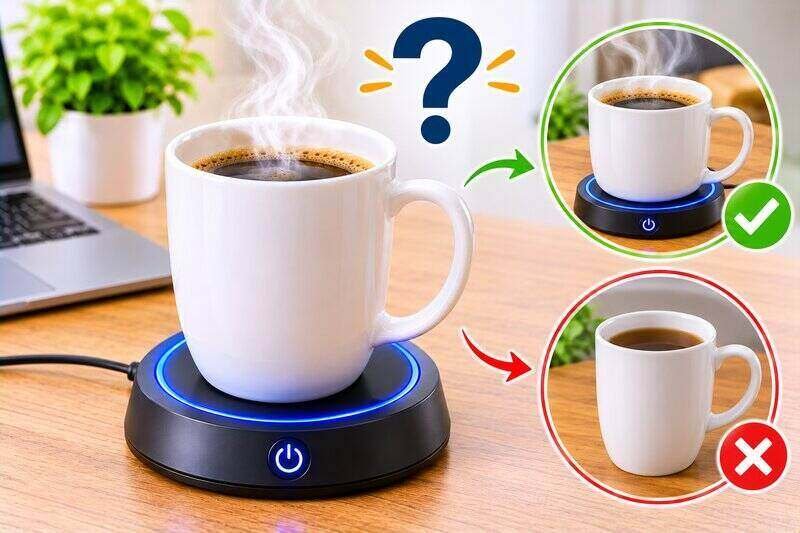
Yes, mug warmers work. However, their main job is to slow cooling, not to heat. A typical warming plate adds heat through the bottom of your mug, while the coffee keeps losing heat through the sides and open top. As a result, the drink settles at a temperature well below the plate setting. If you pour hot coffee and set it down right away, a mug warmer can keep it pleasantly warm for hours. However, if you place a lukewarm cup on a basic plate, it may never get hot again.
Ultimately, that difference explains most of the mixed reviews online. In short, people who expect a slow, steady warmth tend to be happy, while people who expect a mini stove tend to be disappointed.
How a Mug Warmer Works
At its core, a mug warmer is a small heating element under a flat plate. When you set a mug on it, then, heat moves by conduction from the plate into the mug’s base and then into the coffee. Meanwhile, the coffee loses heat in three ways: steam from the surface, contact with the cooler air around the mug, and radiation from the mug walls.
Importantly, the drink stops cooling only when the heat coming in matches the heat going out. Because most warmers use just 17 to 50 watts, that balance point is often around 120°F to 140°F. For comparison, a 2008 study in the journal Burns by Fredericka Brown and Kenneth Diller calculated an optimal coffee drinking temperature of about 136°F (PubMed). So, a balance point in that range is actually close to ideal for many people.
What Independent Tests Found
So, do mug warmers work in real tests? Several publications have measured performance with thermometers. Below, therefore, is a summary of the most useful results.
| Product | Type | Test Result | Source |
|---|---|---|---|
| iKago warmer and mug set | 75 W smart plate | At least 130°F in just under 20 minutes | CNN Underscored |
| Mr. Coffee Mug Warmer | 17 W basic plate | Never above 130°F; under 125°F after 90 minutes | CNN Underscored |
| Mr. Coffee Mug Warmer | 17 W basic plate | About 160°F after an hour | Homegrounds |
| Misby warmer | Basic plate | Stayed under 120°F; target 130°F not reached | CNN Underscored |
| Cosori automatic warmer | Digital plate | Never above 120°F; 1.5 hours to rise 15°F with lid | CNN Underscored |
| Thermacup | Self-heating mug | Room temperature to 140°F in about 40 minutes | Bob Vila |
| Ember Mug 2 | Self-heating mug | About 10°F rise in 10 minutes | CNN Underscored |
Interestingly, notice the split on the Mr. Coffee warmer. CNN Underscored found it never got coffee above 130°F, while a Homegrounds reviewer measured about 160°F after an hour. After all, differences in starting temperature, mug type, room temperature, and lid use can easily explain gaps like this. Therefore, treat any single test as a guide rather than a guarantee.
Why Some People Say Mug Warmers Don’t Work
When a mug warmer seems not to work, the cause is usually one of a few common issues:
- The wrong mug. First, a mug with a raised foot or a ring-shaped base touches the plate only at the edge, so very little heat transfers.
- A double-wall insulated mug. In addition, insulation blocks heat from the plate as well as heat escaping, so the warmer barely affects the drink.
- Starting with cool coffee. Also, a 17-watt plate cannot quickly reheat a cold drink.
- No lid. Without a cover, though, heat escapes from the surface faster than many plates can replace it.
- A cold room. Finally, a chilly office or a fan nearby increases heat loss.
Fortunately, fixing even one of these can make a noticeable difference. For example, switching to a thin, flat-bottomed ceramic mug with a lid often turns a disappointing warmer into a useful one.
Video: FOCUSED on FIRE reviews whether a coffee mug warmer is worth it.
Do Mug Warmers Work Better Than Other Methods?
Of course, it depends on what you compare them with. To illustrate, the table below shows how a mug warmer stacks up against other common ways to keep coffee hot.
| Method | Keeps Heat | Reheats | Portable |
|---|---|---|---|
| Basic mug warmer | Moderately | Poorly | No |
| Smart warming plate | Well | Slowly | No |
| Self-heating mug | Very well | Slowly | Yes, on battery |
| Insulated tumbler | Well, then cools | No | Yes |
| Microwave | No | Quickly | No |
In short, a mug warmer is best for one job: keeping a hot drink warm while you sit in one place. For more ideas, our guide on what coffee maker makes the hottest coffee explains how to start with a hotter cup.
Are Mug Warmers Worth It? A Cost Comparison
Photo: Ruth and Dave via Flickr (CC BY 2.0).
Naturally, money is part of the worth-it question. To compare, the table below shows our estimated electricity costs, using the U.S. Energy Information Administration’s average residential price of about 18.16 cents per kWh.
| Scenario | Energy | Cost |
|---|---|---|
| 17 W mug warmer, 8 hours | 0.136 kWh | About 2.5 cents |
| 36 W mug warmer, 8 hours | 0.288 kWh | About 5.2 cents |
| 1,000 W microwave, 1 minute | About 0.017 kWh | About 0.3 cents |
| Microwave reheat, 4 times a day | About 0.067 kWh | About 1.2 cents |
Keep in mind that these are our estimates at full power. In reality, thermostatic warmers cycle on and off, so they often use less. Either way, the cost difference is tiny, only a few dollars a year. Clearly, cost alone should not decide it. So, the real value of a mug warmer is convenience: no walking to the break room and no uneven microwave hot spots. For a closer look, see our guide on how much electricity a microwave uses.
Which Type of Mug Warmer Works Best?
If you decide a mug warmer is right for you, however, the type you choose matters a lot.
Basic Warming Plates
Basic plates are cheap and simple. However, at around 17 watts, they mainly slow cooling. Therefore, they suit people who drink hot coffee within an hour or two.
Higher-Wattage Plates With Settings
Plates in the 30- to 50-watt range, often with timers, hold heat better and recover faster after each sip. As a result, they suit slow sippers. In addition, many include auto shut-off for safety.
Smart Plates With Sensors
By comparison, smart plates use temperature sensors and higher power. For example, the 75-watt iKago plate reached 130°F in under 20 minutes in CNN’s test, which is among the best plate results published.
Self-Heating Mugs
Self-heating mugs heat the drink directly and measure its temperature, so they are the most accurate. On the other hand, they cost more, run on limited battery off the coaster, and are usually hand wash only.
How to Make Your Mug Warmer Work Better
- Start hot. First, place your mug on the warmer right after brewing.
- Use a thin, flat-bottomed mug. Next, choose ceramic, glass, or stainless steel with full contact on the plate.
- Add a lid. Then cover the mug to stop heat escaping from the top.
- Preheat the mug. Also, rinse it with hot water before pouring.
- Pick a moderate setting. Finally, a middle setting usually lands near the 136°F optimal drinking range.
If you need hot water quickly for preheating, an electric kettle helps; see our guide to the best electric kettle.
Do Mug Warmers Work for Tea, Cocoa, and Other Drinks?
Yes, and in some cases they work even better than with coffee. After all, many drinks taste best a little cooler. For instance, many people prefer tea and cocoa a little cooler, so a warmer’s natural balance point of about 120°F to 140°F suits them well. In addition, herbal teas and hot chocolate are often sipped slowly, which is exactly when a warmer helps most.
However, there are a few cautions. For example, milk-based drinks can form a skin on top if they sit warm for a long time, so stir occasionally. Also, some brands warn against heating plastic cups or milk cartons, so check your manual. Finally, if you steep tea in the mug, remove the bag or infuser on time, since the warmer will not stop the tea from becoming bitter.
Do Mug Warmers Work in a Cold Office?
They work, but less effectively. Indeed, room temperature has a big effect. In a cool room, specifically, the mug loses heat to the air faster, so the drink settles at a lower temperature. As a result, a basic 17-watt plate may leave your coffee lukewarm in a drafty office. If your workspace runs cold, choose a higher-wattage plate in the 36- to 50-watt range, use a lid, and keep the mug away from fans and air vents. Alternatively, a self-heating mug measures the drink directly, so it can adjust for a chilly room.
Real-World Scenarios: Will a Mug Warmer Help You?
| Your Routine | Will It Help? | Best Choice |
|---|---|---|
| Sip one cup over 2–3 hours at a desk | Very much | 36–50 W plate with a lid |
| Drink coffee in about 15 minutes | Barely | A preheated mug is enough |
| Walk between meetings | Only with a heated mug | Self-heating mug |
| Commute by car | Not a plate | Insulated or heated travel mug |
| Often forget your cup for an hour | Yes | Plate with auto shut-off |
As the table shows, the answer to whether mug warmers work for you depends mostly on how long you take to finish a cup and whether you stay in one spot.
Who Should Skip a Mug Warmer?
That said, a mug warmer is not for everyone. For instance, if you drink your coffee in 10 minutes, you do not need one. Likewise, if you are always on the move, an insulated tumbler or a self-heating mug fits better. Similarly, if you mostly drink from double-wall mugs, a plate warmer will barely help.
On the other hand, if you sip slowly at a desk for hours, work in a cool room, or hate reheating, a mug warmer is likely worth it. For a broader look at power use in your coffee routine, see our guide on how many watts a coffee maker uses.
How to Test Whether Your Mug Warmer Works
If you are unsure, a quick home test can settle it. First, brew a fresh cup and measure its temperature with an instant-read thermometer. Next, place it on the warmer with a lid and check again every 15 minutes for an hour. Then, repeat the test on the counter without the warmer. As a result, you will see exactly how much your warmer helps with your own mug and room. If the warmed cup stays roughly 10°F or more above the unwarmed one, the warmer is doing its job. Otherwise, try a thinner mug, a lid, or a higher setting before you give up on it.
Frequently Asked Questions
Do mug warmers work with any mug?
No. Instead, they work best with thin, flat-bottomed ceramic, glass, or stainless steel mugs. Footed, thick, or double-wall mugs heat poorly.
Can a mug warmer reheat cold coffee?
Usually not quickly. In fact, most basic plates only slow cooling, so it is better to reheat cold coffee first and then place it on the warmer.
How hot will my coffee get on a mug warmer?
Typically, around 120°F to 140°F, depending on the warmer, mug, and lid. In CNN’s test, several basic plates stayed below about 130°F.
Are mug warmers worth it?
For slow sippers at a desk, yes. After all, they cost only a few cents a day to run and save trips to the microwave.
Do mug warmers work better with a lid?
Yes. Essentially, a lid blocks heat loss from the surface, which helps the warmer keep up. In heated-mug tests, lids often doubled run time.
Do self-heating mugs work better than mug warmers?
Generally, yes, for accuracy and portability. However, they cost more and need regular charging, so a plate warmer is still the better value for a single desk.
Final Thoughts
So, do mug warmers work? Yes, as long as you use them for what they do best: keeping hot coffee warm, not reheating cold coffee. Independent tests show basic plates often hold coffee around 120°F to 130°F, while stronger smart plates and self-heating mugs perform better. To get the most from any model, start with hot coffee, use a thin flat-bottomed mug, and add a lid. With those habits, a mug warmer is a cheap, convenient upgrade for anyone who sips slowly at a desk.

Hey, My name is MAMON. I am a SEO content creator and affiliate marketer with over 8 years of experience. I create honest product reviews, in-depth buying guides, and practical how-to articles to help readers make informed decisions. My mission is to provide trustworthy, research-backed content that delivers real value.
Leave a Reply