

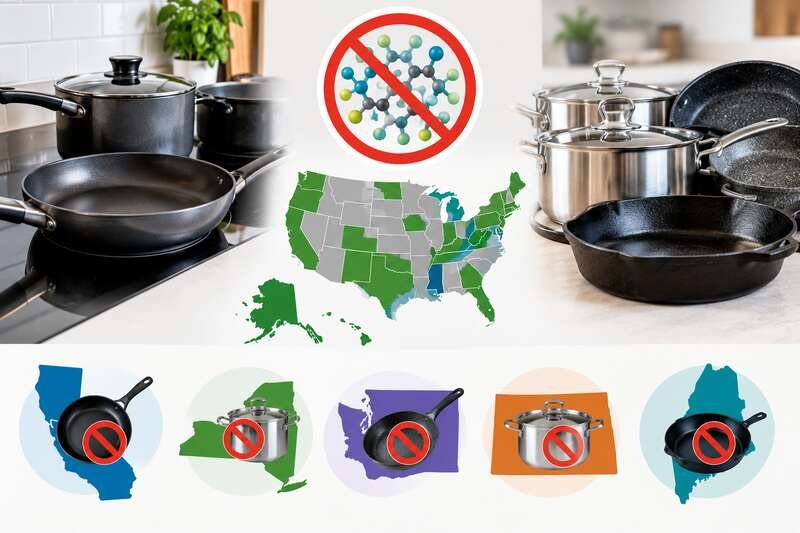
If you shop for nonstick pans in certain states, you may have noticed fewer choices on the shelf. That is because of a new wave of state laws. A PFAS cookware ban stops stores from selling pots and pans made with intentionally added PFAS. These are often called “forever chemicals.” This guide explains which states have a ban and when each takes effect. It also covers what counts as PFAS and what it means for the pans in your kitchen.

Note: This article is for general information, not legal advice. State laws change often, so check your state agency for the latest rules.
Key Takeaways
- Minnesota was first. Its PFAS cookware ban took effect on January 1, 2025.
- Colorado and Maine followed on January 1, 2026.
- Rhode Island’s ban starts January 1, 2027. Connecticut’s full ban is scheduled for 2028, with labeling rules first.
- Vermont delayed its cookware ban from 2026 to July 1, 2028.
- California’s governor vetoed a cookware ban in October 2025, citing affordability.
- The bans cover new sales. They do not require you to throw out pans you already own.
What Is PFAS, and Why Is It in Cookware?
PFAS stands for per- and polyfluoroalkyl substances. It is a large family of man-made chemicals. They resist heat, oil, and water, which makes them useful in many products.
In cookware, the best-known PFAS is PTFE, the slick coating sold under names like Teflon. It is a fluoropolymer, and most state laws count fluoropolymers as PFAS. PFAS break down very slowly in the environment, which is why they earned the nickname “forever chemicals.”
You may also see “PFOA-free” on labels. PFOA is one specific PFAS that was once used to make PTFE. U.S. makers phased it out years ago. A pan can be PFOA-free and still contain PTFE, which is a PFAS under these new laws.
Why States Are Passing a PFAS Cookware Ban
Lawmakers point to health and environmental concerns about PFAS as a group. According to the U.S. Environmental Protection Agency, exposure to certain levels of some PFAS may lead to:
- Reproductive effects, such as decreased fertility.
- Developmental effects or delays in children.
- Increased risk of some cancers, including prostate, kidney, and testicular cancers.
- A weaker immune response, including reduced vaccine response.
- Interference with natural hormones.
- Higher cholesterol levels or risk of obesity.
These findings come from studies of specific PFAS, not every chemical in the group. The EPA also lists many ways people are exposed, including drinking water, food, dust, and consumer products.
The debate over cookware is more specific. Supporters of a ban point to the whole life cycle of fluoropolymers, including how they are made and thrown away. The cookware industry argues that finished PTFE coatings are stable and approved for food contact. Lawmakers in each state have weighed these arguments differently, which explains the patchwork of rules.

PFAS Cookware Ban by State: 2026 Status
Here is where each state stands as of 2026. Dates are for bans on selling cookware with intentionally added PFAS.
| State | Cookware Rule | Effective Date |
|---|---|---|
| Minnesota | Sales ban | January 1, 2025 |
| Colorado | Sales ban (labeling required earlier) | January 1, 2026 |
| Maine | Sales ban | January 1, 2026 |
| Rhode Island | Manufacture and sales ban | January 1, 2027 |
| Connecticut | Labeling and notice first, then full ban | Labeling in 2026; ban in 2028 |
| Vermont | Sales ban, delayed in 2025 | July 1, 2028 |
| California | Disclosure rules only; ban vetoed | No ban in effect |
Sources include state law summaries from SGS, Beveridge & Diamond, ChemRadar, CT Mirror, and PackagingLaw.com.
PFAS Cookware Timeline at a Glance
This timeline shows how the rules have built up over the past decade.
- 2015: Major makers complete the phase-out of PFOA under an EPA stewardship program.
- January 2023: California requires PFAS disclosure on cookware labels and websites.
- January 2024: Colorado’s cookware labeling rules begin.
- January 2025: Minnesota’s PFAS cookware ban takes effect.
- February 2025: A federal court denies the cookware industry’s bid to block Minnesota’s law.
- October 2025: California’s governor vetoes SB 682.
- January 2026: Colorado and Maine bans take effect.
- January 2027: Rhode Island’s ban is scheduled to begin.
- 2028: Connecticut’s full ban and Vermont’s delayed ban are scheduled.
State-by-State Details
Minnesota
Minnesota’s law is often called Amara’s Law. It banned intentionally added PFAS in cookware and 10 other product types starting January 1, 2025. A cookware industry group sued to block it. A federal court denied the request for an injunction in February 2025 and later dismissed the case.
In 2025, Minnesota added a narrow exemption. PFAS used only in electronic or internal parts that users do not touch are now exempt. The ban still covers food-contact coatings.
Colorado
Colorado’s SB 24-081 made its PFAS cookware ban effective January 1, 2026. Before that, the state required PFAS disclosure labels on cookware.
Maine
Maine banned the sale of cookware with intentionally added PFAS starting January 1, 2026. Amendments to Maine’s law moved this date up and made cookware part of the first wave of product bans.
Rhode Island
Rhode Island will ban the manufacture and sale of cookware with intentionally added PFAS starting January 1, 2027.
Connecticut
Connecticut uses a two-step approach. First, sellers must meet notice and labeling rules in 2026. A full sales ban is scheduled for 2028. In 2025, lawmakers debated an exemption for some nonstick cookware, so check the current rules before you buy or sell.
Vermont
Vermont’s cookware ban was first set for January 1, 2026. A 2025 revision pushed it back by two and a half years. According to SGS’s summary of the Vermont revision, the new date is July 1, 2028.
California
California already requires PFAS disclosure on cookware. However, a full ban did not pass. On October 13, 2025, Governor Newsom vetoed SB 682, which would have banned PFAS cookware sales starting in 2030. He cited concern about “affordable options in cooking products,” as reported by PackagingLaw.com.
What the PFAS Cookware Ban Means for You
You Do Not Have to Throw Out Your Pans
These laws target the sale of new products. They do not ban owning or using nonstick pans. Still, many people choose to replace worn nonstick pans with other materials.
Store Shelves Are Changing
In states with a PFAS cookware ban, retailers must remove covered products from sale. The rules apply to anyone who sells, offers for sale, or distributes the product, not just the maker.
Online Shopping Is Covered Too
The rules generally apply to anyone who sells or distributes covered cookware in the state. That can include online sellers, so check product pages before you order.

PFAS-Free Cookware Alternatives
If you want to avoid PFAS, you have many good options. Each has trade-offs.
| Material | Nonstick Ability | Best For | Watch Out For |
|---|---|---|---|
| Stainless steel | Low | Searing, sauces, all-purpose use | Food sticks without enough oil and heat |
| Cast iron | Good once seasoned | Searing, baking, high heat | Heavy; needs seasoning and drying |
| Carbon steel | Good once seasoned | Stir-frying, eggs, searing | Needs seasoning; can rust |
| Enameled cast iron | Moderate | Braising, soups, stews | Heavy; enamel can chip |
| Ceramic nonstick | High when new | Eggs and delicate foods | Coating wears faster than PTFE |
Learn more in our guides to ceramic cookware pros and cons and caring for enameled cast iron.
How to Tell if a Pan Contains PFAS
- Look for PTFE. If the box says PTFE or names a PTFE brand, the pan contains PFAS.
- Do not rely on “PFOA-free.” This label does not mean PFAS-free.
- Look for “PFAS-free.” This is the clearest claim. Check the maker’s website for details.
- Check for state labels. Some states require PFAS disclosure on the package.
- Know the material. Uncoated stainless steel, cast iron, and carbon steel do not have PFAS coatings.
How to Use Nonstick Pans More Safely
If you keep your current nonstick pans, a few habits help them last and reduce wear on the coating.
- Cook on low to medium heat. Avoid preheating an empty nonstick pan.
- Use wood or silicone utensils instead of metal.
- Hand wash with a soft sponge.
- Replace pans with flaking, deep scratches, or peeling coating.
- Store pans with protectors between them to prevent scratches.
See our tips on storing nonstick cookware properly.
Shopping Tips if You Live in a Ban State
Living in a state with a PFAS cookware ban changes how you shop. These tips can help you find the right pan faster.
- Start with your cooking style. Eggs and pancakes need a slick surface, so ceramic or well-seasoned carbon steel works well. Searing and sauces suit stainless steel or cast iron.
- Buy one pan at a time. Replace your most-used pan first, then learn how it cooks before buying a full set.
- Check your stove type. Induction cooktops need magnetic pans. Cast iron, carbon steel, and most stainless steel work. Some aluminum ceramic pans do not.
- Read the fine print. Look for “PFAS-free” rather than “PFOA-free” or “non-toxic,” which are vague.
- Keep receipts. Ceramic coatings can wear faster, so a good warranty adds value.
Cooking on induction? Our guide to the best induction cookware covers compatible pans.
Will More States Pass a PFAS Cookware Ban?
The trend is mixed. Several states have acted, but the cookware industry has pushed back. California exempted cookware from a 2024 PFAS law, and a New York cookware ban failed that year. California’s 2025 ban attempt was vetoed. Vermont delayed its date, and Connecticut debated an exemption.
On the other side, Minnesota’s ban survived a court challenge. Colorado and Maine bans are now in force. Expect more debate as states weigh cost, supply, and health concerns.
Frequently Asked Questions
Is nonstick cookware banned in the U.S.?
No, there is no federal ban. However, several states ban the sale of cookware with intentionally added PFAS, including Minnesota, Colorado, and Maine.
Does a PFAS cookware ban include Teflon pans?
Generally, yes. PTFE is a fluoropolymer, and these state laws define PFAS broadly enough to include it. Always check the exact wording of your state’s law.
Can I still use my old nonstick pan?
Yes. The laws restrict sales, not ownership. Replace any pan that is scratched or peeling.
Is ceramic cookware PFAS-free?
Most ceramic nonstick coatings are made without PFAS. Check the maker’s claims and look for a clear “PFAS-free” label.
What is the safest cookware?
Many experts favor stainless steel, cast iron, and glass. Read our full guide on the safest cookware for your health.
Final Thoughts
The PFAS cookware ban movement is changing what you can buy in several states. Minnesota, Colorado, and Maine already ban these sales. Rhode Island, Connecticut, and Vermont have bans on the way. California chose not to ban cookware for now. Because dates keep shifting, bookmark your state agency page and check it before a big cookware purchase.
You do not need to panic about the pans in your cabinet. When it is time to replace them, PFAS-free options are easy to find. Stainless steel, cast iron, carbon steel, and ceramic are all good choices. Check your state’s rules, read labels carefully, and pick the material that fits how you cook.


Hey, My name is MAMON. I am a SEO content creator and affiliate marketer with over 8 years of experience. I create honest product reviews, in-depth buying guides, and practical how-to articles to help readers make informed decisions. My mission is to provide trustworthy, research-backed content that delivers real value.