

Non slip cutting boards solve one of the most common and most overlooked kitchen hazards: a board that slides while you cut. When a board shifts under pressure, your knife can skip off the food and into your hand. That is why professional cooks almost never chop on a board that moves. In this guide, we look at the injury data, compare the main types of non-slip features, show you how to stop any board from sliding, and explain what to look for when you buy one.

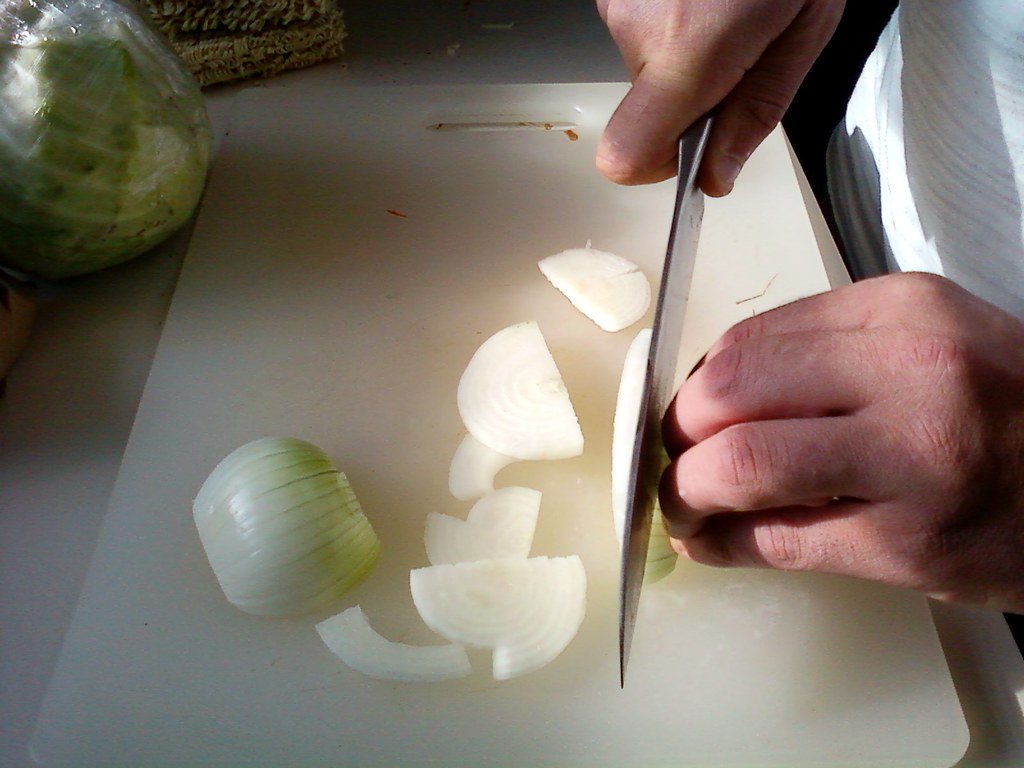
Photo: TheDarkThing via Flickr (CC BY 2.0).
Key Takeaways
- First, a sliding board is a real injury risk. Kitchen knife cuts send tens of thousands of Americans to the ER, including more than 27,000 avocado-related cuts in just five years.
- Non slip cutting boards use rubber feet, rubber edges, textured undersides, or grippy mats to stay in place.
- A damp towel or a sheet of shelf liner can make almost any board non-slip in seconds.
- Heavier and thicker boards also slide less, because weight adds friction.
- However, rubber feet can trap moisture, so they need regular cleaning and drying.
Why a Sliding Cutting Board Is Dangerous
Most kitchen knife cuts happen in a split second. For example, you press down on a hard squash, the board shifts an inch, and the blade lands on your finger instead of the food. A board that stays put removes that surprise.
The data shows how common these injuries are. A study in the American Journal of Emergency Medicine estimated that 50,413 avocado-related knife injuries were treated in U.S. emergency departments from 1998 to 2017. In fact, the yearly number grew sharply, from 3,143 injuries in 1998 to 2002 to 27,059 in 2013 to 2017, closely tracking the rise in avocado eating. One common cause is holding the fruit in your palm instead of placing it on a stable board.
In other words, a steady cutting surface is one of the simplest ways to prevent a trip to urgent care. Also, a board that does not move lets you use better knife technique, since you can focus on the food instead of holding the board in place.
Types of Non Slip Cutting Boards
Manufacturers use several methods to keep boards from sliding. Each has strengths and weaknesses:
| Non-Slip Feature | How It Works | Pros | Cons |
|---|---|---|---|
| Rubber feet | Small rubber pads on the bottom corners | Strong grip, lifts board for airflow | Board is one-sided; feet can loosen |
| Rubber edges or corners | Rubber strips molded into the sides | Board stays reversible | Less grip on wet counters |
| Textured underside | Rough or ribbed plastic on the bottom | No parts to fall off | Weaker grip than rubber |
| Full rubber or silicone backing | Grippy layer across the whole bottom | Excellent grip | Can trap water underneath |
| Heavy weight | Thick wood or rubber board | Natural stability, no extra parts | Hard to lift and wash |
As a result, there is no single best option. Instead, choose the feature that fits how you cook and clean. For example, if you flip your board often, rubber edges keep both sides usable. On the other hand, if you want maximum grip, rubber feet or a full backing work best.
Non-Slip Plastic Boards
Plastic boards are light, so they slide more than any other type. That is why many plastic boards now include rubber corners or a rubberized border. In addition, thin flexible mats often have a textured back. These are great for quick jobs, but they can still move on a wet or smooth counter.
Non-Slip Wooden Boards
Wooden boards are heavier, so they naturally slide less. Still, many end grain and butcher block boards add rubber feet for extra stability. Feet also raise the board off the counter, which lets air dry the bottom. For heavy boards, see our guide to end grain cutting boards, or our picks for a large wooden cutting board.
Rubber and Composite Boards
Rubber boards are dense and grippy on their own, so they rarely slide on a dry counter. Similarly, some composite boards include non-slip feet or grippy corners. However, both types can still move on a wet surface.
How to Stop Any Cutting Board From Sliding
You do not need to buy a new board to stop it from slipping. In fact, chefs have used these tricks for decades:
- Use a damp towel. First, wet a thin kitchen towel, wring it out well, and lay it flat under the board. This is the classic restaurant method.
- Try a damp paper towel. Similarly, one or two damp paper towels work for small boards and quick tasks.
- Add shelf liner. Next, cut a piece of rubber shelf liner slightly smaller than your board. It is cheap, reusable, and easy to wash.
- Use a silicone mat. A silicone baking mat also grips both the counter and the board.
- Add stick-on rubber feet. Finally, for wooden boards, you can screw or glue on food-safe rubber feet. However, this makes the board one-sided.
As you can see, the damp towel method costs nothing and works on almost any board. Therefore, it is a smart habit even if your board already has non-slip features.

Video: Chef Dawn Fiacco, PhD, shows how to keep your cutting board from slipping.
What to Look for in Non Slip Cutting Boards
When you shop for non slip cutting boards, check these features:
- Grip type. To begin with, rubber feet and full rubber backing grip best. Textured plastic grips least.
- Removable or molded grips. Molded rubber edges cannot fall off, while glued feet may loosen over time.
- Weight and thickness. In general, heavier boards stay put better. Boards at least 3/4 inch thick also resist warping, and a warped board rocks on the counter.
- Dishwasher safety. If you want a dishwasher-safe board, check that the rubber parts are rated for high heat.
- Reversibility. In addition, boards with rubber edges stay usable on both sides, while boards with feet do not.
- Juice groove. Specifically, a groove keeps liquid from running under the board and making the counter slippery.
- Size. Finally, choose a board large enough for your tasks. Food that spills over the edge makes cutting less stable.
For compact options, see our guide to small cutting boards for the kitchen. Also, if you like to carry your board to the stove or table, a wooden cutting board with a handle can be easier to move.
Non-Slip Feet vs. Damp Towel: Which Is Better?
| Factor | Built-In Rubber Feet | Damp Towel |
|---|---|---|
| Grip strength | Strong on dry counters | Strong on most counters |
| Cost | Built into price | Free |
| Board reversible? | No | Yes |
| Cleaning | Feet need scrubbing and drying | Toss towel in laundry |
| Airflow under board | Good | None while in use |
| Best for | Daily use, heavy boards | Any board, any time |
In short, both methods keep a board steady. Many cooks, in fact, use both: a board with feet for daily prep and a damp towel for extra grip on wet or slick counters.
Cleaning and Caring for Non-Slip Boards
Non-slip features add a few cleaning steps. Rubber feet, edges, and backings can trap water and food, which can lead to mold or odors. So, follow these tips:
- Clean around the rubber. First, scrub the seams where rubber meets wood or plastic, using a small brush.
- Dry upright. Then stand the board on its edge so the feet and underside can air dry.
- Check the feet often. If feet become loose, cracked, or moldy, replace them.
- Follow the material’s rules. For example, wooden boards with feet still need hand washing and oiling. Our guide on how to take care of a wooden cutting board covers the steps.
- Sanitize after raw meat. Likewise, use a dilute bleach or vinegar solution after raw meat. For details, see how to disinfect cutting boards.
Also, store boards where air can reach them. A cutting board organizer keeps them upright and dry between uses.

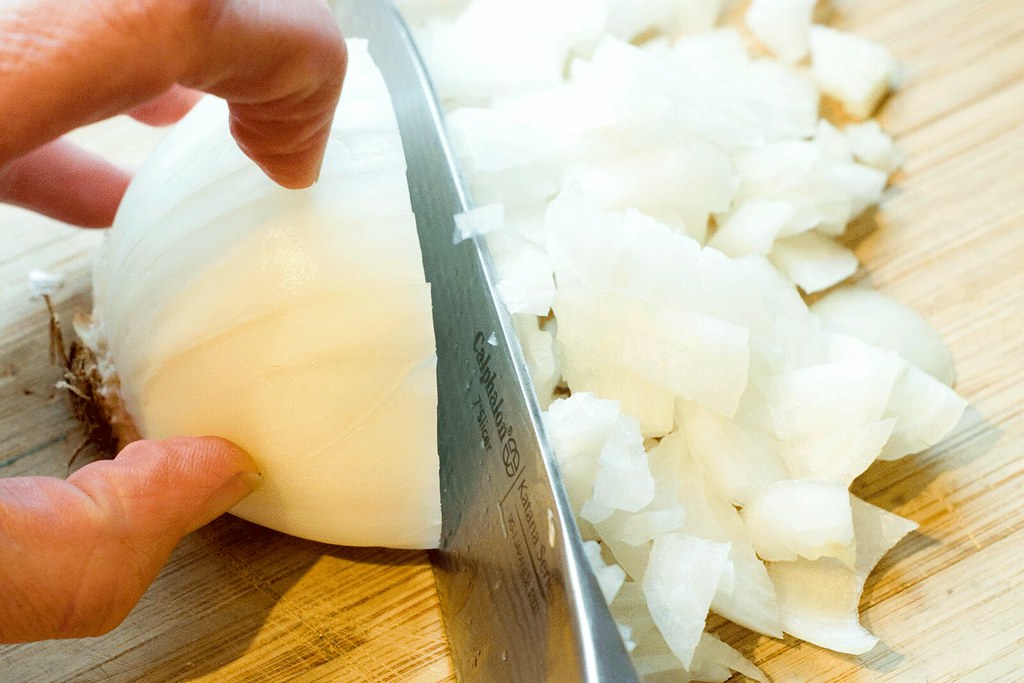
Photo: Kim Becker via Flickr (CC BY 2.0).
Knife Safety Tips Beyond the Board
Non slip cutting boards are only part of safe cutting. Here are other habits that prevent injuries:
- Keep knives sharp. Surprisingly, a dull knife is more dangerous because it needs more force and is more likely to slip.
- Use the claw grip. Curl your fingertips under and guide the blade with your knuckles.
- Create a flat side. For round foods like onions or potatoes, cut a thin slice off one side first, then set the flat side down.
- Never cut in your hand. As the avocado data suggests, cutting food while holding it in your palm is risky.
- Keep the area dry. In addition, wipe up spills so neither the board nor your hands slip.
- Do not catch a falling knife. Instead, step back and let it drop.
Also, if you are still deciding on a board material, America’s Test Kitchen’s guide to choosing a cutting board is a helpful next read.
Do Non Slip Cutting Boards Work on Every Counter?
Not equally. Grip depends on both the board and the surface underneath it. In general, rubber grips best on smooth, dry, non-porous surfaces. Here is how common U.S. countertops behave:
| Countertop | Grip With Rubber Feet | Tip |
|---|---|---|
| Granite and quartz | Good when dry | Wipe away water and oil first |
| Laminate | Good | Avoid hot pans near rubber feet |
| Butcher block | Fair | Oiled wood can feel slick, so add a damp towel |
| Stainless steel | Fair to poor | Use shelf liner or a damp towel |
| Tile | Varies | Grout lines can make boards rock, so check for wobble |
Therefore, even the best non slip cutting boards benefit from a clean, dry counter. If your surface is oily or wet, the rubber has nothing to grip, and the board can still move.

Photo: jason.c.hansen via Flickr (CC BY 2.0).
Non Slip Cutting Boards for Seniors and Limited Grip
For people with arthritis, weak grip, or the use of only one hand, a stable board matters even more. Fortunately, adaptive cutting boards are designed for this. Many include suction feet or rubber backing, raised corner guards that hold bread for spreading, and stainless steel spikes that hold vegetables in place while you cut. As a result, the user does not need to hold the food or the board at all.
In addition, occupational therapists often suggest pairing these boards with lightweight, sharp knives and rocker knives, which need less force. So, if you are shopping for an older relative, look for non slip cutting boards labeled “adaptive” or “one-handed,” and choose a size that fits easily on their counter.
Common Mistakes to Avoid
- Using a warped board. A board that rocks is just as unsafe as one that slides, so replace or flatten it.
- Cutting on a wet counter. Water under the board acts like a lubricant. Therefore, dry the counter first or use a damp towel deliberately.
- Using a towel that is too wet. Similarly, a soaking towel can let the board float. Wring it out well.
- Ignoring loose feet. A missing or loose foot makes the board wobble. Replace it right away.
- Stacking boards while cutting. Never stack a small board on top of a larger one, since the top board can slide easily.
Signs Your Board Is Not Stable Enough
Not sure whether your current board needs an upgrade? Watch for these warning signs during prep:
- It shifts when you chop. For example, if the board moves even slightly when you cut carrots or squash, it is not stable enough.
- It rocks from corner to corner. This usually means the board has warped, or one foot is missing.
- You hold it with your free hand. If you steady the board instead of the food, your guiding hand is in the wrong place.
- It spins when you push food aside. Light plastic boards often do this, especially on smooth stone counters.
If you notice any of these, try a damp towel first. Then, if the problem continues, consider a heavier board or one with rubber feet.
FAQ
What makes a cutting board non-slip?
Most non slip cutting boards use rubber feet, rubber edges, a textured underside, or a grippy backing. Heavy boards also resist sliding because of their weight.
How do I stop my cutting board from sliding?
Place a damp, well-wrung towel or a sheet of rubber shelf liner under the board. This works on almost any board and counter.
Are non-slip feet safe on wooden boards?
Yes, as long as you keep them clean and dry. However, feet make the board one-sided, so you lose the option to flip it.
Can non-slip cutting boards go in the dishwasher?
Some plastic ones can. Still, check the label, because high heat can loosen or warp rubber parts.
Are flexible cutting mats non-slip?
Many have a textured back that helps. However, they are light, so a damp towel underneath adds useful grip.
Do professional chefs use non-slip boards?
Generally, yes. Most commercial kitchens either use heavy boards with grippy feet or place a damp towel under every board.
Final Thoughts
Non slip cutting boards are a small upgrade with a big safety payoff. Whether you choose a board with rubber feet, molded rubber edges, or simply use a damp towel, the goal is the same: keep the board still so your knife goes where you want it. Combine a stable board with sharp knives and good technique, and you will greatly lower your risk of a kitchen cut. Finally, for a full overview of board materials and safety, read our main guide to the safest and healthiest cutting boards.


Hey, My name is MAMON. I am a SEO content creator and affiliate marketer with over 8 years of experience. I create honest product reviews, in-depth buying guides, and practical how-to articles to help readers make informed decisions. My mission is to provide trustworthy, research-backed content that delivers real value.