Are mug warmers safe to leave on your desk all day? For most people, the answer is yes, as long as you choose a model with the right safety features and use it correctly. However, a mug warmer is still a small heating appliance, so it can cause burns, scorch surfaces, or create a fire risk if it is misused. In this guide, we look at real burn-temperature data from the U.S. Consumer Product Safety Commission, safety certifications, auto shut-off features, and recall history for related products. Then we share a simple checklist so you can use a mug warmer with confidence.
Key Takeaways
- Mug warmers are generally safe when they have auto shut-off, a recognized safety listing such as UL or ETL, and are used on a clear, hard surface.
- Many warmer plates go well above drinking temperature. For example, settings in popular models reach 176°F to 194°F.
- According to the CPSC, most adults can suffer third-degree burns from 150°F water in about 2 seconds and from 130°F water in about 30 seconds.
- A 2008 study in the journal Burns calculated an optimal coffee drinking temperature of about 136°F, so very high settings add risk without much benefit.
- Our search of CPSC recall notices found no recall specific to plug-in mug warmers, but related mugs have been recalled for fire and burn hazards.
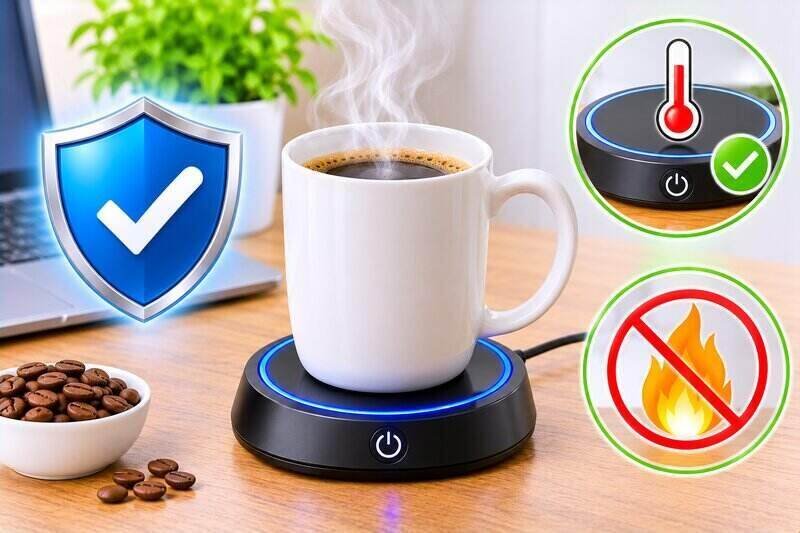
Are Mug Warmers Safe? The Short Answer
Yes, mug warmers are safe for most people when used as directed. Most models draw only 17 to 50 watts, which is far less than a space heater or toaster. Still, the plate gets hot, and it may stay warm after you turn it off. So, the real question is not just whether mug warmers are safe in general, but whether your model and your habits are safe.
In practice, three things decide the answer. First, the warmer should have an auto shut-off or a timer. Second, it should carry a safety listing from a recognized testing lab. Third, you should use it on a stable, hard surface away from paper and liquids.
How Hot Do Mug Warmers Get?
Mug warmer plates often run much hotter than your drink. Because heat escapes through the sides and top of the mug, manufacturers set the plate temperature high to keep the drink warm. For example, here are listed settings from popular models:
| Model Type | Listed Settings | Safety Feature |
|---|---|---|
| Basic 17 W plate | Single setting | Often no auto shut-off |
| 36 W plate with timer | 130, 150, 176°F | 4-hour default shut-off |
| High-heat plate | Up to 185°F | 1–12 hour timer |
| Digital plate | Plate 77–194°F | Pressure sensor |
| Self-heating mug | About 113–150°F | Sleeps when empty |
Interestingly, the drink itself usually stays much cooler. For instance, one digital model’s listing says the plate can reach 194°F, but liquid stays up to about 131°F. In CNN Underscored’s testing, several basic plates kept coffee at or below about 120°F to 130°F. Even so, the plate surface can be hot enough to cause a burn if you touch it.
The Burn Risk: What the Data Shows
Burns are the most common mug warmer risk, either from touching a hot plate or from spilling a hot drink. To put temperatures in context, the U.S. Consumer Product Safety Commission reports how quickly hot water can cause third-degree burns in adults:
| Water Temperature | Exposure Time for Third-Degree Burns |
|---|---|
| 150°F | About 2 seconds |
| 140°F | About 6 seconds |
| 130°F | About 30 seconds |
| 120°F | About 5 minutes |
Source: CPSC, Tap Water Scalds safety alert. The CPSC also notes that most tap water scald injuries and deaths involve older adults and children under 5.
These numbers matter because many mug warmer settings sit in that 130°F to 185°F range. Meanwhile, a 2008 study in the journal Burns by Fredericka Brown and Kenneth Diller calculated an optimal coffee drinking temperature of about 136°F to balance taste and scald risk (PubMed). In other words, the hottest settings add burn risk without improving your coffee much.
Fire Risk: How Real Is It?
A mug warmer uses little power, so the fire risk is low compared with high-wattage appliances. However, low risk is not zero risk. A hot plate left on for hours can scorch paper, napkins, or a wooden desk surface, and a damaged cord can overheat.
When we searched CPSC recall notices, we did not find a recall specific to plug-in mug warmers. Still, related products show what can go wrong. For example, in January 2020 the CPSC announced a recall of about 2,400 holiday travel mugs sold at Meijer because they were mislabeled as microwave safe, and their metallic decoration could spark in a microwave. Similarly, in December 2024 Stanley recalled about 2.6 million travel mugs after reports that lids could detach and cause burns, with 38 burn injuries reported worldwide.
The lesson is simple: follow the manufacturer’s instructions, and never assume a mug or warmer can be used in ways it was not designed for.
Video: Crane Reviews explains what to know before buying a mug warmer.
Safety Features to Look For
If you are wondering whether mug warmers are safe enough for your home or office, start with the features. Here is what to look for:
- Auto shut-off or timer: First, choose a model that turns off on its own, commonly after 4 hours, or one with a 2- to 12-hour timer.
- Safety listing: Next, look for UL or ETL marks. Both UL and Intertek, which issues the ETL mark, are recognized under OSHA’s Nationally Recognized Testing Laboratory program.
- Cup detection: Also, gravity or infrared sensors stop heating when you lift the mug.
- Residual-heat indicator: In addition, some warmers flash a light while the plate is still hot after shut-off.
- Waterproof top: Finally, a sealed glass or coated surface handles small spills better.
Are Mug Warmers Safe to Leave On All Day?
It depends on the model. A warmer with auto shut-off is designed to be left on during use, then turn itself off. On the other hand, a basic plate without auto shut-off will stay on until you switch it off or unplug it. For example, CNN Underscored noted that the classic Mr. Coffee warmer has no auto shut-off.
So, are mug warmers safe to leave on all day? With auto shut-off, generally yes during your workday. Without it, you should switch it off whenever you step away. In either case, do not leave a warmer running overnight or while you are out of the house.
Are Mug Warmers Safe Overnight?
We do not recommend it. Even a low-wattage plate is a heat source, and no one is there to notice a spill, a fallen paper, or a damaged cord. Instead, unplug it at the end of the day. As a bonus, you will also save a little electricity.
Are Self-Heating Mugs Safer?
Photo: waferboard via Flickr (CC BY 2.0).
Self-heating mugs tend to run at lower temperatures, often about 113°F to 150°F, and many sleep automatically when empty or after 2 hours without movement. As a result, they avoid some plate-related risks. However, they add a lithium-ion battery, so you should use only the included charger and follow cleaning rules closely.
For example, several brands warn against dishwashers, microwaves, and hot-water cleaning, and some say the base must be fully dry before charging. In addition, the FAA says spare lithium batteries and power banks belong in carry-on bags, not checked luggage, if you travel with one.
Safety by Mug Warmer Type
Not every warmer carries the same risks. The table below compares the main types, so you can see which safety features matter most for each.
| Type | Main Risk | Key Safety Feature |
|---|---|---|
| Basic plug-in plate | Left on too long | Manual switch; unplug when done |
| Plate with timer | Hot surface | Auto shut-off; residual-heat light |
| Smart plate with sensor | Hot surface | Stops heating when the cup is lifted |
| Self-heating mug | Battery and water damage | Sleep mode; dry charging base |
| Cordless pad | Battery care | Use the included charger |
As the table shows, plug-in plates mostly carry heat and time risks, while battery models add battery-care concerns. Either way, are mug warmers safe? Yes, when you match your habits to the type you own.
What Safety Listings Actually Mean
A UL or ETL mark means an independent lab has tested the product against a recognized safety standard. Both marks come from labs on OSHA’s list of Nationally Recognized Testing Laboratories. By contrast, some low-cost warmers list no certification at all. In that case, you are relying on the seller’s own claims.
To check, look for the mark on the product or packaging, not just in the listing text. In addition, some sellers include a control or file number, which you can use to confirm the listing with the testing lab. For example, one desk warmer we reviewed lists its ETL control number directly on its product page.
What to Do If You Get a Burn
Minor burns from a hot plate or spilled coffee are usually treatable at home. First, move away from the heat source and unplug the warmer. Next, cool the burn under cool, not cold, running water for about 10 minutes. Then cover it loosely with a clean, non-stick bandage. However, seek medical care for large burns, burns on the face, hands, or joints, blistered burns in young children or older adults, or any burn that looks deep or white.
Who Should Be Extra Careful?
- Homes with young children: Since the CPSC notes that children under 5 are among those most affected by scalds, keep warmers out of reach and away from table edges.
- Older adults: Similarly, choose a lower setting and a model with auto shut-off.
- Pet owners: Also, keep cords out of reach so pets cannot pull a hot mug down.
- Shared offices: Finally, check your workplace policy, since some offices limit personal heating devices.
Mug Warmer Safety Checklist
- Buy a warmer with auto shut-off and a UL or ETL listing.
- Place it on a hard, flat, heat-resistant surface.
- Keep paper, napkins, and sticky notes off and around the plate.
- Use a mug the manufacturer recommends, typically flat-bottomed ceramic, glass, or stainless steel.
- Choose a moderate setting, since about 136°F is optimal for drinking.
- Wipe spills right away, after unplugging.
- Inspect the cord regularly, and stop using it if it is damaged.
- Turn it off when you leave, and never run it overnight.
Common Mug Warmer Safety Mistakes
- Using it as a candle warmer and forgetting it. As a result, wax and wicks near a hot plate add fire risk if left unattended.
- Heating plastic cups. In fact, many brands warn against plastic, which can soften or warp.
- Placing it on soft surfaces. Instead, avoid cushions, blankets, or stacks of paper.
- Touching the plate right after use. Otherwise, residual heat can still burn fingers.
- Using damaged power strips. Rather, plug into a wall outlet or a quality, undamaged power strip.
How Much Power Does a Mug Warmer Use?
Most mug warmers use very little power. For example, a 17-watt warmer uses about 0.136 kWh in 8 hours, which costs about 2.5 cents at the U.S. average residential price of about 18.16 cents per kWh. By comparison, see our guide on how many watts a coffee maker uses. If you reheat coffee instead, our guide on how much electricity a microwave uses explains that cost.
Starting with properly brewed coffee also means you need less heat later. Our guide on what coffee maker makes the hottest coffee explains which brewers start hotter. Also, for fast hot water without a stovetop, see the best electric kettle.
Frequently Asked Questions
Are mug warmers safe for the office?
Generally, yes, if the model has auto shut-off and a safety listing. However, check your office policy, since some workplaces limit personal heating devices.
Can a mug warmer start a fire?
The risk is low because mug warmers use little power. Still, a hot plate can scorch paper or other materials, so keep the area clear and turn it off when you leave.
How hot is too hot for a mug warmer?
Plate settings of 176°F or more can burn skin quickly. Since about 136°F is optimal for drinking, a moderate setting is usually enough.
Is it safe to leave a mug warmer on overnight?
No. Even with auto shut-off, it is safest to unplug it when you are not around.
Are mug warmers safe with kids around?
They can be, with care. Keep warmers out of reach, away from table edges, and set to a lower temperature, since young children are especially vulnerable to scalds.
Which mugs are safe to use on a mug warmer?
Most brands recommend flat-bottomed ceramic, glass, or stainless steel mugs. On the other hand, avoid plastic cups, paper cups, and double-wall insulated mugs, since they either block heat or can soften on a hot plate.
Do mug warmers use a lot of electricity?
No. Most use 17 to 50 watts, so running one for a full workday typically costs only a few cents.
Final Thoughts
So, are mug warmers safe? For most people, yes. The key is to choose a warmer with auto shut-off and a UL or ETL listing, use it on a clear, hard surface, and pick a moderate setting near the 136°F optimal drinking temperature. Avoid leaving any warmer on overnight, keep it away from kids and pets, and follow the manufacturer’s mug and cleaning instructions. With those habits, a mug warmer is a safe, low-cost way to enjoy warm coffee all morning.

Hey, My name is MAMON. I am a SEO content creator and affiliate marketer with over 8 years of experience. I create honest product reviews, in-depth buying guides, and practical how-to articles to help readers make informed decisions. My mission is to provide trustworthy, research-backed content that delivers real value.
Leave a Reply