

This page may contain affiliate links. If you buy something from the links on this page, I may earn a small commission at no extra cost to you. Learn more


Healthy trees add real value to a New Mexico property: shade in a hot, dry climate, windbreaks, and curb appeal. But 2025 was a rough year for the state’s trees, and that changes the calculus for homeowners deciding whether to call a professional.
Key Takeaways
- New Mexico tree mortality tripled in 2025, with beetle-killed conifer acreage up 211%, as drought and warm winters left forests more vulnerable (New Mexico Forestry Division / U.S. Forest Service, 2025 forest health report).
- Tree care is one of the most hazardous trades in the country: BLS-derived estimates put tree trimmer and pruner fatality rates at roughly 15-30x the all-industry average.
- An ISA Certified Arborist has passed a 200-question exam and holds at least three years of field experience or a relevant degree, with recertification required every three years.
Why New Mexico trees need extra attention right now
A 2025 forest health report from the New Mexico Forestry Division and U.S. Forest Service found that tree mortality across the state tripled compared to 2024, with beetle-killed conifer acreage climbing 211% as warm winters let bark beetles stay active longer and prolonged drought left trees too stressed to fight them off. Forests affected by drought and heat combined rose 66% over the same period.
That matters for anyone with mature trees on their property. Drought-stressed trees are more likely to drop large limbs unexpectedly, more attractive to bark beetles and other pests, and, once dead, a wildfire risk until their needles fall. None of that is something a homeowner can diagnose reliably by eye, which is where a trained arborist comes in.
What is an arborist?
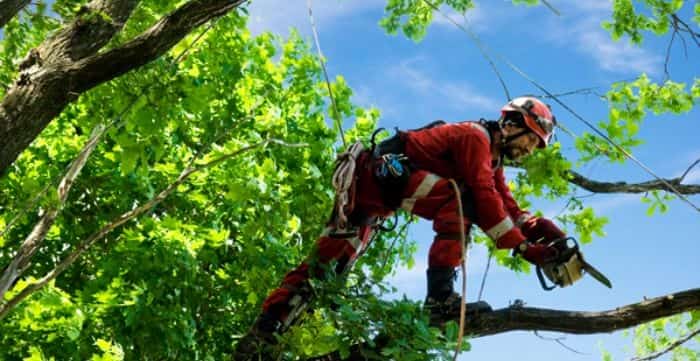

An arborist is a tree care specialist, and the clearest way to check someone’s qualifications is the ISA Certified Arborist credential from the International Society of Arboriculture (ISA). Earning it requires passing a 200-question exam covering tree biology, risk assessment, pruning, and safety, plus either three years of full-time field experience or a relevant degree. Certification has to be renewed every three years through continuing education, so a current credential reflects up-to-date practice, not a one-time test.
You can verify anyone’s certification status directly through ISA’s credential verification tool, which is a faster and more reliable check than taking a company’s word for it.
Services a certified arborist typically offers
Pruning — Selective pruning improves a tree’s structure, health, and appearance, and it’s easy to get wrong. Over-pruning or cutting in the wrong place can stress a tree or invite disease; an arborist knows which cuts help and which ones just look like progress.
Tree removal — Costs vary widely depending on size, location, and condition. Removal is usually worth pursuing if a tree is dead or dying, poses a clear hazard, is crowding other trees, or sits where new construction is planned. In New Mexico’s current conditions, more trees are meeting that bar than in a typical year.
Emergency and storm damage care — Downed limbs and trees near power lines are dangerous to approach without training. If a storm brings a tree into contact with utility lines, contact your local power provider before attempting anything yourself.
Planting — Arborists who specialize in planting choose species suited to a region’s soil and climate. In a state where drought has already killed hundreds of millions of piñon pines over the past two decades, species selection is not a minor detail.
Why not just DIY it
Tree work is consistently ranked among the most dangerous jobs in the country. Bureau of Labor Statistics data, as analyzed by Tree Care Industry Association (TCIA) Magazine, puts the fatality rate for tree trimmers and pruners at roughly 110 per 100,000 workers, about 30 times the all-industry average of 3.3–3.7. Even the broader “grounds maintenance workers” category BLS tracks more formally shows a rate 4-6 times the national average. Falls and being struck by falling limbs or equipment are the leading causes.
That risk is exactly what a trained crew is equipped to manage: proper rigging, chainsaw safety, and rope access technique that isn’t intuitive to learn from a video the day before a storm.
How to find a qualified arborist
Two free lookup tools do most of the vetting work for you:
- ISA’s “Find a Tree Care Service” directory lists certified arborists by ZIP code.
- TCIA’s Accredited Company directory lists companies that have passed a business-practices and safety audit, not just individual certification.
Ask any company you’re considering for proof of current ISA certification and liability insurance before work starts.
FAQ
Is it worth hiring an arborist instead of a general landscaper?
For pruning, removal, or diagnosing a sick tree, yes. Landscapers handle lawns and general yard maintenance; arborists are trained specifically in tree biology, risk assessment, and the safety practices tree work requires.
How much does tree removal cost in New Mexico?
It depends heavily on tree size, location, and condition, so get a written estimate from a certified arborist rather than relying on a rule of thumb.
How do I know if my tree is drought-stressed or dying?
Yellowing or thinning foliage, bark beetle exit holes, and dead upper branches are all signs worth having a professional look at, especially given how sharply tree mortality rose statewide in 2025.
How often should mature trees be pruned?
It depends on species and condition; an arborist can recommend a schedule during an on-site assessment rather than a fixed interval.
Sources: New Mexico Forestry Division & U.S. Forest Service 2025 Forest Health Report (via Santa Fe New Mexican, Taos News, Los Alamos Daily Post, June 2026 coverage); International Society of Arboriculture (isa-arbor.com); Tree Care Industry Association Magazine, “Tree-Work Safety by the Numbers”; U.S. Bureau of Labor Statistics.


Hey, My name is MAMON. I am a SEO content creator and affiliate marketer with over 8 years of experience. I create honest product reviews, in-depth buying guides, and practical how-to articles to help readers make informed decisions. My mission is to provide trustworthy, research-backed content that delivers real value.