

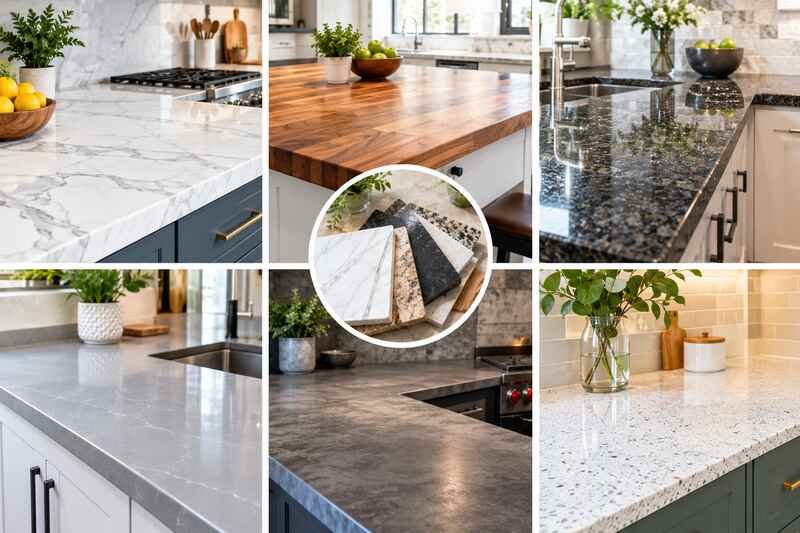

If your countertops are over a decade or two old, updating them is one of the highest-impact moves in any set of kitchen renovation plans. Countertops are one of the largest visible surfaces in the room next to your cabinets. Buyers and everyday cooks both notice them immediately. Here’s a full breakdown of the top countertop materials worth considering, along with what each one actually costs installed.
Key Takeaways
- Quartz ($50-$150/sq ft) and granite ($40-$175/sq ft) remain the two most popular choices for durability and resale appeal.
- Butcher block ($50-$150/sq ft) and laminate ($25-$65/sq ft) are the most budget-friendly ways to update a kitchen without a full remodel.
- Porcelain and sintered stone are the fastest-growing countertop category, prized for near-total resistance to heat, scratches, and stains.
- For a typical 30-40 sq ft kitchen, total installed costs range from about $2,000 for laminate to $10,000+ for premium marble or quartzite.
Why Countertops Matter So Much in Your Kitchen Renovation Plans
According to This Old House, engineered quartz requires very little upkeep while natural stone needs periodic resealing. That’s a distinction worth weighing early in your kitchen renovation plans. A kitchen remodel is consistently one of the projects that recoups the most value at resale. According to HGTV’s Cost vs. Value data, a minor kitchen remodel returns roughly 96% of its cost at resale. Countertops are usually the single upgrade within that project that buyers notice first. Cabinets set the tone of a kitchen, but countertops are what people actually touch, cook on, and photograph in a listing.
Modern and Sleek: Quartz Countertops
There’s a reason quartz remains at the top of the list in nearly every kitchen renovation plans article, including this one. It’s breathtaking, minimalist, and highly resistant to bacteria, heat, scratches, and stains. Manufacturers engineer quartz rather than quarry it, so it’s a man-made material available in nearly any color, finish, or pattern. That makes it easy to match to your existing cabinetry and backsplash. Installed quartz typically runs $50-$150 per square foot. If you cook often, it’s one of the few materials that genuinely holds up to daily mess without special sealing.
Natural Stone Countertops: Granite, Marble, and Quartzite
On the opposite end of the spectrum from engineered quartz are natural stone countertops. Stone has been a fixture in U.S. kitchens for decades, and for good reason: it’s genuinely stunning, and no two slabs look exactly alike.
- Granite ($40-$175/sq ft): Extremely durable and heat-resistant, with a huge range of natural color variation. Needs periodic resealing to stay stain-resistant.
- Marble ($65-$250/sq ft): The most elegant option and a strong resale signal. It’s porous, though, and prone to scratching and etching from acidic foods like citrus and wine.
- Quartzite ($70-$200/sq ft): A natural stone that looks similar to marble but performs closer to granite in durability. It’s currently the fastest-growing natural stone category.
Just listing a home with marble or quartzite countertops can meaningfully boost the appeal of the listing photos. Plan on resealing natural stone roughly once a year to keep it looking its best. If a spill gets ahead of you, see our guide on removing tough stains from a kitchen counter.
Butcher Block Countertops
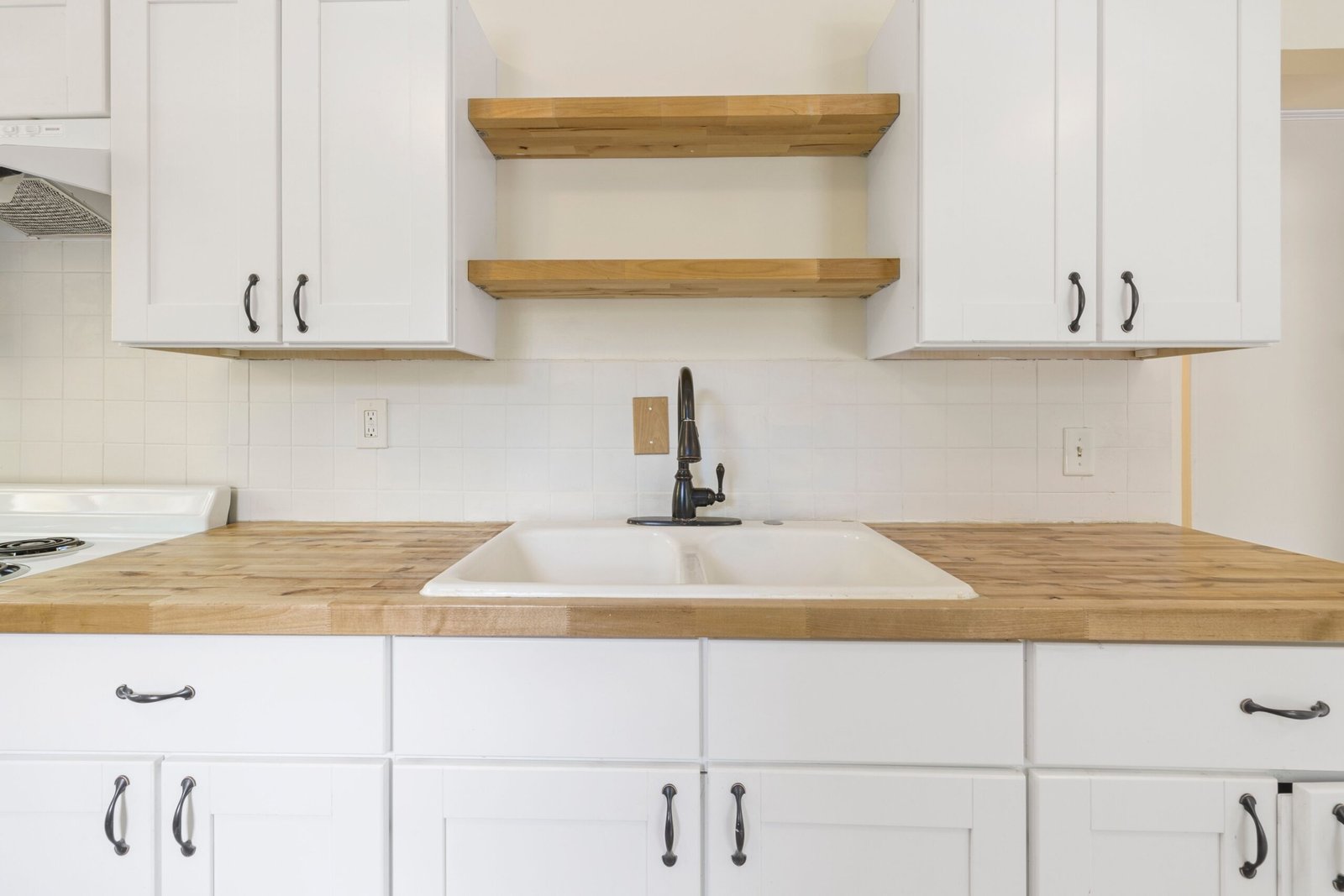
If your kitchen leans industrial or farmhouse in style, butcher block is a natural fit. It works with both light and dark color palettes. It’s available in a wide range of wood species and finishes, so matching your existing cabinetry is usually simple. Installed cost runs $50-$150 per square foot, comparable to quartz. Maintenance is straightforward: wipe with a damp cloth and dish soap daily. Apply a mineral oil coating every one to two months near the sink, and about once or twice a year elsewhere. Unlike stone, you can sand out minor scratches and burns, a real advantage for a heavily used kitchen.
Concrete Countertops
Concrete isn’t the first material most homeowners picture in a kitchen. But as industrial-style kitchens have grown in popularity, it’s had a genuine resurgence. It brings an instantly modern, urban look, and when you seal it properly, it’s highly durable with real staying power. Installed cost runs $65-$185 per square foot. Because installers pour and cure it on-site, or cast it as a custom slab, concrete offers design options no other material can match. Fabricators can tint it, embed it with objects like glass or shells, or shape it into a custom edge profile. Pair it with sparse, edgy decor for the best overall effect. Plan on resealing it every year or two, since concrete stays porous until you coat it.
Porcelain and Sintered Stone: The Fastest-Growing Trend
Porcelain and sintered stone slabs are the newest major category in the countertop world. Manufacturers sell them under brand names like Dekton and Neolith. They’re growing faster than any other material year over year. Manufacturers produce them under extreme heat and pressure, which makes them nearly impervious to scratches, UV fading, and heat. Installed cost runs $55-$120 per square foot, often cheaper than premium quartz or marble. If you want a marble look without the maintenance of natural stone, this is worth a serious look in your kitchen renovation plans.

Budget-Friendly Options: Laminate and Solid Surface
Not every kitchen renovation plan has room for a $10,000 countertop budget, and that’s fine. Two materials deliver a real style upgrade without the premium price tag:
- Laminate ($25-$65/sq ft): The most affordable option by a wide margin. Modern laminates convincingly mimic stone and wood grain. You can often repair minor chips with a heat gun or laminate paste instead of a full replacement.
- Solid Surface, such as Corian ($40-$110/sq ft): Nonporous and seamless, so there are no grout lines to catch grime. It scratches more easily than quartz, but you can sand it down to remove surface damage, similar to butcher block.
Sustainable Countertop Options Worth Considering
If eco-friendly materials matter for your kitchen renovation plans, a few options stand out beyond the mainstream choices above.
- Recycled glass and quartz blends: Manufacturers make these from post-consumer glass suspended in a resin or cement binder. They run in a similar price range to standard quartz, $50-$150 per square foot, and divert waste glass from landfills.
- Reclaimed wood butcher block: Fabricators source reclaimed butcher block from salvaged barn wood or old-growth lumber. It carries the same $50-$150 per square foot range as new butcher block, with the added character of reused material.
- Responsibly quarried natural stone: Ask your fabricator whether quarries with documented environmental and labor practices supplied their granite or marble. Sourcing varies significantly by supplier, even within the same material category.
None of these will necessarily save you money over conventional options. But they’re worth asking about if sustainability is part of what’s driving your kitchen renovation plans.
Cost Comparison: What Countertops Cost Installed
Here’s a quick side-by-side for planning your budget:
- Laminate: $25-$65/sq ft
- Solid Surface (Corian): $40-$110/sq ft
- Granite: $40-$175/sq ft
- Butcher Block: $50-$150/sq ft
- Quartz: $50-$150/sq ft
- Porcelain/Sintered Stone: $55-$120/sq ft
- Concrete: $65-$185/sq ft
- Marble: $65-$250/sq ft
- Quartzite: $70-$200/sq ft
For an average 30-40 sq ft kitchen, that translates to roughly $2,000 on the low end and $10,000 or more for premium natural stone. That range doesn’t yet include edge profiles, cutouts for sinks and cooktops, or old countertop removal.
Beyond Material: Other Costs to Budget For
The per-square-foot price of the slab itself is only part of the total bill in most kitchen renovation plans. A few line items catch homeowners off guard:
- Edge profile: Most fabricators include a basic straight or eased edge in the base price. Decorative edges like bullnose, ogee, or waterfall can add $10-$40 per linear foot.
- Sink and cooktop cutouts: Most fabricators include one or two standard cutouts in the base price. An undermount sink cutout or a custom cooktop opening can add $100-$300 each.
- Old countertop removal and disposal: Tearing out an existing countertop typically adds $5-$15 per square foot, more if it’s tile or requires cutting through adhesive.
- Backsplash: If you’re replacing the countertop, it’s worth budgeting for a matching or coordinating backsplash at the same time. That’s simpler than treating it as a separate project later.
Get a full quote that itemizes these costs upfront, rather than just the per-square-foot slab price. That step will save you from an unpleasant surprise partway through your kitchen renovation plans.
Watch: Countertop Materials Worth a Second Look

Watch “5 Kitchen Countertops I’d Think Twice About” on YouTube: https://www.youtube.com/watch?v=hj-PegPy-dw
How to Choose the Right Countertop for Your Kitchen Renovation Plans
With this many good options, the right choice comes down to a few honest questions:
- How hard do you cook? If you’re chopping, setting down hot pans, and prepping acidic ingredients daily, prioritize quartz, granite, or porcelain. Save marble or unsealed butcher block for lighter use.
- What’s your maintenance tolerance? Quartz and porcelain need almost none. Natural stone and butcher block need regular sealing or oiling to stay in good shape.
- Are you renovating to sell? Quartz and granite have the broadest buyer appeal. Marble and quartzite photograph exceptionally well for listings, even though they require more upkeep.
- What’s the rest of the kitchen doing? Match the countertop to your cabinet style and planned appliances before finalizing the material. A mismatched countertop can undercut an otherwise cohesive kitchen renovation. If a range is also part of your plans, read our guide on choosing a gas range alongside your countertop decision. Heat tolerance near the cooktop affects which materials make sense.
If you’re not happy with your current setup, it may be time to think about selling rather than renovating further. Fortunately, selling your home doesn’t have to be stressful. Even a modest countertop update can help streamline the process and support a stronger asking price.
Frequently Asked Questions
What’s the most popular countertop material for kitchen renovation plans right now?
Quartz remains the most popular choice nationally. It combines low maintenance with a huge range of color and pattern options. Porcelain and sintered stone are the fastest-growing category as homeowners look for a similar look with even less upkeep.
What’s the cheapest countertop material that still looks good?
Laminate, at $25-$65 per square foot installed, is the most affordable option. Modern laminates do a convincing job of mimicking stone and wood grain from a normal viewing distance.
Do granite or quartz countertops add more resale value?
Buyers view both favorably, and the difference in resale impact is minor. Quartz tends to be an easier sell because buyers know it requires no sealing. Granite’s natural variation, though, can be a stronger visual draw in listing photos.
How often should you reseal natural stone countertops?
Most granite and marble countertops need resealing about once a year. The exact timing varies by the specific stone’s porosity and how much daily wear the surface gets.
Is butcher block a good countertop choice near a kitchen sink?
It can be, as long as you seal it properly and keep standing water off the surface. Many homeowners use butcher block for an island or secondary prep area. They pair it with a more water-resistant material like quartz or granite around the sink itself.
How long does a countertop installation take once you choose the material?
Templating and fabrication for stone, quartz, or porcelain slabs typically takes 1-3 weeks after a fabricator takes measurements. Installers usually complete the actual installation in a single day. Fabricators can sometimes turn around laminate and solid surface faster, since they don’t require the same fabrication lead time.
Should I choose my countertop before or after my cabinets in my kitchen renovation plans?
Most designers recommend finalizing cabinets first, since countertop fabricators need exact cabinet dimensions to template and cut the slab. Choosing the countertop material and color early is fine. Just don’t schedule the fabrication and installation until your cabinets are in place.
Conclusion
Countertops are one of the most visible and highest-return decisions in any kitchen renovation plans. That’s true whether you’re updating a kitchen you plan to live in for years or preparing to sell. Quartz and porcelain offer the least maintenance. Granite and marble deliver the strongest natural-stone look, and butcher block or laminate can refresh a kitchen without stretching the budget. Whichever material you choose, match it to how you actually cook and how long you plan to stay. That’s how you get the most value out of the investment.


Hey, My name is MAMON. I am a SEO content creator and affiliate marketer with over 8 years of experience. I create honest product reviews, in-depth buying guides, and practical how-to articles to help readers make informed decisions. My mission is to provide trustworthy, research-backed content that delivers real value.