

Mug warmer vs self-heating mug: which one keeps your coffee hot better? Both solve the same problem, cold coffee, but they work in very different ways. A mug warmer is a heated plate that sits under almost any flat-bottomed mug, while a self-heating mug has a heater and battery built into the mug itself. As a result, they differ in price, accuracy, portability, and cleanup. In this guide, we compare the two using independent test results, product specs, and running-cost estimates, so you can decide which fits your routine.
Key Takeaways
- First, a mug warmer is cheaper and works with mugs you already own, but the drink usually runs much cooler than the plate.
- A self-heating mug measures and heats the drink directly, so it holds a set temperature more accurately, typically between 113°F and 150°F.
- In CNN Underscored’s tests, several basic plates kept coffee at or below about 120°F to 130°F, while a 75-watt smart plate reached 130°F in under 20 minutes.
- However, self-heating mugs run on limited battery off the coaster. For example, CNN measured a Nextmug at 2 hours 55 minutes with its lid and just over 1 hour without.
- Finally, both cost only a few cents a day to run at average U.S. electricity prices.

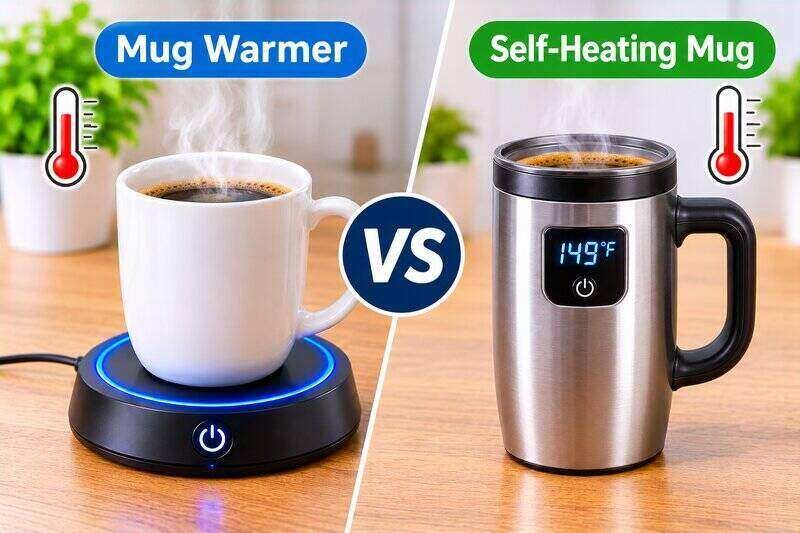
Mug Warmer vs Self-Heating Mug: The Quick Answer
In short, choose a mug warmer if you sit at one desk and want a low-cost way to slow cooling. On the other hand, choose a self-heating mug if you move around, want a precise temperature, or dislike lukewarm coffee. Both work, but each one shines in a different situation.
To put it simply, the mug warmer vs self-heating mug decision comes down to three questions. First, do you stay in one place? Second, how much do you want to spend? Third, how much do you care about an exact temperature? Once you answer those, the right choice is usually clear.
How Each One Works
How a Mug Warmer Works
A mug warmer is a small heating element under a flat plate. When you set a mug on it, heat moves by conduction into the mug’s base and then into the coffee. Meanwhile, the coffee keeps losing heat through the sides and open top. Consequently, the drink settles at a temperature well below the plate setting. For instance, Cosori’s own listing says its plate can reach 194°F, yet liquid stays up to about 131°F.
How a Self-Heating Mug Works
A self-heating mug has three main parts: a heating element in the base or wall, a rechargeable lithium battery, and a temperature sensor. Because the sensor reads the drink itself, the heater turns on only when the coffee falls below your setting. In addition, most self-heating mugs use double-wall bodies, which slow heat loss. As a result, they can hold a set temperature on or off the charging coaster.
Mug Warmer vs Self-Heating Mug: Side-by-Side Comparison
| Feature | Mug Warmer | Self-Heating Mug |
|---|---|---|
| How it heats | Plate under the mug | Heater inside the mug |
| Temperature accuracy | Drink runs cooler than plate | Measures the drink directly |
| Typical settings | Plate about 104–185°F | Drink about 113–150°F |
| Portability | Only works on the plate | Works on battery away from base |
| Mug choice | Most flat-bottomed mugs | Its own mug only |
| Cleaning | Mug may be dishwasher safe | Usually hand wash only |
| Power | About 16–75 W | Small battery plus coaster |
| Safety features | Auto shut-off on many models | Sleep mode when empty or idle |
Mug Warmer vs Self-Heating Mug: Which Keeps Coffee Hotter?
Independent testing gives a clear pattern. In CNN Underscored’s three-week test against a 130°F target, basic plates struggled. For example, the Mr. Coffee warmer never got coffee above 130°F, a Misby plate stayed under 120°F, and a Cosori warmer never exceeded 120°F. By contrast, the 75-watt iKago smart plate reached at least 130°F in just under 20 minutes.
Self-heating mugs, meanwhile, held temperature more precisely once they got there. However, they also heat slowly from cold. For instance, CNN found the Ember Mug 2 raised coffee by about 10°F in 10 minutes, and Bob Vila found a Thermacup took about 40 minutes to heat room-temperature liquid to 140°F. In other words, both types work best when you start with hot coffee.
So, which keeps coffee hotter? A good self-heating mug or a high-powered smart plate will usually beat a basic warming plate. Still, a basic plate with a thin, flat mug and a lid can keep coffee pleasantly warm for slow sipping.
Battery Life vs. All-Day Power
This is the biggest practical difference. A plug-in warmer runs all day as long as it is plugged in and switched on. On the other hand, a self-heating mug runs on battery when you lift it off the coaster.
Battery life depends heavily on the lid. In CNN’s test, a Nextmug lasted 2 hours 55 minutes with its lid and just over 1 hour without. Similarly, Bob Vila measured about 5 hours on Warm with the lid compared with about 2 hours without. Therefore, if you choose a self-heating mug, keep the lid on and return it to the coaster whenever you can.

Video: Dining Delights compares smart mugs and warming plates.
Cost to Buy and Run
Up front, mug warmers are usually much cheaper. Basic plates are often budget-friendly, while self-heating mugs from brands such as Ember and Nextmug sit at premium prices. However, running costs are tiny for both.
For example, a 17-watt warmer running 8 hours uses about 0.136 kWh, or roughly 2.5 cents at the EIA’s projected 2026 average residential price of 18.2 cents per kWh. Meanwhile, charging a self-heating mug with a 4,000 mAh battery once uses roughly 0.015 kWh, which is well under 1 cent. These are our estimates. In short, electricity should not decide the mug warmer vs self-heating mug question; price, convenience, and features matter far more.
For a broader look at power use, see our guides on how many watts a coffee maker uses and how much electricity a microwave uses.
Convenience and Daily Use

Photo: basheertome via Flickr (CC BY 2.0).
Mug Warmer Pros and Cons
On the plus side, a mug warmer works with your favorite mug, as long as it has a thin, flat bottom. It also needs no charging and often runs all day. Moreover, the mug itself may be dishwasher safe. On the downside, it only works while the mug sits on the plate, and the drink runs cooler than the setting.
Self-Heating Mug Pros and Cons
On the plus side, a self-heating mug holds a precise temperature and works away from your desk. In addition, many models offer apps or one-button presets. On the downside, it costs more, needs charging, and is usually hand wash only. For example, several brands warn against dishwashers, microwaves, and even hot-water cleaning.
Safety Compared
Both are generally safe when used as directed. However, they carry different risks. Plate warmers can get hot enough to burn fingers, since some list settings up to 176°F or 185°F. For context, the U.S. Consumer Product Safety Commission says 140°F water can cause third-degree burns in about 6 seconds. So, choose a plate with auto shut-off and keep it away from paper.
Self-heating mugs, on the other hand, usually run at lower temperatures and sleep when empty. Yet they add a lithium battery, so follow charging and cleaning instructions closely. In addition, keep the charging base dry.
What Temperature Should You Aim For?
Whichever you choose, you probably do not need extreme heat. In a 2008 study in the journal Burns, Fredericka Brown and Kenneth Diller calculated an optimal coffee drinking temperature of about 136°F (PubMed). Many self-heating mugs let you set 130°F to 140°F directly. With a plate, a middle setting usually lands in that range.
Mug Warmer vs Self-Heating Mug by Setting
At the Office
In an office, you often sit at one desk but leave for meetings. A mug warmer works well while you are seated, and an auto shut-off model protects you if you forget it. However, your coffee will cool while you are away. By contrast, a self-heating mug comes with you into the meeting and keeps its temperature on battery. So, if you have frequent meetings, the self-heating mug has an edge. Before you buy, check your workplace policy, since some offices limit personal heating devices.
At Home
At home, you may move from the kitchen to the couch to a home office. A self-heating mug handles that well, as long as you keep it charged. On the other hand, if you mostly work at one desk, a plate warmer is simpler and lets you use any of your favorite mugs. In addition, a plate is easier for families, since everyone can use their own cup.
On the Go
Neither a plate warmer nor a standard self-heating mug is ideal for travel. Instead, a heated travel mug with a leakproof lid, or a simple vacuum-insulated tumbler, works best for commuting. In particular, plates need an outlet, and many desk-style heated mugs are not designed to fit cup holders or resist spills.
Real-World Scenarios
| Your Routine | Better Pick |
|---|---|
| Remote worker at one desk all morning | Mug warmer with a lid |
| Office worker with many meetings | Self-heating mug |
| Tea drinker who wants an exact temperature | Self-heating mug or smart plate |
| Household sharing one warmer | Mug warmer |
| Gift for a gadget lover | Self-heating mug |
As the table shows, the mug warmer vs self-heating mug choice depends far more on your routine than on raw heating power.
Which Should You Buy?
- Go with a mug warmer if: you sit at one desk, want to use your own mugs, prefer dishwasher-safe cleanup, or want the lowest price.
- Pick a self-heating mug if: you walk between rooms or meetings, want an exact temperature, or want coffee hot to the last sip away from your desk.
- Consider a smart plate if: you want near-mug accuracy at a desk but still want to use regular mugs.
- Skip both if: you finish coffee in 10 to 15 minutes; a preheated mug and lid are enough.
Not sure yet? Start with how you drink coffee. If your cup rarely leaves your desk, a mug warmer is the simple, low-cost answer. However, if your coffee follows you around, a self-heating mug is worth the extra cost.
Tips for Either Option
- Start hot. First, pour freshly brewed coffee, since both types maintain heat better than they reheat.
- Use a lid. Next, a lid helps plates keep up and extends battery life on heated mugs.
- Pick a moderate setting. Also, aim near 136°F for comfort and safety.
- Preheat the mug. In addition, rinse a regular mug with hot water before pouring; an electric kettle makes this quick, see the best electric kettle.
- Follow care rules. Finally, hand wash heated mugs and unplug plates before cleaning.
For a hotter start, see our guide on what coffee maker makes the hottest coffee.
Frequently Asked Questions
Is a self-heating mug better than a mug warmer?
It is better for accuracy and portability. However, a mug warmer is cheaper and works with mugs you already own.
Do self-heating mugs keep coffee hotter?
Usually, they hold a set temperature more reliably. In contrast, basic plates often let coffee settle around 120°F to 130°F.
How long does a self-heating mug last off the charger?
It depends on the model and lid. In independent tests, results ranged from about 1 hour without a lid to about 5 hours with one.
Can I use my own mug with a self-heating base?
Generally, no. Self-heating mugs work only with their own mug. If you want to use your own mug, choose a mug warmer plate instead.
Which is cheaper to run?
Both are very cheap. A 17-watt plate costs about 2.5 cents per 8-hour day, and a self-heating mug charge costs well under 1 cent.
Are smart warming plates a good middle ground?
Yes, for desk users. Smart plates such as the 75-watt iKago use sensors and higher power, and in CNN’s test the iKago set reached 130°F in under 20 minutes. As a result, they offer near-mug accuracy while still letting you use regular mugs.
Which lasts longer, a mug warmer or a self-heating mug?
Generally, a plug-in mug warmer has fewer parts to wear out, since it has no battery. By contrast, a self-heating mug relies on a rechargeable battery, which, like any lithium battery, gradually loses capacity over time. So, if long-term durability matters most, a simple plate is the safer bet.
Final Thoughts
In the mug warmer vs self-heating mug debate, there is no single winner. Instead, a mug warmer is the best value for a single desk, especially with a thin, flat-bottomed mug and a lid. Meanwhile, a self-heating mug is the better choice if you move around or want a precise temperature, as long as you are happy to hand wash it and keep it charged. Either way, start with hot coffee, use a lid, and aim for about 136°F for the best balance of flavor and safety.


Hey, My name is MAMON. I am a SEO content creator and affiliate marketer with over 8 years of experience. I create honest product reviews, in-depth buying guides, and practical how-to articles to help readers make informed decisions. My mission is to provide trustworthy, research-backed content that delivers real value.