

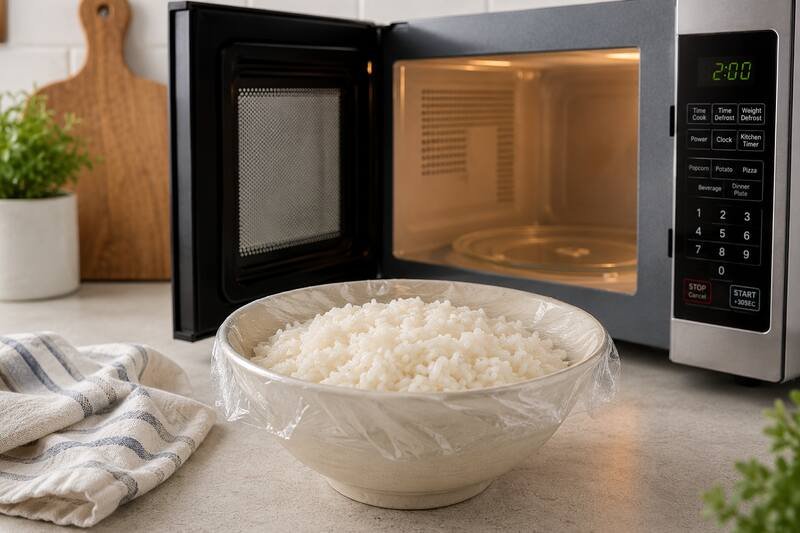

Reheating rice in a microwave oven is easy once you know how to reheat rice in microwave oven the right way. With a few simple steps, leftover rice turns back into a fluffy side dish in minutes instead of a dry, clumpy mess, saving time and cutting down on food waste.
The short version: add a splash of water, cover the dish, and heat in short bursts instead of one long blast. Just one tablespoon of water per cup of cooked rice keeps the grains soft. This one habit fixes most of what goes wrong when people reheat rice in the microwave.
Key Takeaways: How to Reheat Rice in Microwave Oven
- Add 1 tablespoon of water per cup of rice to keep it moist while reheating
- Microwave reheating takes only 1-2 minutes for most portions
- Refrigerate leftover rice within 2 hours of cooking, and use it within 3-4 days
- Reheated rice needs to reach 165°F internally to be safe
- Stir rice halfway through reheating so it heats evenly instead of in hot and cold patches
Understanding Rice Storage and Safety Guidelines
Storing rice the right way matters just as much as reheating it correctly. Rice behaves a little differently than most other leftovers, and skipping the storage rules is the most common way people end up with a stomach ache instead of a quick meal.

The USDA Food Safety and Inspection Service sets clear rules for handling cooked food like rice. Bacteria grow fastest between 40°F and 140°F, so getting rice out of that range quickly is what keeps it safe to reheat later.
Proper Storage Temperature and Duration
Here’s what the USDA actually recommends for cooked rice and other leftovers:
- Refrigerate rice within 2 hours of cooking (within 1 hour if the room is hotter than 90°F)
- Cool it to 40°F or below as quickly as you can
- Store it in the refrigerator for 3-4 days
- Freeze it for longer storage, up to 3-4 months
Splitting a big pot of rice into smaller, shallow containers before refrigerating helps it cool faster than one deep container would.
Signs of Spoiled Rice
Before you reheat rice in microwave oven settings of any kind, give it a quick check. Spoiled rice usually shows one of a few warning signs:
- An unusual, sour, or off smell
- A slimy texture or discoloration
- Any visible mold, even a small spot
If you notice any of these, don’t try to salvage it by reheating it longer. Throw it out instead.
Best Practices for Storing Leftover Rice
| Storage Method | Duration | Safety Notes |
|---|---|---|
| Refrigerator | 3-4 days | Use an airtight container |
| Freezer | 3-4 months | Store in a single layer for faster thawing |
Whichever method you use, reheat rice in microwave oven settings only until it reaches 165°F all the way through, and avoid reheating the same batch more than once.
Why Rice Needs Extra Care When You Reheat It
Rice carries a specific food safety risk that most other leftovers don’t. Cooked rice can harbor Bacillus cereus, a bacteria that survives normal cooking as a heat-resistant spore. If rice sits out too long, those spores multiply and produce a toxin.
Reheating rice doesn’t undo that. As Emily Hovis of the University of Washington School of Public Health put it: “Even when you reheat it, you’re killing the vegetative cells, you’re not destroying the toxins.”
That’s why the 2-hour refrigeration rule matters so much for rice specifically. Symptoms usually show up within 6 to 12 hours and include nausea, vomiting, and stomach cramps. Most people recover within a day, but the fix is simple enough that there’s no reason to risk it: cool rice quickly, refrigerate it promptly, and don’t push storage past 3-4 days. If you keep a rice cooker’s warming function running for hours instead, check how long rice actually stays safe in a rice cooker first, since “keep warm” isn’t the same as refrigeration.

When rice cools in the fridge, its starch molecules go through a real, well-documented change. Scientists call it retrogradation. It’s the same basic process that makes bread go stale.
As rice cools, the starch molecules that gelatinized during cooking reorganize into tighter structures. That squeezes out moisture, which is why day-old rice already feels tough and dry before you’ve even reheated it.
Understanding this explains why the fixes below work:
- Starch molecules reorganize as rice cools, which is what causes the firming
- This retrogradation happens faster in the refrigerator than at room temperature
- Moisture loss during storage makes the effect worse
Since the problem is moisture loss, the fix is straightforward. Add moisture back in, and use gentle, even heat instead of one long blast.
| Rice Storage Condition | Starch Retrogradation Rate |
|---|---|
| Refrigerator (below 40°F) | Fast |
| Room temperature | Moderate (but unsafe for food safety reasons) |
| Freezer (below 0°F) | Slowed significantly |
That’s why freezing works better than fridge storage for rice you won’t eat within a few days.
Essential Tools and Materials for Reheating Rice
When you reheat rice in microwave oven appliances, the right tools make the difference between rice that tastes freshly made and rice that tastes reheated.
Microwave-Safe Containers
Choosing the right container matters more than people expect. Look for one that’s:
- Made from microwave-safe glass or ceramic
- Wide and shallow, so heat reaches the rice evenly
- Roomy enough that the rice can spread into a thin layer
- Free of any metal trim or decoration
If your microwave runs unevenly no matter what container you use, that often points to an aging unit. Our guide to compact microwave ovens covers models built for more consistent heating.
Additional Items Needed
Four other items round out the setup:
- A microwave-safe lid or a damp paper towel
- A fork for fluffing the rice afterward
- Measuring spoons for the water
- Optionally, a kitchen thermometer to check for 165°F precisely
Water Requirements
Water is what keeps the rice from drying out further as it reheats. Use this as a rough guide:
| Rice Quantity | Water Amount | Heating Time |
|---|---|---|
| 1 cup rice | 1-2 tablespoons | 30-60 seconds |
| 2 cups rice | 2-4 tablespoons | 1-2 minutes |
| 3 cups rice | 3-6 tablespoons | 2-3 minutes |
Stir the rice halfway through so it doesn’t develop dry spots on top while the bottom overheats. With the right container and a little water, most rice reheats well on the first try.
How to Reheat Rice in Microwave Oven
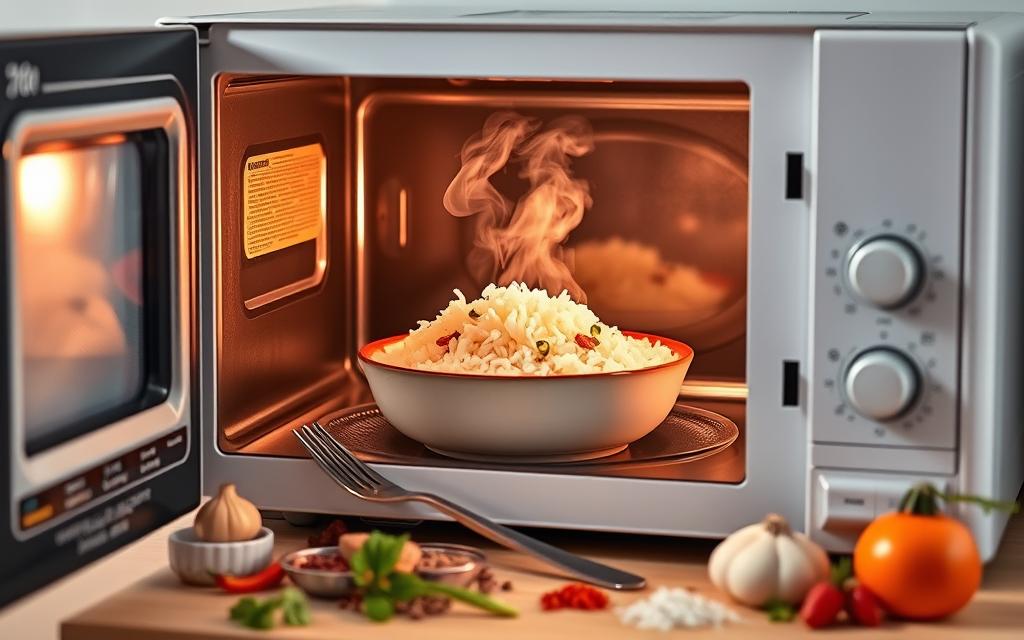

Once you have your tools and rice ready, the actual process is quick. The main trick is keeping the rice moist and heating it gently instead of blasting it on full power for two minutes straight.
Here’s the step-by-step method:
- Put the leftover rice in a microwave-safe dish
- Add 1 tablespoon of water for every cup of rice
- Break up any large clumps with a fork
- Cover the dish with a lid or a damp paper towel
- Heat in 30-second bursts rather than one long cycle
- Stir after each burst so the heat spreads evenly
- Check that the rice has reached at least 165°F before eating
Different rice types reheat a little differently. Long-grain white rice usually warms through faster than brown rice, which has a denser bran layer that holds onto more moisture and takes slightly longer to heat evenly.
Pro tip: Medium power, around 50-70%, usually gives better results than full power. Most portions are ready in 1-2 minutes total.
- Refrigerate leftover rice within 2 hours of cooking
- Use refrigerated rice within 3-4 days
- Reheat rice only once, and eat what you reheat
The Ice Cube Method for Perfect Reheated Rice
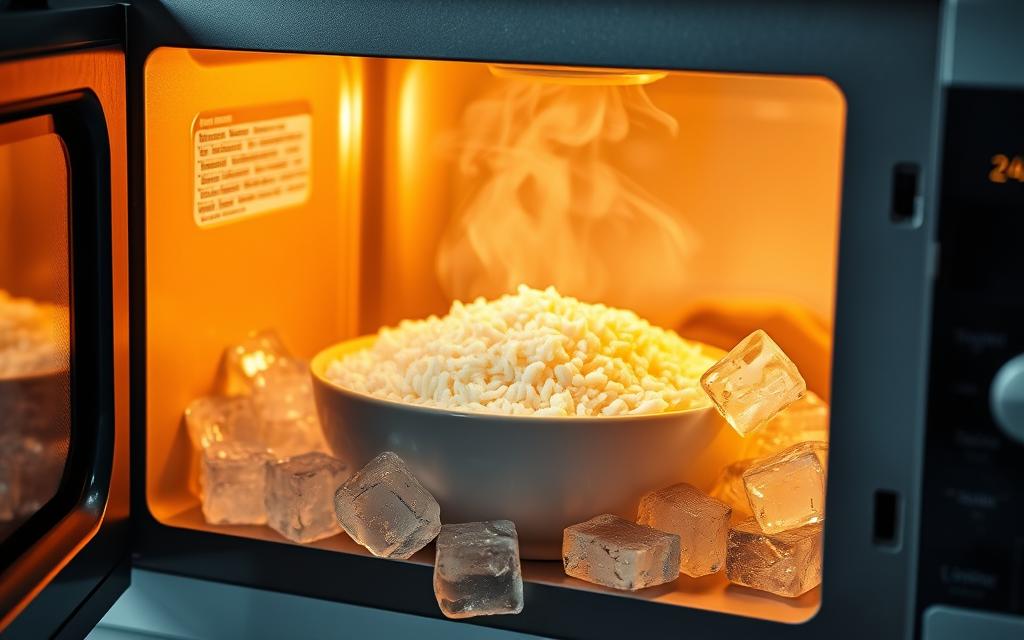
If plain water and a paper towel aren’t cutting it, the ice cube trick is worth trying. It’s a popular technique among home cooks for one simple reason: it works, and it’s nearly impossible to mess up.
Step-by-Step Ice Cube Technique
- Spread the leftover rice evenly on a microwave-safe plate
- Set a single ice cube in the center of the rice
- Cover the plate with a damp paper towel
- Microwave on high for about 1 minute
Why It Works
As the ice cube melts, it creates a small pocket of steam right where the rice needs it most. That steam spreads through the rice more evenly than pouring water over the top. Because the ice melts gradually, it’s also harder to end up with soggy rice than with the tablespoon method.
Timing depends on your microwave’s power. A full-power 1100-watt microwave might only need a minute, while an older unit could need closer to 90 seconds. Serve the rice right away, since it firms back up quickly once it’s off the heat.
Common Mistakes to Avoid When Reheating Rice
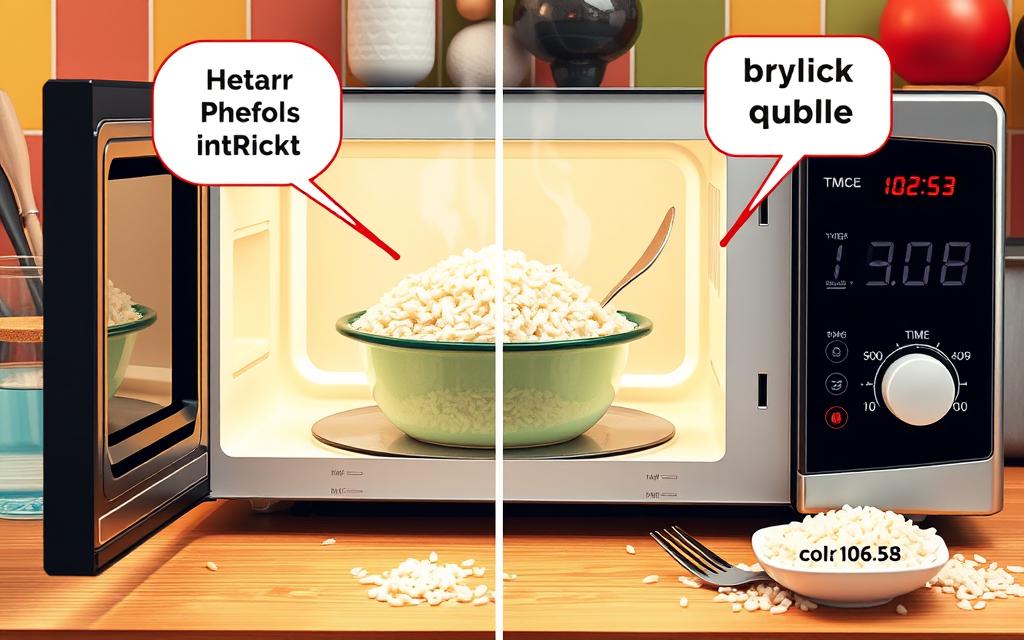
Even a simple task like reheating rice goes wrong in a few predictable ways. Knowing what to avoid saves you a ruined side dish.
- Overheating: Running the microwave too long turns rice dry and hard, sometimes even scorched around the edges
- Skipping moisture: Reheating rice completely dry, with no water or cover at all
- Reheating more than once: Every extra reheating cycle adds food safety risk on top of worse texture
- Using the wrong container: Non-microwave-safe dishes can warp, crack, or damage the inside of your microwave
Dry, tough reheated rice is almost always a moisture problem, a heat problem, or both. Adding water and covering the dish solves the first issue. Using shorter bursts at medium power instead of one long blast on high solves the second.
If a container mistake ever leaves scorch marks or a burnt smell inside your microwave, it’s fixable. Our guide to cleaning a burnt microwave walks through getting the smell and residue out safely.
| Mistake | Consequence | Solution |
|---|---|---|
| No added moisture | Dry, crunchy rice | Add 1-2 tablespoons of water |
| Excessive heat | Overcooked, tough texture | Use 50-70% power instead of full power |
| Multiple reheats | Added food safety risk | Reheat only once, and eat it |
Avoiding these four mistakes covers most of what goes wrong with reheated rice.
Alternative Methods for Reheating Rice
The microwave is the fastest option, but it’s not the only one. These methods take longer, though some people prefer the texture they produce.
Stovetop Reheating Technique
The stovetop gives you more control over both temperature and moisture as you go.
- Let the rice sit at room temperature for a few minutes first
- Add 2 tablespoons of water for every cup of rice
- Use a small pot with a tight-fitting lid
- Heat on low for about 5 minutes
- Stir occasionally so it doesn’t stick to the bottom
Oven Reheating Method
For larger batches, the oven works better than trying to fit everything into one microwave dish.
- Preheat the oven to 300°F
- Put the rice in an oven-safe dish
- Add 1-2 tablespoons of water
- Cover tightly with aluminum foil
- Heat for 15-20 minutes
Steam Reheating Approach
Steaming is the gentlest option and does the least damage to texture.
- Set up a steamer basket or colander over simmering water
- Keep the water level below the rice itself
- Cover and steam for 3-5 minutes
- Fluff with a fork once it’s heated through
Whichever method you choose, the same rule applies: get the rice back up to 165°F before you eat it.
Frequently Asked Questions
What’s the fastest way to reheat rice in microwave oven settings?
Adding a tablespoon of water per cup of rice, covering the dish, and microwaving in 30-second bursts at medium power is the fastest reliable method. Most portions are ready in 1-2 minutes.
Can I reheat rice without adding water?
You can, but it usually comes out dry and a little tough. The starch changes that happen during cold storage pull moisture out of the rice, so adding a little back in during reheating makes a noticeable difference.
Is it safe to reheat rice more than once?
It’s best to reheat rice only one time. Each additional round of cooling and reheating gives any surviving bacteria more opportunity to grow, and the texture also degrades further with each cycle.
Why does my reheated rice sometimes taste sour or off?
That’s usually a sign the rice sat out too long before refrigeration, or was stored longer than 3-4 days. If rice smells sour, looks slimy, or shows any mold, it’s safer to throw it out than to try reheating it.
Does the ice cube method work for all types of rice?
It works well for white rice, brown rice, and most grain-based sides. Brown rice may need a few extra seconds since its bran layer holds onto more moisture and heats a little more slowly.
Conclusion
Learning how to reheat rice in microwave oven settings comes down to two things: adding moisture back in, and heating it gently instead of blasting it on high. Get those two details right and leftover rice tastes close to freshly cooked.
It’s also the smart choice for your wallet and for cutting food waste. Follow the storage guidelines above and you protect yourself from foodborne illness at the same time: refrigerate within 2 hours, keep it below 40°F, and reheat to at least 165°F.
From there, leftover rice becomes a building block instead of a chore, whether that’s a quick stir-fry or a simple side dish. Just check for spoilage first, and don’t reheat the same batch twice.


Hey, My name is MAMON. I am a SEO content creator and affiliate marketer with over 8 years of experience. I create honest product reviews, in-depth buying guides, and practical how-to articles to help readers make informed decisions. My mission is to provide trustworthy, research-backed content that delivers real value.