


Learning how to use a french fry cutter is the fastest way to turn a bag of russet potatoes into restaurant-style fries. No more hand-cutting each one. These countertop tools use a push-down blade grid to slice a whole potato into uniform strips in one motion. Once you know the setup, prep, and frying steps, you’ll get consistent results every time.
This guide covers choosing the right cutter, prepping potatoes, using the cutter safely, and frying the results into genuinely crispy fries.
Key Takeaways
- Knowing how to use a french fry cutter comes down to three steps: load a potato, press the handle, catch the strips
- Uniform cuts matter because they cook at the same rate, so use similarly sized potatoes and a consistent blade size
- Russet potatoes with high starch content (specific gravity around 1.070-1.080) fry crispier than waxy varieties
- Soaking cut potatoes in water for 30 minutes to 2 hours removes surface starch and can cut acrylamide formation by up to 48%
- The double-fry method (a lower-temperature blanch, then a hot second fry) is what produces restaurant-style crispness
What Is a French Fry Cutter?
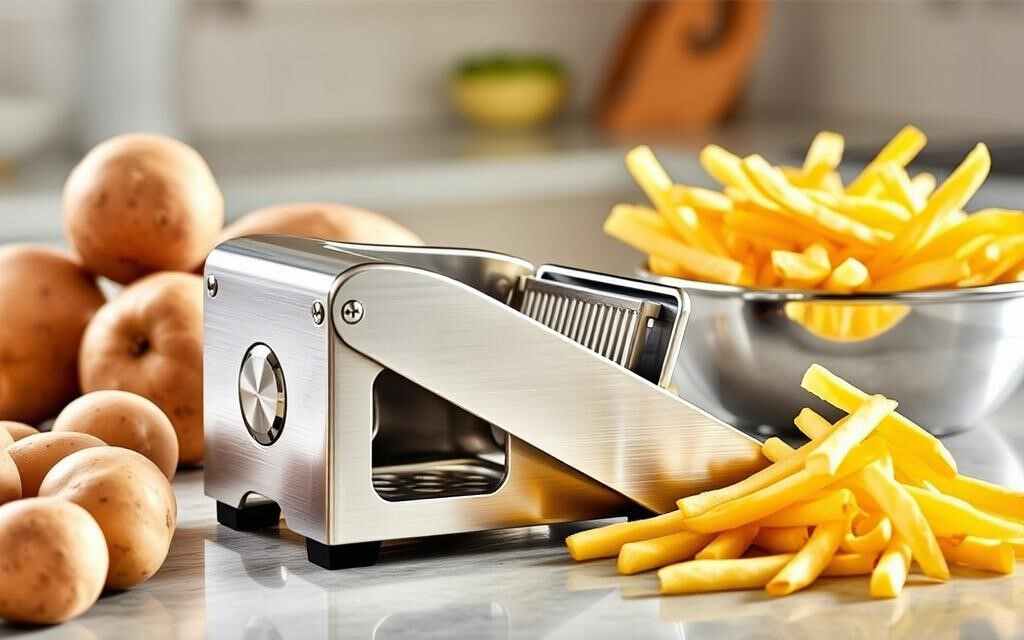
A french fry cutter is a manual or electric kitchen tool that presses a whole potato through a grid of blades. One motion cuts it into evenly sized, fry-shaped strips. It’s built around a sturdy frame, a blade grid sized for a specific fry thickness, and a handle or pusher that forces the potato through.
How a French Fry Cutter Works
Most manual models clamp to a countertop or use suction-cup feet for stability. You set a whole potato on the blade grid, then pull down a lever-mounted pusher plate. That drives the potato straight through the blades and out the bottom as strips. Electric and air-powered versions do the same job with a motor instead of a hand lever. That matters more for high-volume kitchens than home use.
Types of French Fry Cutters
- Standard straight cutters: produce classic straight-cut fries in fixed thicknesses, typically 1/4″, 3/8″, or 1/2″.
- Wedge cutters: use fewer, angled blades to produce thick wedge-style fries instead of thin strips.
- Specialty and crinkle cutters: use wavy or offset blades to produce crinkle-cut, waffle-style, or ribbon fries.
Whichever style you pick, the basic process is the same across manual and electric models. Load a potato, press it through the blades, and catch the strips underneath.

Benefits of Using a French Fry Cutter
A dedicated cutter earns its counter space mostly on speed and consistency, whether you’re feeding a family or prepping a full dinner service.
Time-Saving Advantages
Hand-cutting fries with a knife means squaring off a potato, slicing it into planks, then slicing those planks into strips. That’s three separate cuts before you’ve cooked anything. A fry cutter collapses that into one press per potato. It adds up fast once you’re prepping more than one or two.
Consistent Size and Shape
Uniform strips cook at the same rate. You won’t end up with some fries burnt and others underdone in the same batch. A mix of thick and thin cuts in one fryer basket will never finish evenly, which is why blade thickness matters as much as cooking method.
How to Choose the Right French Fry Cutter
The right cutter depends more on how often you’ll use it than any single “best” model.
Manual vs. Electric Cutters
Manual cutters cost less, need no outlet, and work fine for typical home batches. Electric or air-powered cutters cost more, but they remove the effort of pressing a lever by hand. That makes sense if you’re processing a large volume of potatoes regularly.
Blade Size and Extra Features
Blade grids commonly range from 1/4″ (shoestring) to 1/2″ (steak fries). Some cutters ship with interchangeable grids. Suction-cup feet or a clamp base add stability during the push, and dishwasher-safe parts make cleanup easier. Our potato slicer buying guide covers current models in more detail. If you’d rather skip a dedicated tool, it’s also possible to cut french fries by hand, though it takes longer per potato.
Choosing and Prepping Your Potatoes
The cutter only does half the job. What you feed into it matters just as much for the final texture.
The Best Potato Variety for Fries
Russet potatoes are the standard choice: they carry more starch and less water than waxy varieties like red or fingerling potatoes. According to the Idaho Potato Commission, fry-bound potatoes should have a specific gravity of roughly 1.070 to 1.080. As they put it, “the more solids, the less water, the crispier fry.” One storage detail is worth knowing before you shop: potatoes stored below 40°F start converting starch to sugar. That makes fries brown too quickly and too dark before the inside cooks through. Look for potatoes stored around 48-55°F, and skip refrigerating any you plan to fry.
Washing, Peeling, and Sizing
- Choose medium potatoes close in size to each other so the strips finish cooking at the same time.
- Scrub off dirt under running water; peeling is optional and mostly a texture preference.
- Dry the potato thoroughly with a towel before cutting. A wet surface makes it slide instead of feeding cleanly through the blades.
- Halve any potato that’s too tall or wide for your cutter’s frame before pressing it through.


How to Use a French Fry Cutter: Step-by-Step
Once your potatoes are washed, dried, and sized, using the cutter itself takes seconds per potato.
1. Set Up the Cutter
Place the cutter on a flat, stable surface: a countertop or a large cutting board works well. Confirm the suction feet or clamp are holding firmly, then lift the pusher handle fully so there’s room to load a potato underneath.
2. Load and Cut the Potato
Set a whole or halved potato onto the blade grid, flat and centered. Put a bowl or tray underneath to catch the strips. Press the pusher handle down in one firm, even motion. A slow, hesitant push leaves ragged edges, while a quick even press cuts cleanly.
3. Cut Safely
Keep your fingers on the handle only, never near the blade grid, even when clearing a stuck piece. Use the back of a spoon instead. Don’t leave the cutter unattended with a potato loaded, and store it with the blade guard on between uses.
Repeat with each potato until you have the fries you need, then move on to soaking or frying.
Soaking Cut Potatoes for Crispier Fries
This step gets skipped more than any other, and it’s worth the extra 30 minutes. Submerging cut fries in cold water rinses off surface starch that would otherwise make them gummy or stick together in the fryer. There’s also a food-science reason beyond texture. A study in the Journal of the Science of Food and Agriculture, led by researcher Rachel Burch at Leatherhead Food International, tracked acrylamide formation, a compound linked to high-heat frying. Washing cut potatoes alone reduced it by up to 23%. A 30-minute soak cut it by up to 38%, and a full 2-hour soak by up to 48%, though the researchers noted these reductions applied mainly to lighter-fried, not deeply browned, potatoes.
Soak your cut strips in cold water for at least 30 minutes, then drain and pat them completely dry. Wet fries going into hot oil cause dangerous splattering and prevent proper browning.
The Double-Fry Method for Restaurant-Quality Fries
If your homemade fries usually come out pale or limp instead of crisp, the fix isn’t the cutter. It’s frying at one temperature instead of two. Food scientist J. Kenji López-Alt’s widely cited method, popularized through Serious Eats, uses two separate oil temperatures:
| Stage | Oil Temperature | Time | Purpose |
|---|---|---|---|
| First fry (blanch) | 325°F | 5-8 minutes, until soft but pale | Gelatinizes internal starch to build the crust’s structural framework |
| Rest | Room temp or freezer | 10+ minutes | Lets the exterior dry and firm up before the second fry |
| Second fry (crisp) | 375°F | 2-4 minutes, until golden | Flash-evaporates surface moisture into a crisp shell while the inside stays fluffy |
The lower first-fry temperature gelatinizes the potato’s starch, forming the crust’s internal scaffolding. The hotter second fry then drives off surface moisture fast, browning and crisping the outside before the inside overcooks. If deep frying isn’t your preference, our guide to cooking french fries in an air fryer covers timing for that method. A true double fry will still crisp better than a single pass in either appliance, though.

Tips for Perfect Fries Every Time
Match Thickness to the Texture You Want
Thinner cuts (around 1/4″) cook fast and crisp almost all the way through, closer to a shoestring fry. Thicker cuts (around 1/2″) take longer but keep a fluffier interior. Neither is “correct,” it’s preference, but the thickness should match your frying time.
| Cut Thickness | Approx. Frying Time (second fry) | Texture |
|---|---|---|
| 1/4 inch (shoestring) | 2-3 minutes | Crispy throughout, minimal interior |
| 3/8 inch (standard) | 3-4 minutes | Crisp exterior, soft interior |
| 1/2 inch (steak fry) | 4-6 minutes | Fluffy interior, thinner crisp shell |
Cleaning and Maintaining Your Cutter
A cutter that isn’t cleaned promptly turns into a magnet for stuck starch and rust on the blades.
Disassembling and Washing
Check your model’s manual before disassembling; some cutters have dishwasher-safe components, while others need hand washing only. Separate the blade grid, pusher plate, and frame, and air-dry everything fully to avoid water spots and rust.
Cleaning by Material
- Stainless steel: mild soap and warm water, dried well; many stainless parts are dishwasher-safe.
- Plastic: a soft-bristled brush with warm soapy water; avoid abrasive cleaners that can scratch or cloud the plastic.
- Wood components: wipe with a damp cloth and dry immediately; never soak wood in water.
For a more detailed walkthrough, see our full guide on how to clean a potato slicer safely.
Troubleshooting Common Issues
A few issues tend to come up repeatedly once you’ve got the hang of how to use a french fry cutter.
| Issue | Likely Cause | Fix |
|---|---|---|
| Uneven or ragged cuts | Misaligned blades, or a slow/hesitant push | Check the manual for blade alignment steps; press with one firm, even motion |
| Potato won’t feed through | Potato too large, or blades dulled from use | Halve oversized potatoes first; replace or sharpen worn blades |
| Hard time cutting dense potatoes | Very firm, cold sweet potatoes or new potatoes | Microwave for 1-2 minutes to slightly soften, then cool briefly before cutting |
Potato Storage and Safety: What About Green Potatoes?
Worth knowing before you stock up for fry night: potatoes exposed to light can turn green and develop a bitter-tasting alkaloid called solanine. According to Purdue University’s Yard and Garden Extension, solanine concentrates in the skin. Cutting away the green portion, plus any sprouts or eyes, removes most of it. Consuming a large amount can cause illness, though the bitter taste naturally discourages people from eating enough to be harmful. If a potato is green through most of its flesh, not just the skin, discard it instead of trying to salvage it. Store fry-bound potatoes in a cool, dark, well-ventilated spot rather than on a sunny counter, and you’ll avoid the issue almost entirely.
Creative Ways to Use a French Fry Cutter
The blade grid isn’t limited to potatoes. Firm vegetables like carrots, zucchini, and sweet potatoes cut into uniform sticks for roasted veggie fries or chips. Firm cheeses cut into neat sticks for a platter, too. Crinkle-blade cutters make decorative garnish slices for fruit or cucumber. For a variation beyond straight-cut fries, our guide to making curly fries with a potato slicer covers that step by step.
Frequently Asked Questions
What oil temperature is best for frying cut fries?
For the double-fry method, blanch at 325°F until the potato is soft but pale, then fry a second time at 375°F until golden. A single fry at 375°F works too, but won’t produce as thick or crisp a crust as the two-stage method.
Do I have to soak the potatoes before frying?
No, but it noticeably improves the result. Soaking for at least 30 minutes rinses away surface starch (preventing gumminess) and has been shown to reduce acrylamide formation during frying.
Can I use a french fry cutter on sweet potatoes?
Yes, though sweet potatoes are denser and can be harder to push through. Microwaving them for a minute or two first softens them enough to cut more easily.
What blade size should I buy if I only get one?
A 3/8″ grid is the most versatile choice. It’s thin enough to crisp up well, thick enough to stay fluffy inside, and close to what most restaurants use for standard-cut fries.
Do I need different steps for an electric cutter?
No. How to use a french fry cutter stays the same whether it’s manual or electric; an electric model just replaces your hand on the lever with a motor.
How often should I clean my french fry cutter?
Clean it after every use. Starch residue left on the blades dries out, attracts moisture, and can lead to rust on metal components over time.
Final Thoughts
Once you’ve got the setup down, knowing how to use a french fry cutter is the fastest way to get evenly cut, restaurant-style fries without a cutting board and knife. Start with a good russet potato, soak your cut strips, and use the double-fry method if crispness is your goal. Then experiment with seasonings like garlic powder, smoked paprika, or fresh rosemary.


Hey, My name is MAMON. I am a SEO content creator and affiliate marketer with over 8 years of experience. I create honest product reviews, in-depth buying guides, and practical how-to articles to help readers make informed decisions. My mission is to provide trustworthy, research-backed content that delivers real value.