

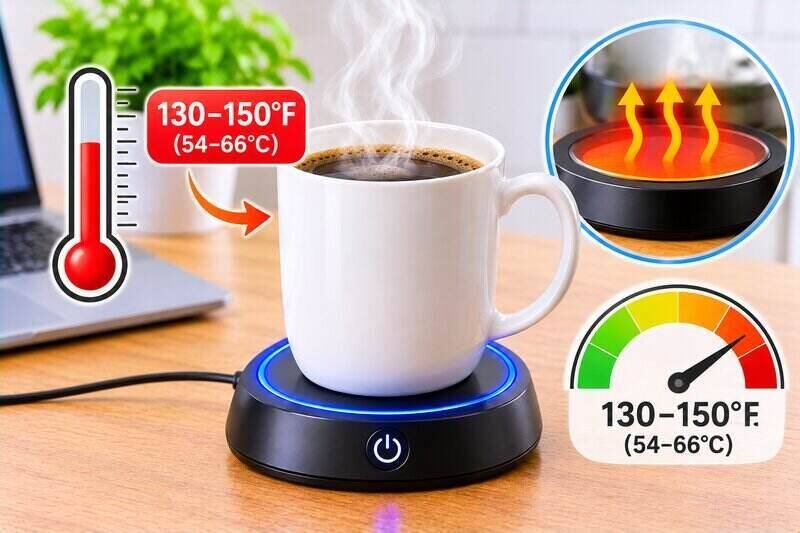
How hot does a mug warmer get? Most plug-in mug warmers have plate settings between about 104°F and 194°F, but your coffee almost never reaches the plate temperature. Instead, the drink usually settles somewhere between 120°F and 140°F, depending on the warmer, the mug, and whether you use a lid. In this guide, we compare listed temperatures from popular models, share independent thermometer tests, and explain why the plate and the drink differ so much. We also cover burn-safety data, so you can choose a setting that keeps coffee hot without making it dangerous.
Key Takeaways
- First, listed plate settings range from about 104°F on the low end to 185°F or even 194°F on high-heat models.
- However, drinks run much cooler than the plate. For example, Cosori’s listing says its plate reaches 194°F while liquid stays up to about 131°F.
- In CNN Underscored’s testing, several basic plates kept coffee at or below about 120°F to 130°F, while a 75-watt smart plate reached 130°F in under 20 minutes.
- Meanwhile, self-heating mugs typically hold drinks between about 113°F and 150°F.
- Finally, the CPSC says 140°F water can cause third-degree burns in about 6 seconds, so the hottest settings carry real risk.

How Hot Does a Mug Warmer Get? The Quick Answer
In short, the plate of a typical mug warmer gets about 130°F to 180°F, depending on the model and setting. However, your coffee usually stays far below that. In practice, most drinks on a warming plate settle around 120°F to 140°F. That gap exists because the plate only heats the bottom of the mug, while the coffee keeps losing heat through the sides and open top.
So, when you ask how hot does a mug warmer get, it helps to think about two numbers: the plate temperature and the drink temperature. The plate number tells you about burn risk if you touch it. Meanwhile, the drink number tells you how warm your coffee will actually be.
Listed Temperatures for Popular Mug Warmers
To give you a clear picture, here are the listed settings from popular mug warmers and heated mugs on Amazon, based on each product’s listing in November 2026.
| Model | Type | Listed Temperatures |
|---|---|---|
| Mr. Coffee MWBLK | 17 W plate | Single setting |
| VOBAGA | Plate | 3 settings, up to 149°F |
| Maestri House | Plate | 104, 131, 149, 176°F |
| SWEETFULL DS1295 | 36 W plate | 130, 150, 176°F |
| BEARWIND | 50 W plate | 125–176°F (4 settings) |
| Cafzed 6-Temp | 30 W plate | 130–180°F (6 settings) |
| KitchekShop | Plate | 131, 145, 167, 185°F |
| iKago | 75 W smart plate | 105–175°F in 1°F steps |
| Cosori Digital | Plate | Plate 77–194°F; liquid up to about 131°F |
| Ember Mug 2 | Self-heating mug | 120–145°F |
| Nextmug | Self-heating mug | 130, 140, 150°F |
| Kepwam T1 | Self-heating mug | 113, 131, 149°F |
As you can see, plates generally list higher numbers than self-heating mugs. That is because a self-heating mug measures and heats the drink directly, while a plate has to overcome heat loss through the mug.
Plate Temperature vs. Drink Temperature
This is the most important point to understand. Essentially, a warming plate sets the temperature of the plate surface, not your coffee. Heat then has to pass through the bottom of the mug and into the liquid. At the same time, the coffee loses heat through steam, the mug walls, and the air.
As a result, the drink settles where heat in equals heat out. Cosori’s own listing makes this clear: its plate can be set as high as 194°F, yet it says liquid stays up to about 131°F. Likewise, Homegrounds noted that the same brand’s set reached about 77°F to 160°F in the cup, even with much higher plate settings.
What Independent Thermometer Tests Found

Photo: AFresh1 via Flickr (CC BY 2.0).
Several reviewers have measured real drink temperatures with thermometers. In particular, CNN Underscored tested warmers against a 130°F target over three weeks.
| Product | Measured Drink Result | Source |
|---|---|---|
| Mr. Coffee (about 155°F plate) | Never above 130°F; under 125°F after 90 min | CNN Underscored |
| Mr. Coffee | About 160°F after an hour | Homegrounds |
| Misby plate | Stayed under 120°F | CNN Underscored |
| Cosori automatic warmer | Never above 120°F | CNN Underscored |
| iKago smart plate set | At least 130°F in under 20 min | CNN Underscored |
| Ohom Ui 3 mug | About an hour to reach 130°F | CNN Underscored |
| Thermacup | Room temperature to 140°F in about 40 min | Bob Vila |
Notably, the Mr. Coffee results differ between testers. CNN found it stayed below 130°F, while Homegrounds measured about 160°F after an hour. Differences in starting temperature, mug, lid, and room temperature can explain this. Therefore, treat these numbers as a range rather than a promise.

Video: Honest Take Reviews tests a high-heat mug warmer.
How Hot Does a Mug Warmer Get by Type?
Different warmer designs behave very differently. So, here is how hot each main type tends to get, based on the listings and tests above.
Basic 17-Watt Plates
Basic plates usually have one setting and no display. For instance, CNN Underscored described the Mr. Coffee plate as running at about 155°F. In testing, however, the drink stayed well below that, often around 120°F to 130°F. As a result, these plates are best for slowing cooling on a cup you plan to finish within an hour or two.
Mid-Power Plates With Settings
Plates in the 30- to 50-watt range typically offer three to six settings, often topping out at 176°F to 180°F. Because they deliver more power, they recover heat faster after each sip. In addition, most include a 4-hour auto shut-off or a timer, which makes higher settings safer to use.
High-Heat Plates
Some plates list settings as high as 185°F, or a plate range up to 194°F. Admittedly, these numbers look impressive. Yet the drink still runs far cooler, so the main benefit is helping thick mugs or cold rooms. On the other hand, the plate surface becomes a real burn hazard at these settings.
Smart Plates With Sensors
Smart plates, such as the 75-watt iKago, let you set an exact temperature and use sensors to hold it. In CNN’s test, the iKago set reached at least 130°F in under 20 minutes. Therefore, smart plates come closest to matching the number on the display, although Bob Vila noted the iKago display read slightly higher than the actual liquid.
Self-Heating Mugs
Self-heating mugs usually top out around 145°F to 150°F. However, because they measure and heat the drink itself, they can hold that exact temperature far more reliably than a plate.
Why Do Manufacturers List Such High Plate Temperatures?
At first glance, a 185°F setting can seem excessive. In reality, high plate temperatures are needed to push enough heat through a ceramic or glass mug base. Moreover, many warmers double as candle or wax warmers, which benefit from extra heat. Consequently, the highest settings are often more useful for candles or very thick mugs than for everyday coffee.
How to Measure Your Mug Warmer’s Real Temperature
If you want to know exactly how hot does a mug warmer get with your own setup, a simple test will tell you:
- Brew a fresh cup. First, pour freshly brewed coffee into your usual mug.
- Take a starting reading. Next, measure the coffee with an instant-read thermometer.
- Place it on the warmer. Then set the warmer to your preferred setting and add a lid if you use one.
- Check every 15 minutes. After that, record the temperature for at least an hour.
- Compare. Finally, repeat with the warmer off to see how much difference it makes.
In most cases, you will find the drink levels off within 30 to 60 minutes. If it settles too low, try a thinner mug, a lid, or a higher setting.
What Affects How Hot Your Coffee Gets?
Several factors change how hot your drink gets on a warmer. Here are the biggest ones:
- Wattage: First, higher-wattage plates, such as 50- to 75-watt models, replace lost heat faster than 17-watt plates.
- Mug base: Next, a thin, flat bottom transfers heat well, while a raised foot touches only at the edge.
- Mug material: Also, double-wall insulated mugs block heat from the plate, so they barely warm.
- Lid: In addition, a lid reduces heat lost through steam at the surface.
- Room temperature: Similarly, a cold office or a nearby fan pulls heat away faster.
- Starting temperature: Finally, freshly brewed coffee stays warmer than coffee that has already cooled.
What Temperature Should You Set on a Mug Warmer?
For most people, a middle setting is best. In a 2008 study in the journal Burns, Fredericka Brown and Kenneth Diller cited consumer data showing a preferred drinking temperature of 140°F, plus or minus 15°F, and calculated an optimal temperature of about 136°F (PubMed).
| Drink | Suggested Starting Setting | Why |
|---|---|---|
| Black coffee | Middle plate setting | Lands near the 136°F optimum |
| Latte or milk drinks | Low to middle | Helps avoid a milk skin |
| Tea | Middle | Many people sip tea slightly cooler |
| Thick mug or cold room | Middle to high | Offsets extra heat loss |
These are our suggestions based on the research above, not manufacturer rules. So, start in the middle and adjust after a few cups.
How Hot Is Too Hot? Burn Safety Data
Because plates can run very hot, burn safety matters. The U.S. Consumer Product Safety Commission reports how fast hot water can cause third-degree burns in adults:
- 150°F: about 2 seconds
- 140°F: about 6 seconds
- 130°F: about 30 seconds
- 120°F: about 5 minutes
Consequently, a plate set to 176°F or 185°F is well above these levels. Although your drink stays cooler, the plate surface can burn fingers, and a spill from a very hot mug is more dangerous. In addition, the CPSC notes that most tap water scald injuries involve older adults and children under 5, so take extra care in those homes.
Tips for Getting the Right Temperature
- Measure once. First, use an instant-read thermometer to see what your drink actually reaches.
- Start hot. Next, place coffee on the warmer right after brewing.
- Add a lid. Then cover the mug to keep heat in.
- Use a thin, flat-bottomed mug. Also, this improves heat transfer from the plate.
- Adjust gradually. Finally, raise the setting one step at a time instead of jumping to the highest.
If your coffee maker brews too cool, your cup will start lower too. And if you prefer to reheat a cold cup instead, see how much electricity a microwave uses. Our guide on what coffee maker makes the hottest coffee explains which brewers reach proper temperatures. For quick hot water to preheat your mug, see the best electric kettle.
How Hot Does a Mug Warmer Get Compared With Coffee Makers?
For perspective, brewing is far hotter than warming. Breville notes that coffee should brew at about 195°F to 205°F, and it cites a National Coffee Association serving recommendation of 180°F to 185°F. By comparison, a mug warmer only needs to hold your drink in the 130°F to 145°F range. In other words, a warmer is a holding tool, not a brewer or a stove. That is also why even the hottest plate cannot replace a fresh pot.
Does a Hotter Setting Use More Electricity?
Generally, yes, but the cost is small. A higher setting keeps the heating element on longer. For example, a 36-watt warmer running at full power for 8 hours uses about 0.288 kWh, or about 5.2 cents at the U.S. average residential price of about 18.16 cents per kWh. By contrast, a 17-watt plate uses about half that. These are our estimates; thermostatic warmers cycle on and off, so real use is often lower. For more, see how many watts a coffee maker uses.
Frequently Asked Questions
How hot does a mug warmer get on average?
Typically, the plate gets about 130°F to 180°F, depending on the model. However, the drink usually settles around 120°F to 140°F.
Can a mug warmer boil water?
No. Even the hottest listed settings, such as 185°F or 194°F, are below boiling, and the drink stays much cooler than the plate.
Why is my coffee cooler than the warmer setting?
Because the plate only heats the bottom of the mug, while heat escapes from the sides and top. As a result, the drink always runs cooler than the plate.
What is the best temperature for a mug warmer?
Usually, a middle setting. Research points to about 136°F as an optimal drinking temperature, so aim for a setting that keeps your coffee near that.
Do self-heating mugs get hotter than plates?
Not necessarily. Self-heating mugs usually top out around 145°F to 150°F, but they hold the drink at that exact temperature, which plates often cannot.
Final Thoughts
So, how hot does a mug warmer get? Plates commonly reach about 130°F to 180°F, with some models listing up to 185°F or 194°F. Yet your coffee usually stays around 120°F to 140°F because heat escapes through the mug. For the best results, start with hot coffee, use a thin flat-bottomed mug and a lid, and choose a middle setting near the 136°F optimal drinking temperature. That way, you get warm coffee with less burn risk.


Hey, My name is MAMON. I am a SEO content creator and affiliate marketer with over 8 years of experience. I create honest product reviews, in-depth buying guides, and practical how-to articles to help readers make informed decisions. My mission is to provide trustworthy, research-backed content that delivers real value.