

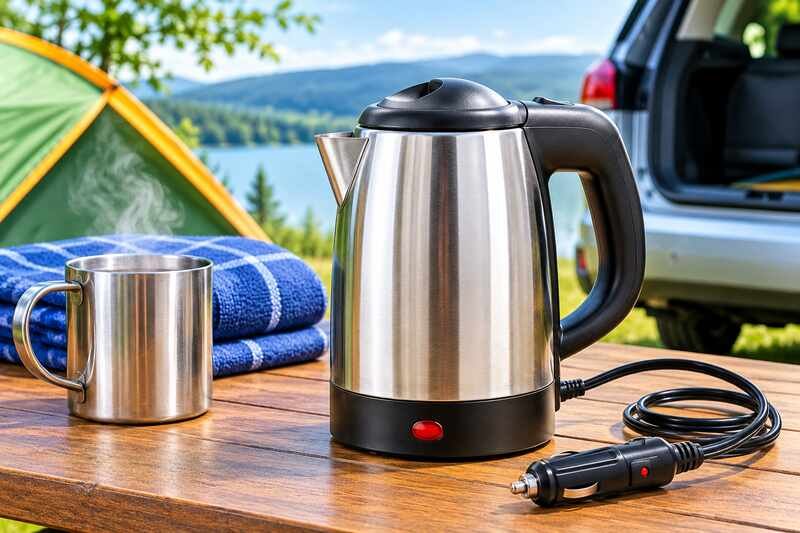
A 12V electric kettle lets you heat water from your car, truck, RV, or camper without a stove or a generator. That sounds perfect for road trips and camping, but there is a catch: a 12-volt socket delivers only a small fraction of the power of a home outlet. As a result, car kettles are much slower than kitchen kettles, and some cheap models have serious safety problems. In this guide, we explain how 12V and battery kettles work, how long they really take to boil, what your vehicle can handle, and how to choose a safe one for U.S. road trips.

Key Takeaways
- Most 12V car kettles run at about 120 to 180 watts, compared with about 1,500 watts for a typical U.S. kitchen kettle.
- At 150 watts, boiling 2 cups of water takes about 19 minutes in ideal conditions, and real times are usually longer.
- A 150-watt kettle draws about 12.5 amps at 12 volts, so check your socket’s fuse rating before you buy.
- In November 2025, the CPSC warned consumers to stop using BLONGKY car kettles after 11 incidents, including nine burn reports.
- Above all, run your engine while boiling, and never leave a car kettle unattended.
What Is a 12V Electric Kettle?
A 12V electric kettle is a small kettle designed to plug into a vehicle’s 12-volt accessory socket, the outlet that used to be called the cigarette lighter. Most hold about 0.5 to 1 liter, and many have a sealed lid so they do not spill while driving. Some are simple boil-only kettles, while others add temperature displays or keep-warm modes.
There are also related products. For example, 24V kettles are made for semi-trucks and some RVs, which use 24-volt systems. Meanwhile, battery-powered and “rechargeable” kettles use built-in or external batteries, and USB kettles try to run from USB power. Each type has very different power limits.
| Type | Power Source | Typical Wattage | Best For |
|---|---|---|---|
| 12V car kettle | Car or RV accessory socket | 120–180 W | Road trips, car camping |
| 24V truck kettle | Truck or 24V RV system | About 200–300 W | Long-haul trucking |
| Rechargeable battery kettle | Built-in battery | Varies widely | Short trips, small amounts |
| USB-powered kettle | USB-C power delivery | Up to about 100–240 W | Warming small amounts |
| Standard kettle on an inverter | Inverter or power station | 1,000–1,500 W | RVs with large battery banks |
The wattage ranges are typical of products on the U.S. market rather than formal standards, so always check the label.
How Long Does a 12V Kettle Take to Boil?
Because a car kettle uses so little power, patience is part of the deal. We calculated ideal boiling times from room-temperature water using basic physics. These assume every watt goes into the water, so real times are usually longer, especially in cold weather.
| Kettle Power | 2 Cups (0.5 L) | 4 Cups (1 L) |
|---|---|---|
| 120 W (12V) | About 23 minutes | About 47 minutes |
| 150 W (12V) | About 19 minutes | About 37 minutes |
| 180 W (12V) | About 16 minutes | About 31 minutes |
| 300 W (24V) | About 9 minutes | About 19 minutes |
| 1,500 W (home kettle) | About 2 minutes | About 4 minutes |
In other words, a 12V kettle is roughly ten times slower than a typical kitchen kettle. For that reason, most people use car kettles for one or two cups at a time rather than a full liter.

Video: Live Easy shows a 12V kettle boiling water in a car.
Can Your Vehicle Handle a 12V Kettle?
Before you buy a 12V electric kettle, check what your accessory socket can supply. Most vehicle sockets are protected by a fuse, often rated around 10 to 20 amps. Your owner’s manual or fuse box cover lists the exact rating. We calculated the current each kettle size draws using amps equal watts divided by volts.
| Kettle Power | Current at 12 V | Fits a 10 A Socket? | Fits a 15 A Socket? |
|---|---|---|---|
| 120 W | 10 A | At the limit | Yes |
| 150 W | 12.5 A | No | Yes |
| 180 W | 15 A | No | At the limit |
If the kettle draws more than the fuse allows, it will blow the fuse or fail to heat properly. Therefore, match the kettle’s wattage to your socket’s rating, and avoid running other high-draw accessories at the same time. In addition, sockets that are worn or loose can overheat, so make sure the plug fits snugly.
Should the Engine Be Running?
Yes, in most cases. A 150-watt kettle running for 20 minutes uses about 50 watt-hours. That is not much for a healthy battery, but repeated boils without the engine running can drain a car battery, especially in cold weather. For that reason, most car kettle instructions recommend running the engine. However, never idle in an enclosed space such as a garage, because of the risk of carbon monoxide.

Photo: h080 via Flickr (CC BY-SA 2.0).
12V vs. 24V Kettles
Choosing between a 12V electric kettle and a 24V model depends on your vehicle, not your preference. Most passenger cars, SUVs, and many RVs use 12-volt systems. In contrast, many semi-trucks, buses, and some heavy-duty vehicles use 24 volts. Plugging a 12V kettle into a 24V socket can overheat it, while a 24V kettle on a 12V socket will heat very slowly or not at all. Therefore, check the voltage on your vehicle’s socket or in the owner’s manual before you buy. In addition, 24V kettles can deliver more power at the same current, which is why truck kettles often boil faster than car kettles.
Tips to Boil Faster with a 12V Kettle
Since every 12V electric kettle is slow by design, small habits make a noticeable difference.
- Heat less water. First, boil only one or two cups at a time.
- Start with warmer water. Then fill from a warm bottle or hotel tap instead of icy water.
- Keep the lid closed. Next, a closed lid traps heat, especially in cold weather.
- Insulate the kettle. Also, a towel around the base, away from the plug, can reduce heat loss outdoors.
- Use a direct socket. In addition, avoid splitters, which can add resistance and limit power.
- Keep the engine running. Finally, a running alternator keeps voltage steadier than a resting battery.
What You Can Make with a Car Kettle
Even though a 12V electric kettle is slow, it covers many road-trip basics. For example, you can make instant coffee, tea, hot cocoa, instant oatmeal, and cup noodles. Similarly, it can warm water for washing up at a campsite. However, most car kettles are designed for water only, so avoid heating milk, soup, or other liquids that can scorch or foam over.
Battery-Powered and Rechargeable Kettles
Rechargeable kettles sound convenient, but batteries limit how much water they can heat. Boiling just 0.5 liters of water takes about 47 watt-hours of energy in ideal conditions, and 1 liter takes about 93 watt-hours. With real-world losses, the energy needed is higher still. As a result, small built-in batteries can usually heat only a cup or two per charge, and some models warm water rather than fully boil it. Read the specifications carefully, and look for the battery capacity in watt-hours.
What About USB Kettles?
USB kettles are even more limited. Standard USB-C power delivery tops out around 100 watts, while newer extended-power USB-C can reach up to 240 watts with compatible chargers and cables. At 100 watts, boiling 0.5 liters would take about 28 minutes in ideal conditions. Therefore, USB kettles are best for warming water rather than boiling it.
Using a Regular Kettle with an Inverter or Power Station
Many RV owners prefer to run a standard kitchen kettle from an inverter or a portable power station. This is much faster, but it needs serious power. A 1,500-watt kettle requires an inverter rated well above 1,500 watts, ideally a pure sine wave model, and a battery bank that can supply about 125 amps at 12 volts during the boil.
| Setup | What You Need | Trade-Off |
|---|---|---|
| 1,500 W kettle on a 12V inverter | Inverter over 1,500 W and a large battery bank | Fast, but very high current |
| 1,000 W kettle on a power station | Station with at least 1,000 W continuous output | Moderate speed, limited boils per charge |
| Low-watt travel kettle on a generator | Small generator with enough running watts | Slower, but easier on the system |
For low-power options, our guide to the low-wattage coffee maker covers similar trade-offs. If your RV has a propane stove, a stovetop kettle may be the simplest choice, and our guide on how to make tea in a pot on the stove applies there too.
Safety Warnings You Should Know
Unfortunately, some 12V electric kettle models have had real safety problems, especially low-cost models sold online. In November 2025, the U.S. Consumer Product Safety Commission warned consumers to stop using BLONGKY portable car kettles, model FCC 390 Pro. The kettles could release steam or hot water when opened, and the lid could pop open unexpectedly. CPSC reported at least 11 incidents, including nine burn reports.
Similarly, in June 2026, the CPSC warned about Sekaer travel kettles that could pressurize and suddenly release hot liquid, with 116 incidents and 89 injuries reported. In both cases, the sellers did not agree to a recall, so CPSC issued warnings instead.
These cases show why sealed travel kettles need extra care. Pressure can build in small, tightly closed containers, and a faulty lid turns that pressure into a burn risk.
How to Use a 12V Kettle Safely
- Park first. To begin with, never boil water while driving.
- Set it on a flat, stable surface. Then use a floor mat or a cup holder designed for it, never your lap.
- Fill below the max line. Next, leave room for expansion and steam.
- Run the engine in open air. After that, avoid garages and enclosed spaces.
- Stay with it. Also, watch the kettle the entire time it heats.
- Let pressure release before opening. In addition, open the lid slowly and away from your face.
- Unplug when done. Finally, remove the plug so the socket and kettle can cool.
How to Choose a Safe 12V Electric Kettle

Photo: RichardBH via Flickr (CC BY 2.0).
- Known brand and seller: First, choose a brand you can contact, with clear instructions and support.
- Correct voltage: Next, match 12V or 24V to your vehicle.
- Wattage within your fuse rating: Also, compare the amp draw with your socket’s fuse.
- Auto shut-off and boil-dry protection: In addition, these features prevent overheating.
- Pressure-safe lid: Meanwhile, look for a lid that vents steam and locks firmly.
- Recall check: Finally, search the model on CPSC.gov before you buy.
At home, a regular kitchen kettle is far faster. Our guide to the best electric kettle covers top picks for everyday use.
Using a Car Kettle in Cold Weather
Winter road trips and ski weekends are where a car kettle feels most useful, yet cold weather also makes it slower. Water from a cold car may start near freezing instead of room temperature, which adds roughly a quarter more energy to reach a boil. In addition, the kettle loses heat faster to cold air. Therefore, expect longer boil times in winter, keep the kettle and water inside the warm cabin when possible, and run the engine so the battery stays healthy. Also, never use a kettle as a substitute for proper heating, and keep the vehicle ventilated.
Is a 12V Kettle Worth It?
For many travelers, yes, especially for a hot drink at a rest stop or a campsite without hookups. However, if you mostly stay at campgrounds with electricity, a regular low-watt kettle is far faster. Similarly, if you already carry a camp stove, it will usually beat a car kettle on speed. In short, a car kettle is a convenience tool for small amounts, not a replacement for your kitchen kettle.
Alternatives for Hot Water on the Road
- Camp stove and kettle: Fast and reliable, but use only outdoors with good ventilation.
- Insulated bottle: Fill with hot water before you leave, and it can stay hot for hours.
- Gas station or hotel hot water: Convenient for a quick cup on long drives.
- Power station with a low-watt kettle: Useful for campsites without hookups.
FAQ
How long does a 12V electric kettle take to boil?
A 150-watt 12V kettle takes about 19 minutes to boil 2 cups in ideal conditions, and often longer in practice. Cold water and cold weather add time.
Will a 12V kettle drain my car battery?
It can if you run it repeatedly with the engine off. Most makers recommend running the engine while boiling.
Can I use a 12V kettle in a semi-truck?
Many trucks use 24-volt systems, so you may need a 24V kettle. Check your vehicle’s electrical system first.
Do battery-powered kettles really boil water?
Some can boil small amounts, while others only warm water. Check the battery capacity and stated boil volume before you buy.
Are car kettles safe?
Quality models used carefully can be safe. However, CPSC has warned about specific travel and car kettles, so check for warnings and never leave one unattended.
Can I use a 12V electric kettle in an RV?
Yes, if your RV has a 12V socket that matches the kettle’s wattage. However, many RV owners prefer a propane stove or an inverter with a regular kettle, since a 12V model is much slower.
Final Thoughts
A 12V electric kettle is a handy road-trip tool, as long as you set the right expectations. In short, it is slow, typically 15 to 25 minutes for two cups, and it must match your socket’s fuse rating. In addition, recent CPSC warnings show that cheap, sealed car kettles can be dangerous. Choose a known brand with proper safety features, run the engine in open air, and stay with the kettle while it heats. For bigger needs, a power station or a camp stove may serve you better.


Hey, My name is MAMON. I am a SEO content creator and affiliate marketer with over 8 years of experience. I create honest product reviews, in-depth buying guides, and practical how-to articles to help readers make informed decisions. My mission is to provide trustworthy, research-backed content that delivers real value.